
The Devastation of May 2, 1929: Montgomery County’s Deadliest Tornado in Historic Photographs
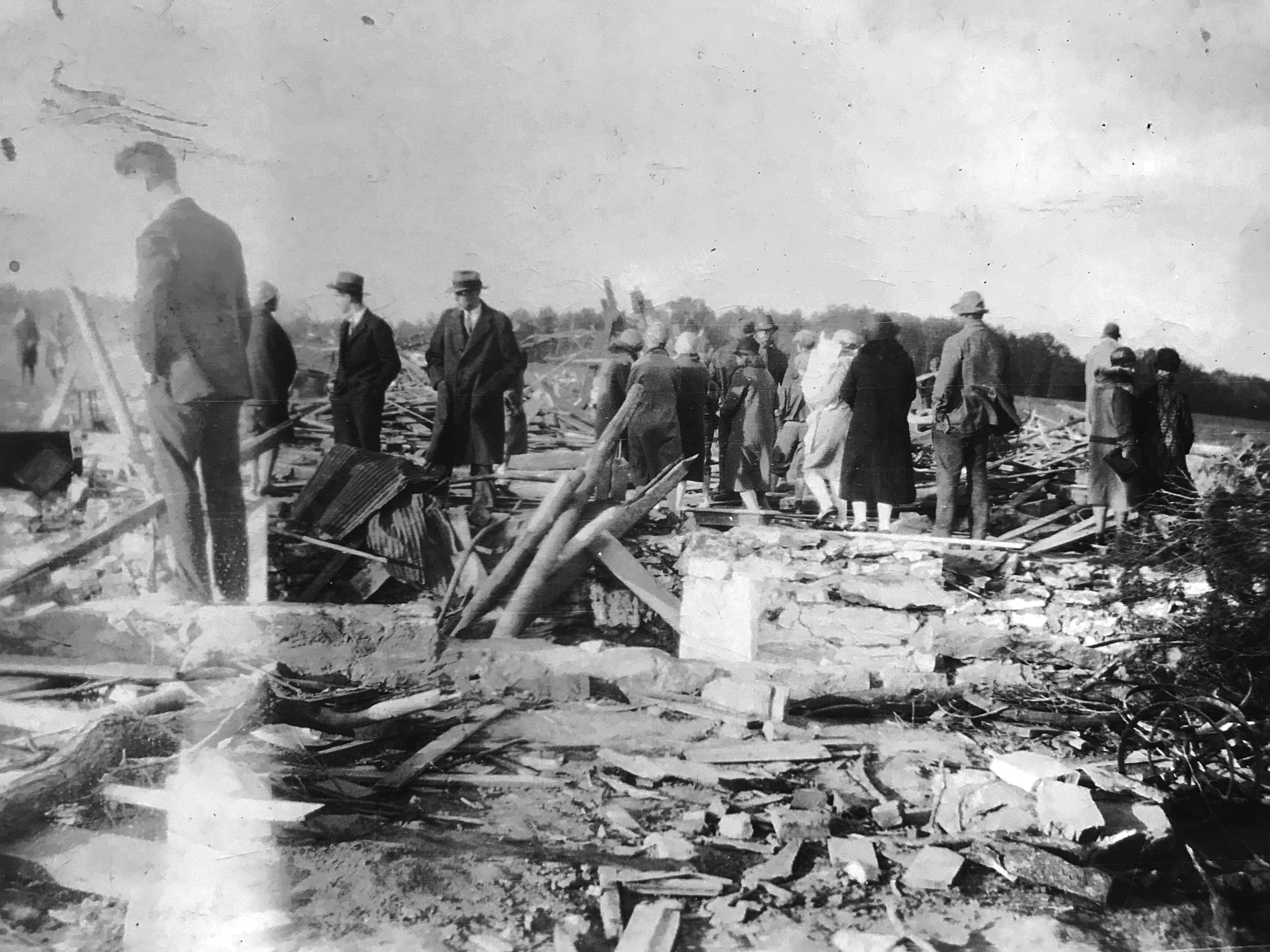
Spectators view the destruction at the Benson farm, May 1929. Photo by Lewis Reed
Ninety-seven years ago today, one of the worst tornado outbreaks in area history devastated a part of Montgomery County Maryland. At about 9 p.m. on Thursday, May 2, 1929, northeastern Montgomery County was struck by an F3 tornado, part of a large storm system that caused devastation from Florida to Ohio. The weekly Montgomery County Sentinel reported on May 10th that the “wind storm of cyclonic power… was of limited width and serpentine on its course. Everything in its path met with destruction.” These photographs were taken by Lewis Reed “after the tornado of May 2, 1929”.
Among the hardest hit was the farm of J. William Benson, where every structure, including the house, a massive barn, and multiple outbuildings, was completely obliterated. Even the surrounding landscape was reshaped. Trees from the orchard were reportedly lifted into the air and carried miles away, a testament to the storm’s incredible force.
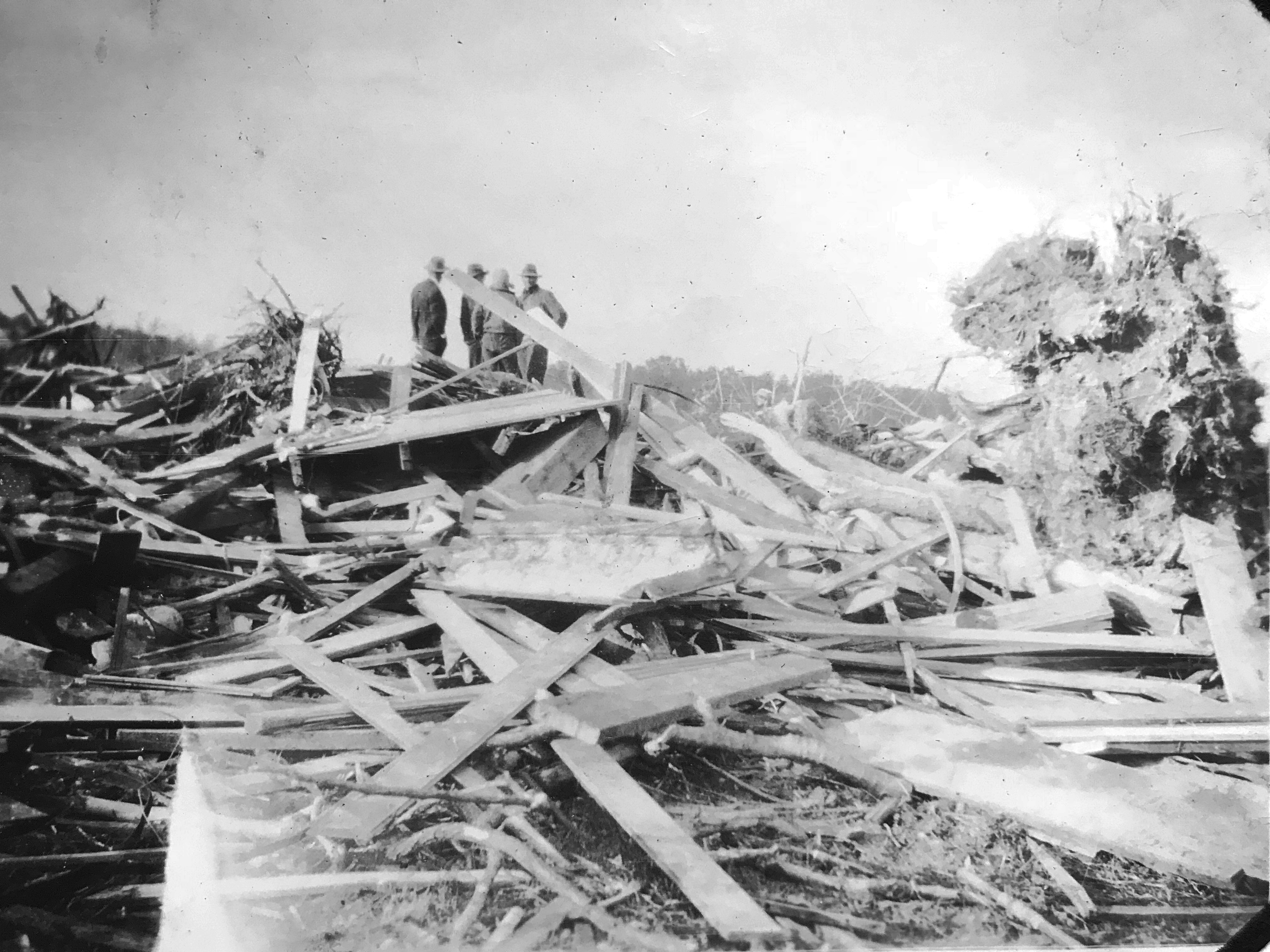
Surveying the wreckage: Local men stand atop the splintered remains of a farmstead, where the 1929 tornado reduced buildings to a tangled mass of lumber. Photo by Lewis Reed
In the days following the disaster, Lewis Reed traveled to the scene to document the devastation. His photographs, now a haunting window into the past, capture the sheer force of a storm that could lift entire orchards into the air and reduce sturdy farmsteads to splinters. For days, thousands of people traveled to the area to witness the devastation firsthand. What they encountered was described as “indescribable wreckage,” a scene that defied easy explanation and lingered in memory long after the debris was cleared.
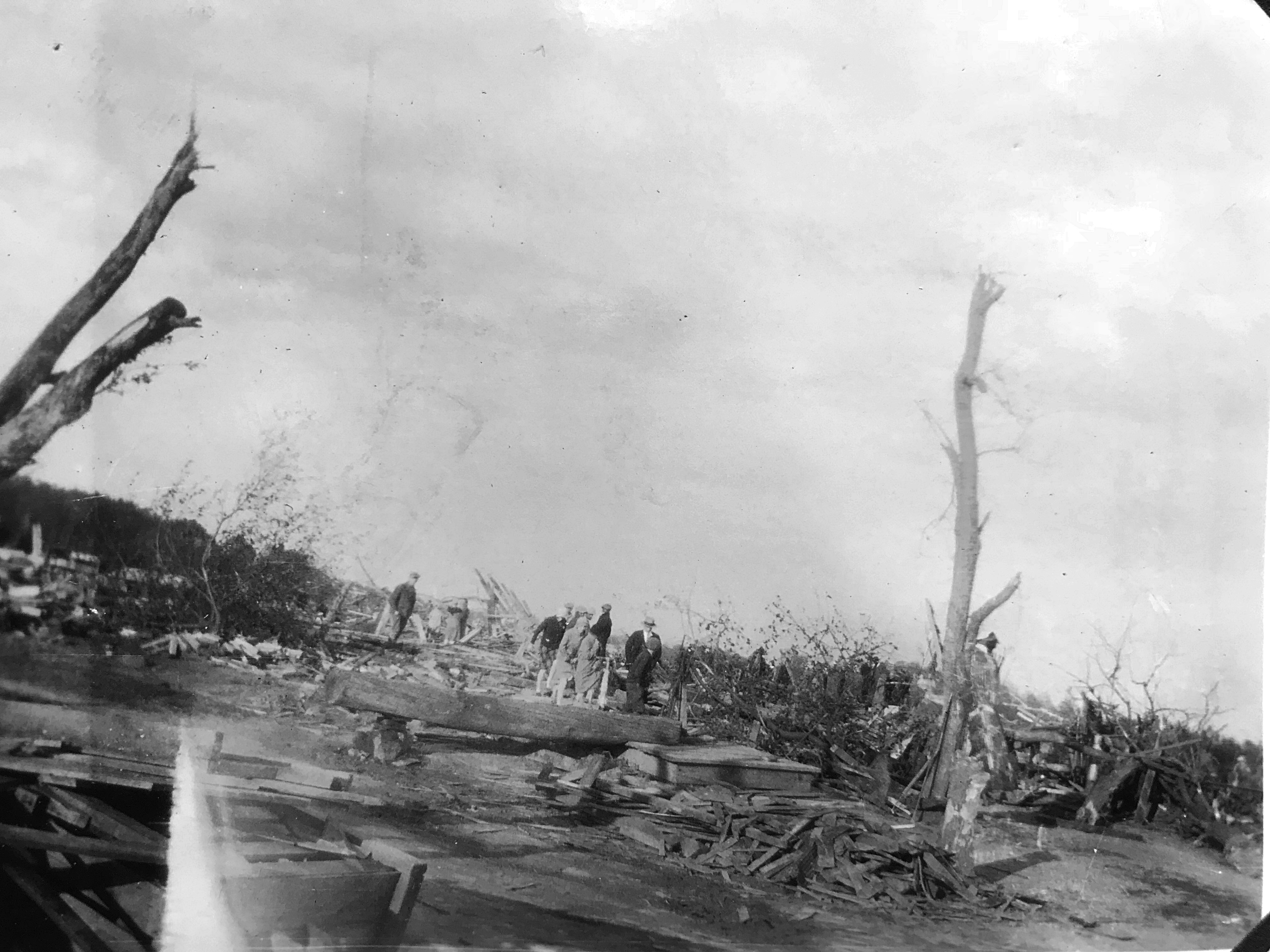
In the tornado’s aftermath, residents pick their way through a flattened landscape, where shattered timber, uprooted trees, and scattered debris mark the storm’s destructive path across the countryside. Photo by Lewis Reed
Amid this chaos, help arrived quickly. Local fire departments from Rockville, Gaithersburg, and Sandy Spring responded after a farm worker, having freed himself from the wreckage, ran to summon aid. Relief efforts soon followed, including support organized by the local Red Cross to assist those who had lost homes, livelihoods, and stability in a single night.
While Montgomery County was spared the worst loss of life, the broader storm system proved deadly. Reports at the time indicated that 28 people were killed across Maryland and Virginia, with the most tragic losses occurring in Virginia when a school was struck directly.
One particularly meaningful photograph includes Reed’s young daughter, Mary Jane, standing amid the aftermath. Decades later, she would help identify the locations of these images, connecting memory with history in a way few archival collections can. This personal link transforms the photographs from simple documentation into living history.
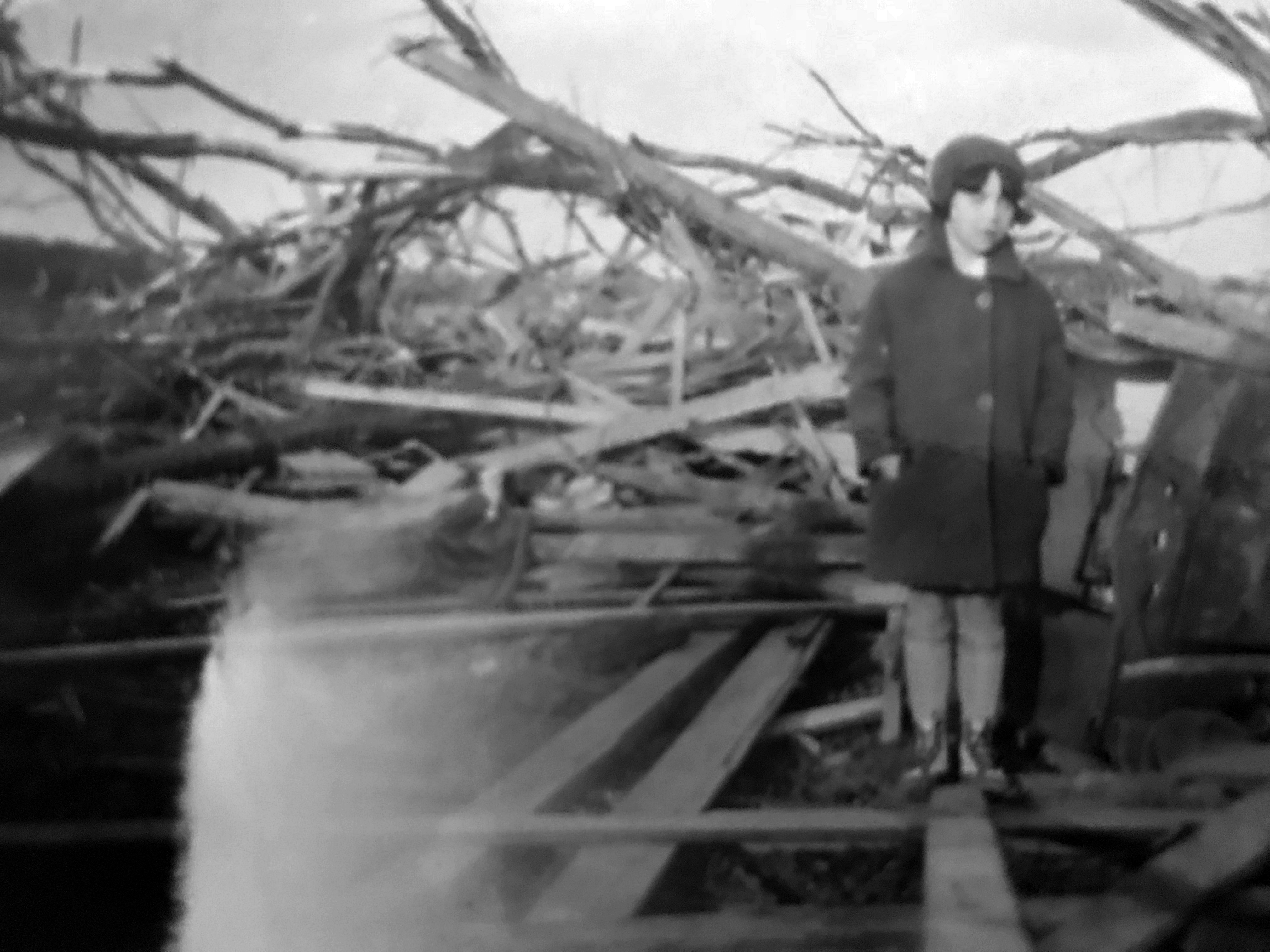
Seven-year-old Mary Jane Reed surveys the aftermath of the F3 tornado that decimated the J. William Benson farm in Unity, Maryland. Captured by her father, Lewis Reed, this image highlights the complete destruction of the 117-foot barn and the surrounding landscape following the deadliest storm in Montgomery County history.
Originally undated and unlabeled, these images might have remained anonymous fragments of the past. Instead, through family recognition and preservation, they now serve as vital historical evidence, offering a rare glimpse into one of the most destructive storms ever to strike Montgomery County.
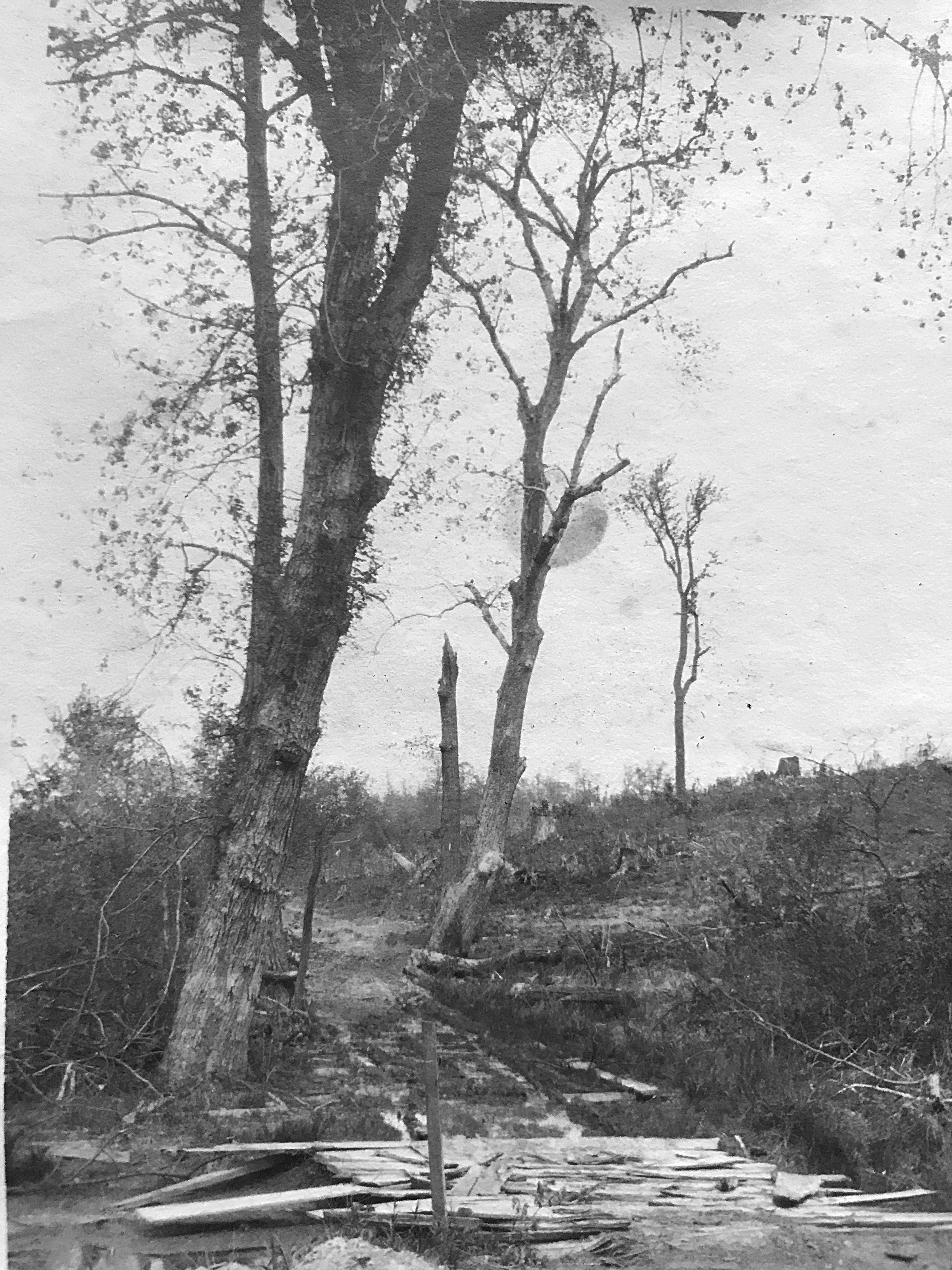
The skeletal remains in this photo stand as a silent testament to the F3 twister that devastated northeastern Montgomery County. Photo by Lewis Reed
Today, nearly a century later, the 1929 tornado is remembered not only for its level of destruction, but for the resilience of those who endured it. And for the photographs that ensure their story is never lost.
Sources of Information:
A Fine Collection
The Montgomery County Sentinel, May 10, 1929
More Than Just Motors: The Enduring Link Between Reed Brothers Dodge and the MCPD
When you look back at the history of Montgomery County, Maryland, certain names are synonymous with the growth of the region. Reed Brothers Dodge is certainly one of them, but while we are often remembered as the first Dodge dealership in the area, our history is also deeply intertwined with the very foundation of the Montgomery County Police Department (MCPD). This connection wasn’t just about the cars and motorcycles; it was about the people who kept them on the road.

This is the first known photograph of the entire Montgomery County Police Force Motor Unit. Pictured left to right: Earl Burdine, Lawrence Clagett, Guy Jones, Chief Charles Cooley, Leroy Rodgers, and Oscar Gaither. Photo taken by Lewis Reed on July 4, 1922.
The relationship between Lewis Reed and the MCPD began on the department’s very first day of duty: July 4, 1922. On that historic morning, Chief Charles Cooley and his five original officers gathered at Reed Brothers Dodge to have their first official group photo taken. At the time, the department was a “mounted” unit on Harley-Davidson motorcycles. Because modern, branded dealerships didn’t exist yet, Reed Brothers served as a vital hub for sales and service. Lewis Reed and his brother Edgar were motorcycle enthusiasts who had founded Rockville’s Park Avenue Motorcycle Club a decade earlier in 1912, and their expertise made the dealership the natural home for the county’s early fleet. In those early days, each officer was allotted $300 a year for motorcycle upkeep, and our shop was where much of that vital work happened.
As the decades passed and the MCPD grew into a modern force, the need for expert maintenance grew with it. The department eventually established its own internal garage, but they didn’t have to look far to find the best talent to staff it. The “Reed Brothers standard” was so well-regarded that the police garage specifically recruited veteran mechanics from the dealership. By the late 1970s, two of our most skilled technicians, Ben McGowan and John Hall, transitioned from the service bays at Reed Brothers Dodge to work for the Montgomery County Police garage. Ben, an electrical and AC specialist, and John, a Maryland State Inspector and ASE-certified mechanic, brought a wealth of “under-the-hood” knowledge to the county.


This pipeline of talent from the dealership to the public sector highlights a beautiful piece of Rockville history. It shows that Reed Brothers Dodge was more than just a business; it was a training ground for the craftsmen who kept the county moving. When we see photos of those early 1922 officers on their Harleys or hear stories of the police fleet in the decades that followed, we aren’t just looking at machines. We are looking at the legacy of men like Lewis Reed, Ben McGowan, and John Hall– the hands that built, serviced, and supported the safety of our community for over a century.
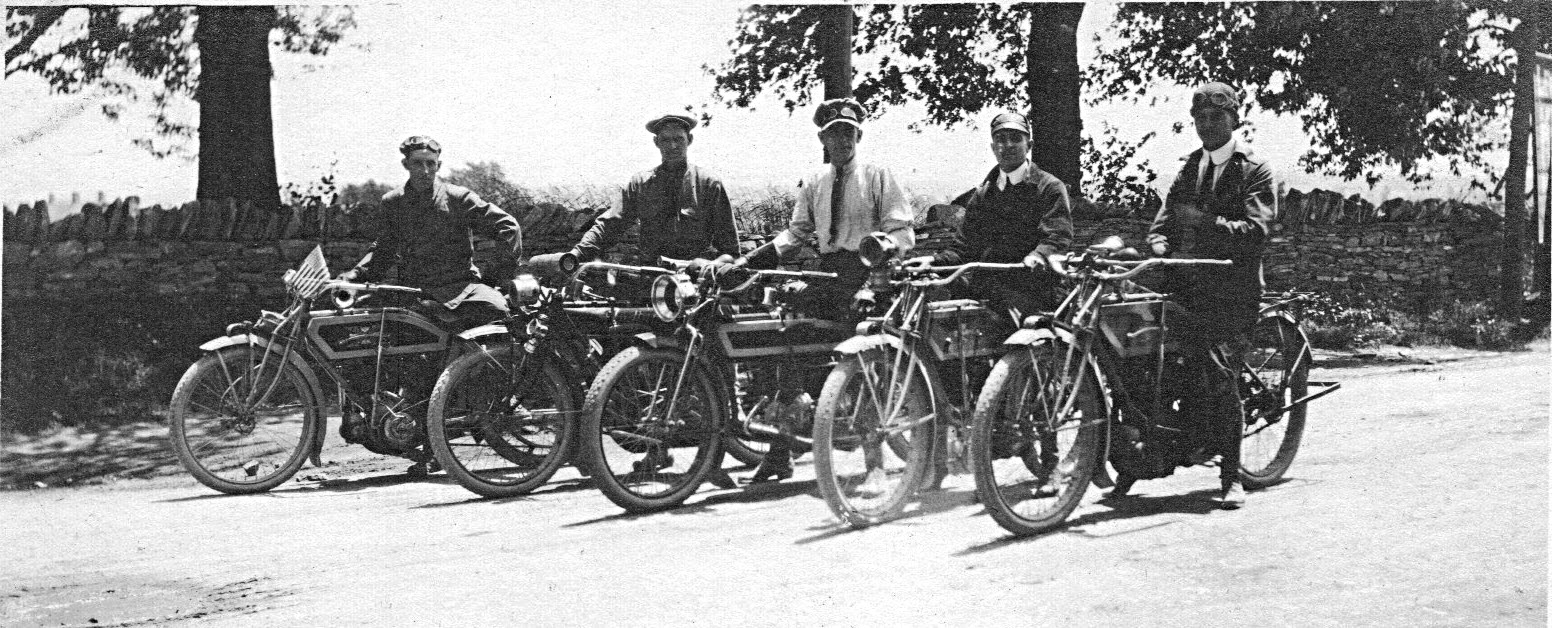
First motorcycle club in Rockville, Maryland. One Harley Davidson, one Indian, and Three Excelsior motorcycles on Park Avenue, 1912. Lewis Reed, far left.
As the curator of these archives and the granddaughter of Lewis Reed, I feel a great sense of pride in preserving these connections. Seeing the faces of men like Ben McGowan and John Hall reminds me that our family business was built on the shoulders of dedicated craftsmen who served their neighbors and their county. It is a legacy of service that I am honored to document and share with you today.
Snow, Tinsel, and Memories: A Century of Christmas at the Reed Family Home
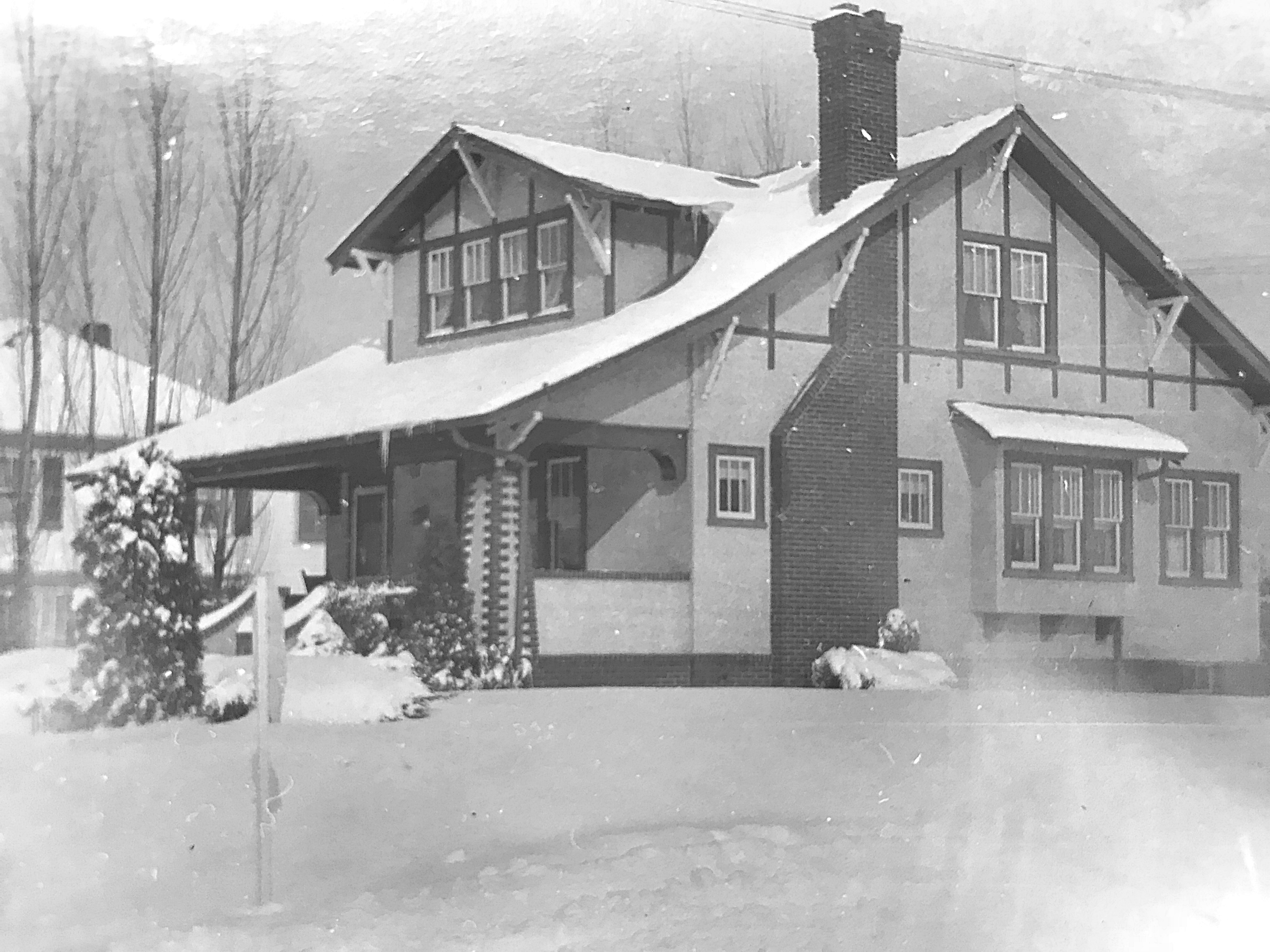
Lewis Reed’s craftsman-style home, looking rather solitary on a snowy day. Photo by Lewis Reed.
With only a few days left until Christmas, I thought it might be fun to take a look at some photos from Lewis Reed’s collection that show us what Christmas trees used to look like 100 years ago. In those days, there was not wide-spread agreement on exactly what a tree should look like, which made for a lot of creativity. Not surprisingly, they were very different than the perfectly shaped tress we have on display today.
The trees were big back then and always fresh. They went right to the ceiling and were very wide. Early Christmas trees were generally fastened onto a flat board surrounded with fence-rails, snow villages and carpeted with cotton blankets of snow. The tree in the photo below has an abundance of tinsel, which grew in popularity to the point that, by the 1920s, it was common to nearly cover the tree in the decorative material.
So, what is tinsel (aka icicles) exactly? Originally made from strands of silver alloy, tinsel was in fact first used to decorate sculptures. It was only later that it became a Christmas tree decoration, employed to enhance the flickering of the candle flames. In the 1950s, tinsel became so popular that it was often used as a substitute for Christmas lights.
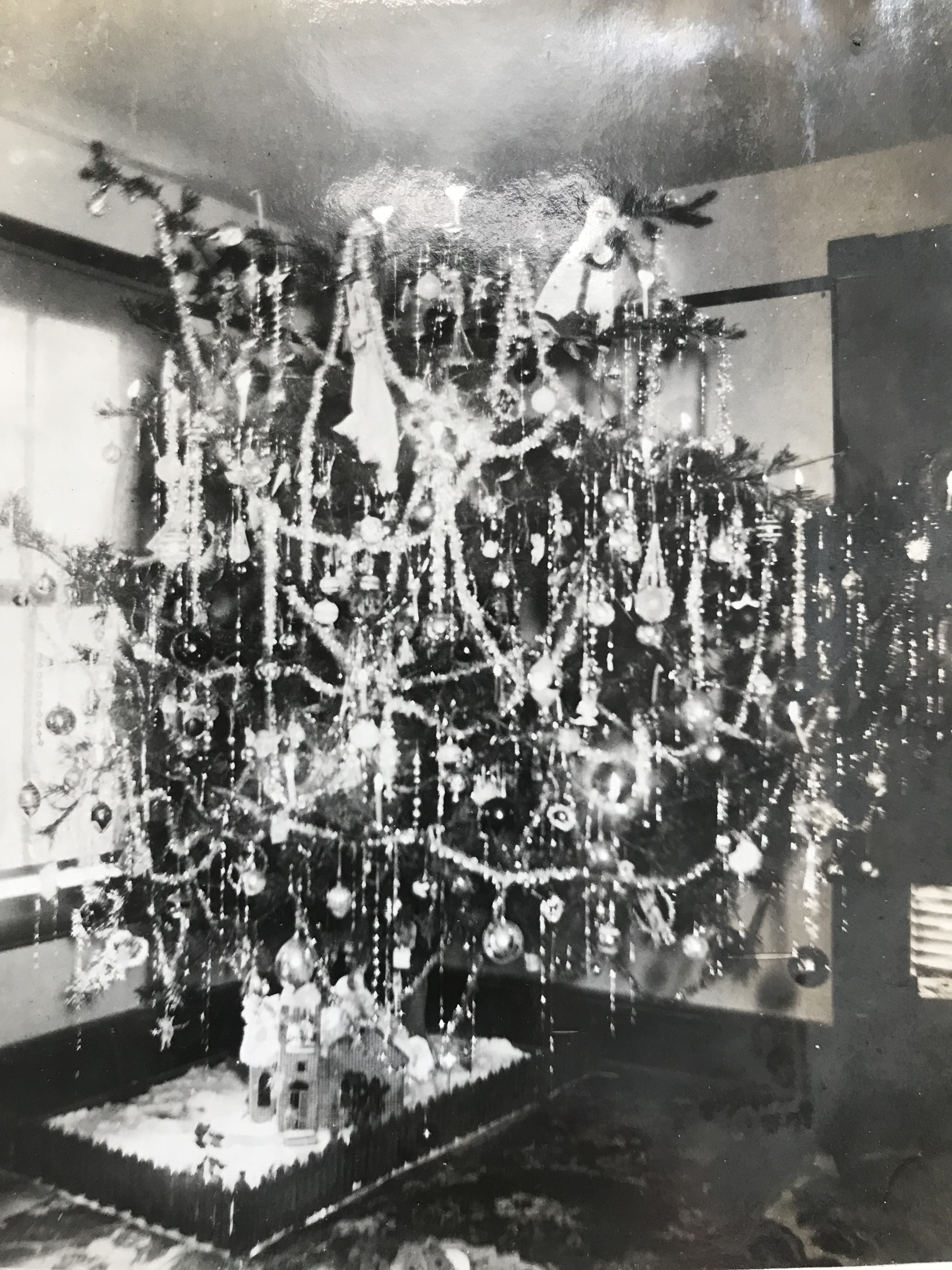
A small snow scene with what appears to be a miniature church is arranged at the foot of the Christmas tree. A popcorn garland adorns the tree. Photo by Lewis Reed
So, where did Washingtonians get their trees?
From The Evening Star, Washington, DC 23 December 1923:
Conduit Road on the long stretch between Glen Echo and Great Falls for many years has been a favorite hunting ground where hundreds and hundreds of families have customarily obtained scrub pine trees for Christmas week. Usually there is plenty of holly and some mistletoe to be found in the rugged and rolling hill lands which are the gateway to Great Falls.
In the early 1900s, Christmas trees weren’t the uniform, perfectly trimmed evergreens we see today. They were large, often reaching the ceiling, and proudly displayed their natural, sometimes misshapen forms. Families fastened them to flat boards, surrounded them with fence rails, and carpeted the ground with cotton blankets to mimic snow. Tinsel, originally made from strands of silver alloy, became a staple used to catch the flicker of candlelight and later, as a substitute for electric lights by the 1950s.
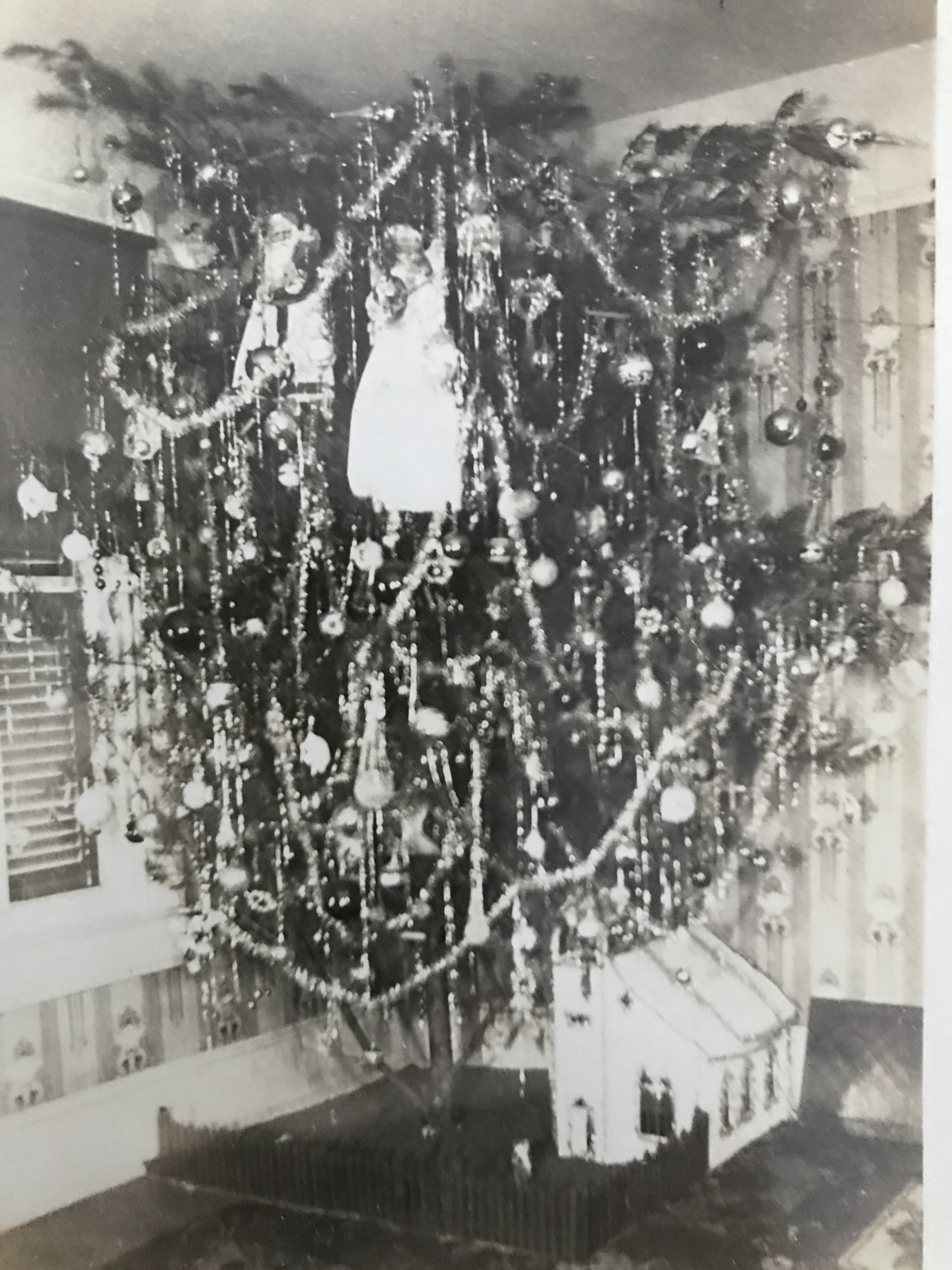
No room for a star on the top of this tree! And just look at those big Santa and Angel dolls. Other fun little details are notable, including a miniature church with picket fence is arranged at the base of the tree. Photo by Lewis Reed
There’s a fine art to decorating Christmas trees that’s been developing since over 100 years ago. People consider lights, garland, ornaments, skirt, and more. But one thing that’s hard to resist sometimes is just filling every available space with decorations. Clearly, that was the case years ago, too. What I like about these trees is that they are so randomly shaped and even misshapen. Folks back then didn’t trim them down to a more aesthetically pleasing symmetry like we do today.
The tradition of building miniature Christmas village landscapes, including houses, animals, and other hand-crafted wooden figures, began with the Pennsylvania Dutch in the late 1800s. Mass-produced cardboard houses, sold in dimestores, became popular in the mid-20th century. Today, these villages in good condition can be highly collectible.
Below are photos of Lewis Reed’s snow village set up under the Christmas tree decorated with vintage ornaments, tinsel, and lights. I don’t remember the odd-shaped Christmas trees, but I do remember having a lot of fun helping my grandfather set up the miniature landscapes with the varied figures, little houses, and trees at Christmastime each year. It seemed like a holiday village right out of a storybook.
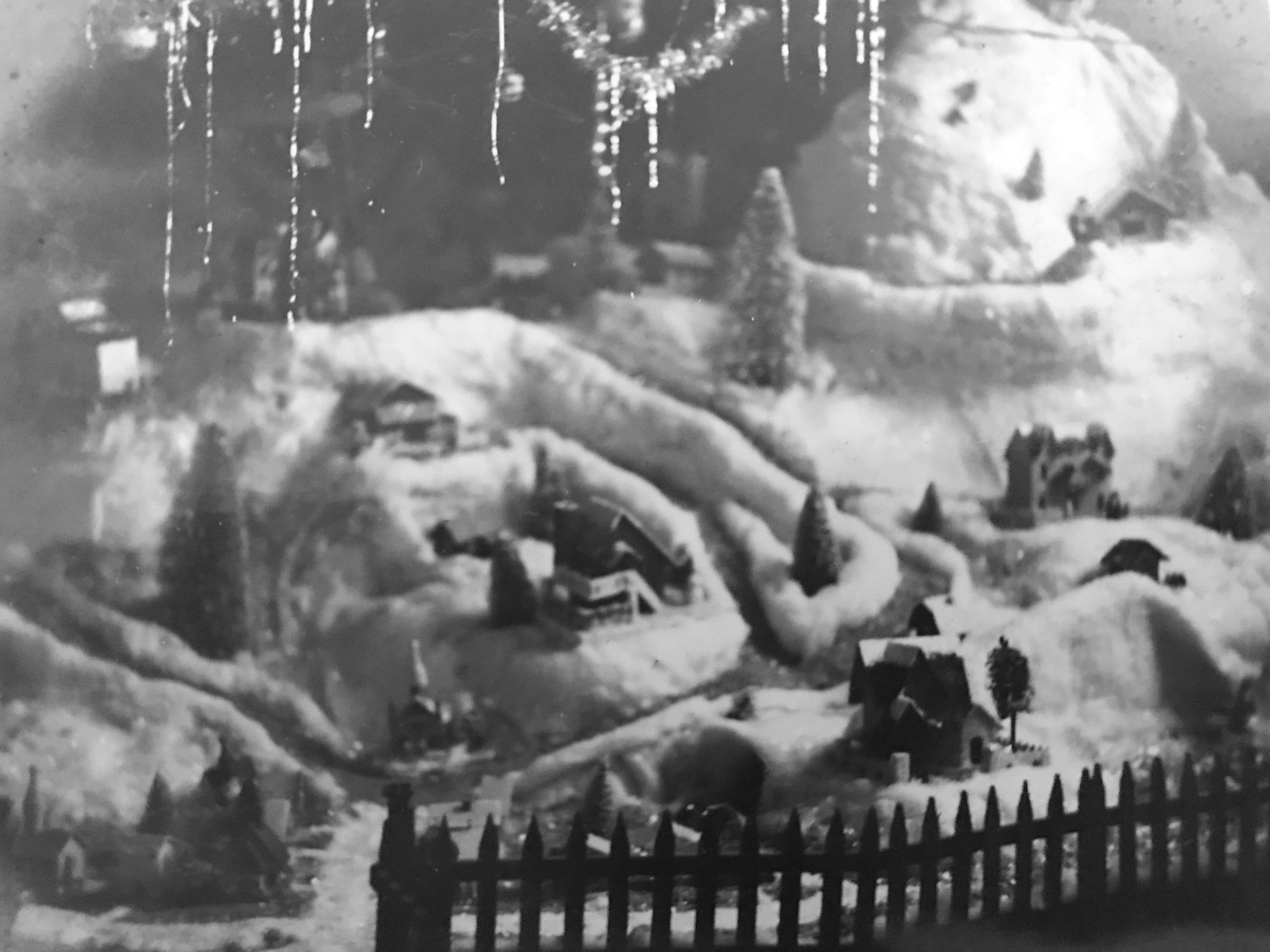
A rustic picket fence is used to set off the village display. Dangling strands of tinsel hang below the tree. Photo by Lewis Reed
The snow villages were set up in Lewis Reed’s basement on top of a big table beneath a small Christmas tree. He made the snow scenes entirely by hand using wire-covered cardboard and balled up paper to make hills and pathways. The little houses and figurines would fit into the landscape with cotton ‘snow’ all around; and lights would be wired underneath.
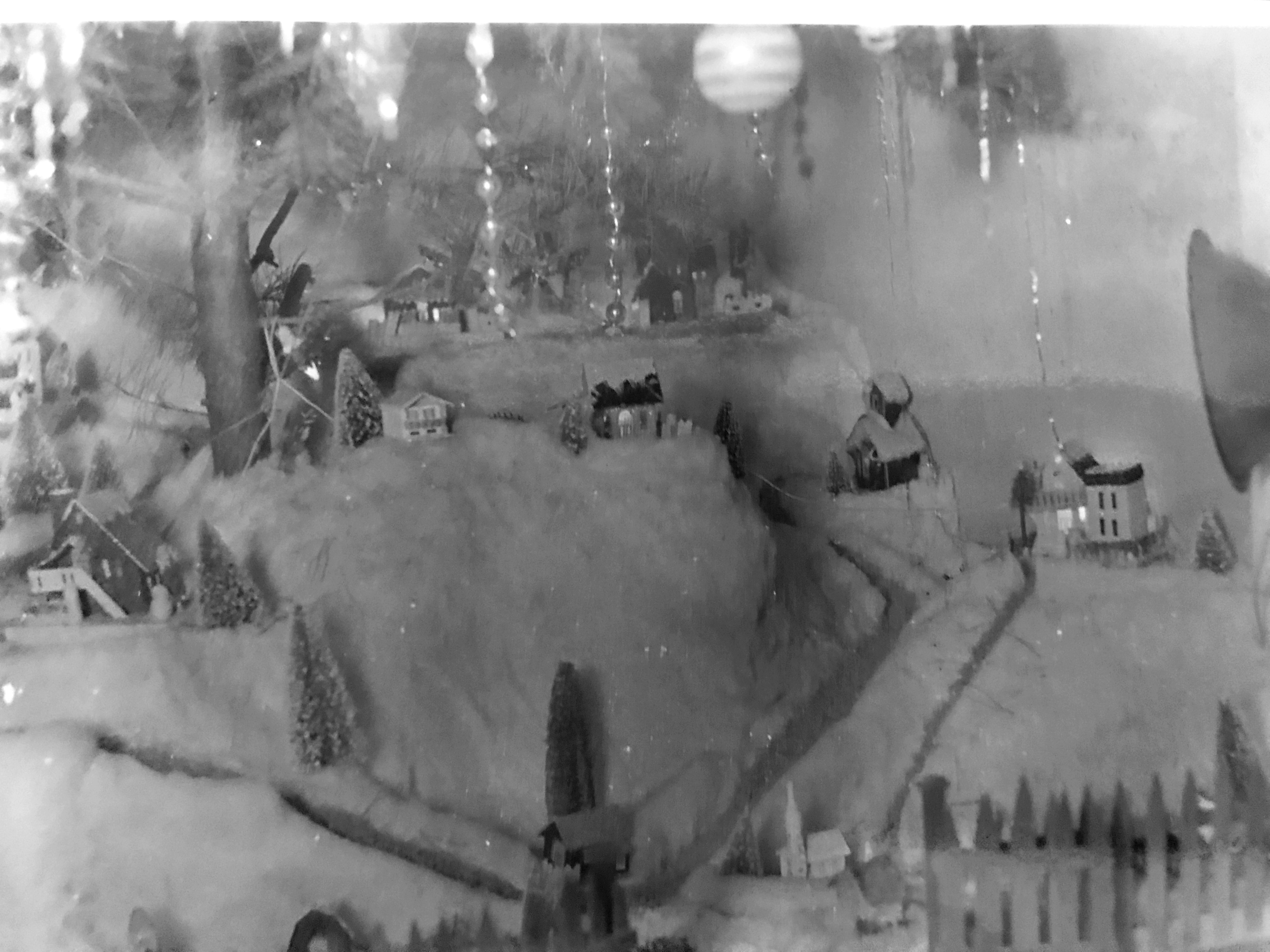
Little houses, churches, fences, trees, and pathways were added to the scene. Some of the houses have charming light effects in the windows. The roofs of the houses were decorated with fake snow. Photo by Lewis Reed
These early Christmas villages were the forerunners of today’s elaborate holiday displays, most famously popularized by Department 56. What began as simple, handmade scenes beneath family Christmas trees eventually evolved into the collectible ceramic villages that fill shelves and mantels during the holidays today.
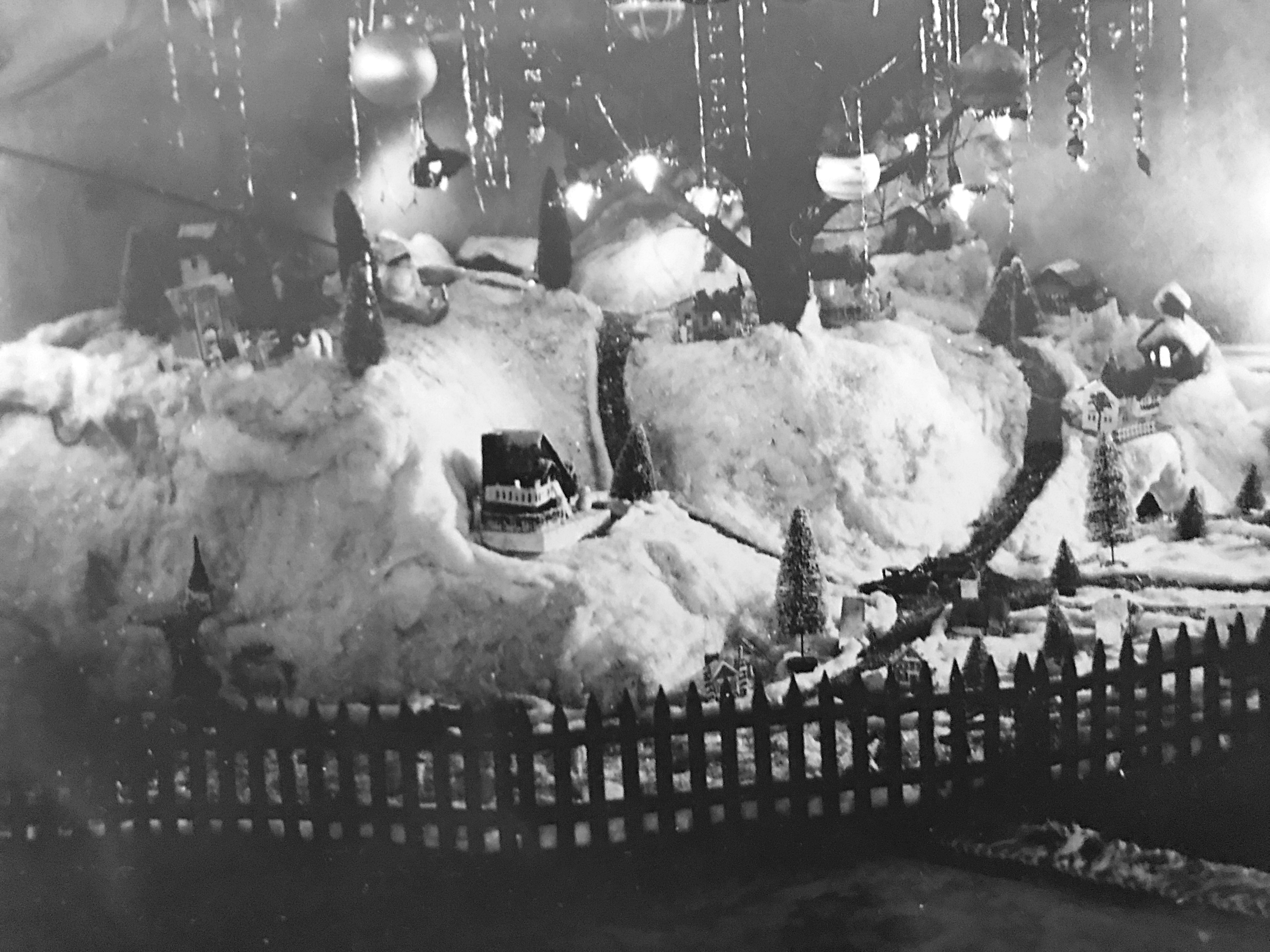
Old-fashioned lights can be seen on the tree, along with lit windows in the houses. The miniature houses usually had holes in the back or the bottom through which tiny lights were placed to provide illumination. Photo by Lewis Reed
Thanks for taking the time to visit. May your Christmas be merry, your New Year bright, and your holidays filled with everything that brings you joy. Stay safe and enjoy the season with family and friends!

Montgomery History Online Exhibit: Reed Brothers Dodge

Opened September 24, 2024
Curated by Jeanne Gartner and Sarah Hedlund
Montgomery History has unveiled a new online exhibition titled “Reed Brothers Dodge – Montgomery County’s Oldest Dodge Dealership.” Officially launched on September 24, 2024, the exhibition was co-curated by Jeanne Gartner, author of the Reed Brothers Dodge History blog and co-owner of the former dealership, in collaboration with Sarah Hedlund, Montgomery History’s Librarian and Archivist.
This digital exhibition presents a comprehensive narrative of Reed Brothers Dodge, tracing its evolution from its founding in the early twentieth century through its decades of service to the Montgomery County community. Organized into distinct historical periods, the exhibition highlights rare artifacts, photographs, and memorabilia; offering insights into not only the dealership’s operations but also broader cultural contexts such as automotive service, local sports, and mid-century fashion. The full exhibition is available online at https://sites.google.com/view/reedbrothersdodge/home
Jeanne Gartner, granddaughter of Lewis Reed, founder of Reed Brothers Dodge, serves as the curator and historian behind the Reed Brothers Dodge History blog. Honored with the 2016 Arthur M. Wagman Award for Historic Preservation Communication from Peerless Rockville, the blog functions as a living digital archive that preserves the dealership’s enduring legacy and its integral role in Montgomery County’s development. Since its debut in April 2012, the site has garnered more than half a million views, documenting over a century of the family business’s history, community engagement, and contributions to the American automobile industry. Drawing from Lewis Reed’s extensive photographic collection and business records, Gartner’s work offers a richly detailed portrait of local enterprise, early transportation, and the entrepreneurial spirit that helped shape both the region and the broader American story.
The 100th Anniversary of the Founding of the Montgomery County Police Department
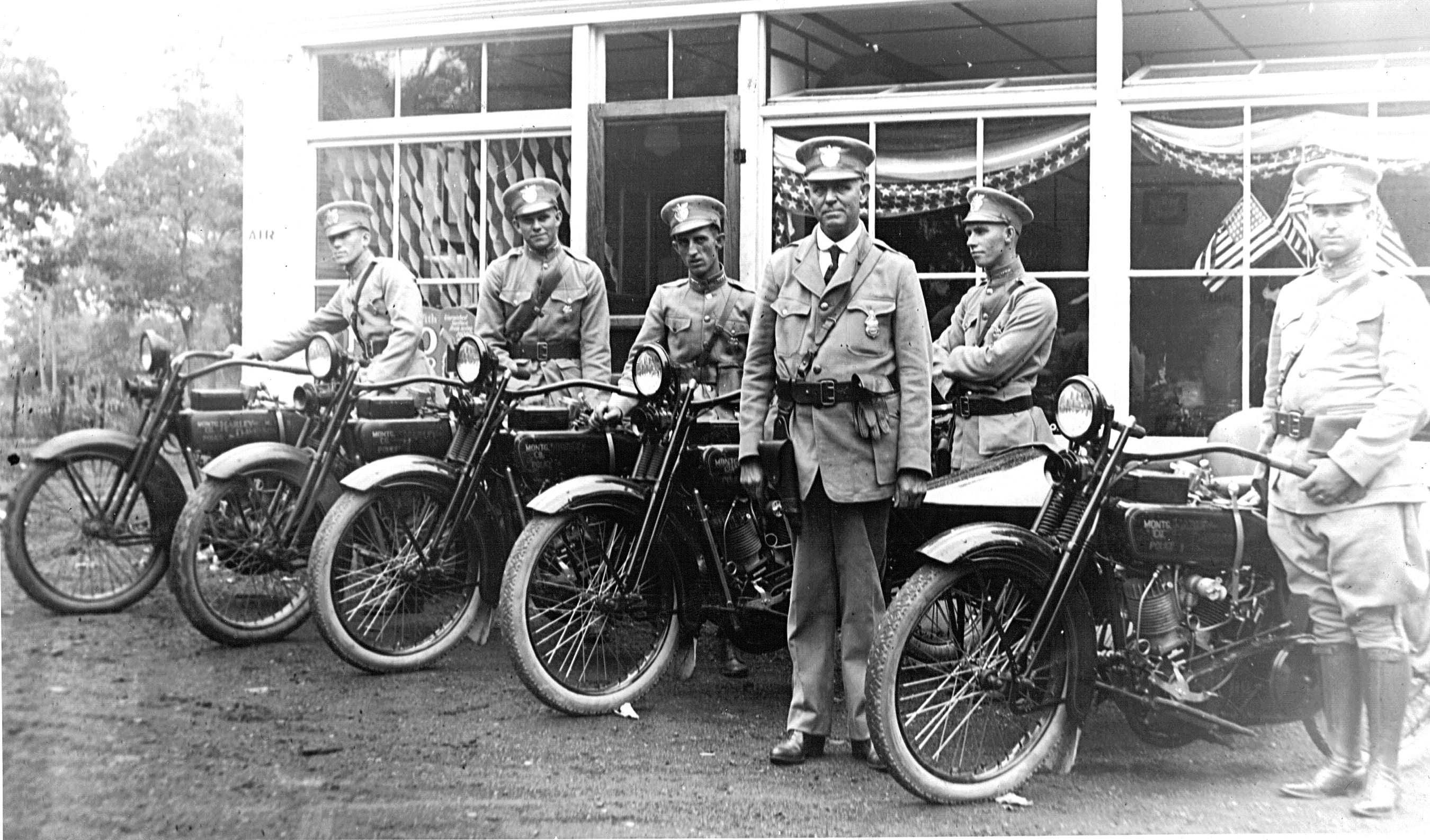
Here posing in front of Reed Brothers Dodge on July 4, 1922 is the first known photograph of the entire MCPD. Pictured left to right: Earl Burdine, Lawrence Clagett, Guy Jones, Chief Charles Cooley, Leroy Rodgers, and Oscar Gaither. Photo taken by Lewis Reed on July 4, 1922.
July 4th marks the 100th anniversary of the beginning of the Montgomery County Police Department. Cattle rustling, bootlegging and stealing poultry were among the most common crimes when Montgomery County hired its first police chief and five officers in July 1922. So widespread was the theft of chickens and turkeys that some residents employed a homespun form of crime prevention by cutting off a specific claw on their birds to identify them. “Officers knew who all the chicken thieves were,” said one historical account of the era put together by the police department, “and upon getting a report of missing Rhode Island Reds, or some other breed, would head straight for the thieves’ hideaway to try to catch them ‘red handed’ before the birds got to the frying pan.”
Posing in front of Reed Brothers Dodge on July 4, 1922 Chief Charles Cooley, center, and his men of the first mounted unit of the Montgomery County Police Force, were on their first day of duty. For several years, since there was no police station, the officers would meet for “roll call” on the steps of the Red Brick Courthouse in Rockville at 2:00 p.m. every day to let each other know they were alive and well. Chief Cooley was given the privilege of a Model T Ford. The chief was paid $1,800 a year (the chief now gets $112,564) while the officers got $1,500. Each of the officers was issued a Harley-Davidson motorcycle, a .38 Smith & Wesson handgun, a black jack, law book and was allotted $300.00 a year for the upkeep of their motorcycle. Jones patrolled Silver Spring, Rodgers the Bethesda-Chevy Chase area and Burdine, Clagett and Gaither the Upper County areas.
The county’s population in the early 1920s was just 35,000 (it’s now more than 800,000). Much of the county was farmland, which accounted for the thefts of livestock. It also was the Prohibition era, when bootlegging and moonshine still factored routinely on an officer’s shift.
The officers worked 14 hours at night, 10 hours in the day, with two days off every two weeks. But they were on call at all times. Since there was no mobile radio contact (the first one-way radio system was installed in cars in the early 1930s), the officers tended to hang around the courthouse or a local firehouse that had a phone.
One of the officers came up with the idea of placing a flashing red beacon light on a pole atop the Rockville courthouse. When flashing, it would alert police that they had a call or were wanted at the office. In 1927, similar lights were used at district stations in Silver Spring and Bethesda.
As part of the 100th anniversary celebration, there will be a Commemorative Ceremony at the Red Brick Court House on July 7, 2022 from 10am-12pm that will mirror the swearing in that took place 100 years ago. The Chief will reveal the contents of the time capsule that was buried 25 years ago, as well as reveal the contents of what will be placed in the new time capsule. This event is free of charge to attend. For more info and other scheduled events, click here: https://www.mcpd100.org/live-events
Congratulations MCPD and thank you for your many years of service!
Books

Related Resources


Copyright Notice

Reed Brothers Dodge History (1915-2012) by Jeanne Gartner is licensed under a Creative Commons Attribution-NonCommercial 3.0 Unported License.


Recent Comments