
Driving Into the 20th Century
Before 1900, there weren’t any traffic laws in regular use pertaining to automobiles other than certain regulations for the use of horse-drawn wagons and locomotives. The rise of the automobile changed all that. Local governments attempted to develop signage and laws to deal with this massive increase in the use of mechanized vehicles.

In the early 20th century, traveling cross-country by automobile was intimidating, if not a little bit dangerous. Cars were unreliable and roads were rough. The child in the photo is Lewis Reed’s daughter, Mary Jane. Photo by Lewis Reed
There were no paved highways for automobiles to shoot along at 60 and 70 miles an hour; just country roads, filled with ruts, sand, and mud, over which no one wanted to drive at the maximum speed of passenger cars, which was about 25 miles an hour.
You didn’t always need a license to drive. In fact, in the beginning of the 20th century, driver’s licenses didn’t even exist. Anyone could operate a vehicle, even if they had no idea what they were doing. As the number of automobiles increased, states slowly began to require people to be licensed in order to drive, with Maryland beginning in 1910.
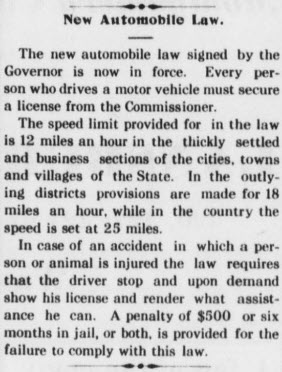
New license and speed limit laws in effect regarding automobile use for the state of Maryland. Montgomery County Sentinel, May 6, 1910.
Horses were skittish of the loud motors, and those who drove cars often had little training on how to operate them safely–both situations caused unprecedented accidents. Reed Brothers Dodge salesmen at the time often had to teach their customers how to drive the automobiles they had just purchased. “Speed limits” were a new concept, as individually-controlled vehicles capable of speeds much faster than a horse were previously non-existent.
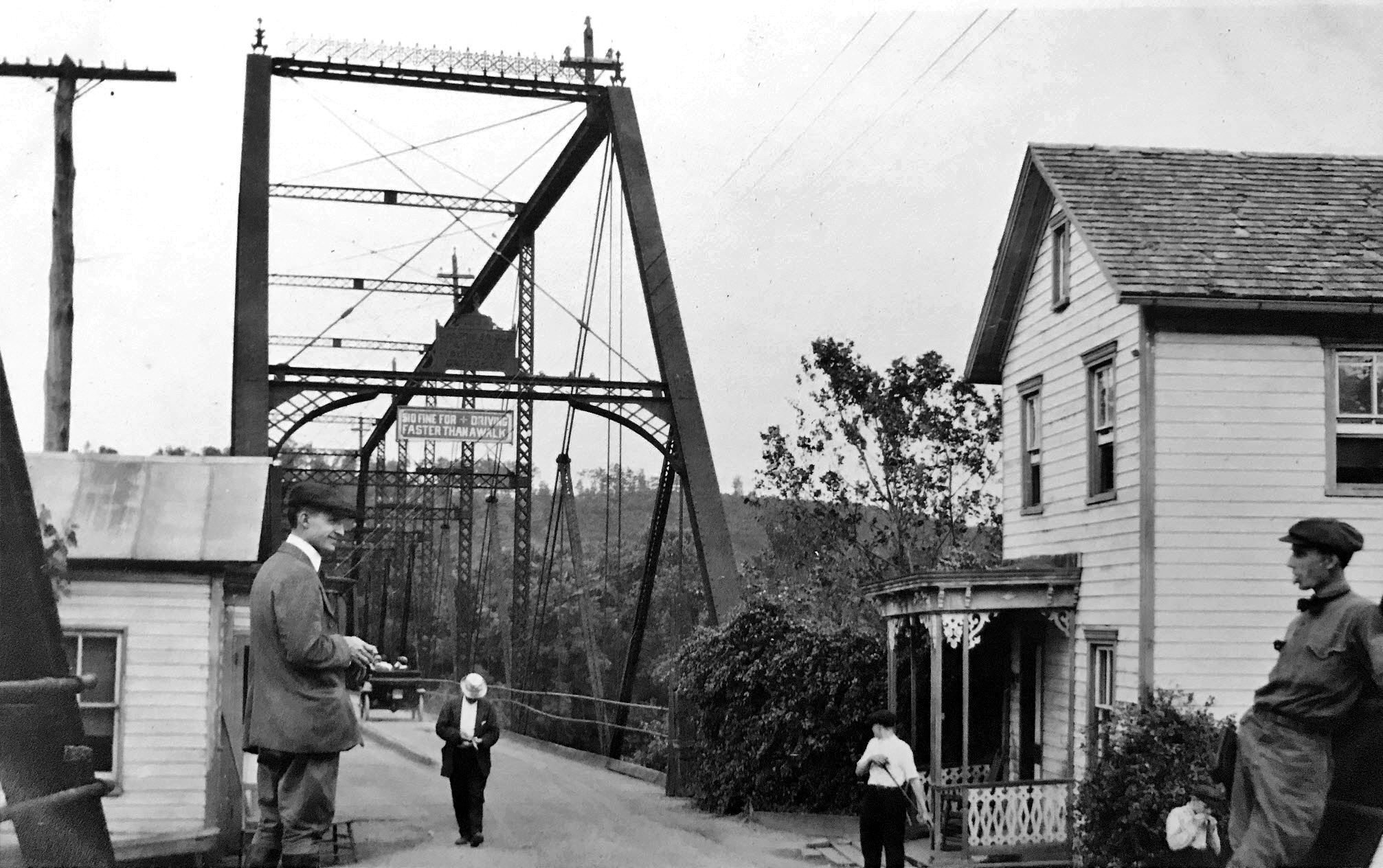
Sign on this bridge reads “$10 fine for driving faster than a walk.” Photo by Lewis Reed, c. 1910
The photograph above evokes a sense of nostalgia for slower-paced times. Literally slower: the sign over the bridge entrance reads “$10 fine for driving faster than a walk.” That’s equivalent to about $300 in today’s money.
From “Rules of the Road,” written by William P. Eno in 1903:
The mandatory registration of automobiles was one of the first traffic regulations in the United States. New York became the role model in 1901 by being the first state to require that automobile owners register their vehicles. By 1920, license plates were mandatory in all states. It took longer for the states to require a driver’s license. In 1935, there were just 39 states that issued the licenses and only a few tested applicants. Before the 1930s, most drivers received their training from automobile salesmen, nonprofit organizations such as the YMCA, family members and friends.
There was a good reason to discourage speeding in the first decades of the 1900s, as there were no stop signs, traffic lights, lane lines, brake lights, driver’s licenses, or posted speed limits, to name only a few modern safety measures. Drinking and driving? Not that big a deal. Poorly maintained roads, untrained and inexperienced drivers, and potential speeds approaching 40 mph created the perfect catalyst for horrific accidents. The photograph below illustrates how fragile those early cars were.
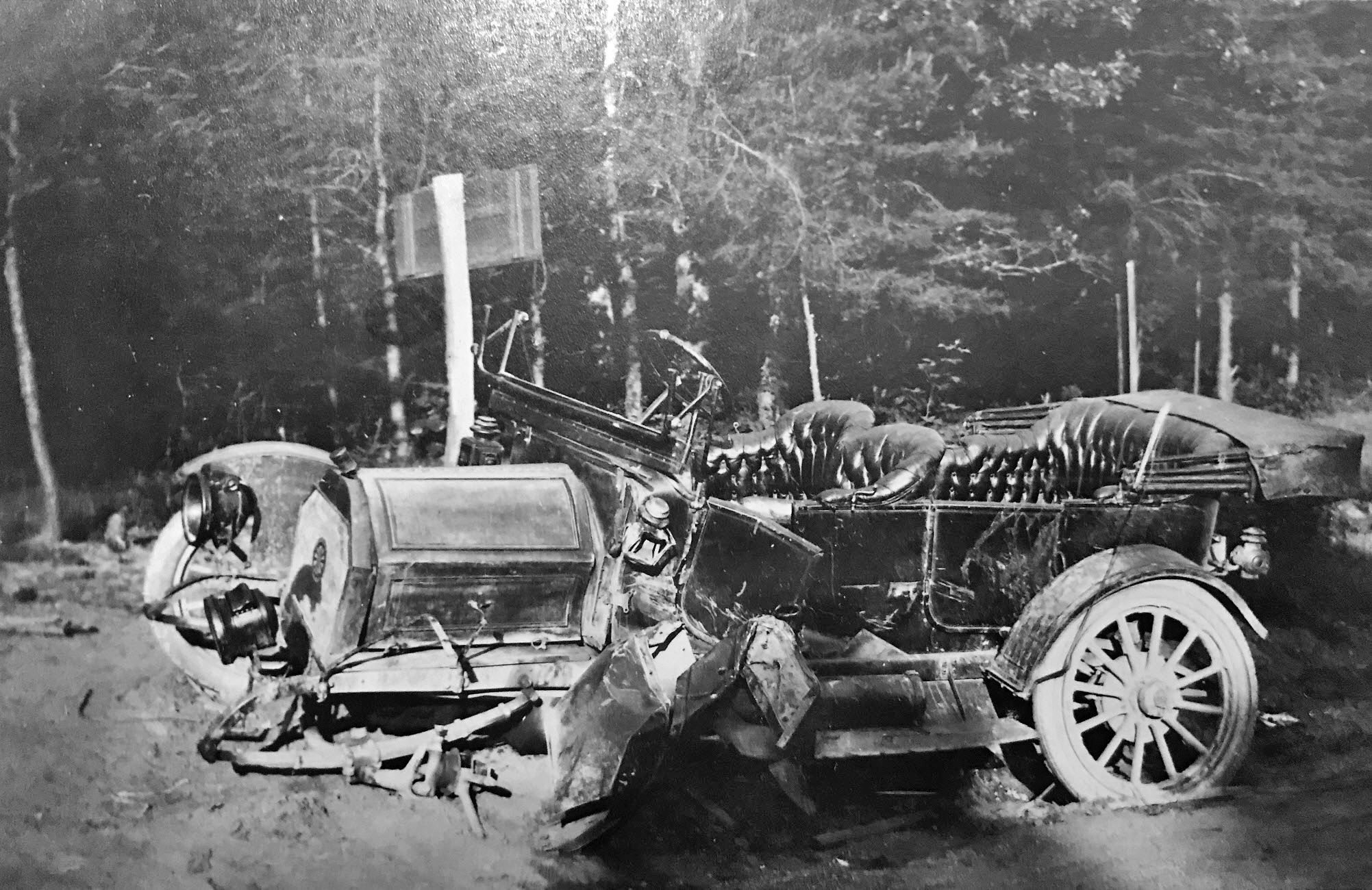
Early 20th century automobile accident. Photo by Lewis Reed
Trained as a chauffeur early in his life, Lewis Reed later leveraged his knowledge of automobiles into founding one of the longest-lived and most successful car dealerships in the state of Maryland.
Then & Now: Emmanuel Episcopal Church (Cumberland, Maryland) 1912
Cumberland is known as the “Queen City of the Alleganys.” The National Road, the Baltimore and Ohio Railroad, and the Chesapeake and Ohio Canal pass through the town, which was once an Ohio Company outpost and the westernmost part of the British Empire in North America. Cumberland has changed from a trading site to a manufacturing locality, to a tourist haven over many generations.
For this post, I have used one of Lewis Reed’s original photographs for “then” and a google stock image for “now”. Taken over 113 years apart, you can see how the Emmanuel Episcopal Church in Cumberland, Maryland looks almost the same from over a century ago.
Emmanuel Episcopal Church (THEN): The Emmanuel Episcopal Church of Cumberland, Maryland in Cumberland’s Historic District is built on the foundations of Fort Cumberland, where George Washington began his military career. Although the Emmanuel parish dates from 1803, the cornerstone of the current native sandstone building was laid in 1849 and completed in 1851.
Standing at the eastern end of the Washington Street Historic District, it is one of Maryland’s examples of early Gothic Revival architecture. The church is on the former site of Fort Cumberland, and earthwork tunnels remaining from the fort run under the church. The church was constructed around 1850 and designed by Philadelphia architect John Notman.

Emmanuel Episcopal Church Cumberland, 1912. Photo by Lewis Reed
Emmanuel Episcopal Church (NOW): Emmanuel Episcopal Church is active and continues to service the city of Cumberland. Emmanuel Church is part of the Episcopal Diocese of Maryland. The church allows self-guided tours of the stained glass; the church also offers guided tours of the tunnels. Make contact with the church in order to arrange a tour. Emmanuel Episcopal Church is part of the Washington Street Historic District, which is on the National Register of Historic Places.
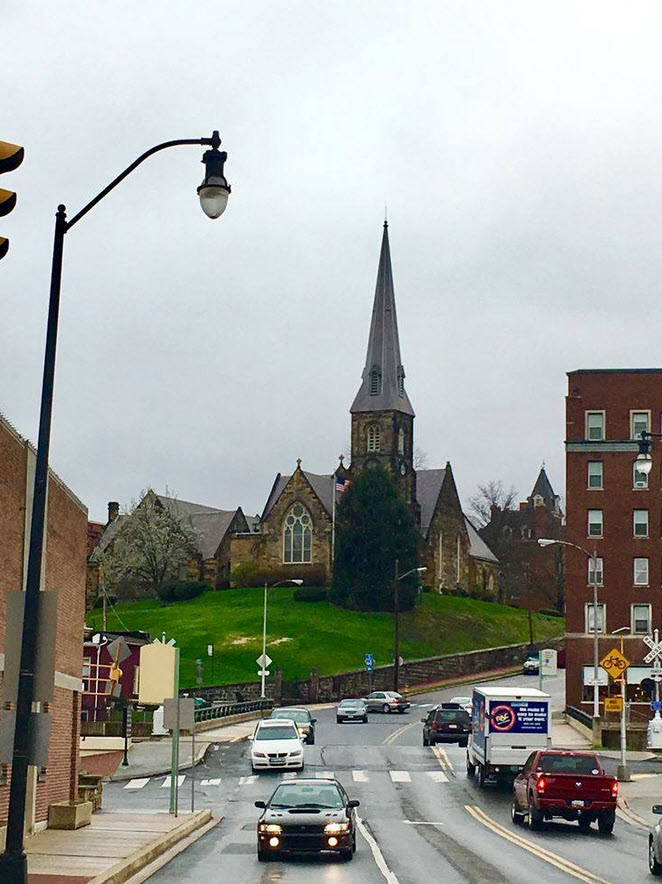
Emmanuel Episcopal Church Cumberland today. Google image.
Source: Wikipedia
Christmas Past at the Reed Family Home
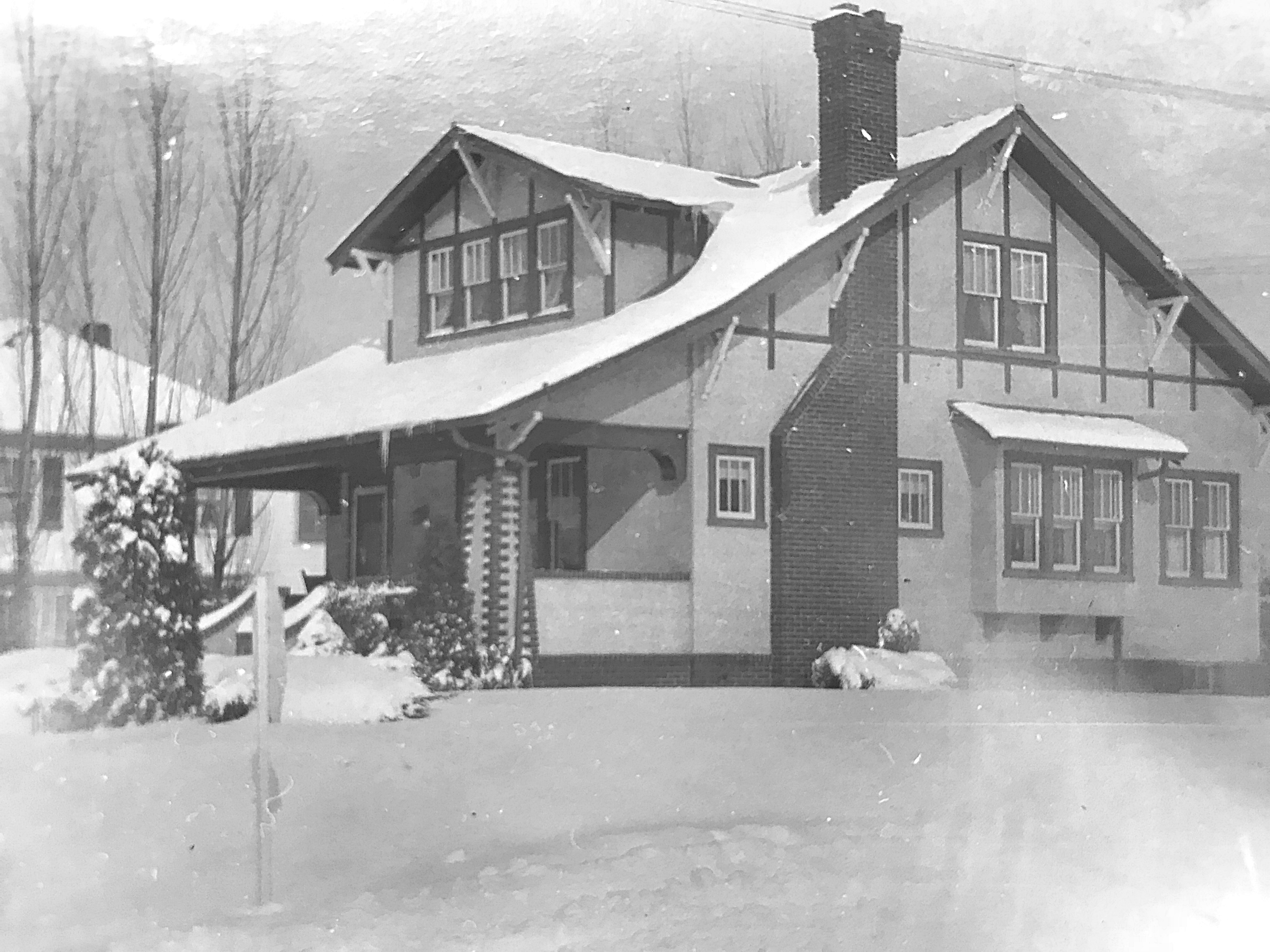
Lewis Reed’s craftsman-style home, looking rather solitary on a snowy day. Photo by Lewis Reed.
With only a few days left until Christmas, I thought it might be fun to take a look at some photos from Lewis Reed’s collection that show us what Christmas trees used to look like 100 years ago. In those days, there was not wide-spread agreement on exactly what a tree should look like, which made for a lot of creativity. Not surprisingly, they were very different than the perfectly shaped tress we have on display today.
The trees were big back then and always fresh. They went right to the ceiling and were very wide. Early Christmas trees were generally fastened onto a flat board surrounded with fence-rails, snow villages and carpeted with cotton blankets of snow. The tree in the photo below has an abundance of tinsel, which grew in popularity to the point that, by the 1920s, it was common to nearly cover the tree in the decorative material.
So, what is tinsel (aka icicles) exactly? Originally made from strands of silver alloy, tinsel was in fact first used to decorate sculptures. It was only later that it became a Christmas tree decoration, employed to enhance the flickering of the candle flames. In the 1950s, tinsel became so popular that it was often used as a substitute for Christmas lights.
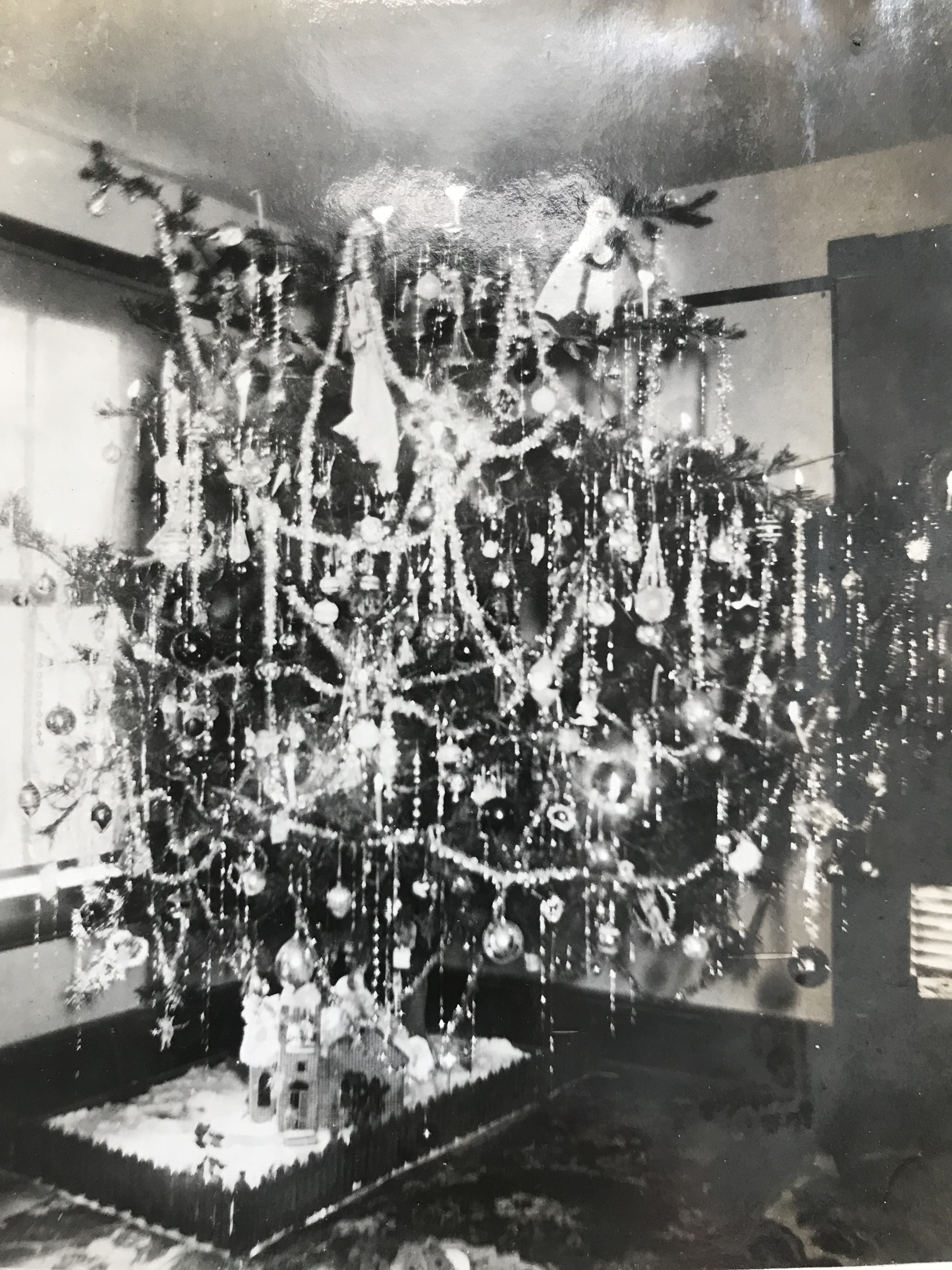
A small snow scene with what appears to be a miniature church is arranged at the foot of the Christmas tree. A popcorn garland adorns the tree. Photo by Lewis Reed
So, where did Washingtonians get their trees?
From The Evening Star, Washington, DC 23 December 1923:
Conduit Road on the long stretch between Glen Echo and Great Falls for many years has been a favorite hunting ground where hundreds and hundreds of families have customarily obtained scrub pine trees for Christmas week. Usually there is plenty of holly and some mistletoe to be found in the rugged and rolling hill lands which are the gateway to Great Falls.
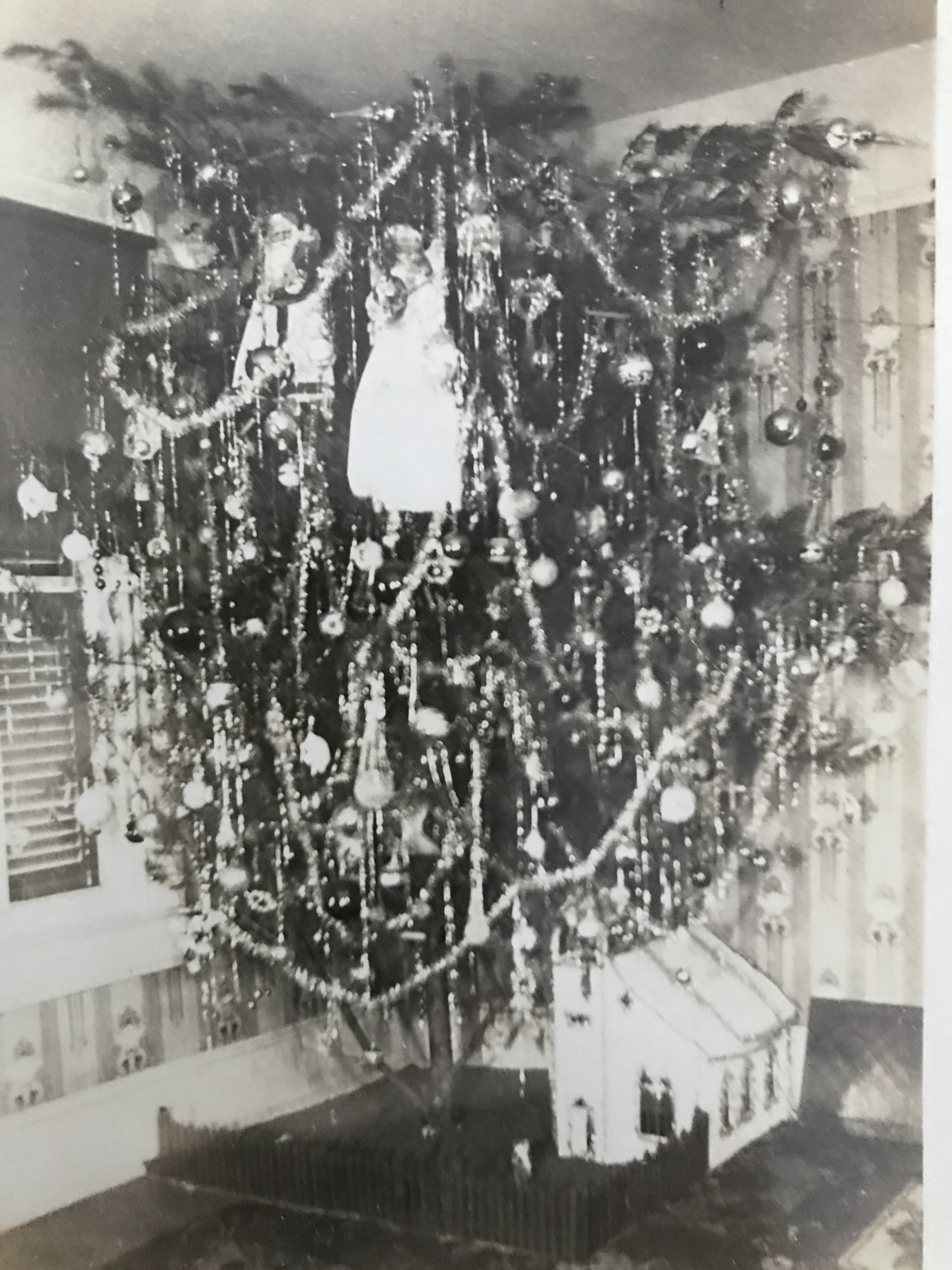
No room for a star on the top of this tree! And just look at those big Santa and Angel dolls. Other fun little details are notable, including a miniature church with picket fence is arranged at the base of the tree. Photo by Lewis Reed
There’s a fine art to decorating Christmas trees that’s been developing since over 100 years ago. People consider lights, garland, ornaments, skirt, and more. But one thing that’s hard to resist sometimes is just filling every available space with decorations. Clearly, that was the case years ago too. What I like about these trees is that they are so randomly shaped and even misshapen. Folks back then didn’t trim them down to a more aesthetically pleasing symmetry like we do today.
The tradition of building miniature Christmas village landscapes, including houses, animals, and other hand-crafted wooden figures, began with the Pennsylvania Dutch in the late 1800s. Mass-produced cardboard houses, sold in dimestores, became popular in the mid-20th century. Today, these villages in good condition can be highly collectible.
Below are photos of Lewis Reed’s snow village set up under the Christmas tree decorated with vintage ornaments, tinsel, and lights. I don’t remember the odd-shaped Christmas trees, but I do remember having a lot of fun helping my grandfather set up the miniature landscapes with the varied figures, little houses, and trees at Christmastime each year. It seemed like a holiday village right out of a storybook.
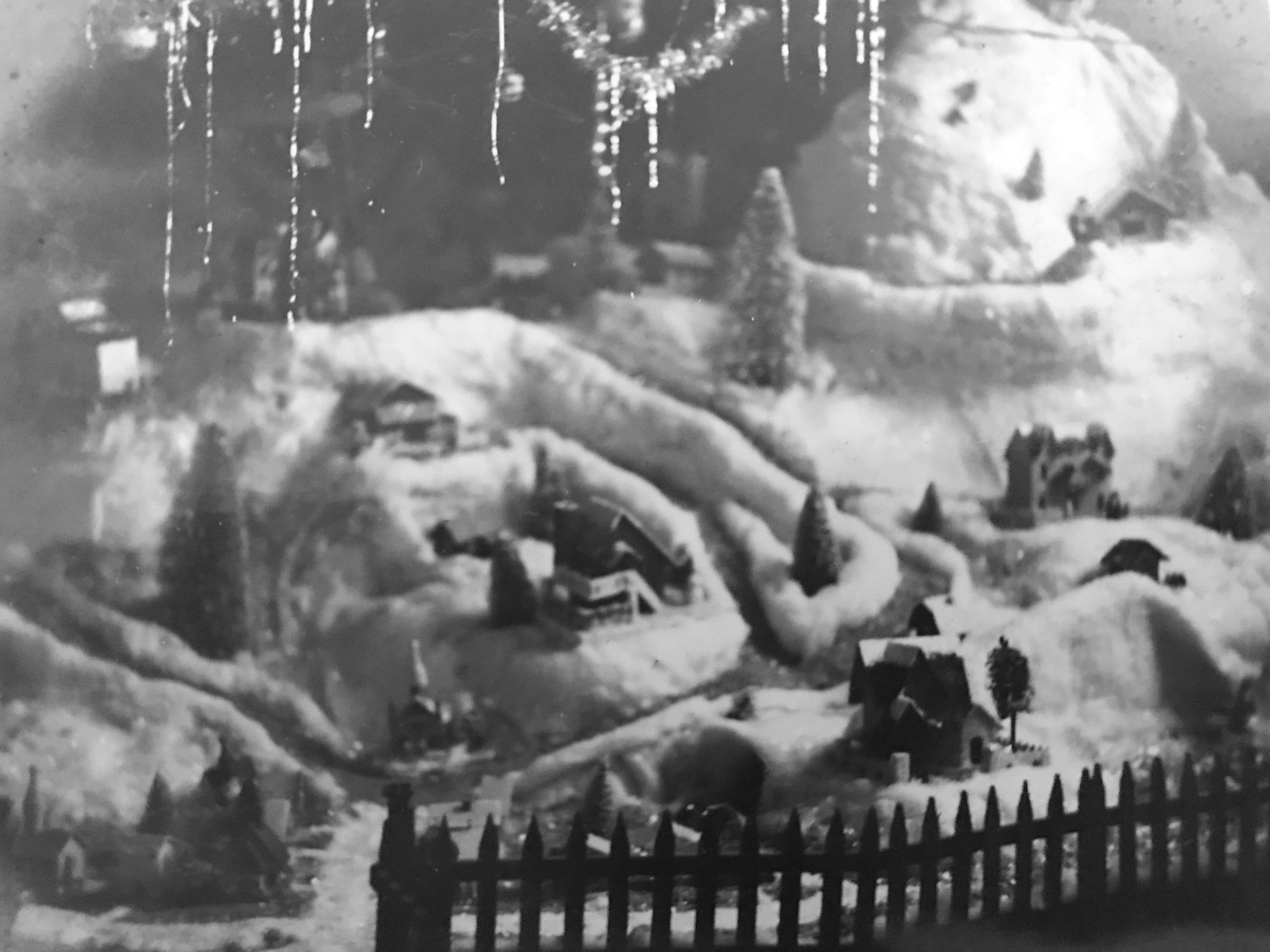
A rustic picket fence is used to set off the village display. Dangling strands of tinsel hang below the tree. Photo by Lewis Reed
The snow villages were set up in Lewis Reed’s basement on top of a big table beneath a small Christmas tree. He made the snow scenes entirely by hand using wire-covered cardboard and balled up paper to make hills and pathways. The little houses and figurines would fit into the landscape with cotton ‘snow’ all around; and lights would be wired underneath.
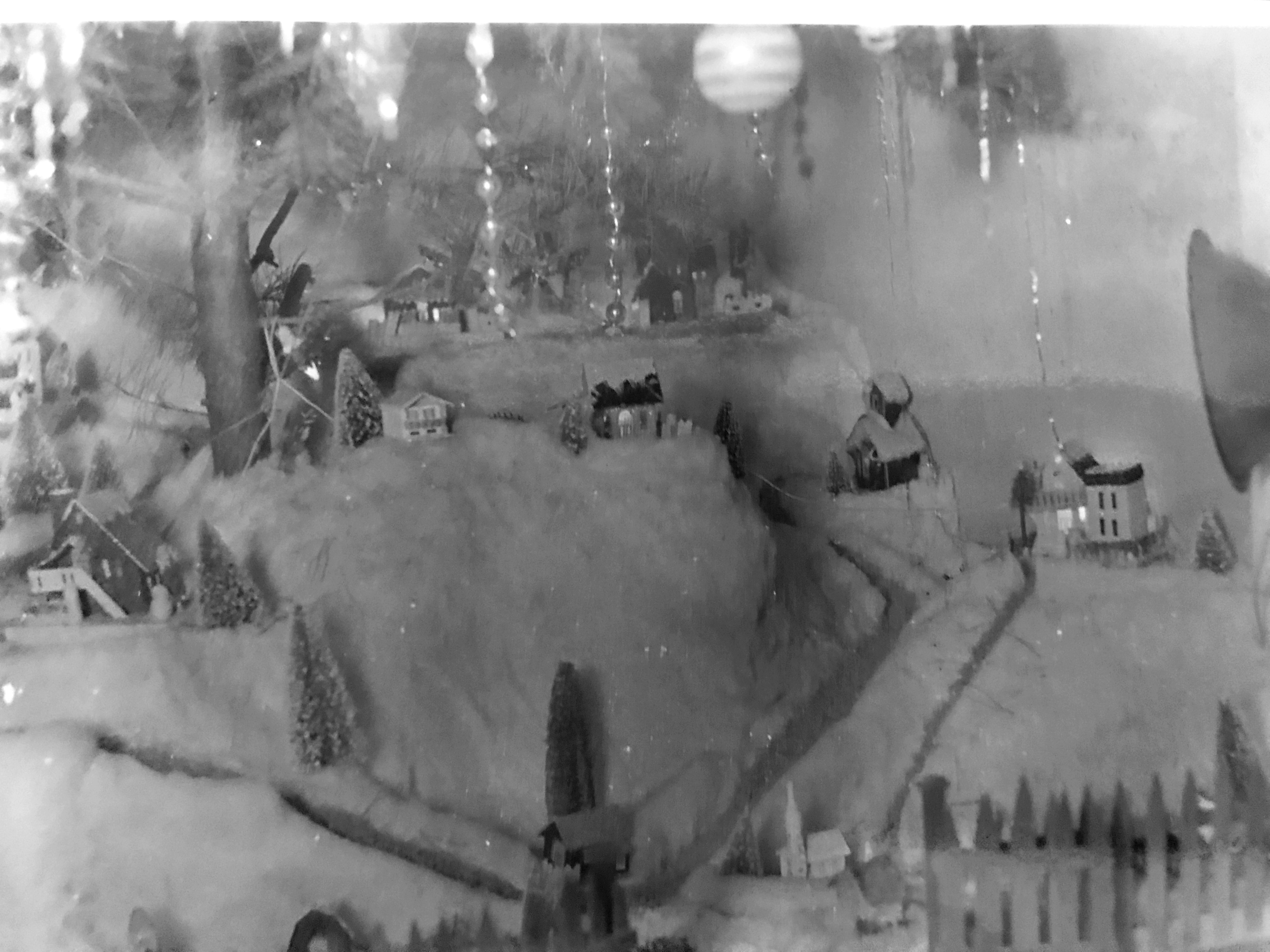
Little houses, churches, fences, trees, and pathways were added to the scene. Some of the houses have charming light effects in the windows. The roofs of the houses were decorated with fake snow. Photo by Lewis Reed
These Christmas villages were precursors of the Holiday Villages that were made popular by Department 56 that you see today.
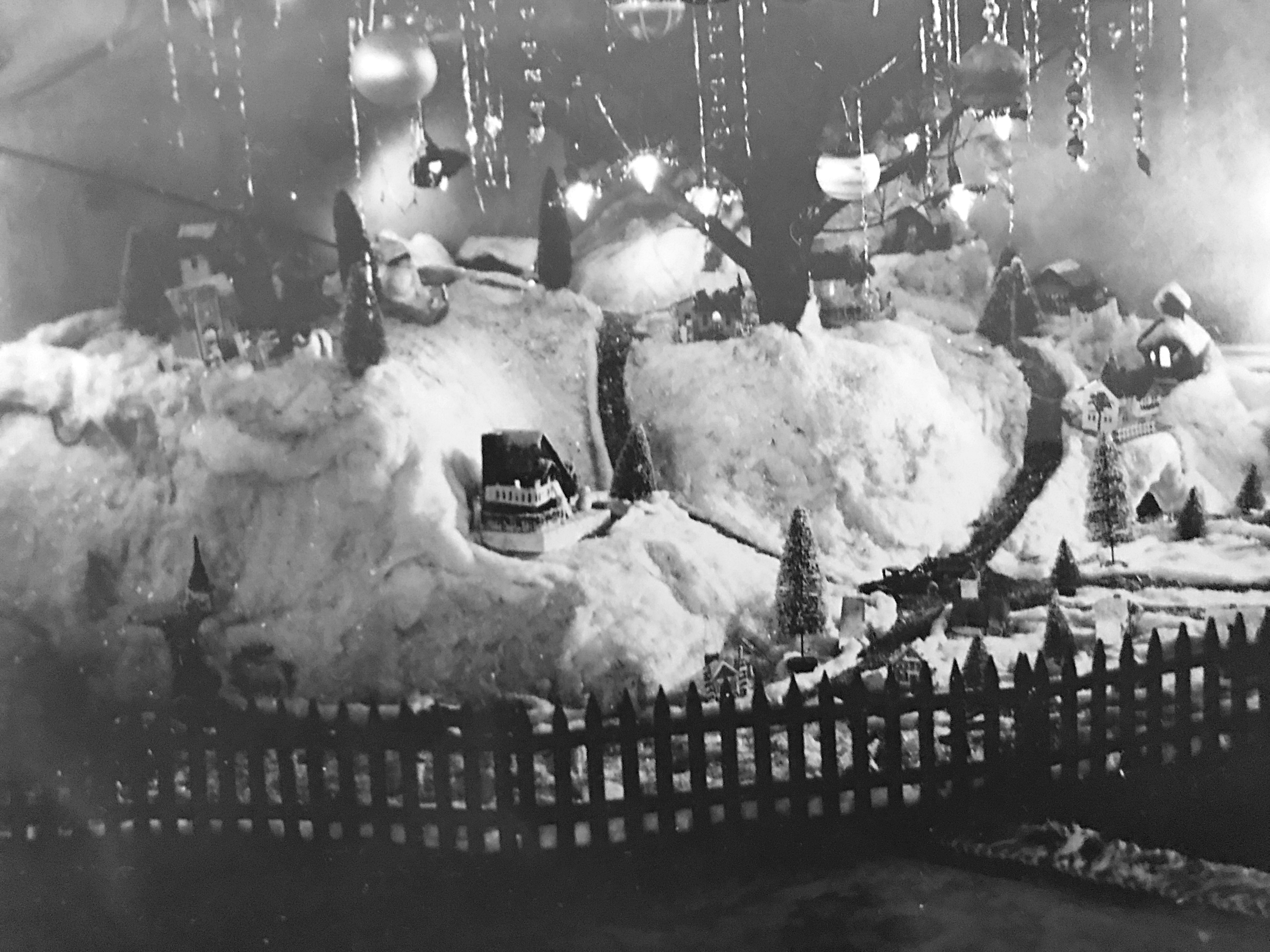
Old-fashioned lights can be seen on the tree, along with lit windows in the houses. The miniature houses usually had holes in the back or the bottom through which tiny lights were placed to provide illumination. Photo by Lewis Reed
Wishing all of you who have stopped in to visit a very Merry Christmas and Happy New Year! Stay safe and enjoy the holiday season with friends and family!
Then & Now: The New Raleigh Hotel Washington DC, 1912
Some of the city’s oldest hotels not only have a long history of storied visitors and impressive tales, but they’ve shaped the city’s landscape for decades and perhaps centuries. However, for every Hay-Adams, Willard Continental and Morrison-Clark, there’s a hotel like the the Raleigh Hotel that’s either been converted and or destroyed entirely.
Raleigh Hotel (THEN): Along with the Willard, the Raleigh Hotel was one of the largest and grandest hotels in Washington in the first part of the twentieth century. It held a commanding position on Pennsylvania Avenue across from the Old Post Office Building and was famous as a Mecca for patrons of the performing arts. In 1911, the building was razed and rebuilt as a 13-story Beaux Arts hotel.
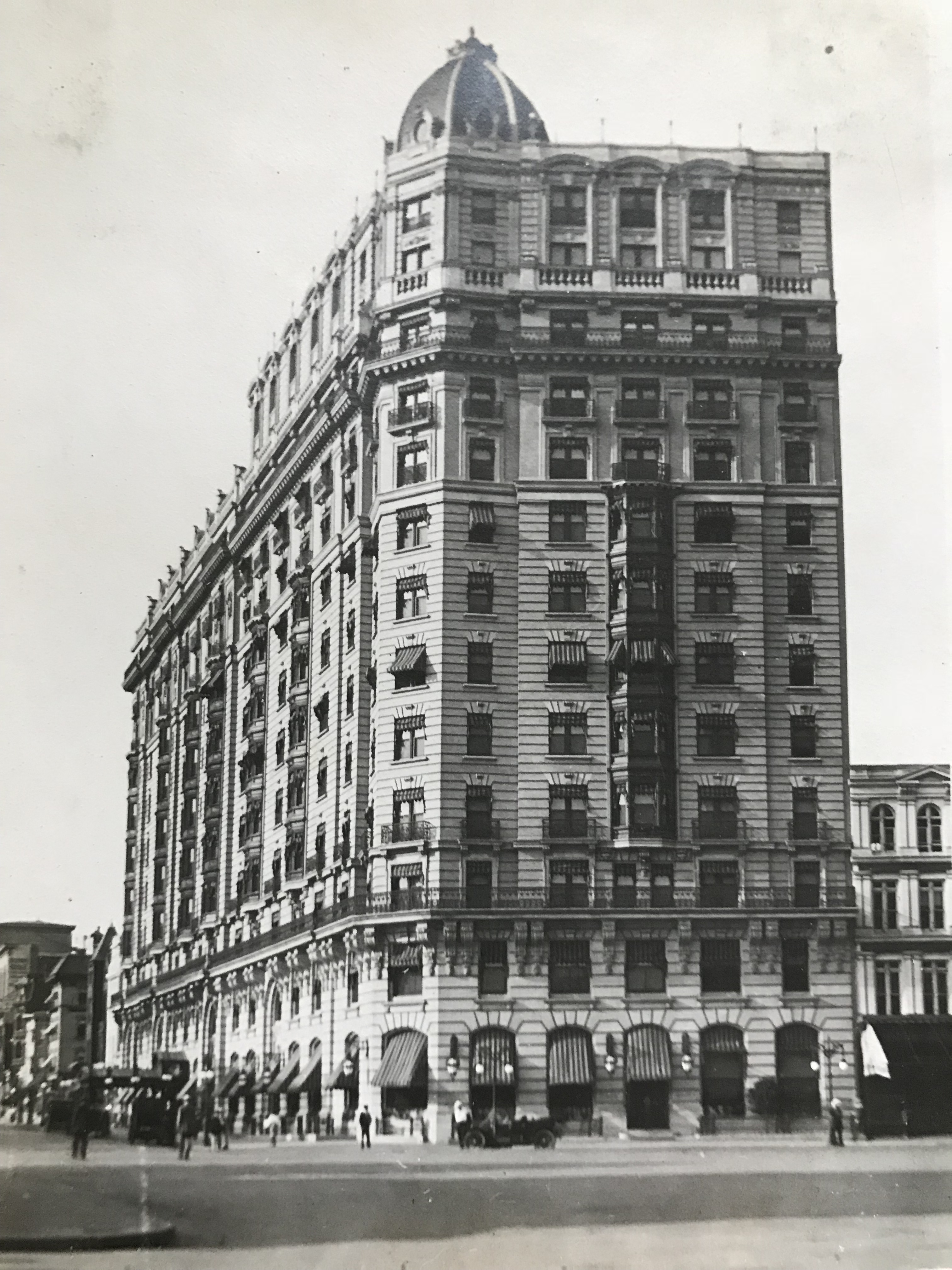
The recently completed Raleigh Hotel at Pennsylvania Ave and 12th Street NW, built on the site of the previous Raleigh Hotel. Photo taken by Lewis Reed, ca. 1912
Raleigh Hotel (NOW): The hotel closed in 1963, its furnishings were sold off, and it was demolished a year later. Its replacement, a 14-story office building at 1111 Pennsylvania Avenue, was completed in 1968, and it still stands on the site today.

The site of the Raleigh as it appears today.
Then & Now: Andrew Small Academy Darnestown, 1908
“Then and Now” photos are an excellent way to explore the passage of time. In this special post, I have combined one of Lewis Reed’s original photograph’s for “then” and matched it with a corresponding contemporary shot for “now”. Taken over a century apart, these photos show the Andrew Small Academy in Darnestown, then and now.
Andrew Small Academy (THEN): In 1869, longtime member of the community and Scottish immigrant Andrew Small left a bequest for the establishment of a school for Darnestown. Named for its benefactor, the Andrew Small Academy was the largest school building in Montgomery County at that time. The building was used as a private educational institution until 1907, then used as a public high school for almost the next 50 years. The building was demolished in 1955 to make way for a new elementary school.
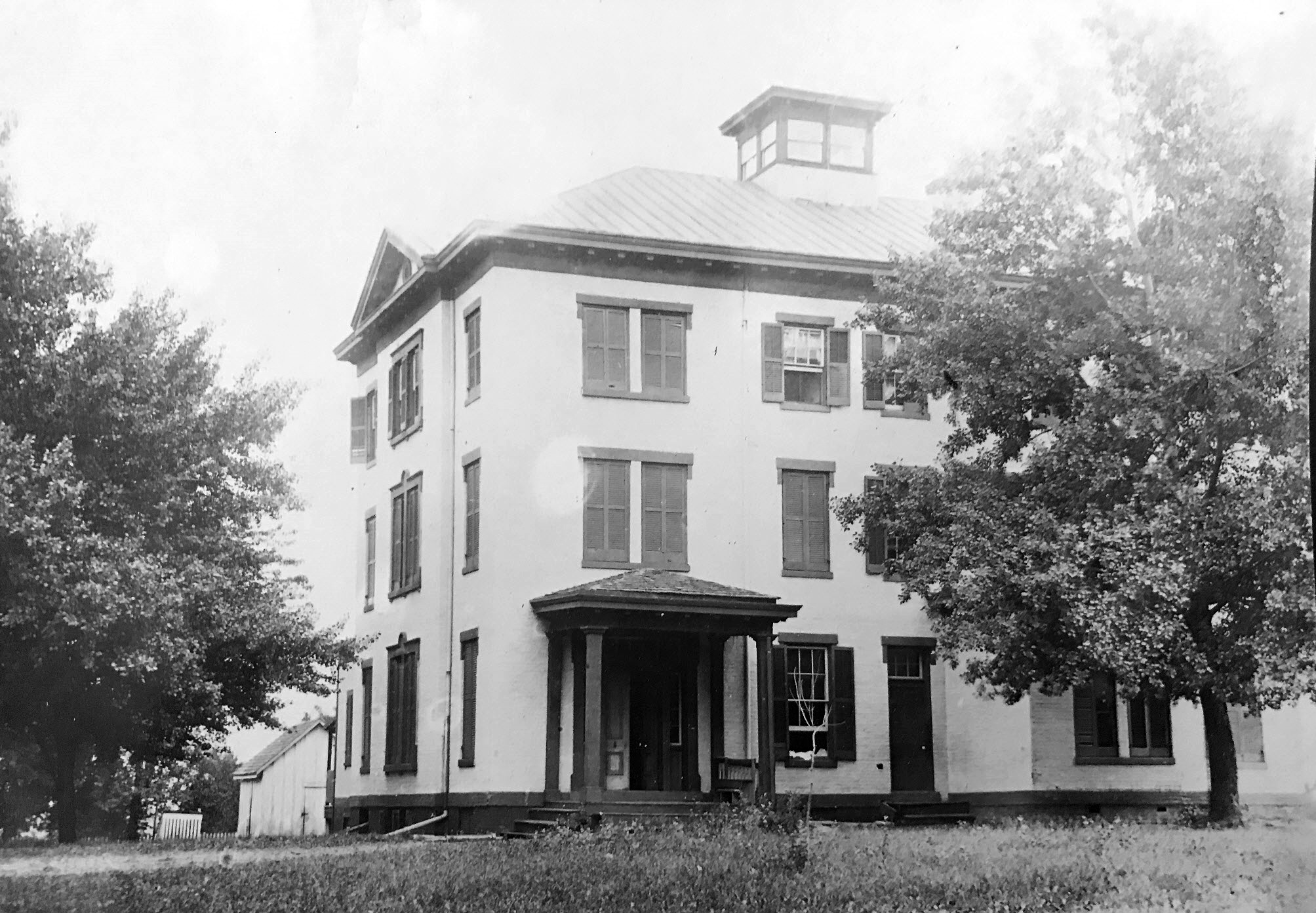
Andrew Small Academy building in 1908, shortly after it was closed. Photo by Lewis Reed
Andrew Small Academy (NOW): No longer standing. Site was located at 15030 Turkey Foot Road directly behind Darnestown Elementary School where a blacktop play area is now located. The tree shown in front of the Academy in Lewis Reed’s photo still stands north of the blacktop. The drive to the Academy came off Darnestown Road (Rt 28) sharing the same entrance to the northwest of the site still in use by Darnestown Presbyterian Church. The Academy was demolished in 1955 and replaced by the existing Darnestown Elementary School, which stands only a few hundred feet from where the academy was once located.

Darnestown Elementary School, which replaced the academy building in 1955.
Historical Marker https://www.hmdb.org/m.asp?m=69716
The Academy was named for its benefactor, Andrew Small (a native of Scotland), who became attached to the neighborhood while working on the C & O Canal. The Andrew Small Academy is no longer standing. The school was located directly behind the Darnestown Elementary School, on Turkey Foot Road. The Andrew Small Academy was an important early private educational institution that was constructed in 1869 and used as a private school until 1907, when it was converted into a public high school.
This was the largest and finest academy in Montgomery County. It had boarding as well as local students, and went up through three years of high school. Up until 1892 the minister of the church was also principal of the academy and received a salary of $600. The school became the cultural center of the community with concerts, plays, recitals, and a literary society. In 1892 the academy got its first full time principal. Then in 1907 it was taken over by the Montgomery County school system, and in 1927 it was changed into an elementary school. This ended its service as a cultural center. A new elementary school (now Darnestown Elementary) was built to replace it in 1955.
Source: Maryland Historical Trust
Books

Related Resources


Copyright Notice

Reed Brothers Dodge History (1915-2012) by Jeanne Gartner is licensed under a Creative Commons Attribution-NonCommercial 3.0 Unported License.
 Reed Brothers Dodge History 1915 – 2012
Recent Comments