
Then & Now: Quebec Bridge (8th Wonder of the World)
The Quebec Bridge (Pont de Québec in French) has been an icon of Canada for more than a century. But did you know that the Quebec Bridge collapsed twice (1907 & 1916) before it was completed, making it the world’s worst bridge construction disaster. Taken approximately 90 years apart, these photos show the Quebec Bridge (8th Wonder of the World) then and now.
Quebec Bridge (THEN): Hailed at the time as the 8th wonder of the world, the Quebec Bridge was the first bridge over the St. Lawrence River in Montreal. Accommodating three highway lanes, one rail line and a pedestrian walkway, it represented a colossal challenge to construct at the time. First conceived in 1887, the bridge collapsed failed twice, at the cost of 88 lives, and took over 30 years to complete. A riveted steel truss structure, the Quebec Bridge is the longest cantilever bridge span in the world. The Quebec Bridge was declared a historic monument in 1987 by the Canadian and American Society of Civil Engineers, and on January 24, 1996, the bridge was declared a National Historic Site of Canada.

Quebec Bridge (8th Wonder of the World). Photo by Lewis Reed, ca. 1930
Quebec Bridge (NOW): The same view almost 90 years later. The bridge remains in use to this day, carrying both road and rail traffic. rails in the middle and roadways on both sides.

Night view of the Quebec Bridge, today. Photo credit: Martin St-Amant – Wikipedia
Source: Wikipedia
Featured Photo: Buffalo Zoo Bear Pits, Early 1920s

Buffalo Zoo Bear Pits, Buffalo, New York, ca. early 1920s. Note the car in the photo is mostly open-bodied, with no windows and certainly no heat. Tire chains are on the rear tires. I cannot say with any certainty, but I believe it is Lewis Reed’s car with his wife and baby daughter, Mary Jane, sitting inside all bundled up. Photo by Lewis Reed.
Founded in 1875, the Buffalo Zoo, located at 300 Parkside Ave in Buffalo, New York, is the third oldest zoo in the United States and is the second largest tourist attraction in Western New York; second only to Niagara Falls. The zoo traces its history to the mid-19th century when Jacob E. Bergtold, a Buffalo furrier, presented a pair of deer to the city of Buffalo. Five years after the deer were donated, more animals were added to the collection, and the first permanent building was erected, signifying the establishment of the Buffalo Zoological Gardens in 1875.
From this simple gift would grow the earliest origins of the Zoo, still operating on the same spot as that original 1871 Deer Paddock. A pair of bison and eight elk were added to the animal collection in 1895, and a zoo curator was hired the same year. Two years later, the bear pits, designed to look like Roman ruins, were built as the zoo we now know was beginning to take shape.
Source: Wikipedia
1929 Montgomery County F3 Tornado: Aftermath Photos

Spectators view the destruction at the Benson farm, May 1929. Photo by Lewis Reed
One of the worst tornadic outbreaks in area history occurred on May 2, 1929. At about 9 p.m. on Thursday, May 2, 1929, northeastern Montgomery County was struck by an F3 tornado, part of a large storm system that caused devastation from Florida to Ohio. The weekly Montgomery County Sentinel reported on May 10th that the “wind storm of cyclonic power . . . was of limited width and serpentine on its course. Everything in its path met with destruction.” These previously unpublished photographs were taken by Lewis Reed “after the tornado of May 2, 1929”.

May 1929. Photo by Lewis Reed
The damage in the county was limited to the rural Unity area, north of Brookeville. The Sentinel article detailed each affected farm, noting that “thousands of persons from far and near visited the scene for several days to look upon the indescribable wreckage.”

May 1929. Photo by Lewis Reed
From the Sentinel: “The storm showed its first violence upon the farm of Mr. J. William Benson. There it destroyed every building – the dwelling house, large barn, 117 feet long, including an attached shed, and all other outbuildings.” The farm was unoccupied, but furniture belonging to “a prospective tenant” was destroyed. Mr. Benson’s apple orchard was also significantly damaged, and the article claimed that “many [trees] were lifted into the air, carried over woods and landed several miles away.”
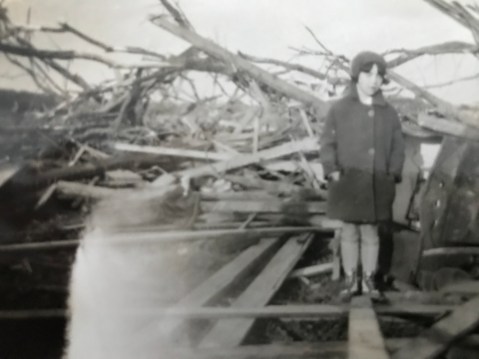
Lewis Reed’s daughter, Mary Jane, May 1929. Photo by Lewis Reed
The fire departments of Rockville, Gaithersburg and Sandy Spring responded to the call made by farm worker James Leizear, who “extricated himself from the wreckage” and ran half a mile to a neighbor’s house to summon help.
The Post reported on May 4th that 28 people in Maryland and Virginia had been killed by tornadoes during the storm; most of the casualties were in Virginia, where an elementary school was struck full-force and at least 18 children died. In Montgomery County, the local Red Cross Chapter formed a citizen committee to raise funds “for relief of the sufferers.”

May 1929. Photo by Lewis Reed
Note: These photographs were undated and unlabeled in my grandfather’s collection. My mother, Mary Jane (Reed) Gartner, who is seen above when she was almost 7 years old, positively identified these photographs and just about pinpointed the location! She is almost 96 years old! It’s amazing the things you remember from your early childhood.
Information Source: A Fine Collection
Then & Now: New Occidental Hotel Washington, DC
In this “Then & Now” feature, I have combined one of Lewis Reed’s original photograph’s for “then” and matched it with a corresponding contemporary shot for “now” to see how the location has changed or remained nearly the same through the years. I started doing this as a research tool, now I mostly do it because of my passion for history and fascination with the subject. In the following photographs, you can see the difference 100 years can make.
New Occidental Hotel (THEN): The New Occidental Hotel was built by Henry Willard (of Willard Hotel fame) in 1906. If any of 2,500 celebrities — including four presidents — forgot who they were, they could stop by the Occidental Restaurant on Pennsylvania Avenue and check their picture on the wall. Within a few years the Occidental became known as the place “Where Statesmen Dine”.
After the restaurant closed in 1971, the wall-to-wall collection of paintings and photographs of the famous was auctioned off. The new Occidental Restaurant re-opened at 1475 Pennsylvania Ave. NW, almost on the old site, as part of the Willard Collection of buildings.
Looking from the Treasury Building directly at the United States Capitol, this 1912 photograph taken by Lewis Reed shows the first floor retail shops and the Occidental Hotel, which has an Electric Grill Room, on the left. On the right are office buildings and the Old Post Office. The magnificent Raleigh Hotel held a commanding position on Pennsylvania Avenue across from the Old Post Office Building. The Occidental Hotel was located at 1411 Pennsylvania Avenue NW.

Historic street view of Pennsylvania Avenue. Photo by Lewis Reed, 1912
New Occidental Hotel (NOW): Google Street View from approximately the same perspective in 2018.
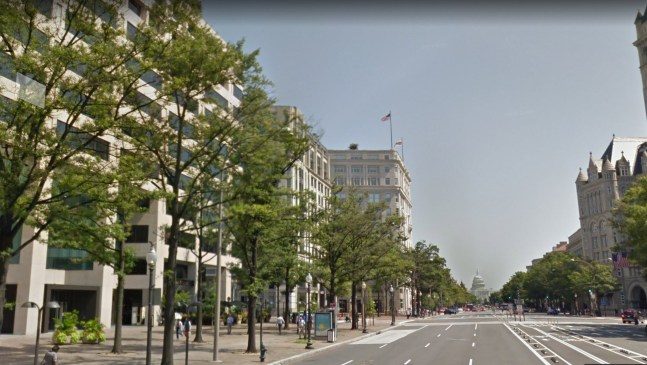
Screenshot of Google Street View 2018
Lewis Reed’s ‘Ghost’ Photograph

Surrealistic, ghost-like effect of Lewis Reed (right) standing next to a tree in the middle of train track. From Lewis Reed’s Photograph Collection
Lewis Reed had a passion for photography and had the know-how to try out a few of the trick shots that were popular at the time — including creating double exposures that made it look as if there were ghosts in the picture.
When I saw this photograph — which is slick enough to fool anyone not paying attention to detail — I became curious. How on earth did he do that? So I did some research to get some information on what went into this type of photography. This technique often left a telltale vertical line along the center of the image — a fuzzy stripe separating the two exposures.
Supernatural effects were mainly accomplished using double exposure. When developing the photos, a pre-prepared glass plate would be used which already had the image of a person on it. This would be the ‘ghost’. It would then be inserted into the camera in front of an unused plate which was used to shoot the photo. The developed negative comes out with both images on it — an incompletely exposed ghostly image as well as a sitter, looking perfectly unaware.
I think it’s really amazing how Lewis Reed’s early photography shows such versatility and creativity.
Books

Related Resources


Copyright Notice

Reed Brothers Dodge History (1915-2012) by Jeanne Gartner is licensed under a Creative Commons Attribution-NonCommercial 3.0 Unported License.
 Reed Brothers Dodge History 1915 – 2012
Recent Comments