
Two New Books Featuring Lewis Reed’s Historic Montgomery County Photographs
More than 125 years ago, a young boy named Lewis Reed picked up a camera and began photographing the world around him. What started as a youthful fascination with photography grew into one of the most important visual records of Montgomery County’s history.
From the late 1890s through the mid-twentieth century, Lewis Reed documented a county in transition. His photographs preserve everyday life during an era when dirt roads gradually gave way to paved highways, horse-drawn wagons shared the road with the first automobiles, and small rural communities evolved into the suburban landscape we know today. Today, the Lewis Reed Photograph Collection contains more than 2,500 photographs and continues to serve as an invaluable resource for historians, educators, museums, and local preservation projects.
For a little more than a decade, I have been privileged to preserve, research, and share this remarkable collection through books, online exhibits, presentations, historical markers, and hundreds of articles published here on Reed Brothers Dodge History. It has been my goal to ensure that Lewis Reed’s photographs remain accessible to everyone interested in Montgomery County’s rich heritage.
I am pleased to announce the completion of two new softcover companion books inspired by the Montgomery History online exhibits that celebrate Lewis Reed’s photographic legacy and introduce these remarkable images to an even wider audience.
Montgomery County: Through the Lens of Lewis Reed
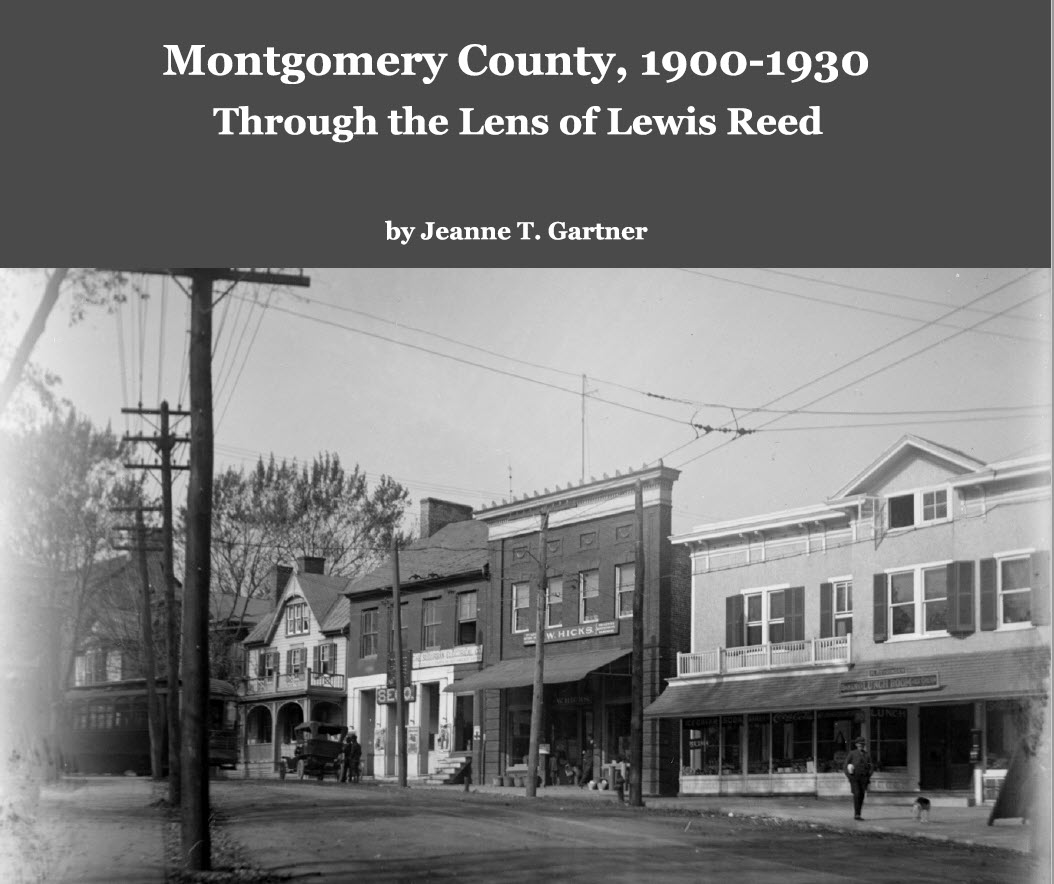
Created as a companion volume to Montgomery History’s online exhibit of the same name, this compact book presents a carefully selected collection of Lewis Reed’s finest photographs. Inspired by the online exhibit, it preserves a remarkable visual record of a Montgomery County that has largely disappeared.
Taken during the first decades of the twentieth century, these photographs capture a county undergoing profound change while demonstrating Lewis Reed’s remarkable gift for documenting history as it unfolded. Today, they stand among the most significant visual records of Montgomery County’s early history.
Montgomery County: Then and Now – Photography of Lewis Reed and Barry Gartner
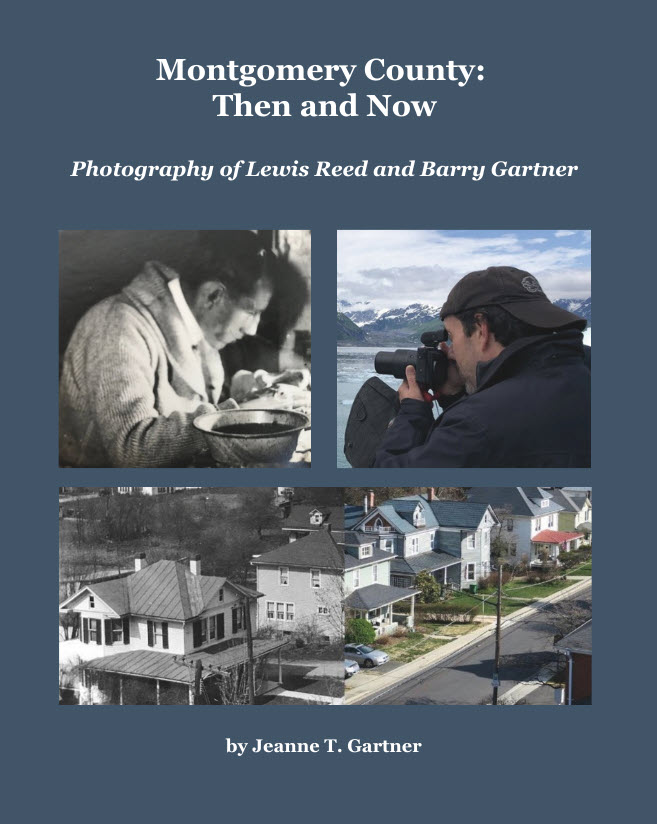
Also created as a companion volume to Montgomery History’s online exhibit of the same name, this full-color book pairs Lewis Reed’s historic photographs with modern images recreated from the same locations by his grandson, Barry Gartner. Together, the photographic pairs reveal more than a century of change while preserving a visual connection between Montgomery County’s past and present.
The result is a unique comparison of familiar landscapes, demonstrating how photography can bridge generations and deepen our understanding of the communities that continue to evolve.
Now Available
I’m excited to share that Montgomery County: Then and Now – Photography of Lewis Reed and Barry Gartner is now available to preview or purchase through Blurb’s print-on-demand bookstore.
Readers can browse the entire book online before ordering, making it easy to explore this unique photographic journey through Montgomery County’s past and present.
Preview or order your copy here:
Montgomery County: Then and Now – Photography of Lewis Reed and Barry Gartner
The companion volume, Montgomery County: Through the Lens of Lewis Reed, will also be available soon.
Continuing the Legacy
Every publication built around the Lewis Reed Photograph Collection helps preserve a remarkable visual record of Montgomery County’s history. More than historic images, these photographs connect us with the people, places, and landscapes that shaped our communities and remind us how much can be learned from a single photograph.
Thank you to everyone who has encouraged and supported this work over the years. Your interest in Lewis Reed’s photography has helped ensure that this extraordinary collection continues to educate, inspire, and preserve Montgomery County’s history for future generations.
To explore these and my other publications, please visit the Featured Publications page here on Reed Brothers Dodge History.
High Flying History: When the Goodyear Blimp Came to Rockville


A Night on the Mooring Mast
According to a 1938 report from The Montgomery County Sentinel, the visit was far more than a simple flyover; it was a full-scale community event that turned Rockville into a temporary hub of aeronautical wonder. Local residents, who had long wondered how such a massive airship could be anchored away from a permanent dock, were given the rare opportunity to see a mobile mooring mast in action as the Enterprise stayed overnight.
The spectacle wasn’t limited to the skies, as Reed Brothers also sponsored a “Life Guard” tire demonstration to prove the safety of Goodyear’s latest technology. In a display that had to be seen to be believed, a car traveling at upwards of 60 miles per hour underwent a deliberate blowout to demonstrate that it could maintain control without serious consequences. This high-speed event was conducted with the full cooperation of local police authorities, who assisted in managing the crowds that gathered to witness the future of automotive safety and aviation.
A Ride to Remember (From the Womb)
History is often best told through the personal stories of those who lived it. One of the most charming accounts of the Enterprise’s visit comes from Janice Beall Taylor, whose parents both worked at the dealership in the 1930s.
Her mother, Mary Anna Slater, was the bookkeeper at Reed Brothers and was eight and a half months pregnant at the time of the blimp’s arrival. Not wanting to miss the chance of a lifetime, Mary Anna called her physician, Dr. Hartley, to ask if it was safe to fly.
Only if I can go, too!” the doctor reportedly replied.
True to his word, the doctor and the expectant mother took to the skies. Janice often jokes with her children that she technically enjoyed her first blimp ride two weeks before she was even born!
Preserving the Legacy
The visit of the Goodyear Blimp was more than a marketing stunt; it was a moment that captured the imagination of a generation. Thanks to Lewis Reed’s foresight in bringing his camera into the cockpit, we have a permanent record of Rockville’s landscape from a time when “aerial photography” was a daring new frontier.
Today, these images serve as a bridge to the past, reminding us of the days when a silver giant in the sky could bring an entire city to a standstill.
Inventing the Scene: Lewis Reed’s Composite Experiment

Not everything in the Reed Collection is what it seems. This early composite by Lewis Reed shows how he experimented with illusion long before Photoshop.
This unusual photograph offers a rare glimpse into the experimental side of early 20th-century photography. Created by Lewis Reed at a time when cameras relied on glass plate negatives and hand-mixed chemicals, the image reflects a period when photographers were not only documentarians, but also inventors; pushing the boundaries of what the medium could achieve.
At first glance, the scene appears to show a peaceful gathering along a wooded stream. Yet the composition quickly reveals signs of careful manipulation. The curved form across the top of the image, resembling the back of a chair or decorative arch, does not belong to the natural landscape. Its texture and sharp edge cut through the sky and treetops, suggesting it was introduced from a separate negative.
The figures also feel slightly detached from their surroundings. Their contrast is stronger, their edges more defined, and the lighting on each does not quite match. Most intriguingly, the woman seated on the ground appears to be the same woman standing between the two men. This repetition is a clear sign that Reed reused the same subject in different positions, further revealing the layered nature of the image and his playful approach to composition.
Such composite images were created through a painstaking darkroom process. Photographers used masking techniques, layered glass plate negatives, and contact printing to merge multiple exposures into a single print. These “trick photographs,” as they were often called, were popular between the late 1890s and the 1920s and were meant to entertain, surprise, and demonstrate technical skill.
This photograph stands as evidence of Lewis Reed’s curiosity and craftsmanship. While he is best known for documenting everyday life and early automotive history, this image reveals another side of his work–one rooted in imagination, experimentation, and the early artistry of the photographic medium.
Lewis Reed: Enters 1936 Amateur Photo Contest
The Star published a series of pictures reproduced from photographs taken by local amateurs. The pictures were selected and judged each week and the best one chosen on its merits and published the following Sunday. Lewis Reed submitted his photo, “Sunset Over the River”, in the Washington Star Best Snapshots of the Week in The Star’s Amateur Contest. There was no indication where the photo was taken, but I’m guessing it was probably on the Potomac River, Maryland. At the time, Lewis Reed would have been 49 years old. There was no mention of whether or not he won a prize for his photograph, but I’m not surprised he entered this contest. He was a passionate photographer and always had his camera with him.
The full page image below is from the Sunday Gravure Section of The Washington Star newspaper. When looking at the top of the page, I wondered what the term “Gravure” meant, so I “googled” it. Turns out gravure refers to the special newspaper sections of photographs which were printed with this process starting around the late 1800s. In the 1930s, newspapers published relatively few photographs and instead published separate gravure sections in their Sunday editions. These sections were devoted to photographs and identifying captions, not news stories.

Full page image from The Sunday Star, Washington, D.C. – Gravure Section – June 28, 1936.

“Sunset Over the River” taken by Lewis Reed in 1936
Lewis Reed was a well-known photographer in Montgomery County and many of his photographs are now part of the Montgomery County (Maryland) Historical Society photo archives. His photography has appeared in highly regarded history books such as, “Montgomery County: Two Centuries of Change” by Jane C. Sween, “Montgomery County (Then & Now)” by Mark Walston, “Montgomery County (MD) Images of America”, by Michael Dwyer, “Rockville: Portrait of a City” by Eileen S. McGuckian, and “Gaithersburg: History of a City”. His photographs have been featured in the Norris-Banonis Automotive Wall Calendar, on the national television show, American Pickers, and on television’s most watched history series, American Experience on PBS.
Meet Lewis Reed, Photographer


Before opening his Dodge dealership in 1915, Lewis Reed was a well-known photographer in Montgomery County Maryland. At the turn of the century, before automobiles were even around, Lewis Reed toured up and down the East Coast on his motorcycle, taking photographs of landscapes, monuments, historic places, and people.
Some of the historic locations in his photograph collection includes the Black Rock Grist Mill, Smithsonian Institution, Montgomery County Maryland Almshouse, United States Capitol, Key Bridge, Union Station and other important sites in and around the Maryland, Virginia, and Washington, D.C. area. There are also photographs of many non-Maryland locations including Virginia, West Virginia, Pennsylvania, Georgia, New York, Boston, Georgia, North Carolina, and Canada. Especially stunning are images of the aftermath of the 1936 Gainesville Georgia tornado, one of the deadliest tornadoes in American history. As his photograph collection reveals, Lewis Reed was on the scene for some of the most important events in the history of the twentieth-century, and he always had his camera with him.
Lewis Reed developed all of his own photographs. He had a darkroom in his house — in the kitchen, to be exact — and worked at night to develop the negatives.
His photography has appeared in highly regarded history books such as, Montgomery County: Two Centuries of Change by Jane C. Sween, Rockville: Portrait of a City by Eileen S. McGuckian, and Gaithersburg: History of a City. His photographs have been featured in the Norris-Banonis Automotive Wall Calendar, on the national television show, American Pickers, and on television’s most watched history series, American Experience on PBS.
In a way, his photographs — more than 2500 in all — serve as an unwritten diary of his early adventures as an amateur photographer. My greatest pleasure now — more than 100 years later — is being able to share them.
Books

Related Resources


Copyright Notice

Reed Brothers Dodge History (1915-2012) by Jeanne Gartner is licensed under a Creative Commons Attribution-NonCommercial 3.0 Unported License.


Recent Comments