
Ice Harvesting in Darnestown, ca.1910

Men harvesting ice with pitchforks and hand saws in Darnestown, Maryland. Photo taken by Lewis Reed, ca.1910. Note the blocks of ice stacked up along the shoreline.
Got ice? Usually, we don’t think about ice very often, unless there’s none in the freezer. At the start of the 19th century, keeping food fresh and edible was one of the biggest challenges of everyday life. So what was life like before we had that incredible device that we now take for granted, the refrigerator?
Before the first successful ice-making machines were built, ice for refrigeration was obtained through a process called “ice harvesting.” Men would venture out onto frozen ponds with saws, tongs, and pitchforks and methodically cut and dragged blocks of ice.
Refrigeration is a modern convenience that we just can’t live without and certainly one that I take for granted … or took for granted until I wrote this!
On the Self-Publishing Horizon … Again!
I’m excited to announce that for the last year or so, I’ve been thinking about self-publishing a photo book specific to my grandfather, Lewis Reed, with a working title of, “Lewis Reed Photograph Collection (1898-1960).” Looking back at photography from the past is a fascinating experience for me, and with a newfound interest in history, the curious part of me wants to learn more: When was the picture taken? Where? What is it? Who’s in it? The majority of his photos are more than 100 years old and many are lacking labels and/or dates, which requires quite a bit of research and a little photo detective work on my part.
With that in mind, I will be frequently spotlighting photographs that may not directly pertain to the history of Reed Brothers Dodge, but will have a lot to do with it’s founder, Lewis Reed. I will not try to be an historian; I will post photos and supply a few paragraphs of context. Many photographic images in this collection have never before been seen publicly in print and will be available in this book for the first time.
I’ve been sitting on this post for a few weeks, timid to hit the ‘publish’ button. Likely because the size of the project is overwhelming and committing to it is a bit daunting (although exciting at the same time). It doesn’t help that as the ambition of my projects and goals increase, so too, can self-doubt. Below is the Draft Table of Contents for the book, which I’m sure will see some revisions as I progress.
Having said that, I will be switching my focus and time to mostly photo identification and researching/writing for the book.
Time to get to work!
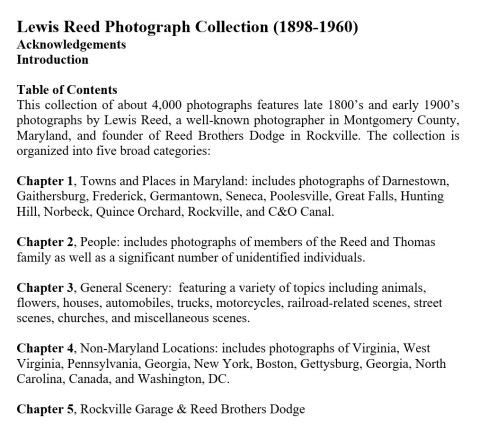
Draft Table of Contents
Books

Related Resources


Copyright Notice

Reed Brothers Dodge History (1915-2012) by Jeanne Gartner is licensed under a Creative Commons Attribution-NonCommercial 3.0 Unported License.
 Reed Brothers Dodge History 1915 – 2012
Recent Comments