
Chauffeur Lewis Reed Drives Pierce-Arrow Limousines

Two ladies with parasols are sitting in the landaulet section of an early Pierce-Arrow limousine, while chauffeur Lewis Reed tends to the motor. The rear portion of the limousine is partitioned from the driver with a glass shield, and covered by a convertible top, which you can see is currently in the lowered position behind the ladies. Ca. 1910
Lewis Reed understood automobiles. He knew how they worked and how to fix them. He loved cars and anything associated with them. Prior to World War I, Lewis Reed’s love of automobiles led him to becoming a chauffeur. Chauffeurs were not only trained to be proficient with their driving skills, but they also had to keep the luxury automobiles in tip top shape which is where his mechanic training – a vital skill in the early days of motoring – would have come into play.
Lewis Reed received his training at the Pierce-Arrow factory at Buffalo, New York, the Dodge Hamtramck and Hudson Motor Car factories in Detroit, Michigan, and the Washington Auto College. Pierce-Arrow was once one of the most recognized and respected names in the automobile industry. For 38 years, the Pierce-Arrow Motor Car Company in Buffalo, New York, produced some of the finest automobiles made.
The photo above would have to date to the time when Lewis Reed drove as a Chauffeur and before he started the Rockville Garage in 1914. Based on the time frame he drove as a Chauffeur and its appearance, the car in the above photo appears to be an early Pierce-Arrow limousine. If you can help to date it and/or identify the model, please leave a comment. The license plate in the photo below is dated 1914, and I would guess the car to be a 1910 – 1911 Pierce-Arrow Model 48.

Chauffeur Lewis Reed (left) in the 1914 photo above poses with an unidentified family and their Pierce-Arrow Model 48.
The earliest car owners had no real repair business to turn to. To be a successful motorist in the early 1900s, you needed to have some sort of mechanical skills. Or you had to find someone who did. Wealthy people employed private chauffeur-mechanics to not only drive, but also maintain and repair their large, expensive automobiles — rather than learn to do it themselves. Chauffeurs would be in charge of everything to do with the owner’s motor vehicle including repairs and maintenance and cleaning this meant that early personal chauffeurs had to be skilled mechanics.
With every car sold was a tool box that had the necessary to tools with instructions on how to dismantle and clean each part of the engine. It was recommended to do so after a certain amount of mileage depending on the make of the car, usually around seven hundred miles. When a tire wore out or was damaged, it was recommended that an expert do it, because it was glued to the rim and it took some doing to get it off. The new tire had to be cut to size for they were not always made to fit.
A mechanical aptitude was also necessary to be a car dealer in the early 1900’s. When cars were shipped to the dealer from the manufacturer, they arrived partially assembled in railroad boxcars. It was the dealer’s responsibility to unpack and assemble the cars at the rail yard and drive them back to the dealership. Mechanics were often needed to repair the new cars if they broke down along the way. During the early years, Reed Brothers represented several franchise nameplates along with Dodge, including Oldsmobile, Hudson and Essex. The Hudson and Oldsmobile were sold at Reed Brothers from roughly 1917 through 1923.
Happy Birthday Lewis Reed! Founder of Reed Brothers Dodge
 Lewis Reed was born in Darnestown, Maryland on November 25, 1887 and was the founder of Reed Brothers Dodge. When Lewis Reed opened his car dealership in October 1915, he never knew he was starting a family tradition that would be carried out for 97 years and three generations. He founded what would become the oldest Dodge dealership under the same family ownership in the state of Maryland, and one of the oldest in the entire nation.
Lewis Reed was just 27 years old when he started selling cars built by brothers Horace and John Dodge in Detroit. Few people jumped onto the Dodge Brothers bandwagon earlier than Lewis Reed, and not many have lasted longer. Reed Brothers was franchised as a Dodge dealership and service facility less than one year after the first Dodge automobile rolled off the assembly line.
Lewis Reed was the first to sell Dodge cars in Montgomery County, Maryland and his company was the first Gulf gas dealer in the Washington, D.C. area. During the early years, Reed Brothers represented several franchise nameplates along with Dodge, including Oldsmobile, Hudson and Essex. The Hudson and Oldsmobile were sold at Reed Brothers from roughly 1917 through 1921.
Before becoming interested in automobiles, Lewis Reed was one of the original employees of the Computing-Tabulating-Recording Company, a Georgetown-based manufacturing firm that eventually became International Business Machines, Inc. He received his training at the Pierce Arrow factory at Buffalo, New York, the Dodge and Hudson factories at Detroit and the Washington Auto College.
When World War I broke out, Lewis Reed along with many other patriotic men joined the war effort. He did his bit in World War I by working at the Navy Yard in Washington DC as a torpedo tester.
Lewis Reed was very active in his community and in his church. He was a member of the Gaithersburg Grace Methodist Church, where he served as a member and Chairman of the Board of Stewards, a Lay Leader and President of the Men’s Bible Class. He was a charter member and Past President (Feb 1933 – Feb 1937) of the Gaithersburg-Washington Grove Volunteer Fire Department and a member of the advisory board of the Rockville branch of the First National Bank of Maryland. Lewis Reed belonged to the Masonic Lodge of Rockville, the Pentalph Chapter of the Eastern Star and the Rockville Rotary Club. He was a Rotarian for 34 years and also had served as President of that group.
Active in the dealership daily until the day of his death, Lewis Reed died on January 28, 1967 at the age of 79. Shortly after his death, the Senate of Maryland passed SENATE RESOLUTION NO. 10 honoring the well-known Rockville automobile dealer for his personality and outstanding contributions. The resolution was sponsored by Senator Thomas M. Anderson, Jr and Senator Louise Gore. At the time of his death, he was in negotiations with the State Roads Commission on the Commission’s proposal to take over a portion of his business property for construction of an interchange at Rockville Pike, Hungerford Drive and Veirs Mill Road.
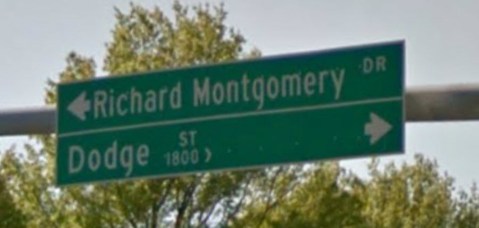
In recognition, the state of Maryland named the connector street behind the original location, “Dodge Street,” commemorating Reed Brothers’ presence from 1914-1970. When the state widened the roads in 1970, the dealership relocated to Route 355 at the Shady Grove Metro.
 When you look back and consider what has taken place in the world in the past 100 years or so, you gain a perspective of what Lewis Reed faced. He overcame a lot of obstacles throughout his life. He steered his dealership through World War I, The Great Depression and World War II. When Reed Brothers had no new cars to sell for three and a half years and many dealers went bankrupt, he converted his car showroom into a display room and sold GE washing machines and other appliances. Reed Brothers Dodge occupied two locations, the original at the Veirs Mill Road and Rockville Pike intersection and the second at 15955 Frederick Road in front of the Shady Grove Metro.
Lewis Reed set an outstanding example through his success, but more importantly through his sacrifices and commitment to the community he served. Today, Bainbridge Shady Grove Metro Apartments pays homage to the oldest Dodge dealership in Maryland with commemorative art on the former site of the iconic Reed Brothers dealership.
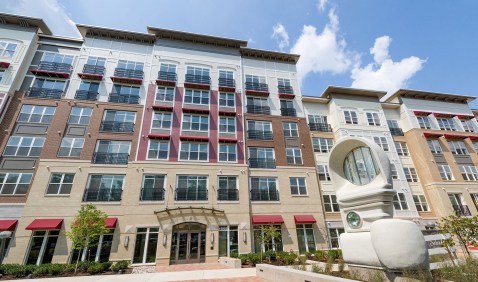
Bainbridge Shady Grove Metro Apartments now stands on the former site of the Reed Brothers Dodge dealership at 15955 Frederick Road. But a sculpture now installed on the property pays tribute to the oldest Dodge dealership in Maryland history. More than 20 feet high, and over 6 feet wide, the public art is inspired by 1939 Dodge headlamps, and the fender of a 1957 Dodge pickup truck.
Feb 8, 1967: Senate Resolution No. 10
On February 8, 1967, the Senate of Maryland passed SENATE RESOLUTION NO. 10 to honor the memory of Lewis Reed shortly after his death on January 28,1967 at the age of 79. The resolution was sponsored by Senator Thomas M. Anderson, Jr and Senator Louise Gore.

Lewis Reed Photo: Early 1900s Tabulating Machine Company Delivery Truck

Early 1900s Tabulating Machine Company Delivery Truck. Photo by Lewis Reed
Before becoming interested in automobiles, Lewis Reed was one of the original employees of the Computing-Tabulating-Recording Company, a Georgetown-based manufacturing firm that eventually became International Business Machines, Inc. It was created in 1911 by Charles R. Flint through the consolidation of four companies: The Tabulating Machine Company, International Time Recording Company, Computing Scale Company of America, and the Bundy Manufacturing Company. Located in Endicott it was renamed International Business Machines (IBM) in 1924.
Note that the writing on the side of the truck is in reverse.. I have no idea why.
Source: Wikipedia
Lewis Reed Photos: Rockville’s First Water Tower

1906 historic view of Rockville Maryland’s first pipestem water tower. (1897-1946)
Photograph by Lewis Reed, founder of Reed Brothers Dodge
This 1906 photograph taken by Lewis Reed depicts Rockville Maryland’s very first water tower. I wanted to share this photograph, because it offers a visual history for its role in the development of public utilities in the City of Rockville. My grandfather picked up the hobby of photography even before automobiles were around. He was a well-known photographer in the county and many of his early photographs are now part of the Montgomery County Historical Society photo archives.

View of Rockville Water Tower and Baltimore Road B&O Railroad Crossing circa 1909. Photo by Lewis Reed
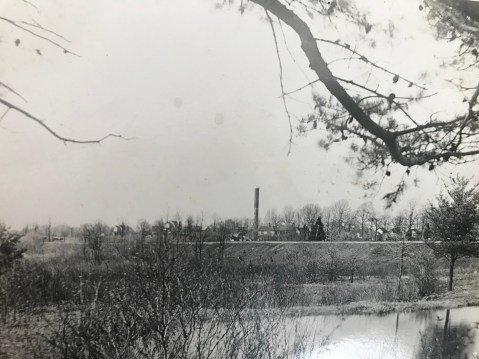
Another view of Rockville Water Tower. Photo by Lewis Reed
The pipestem tower was an element of the 1897 pumping station known as the “Rockville Electric Lights and Water Works,” located in Rockville Park and the future Croydon Park. In the 1890s, Rockville grew both as a resort and as a town. With substantial residential appeal, the need for services grew. In about 1899, Rockville got its first water tower at a cost of about $20,000. Its construction signaled the dawn of local municipal water service. Prior to the tower’s construction water in the city was primarily drawn from private wells. Concern for water quality in the 1880s led to the decision to develop a municipal system. The stand pipe was a typical shape for a water tower at the turn of the century. From this high point, water could be piped throughout the town. The chimney stack originally extended to a height of 50’, as documented in the Sanborn maps 1908, 1915.

Rockville Pump House, circa 1912. Photo by Lewis Reed
Built in 1879, the Pump House at Croydon Park is a historic building in Rockville and the site of the first municipal water supply. Once known as the “Rockville Electric Lights & Water Works.” the building was the City’s first public water system and supplier of electricity for street lights and private homes.
Sources:
National Register of Historic Places, Rockville Pumping Station
Peerless Rockville
Books

Related Resources


Copyright Notice

Reed Brothers Dodge History (1915-2012) by Jeanne Gartner is licensed under a Creative Commons Attribution-NonCommercial 3.0 Unported License.
 Reed Brothers Dodge History 1915 – 2012
Recent Comments