
New Blog Feature: Then & Now
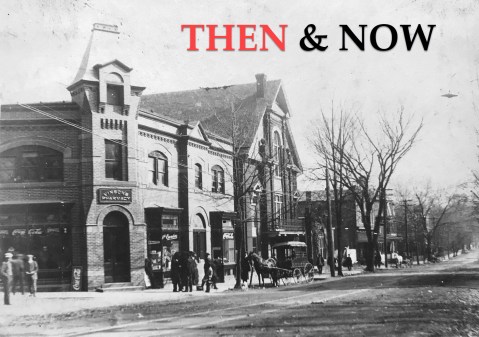
Looking back at photography from the past is a fascinating experience for me, and with a newfound interest in history, it occurred to me that with the vast number of historical photographs in Lewis Reed’s Collection, that this blog would be a great place to feature a series of Then & Now photography. I started doing this about a year ago as a research tool, now I mostly do it because of my passion for history and fascination with the subject. With that in mind, I will occasionally be spotlighting some “Then & Now” images from his collection that will show photographs of buildings, street scenes, and other historical locales alongside photographs of how they appear today.
Some of the historic locations in this series includes the Smithsonian, Capitol, Union Station, Old Post Office, Library of Congress, Raleigh Hotel, Key Bridge and other important sites in and around the Maryland, Virginia, and Washington, D.C. area. There are also photographs of many non-Maryland locations including the historic landmark “Lucy the Elephant”, Gettysburg Battlefield, Mount Vernon, Pennsylvania Monument and United States Regulars Monuments under construction, and Quebec Bridge (the 8th Wonder of the World).
I have no formal history training, just a general interest in local history where I grew up. I will post one of Lewis Reed’s photographs matched with a corresponding contemporary shot of the same area, and supply a few sentences of context. All of them will in some way will offer a visual history of how things have changed over the years. I look forward to sharing them with you.
Ice Harvesting in Darnestown, ca.1910

Men harvesting ice with pitchforks and hand saws in Darnestown, Maryland. Photo taken by Lewis Reed, ca.1910. Note the blocks of ice stacked up along the shoreline.
Got ice? Usually, we don’t think about ice very often, unless there’s none in the freezer. At the start of the 19th century, keeping food fresh and edible was one of the biggest challenges of everyday life. So what was life like before we had that incredible device that we now take for granted, the refrigerator?
Before the first successful ice-making machines were built, ice for refrigeration was obtained through a process called “ice harvesting.” Men would venture out onto frozen ponds with saws, tongs, and pitchforks and methodically cut and dragged blocks of ice.
Refrigeration is a modern convenience that we just can’t live without and certainly one that I take for granted … or took for granted until I wrote this!
Then & Now: Halpine Store/Radio Shack 111 Years Apart
Looking at old photographs is like peering through an open window back into history. Not only do they give you a sense of wonder from traveling back in time, but also a staggering feeling of awe from seeing just how much things have changed. For this post, I have used one of Lewis Reed’s original photographs for “then” and a Google Maps street view image from today for “now”.
The Halpine Store (THEN): The Halpine Store, also known as the Lenovitz General Store, was built on Rockville Pike in 1898, taking advantage of the prime location on the trolley and railroad lines and the Pike. The store sold food, gasoline and other items to locals and Pike travelers. The man standing just in front of the trolley tracks is James H. Handy (b. 1890) who lived at Halpine and worked for Mr. Copeland on the Wilkins farm. Handy served in the U.S. Army during WWI, as a gunner for the 371st infantry, doing two tours of duty in France. In this photo, he is about 16 years old. Note the telephone or telegraph poles, and the trolley tracks paralleling the road. The nearby Halpine railroad station also brought customers to the area, and the store became the social/community gathering place for the Halpine area. Tradition has it that during the days of “Local Option” when the sale of alcoholic beverages was forbidden in the County, the men of Rockville traveled to the Halpine Store to gather on the broad front porch and sip its special brand of “coffee” served in tin cups.
The proprietors, Benjamin and Anna Lenovitz, lived on the second floor. The building burned in 1923 and a new fire-resistant brick building was rebuilt in its place. This building, at 1600 Rockville Pike, became a Radio Shack, selling computers and electronics.
Seen in the black & white photograph taken by Lewis Reed in 1906, is The Halpine-Lenovitz General Store at Rockville Pike and Halpine Road.

Halpine-Lenovitz General Store at Rockville Pike and Halpine Road, 1906. Photo taken by Lewis Reed.
The Halpine Store/Radio Shack (NOW): The same view one hundred and eleven years later. Rockville Pike is now six lanes, linking the once outlying Halpine and Montrose with Rockville’s town center in one long strip of commercial enterprises and office buildings.

Halpine Store/Radio Shack, Google Image Capture, Nov 2016
Source: Maryland Historical Trust
Old Rockville High School First Baseball Team, 1910

Old Rockville High School First Baseball Team, 1910. Photo by Lewis Reed
Front: Billy Beck, Tom Young, Ed Storey, Harry Beall, Roy Warfield.
Back: (first name unknown) Hicks, Lucius Lamar, name unknown, name unknown, Jesse Higgins, name unknown, name unknown, Fred Hays, Roger Whiteford.
Holding pennant: Griffith Warfield
The Montgomery County Historical Society was able to identify several people in the photograph. If anyone can help put a name to a face, please leave a comment.
Warning For Driving Faster Than a Walk
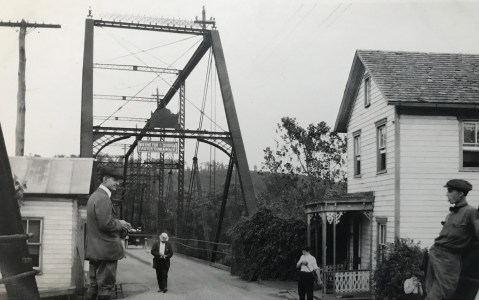
Photo by Lewis Reed
This undated photograph from Lewis Reed’s Collection evokes a sense of nostalgia for slower-paced times. Literally slower: The sign over the bridge entrance reads – “$10 fine for driving faster than a walk” — quite a hit to the money pouch in those days.
Books

Related Resources


Copyright Notice

Reed Brothers Dodge History (1915-2012) by Jeanne Gartner is licensed under a Creative Commons Attribution-NonCommercial 3.0 Unported License.
 Reed Brothers Dodge History 1915 – 2012
Recent Comments