
The Legendary Lake House Hotel of Horror, Then & Now
With Halloween just around the corner, I thought it would be fun to feature a photograph that Lewis Reed took of the Saylorsburg Lake House Hotel, now the site of Hotel of Horror. The aging Lake House Hotel in Saylorsburg, Pennsylvania, once a vibrant Poconos retreat, was a popular hotel for the region’s tourists who were looking for fun on nearby Saylors Lake. During the hotel’s heyday, its staff was booking rooms a year in advance. Today, the former hotel’s fame is generated from its annual Halloween haunted-house attraction.
Lake House Hotel (THEN): The legend of the Lake House Hotel spans more than two-hundred years. According to local folklore, during World War II, many of the employees at the Lake House were called to assist in the Pennsylvania National Guard, leaving the local asylum with one lone security guard to watch over the entire building. The inmates escaped, made their way to the hotel and took it over. The insane patients performed experiments on the guests. What was once a renowned resort for the rich and famous, became a torture chamber.
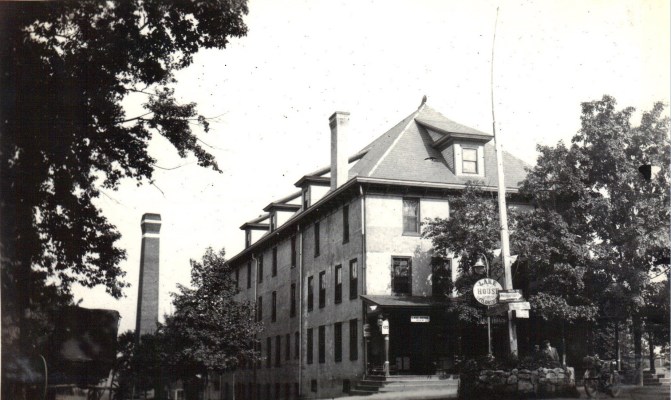
Saylorsburg Lake House Hotel. Photo taken by Lewis Reed, 1915.
Hotel of Horror (NOW): The hotel was purchased in 1990 and turned into an Antique Co-Op, and then in 1992 saw its first haunted house attraction. This 2020 season will celebrate the 28th year that the Hotel of Horror has been fascinating and horrifying legions of fans from the far reaches of the United States and even internationally. To all the readers of this blog: Have a spooky, enjoyable and very safe Halloween!
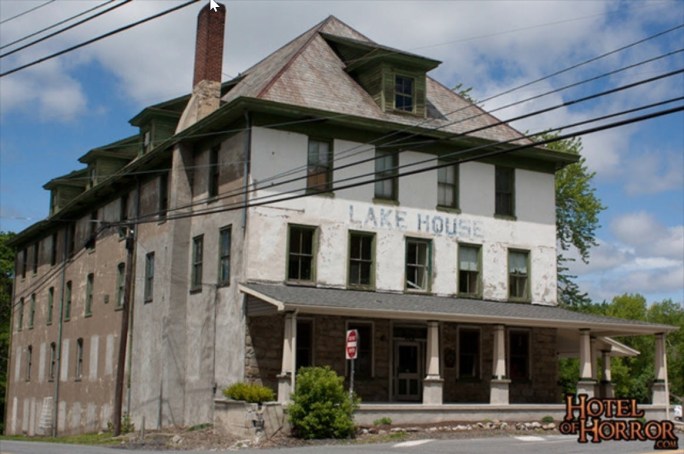
Welcome to The Hotel of Horror, The Pocono Mountains Premier Haunted House Attraction

Thomas Kelley’s Pumpkin Patch, Early 1900s
When the leaves begin to change and the air takes on a chill that means it’s time for one thing – pumpkin picking! This is a rare photograph of three well-dressed men pumpkin picking in Thomas Kelley’s field of pumpkins in Pleasant Hills, circa early 1900s. Tom Kelley farmed much of the land around the Pleasant Hills homestead and was famous for his “Kelley Corn” farm wagon of fresh dairy produce during the summer months, as well as the corn that fed visitors to the Montgomery County Fair each August and, of course, his pumpkin patch in the fall.
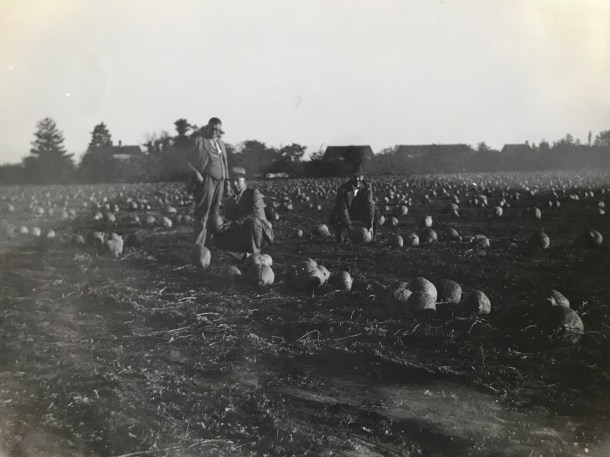
Pumpkin picking in Thomas Kelley’s Pumpkin Patch, Darnestown, Maryland circa. early 1900s. Photo by Lewis Reed
Lewis Reed’s “Sunday Prowlers”
Being of a certain age, going for a “Sunday Drive” was a fixture of life when I was a kid. Not to be confused with driving on Sunday, the Sunday drive meant climbing into the car with your family, for no particular purpose other than to get out of town, take in the scenery, and enjoy the pleasure of moving.
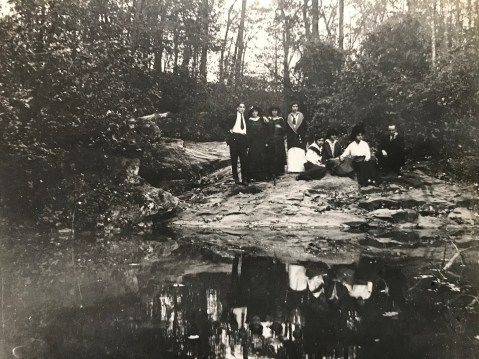
Lewis Reed belonged to a group of Sunday drivers, called the “Sunday Prowlers”. A typical day may have been going to church, coming home for Sunday dinner, spending a little time after the meal on the porch talking or dozing, and then piling into the car for a ride around town or into the country. Back in the day, Lewis Reed always carried his camera to take snapshots along the way. These previously unpublished photographs taken by Lewis Reed capture the lives of traveling companions of a bygone era.

The Sunday Prowlers. Far left, Catherine Reed, unknown, unknown, unknown, Eva Reed, Geneva Reed, unknown. Rear, Bernard Hanshew. Photo by Lewis Reed
While automobile travel offered an escape from everyday existence, motorists’ adventures were not always of the sort that they had sought. Carburetors got out of adjustment, valves burned, gears stripped, clutches fried, and electrical systems succumbed to mysterious ailments. Successful trips often hinged on the ability of drivers and passengers to do roadside repairs. Most problematic of all were tires, which had a useful life of only a couple thousand miles and were prone to go flat at the most inopportune times. Fixing a flat tire entailed wrestling it off the rim, patching the tube, remounting the tire on the rim, and energetically working a hand pump to re-inflate the tire.

The Sunday Prowlers
For all their mechanical shortcomings, early automobiles were usually better than the roads on which they traveled.
From The Baltimore Sun 30 Jul 1922:
Driving a motorcar is better exercise than walking, according to Dr. Royal S. Copeland, Commissioner of Health of New York City… According to the doctor the slight physical effort needed in moving the steering wheel reacts on the muscles of the arms and abdomen… Summing it up. The doctor maintains that the motorcar is a wonderful aid in maintaining health and promoting happiness.
Sunday Prowlers. Lewis Reed far right.
Since now, at least for a while, there isn’t much of anywhere to go, just “going for a drive” doesn’t seem like a such a bad idea.
A Look Back at Montgomery County High School from 110 Years Ago
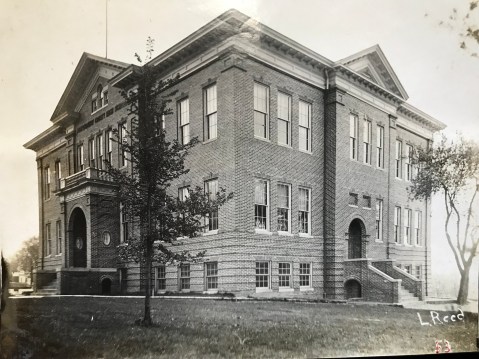
Originally known as Montgomery County High School, later as Rockville High School and Richard Montgomery High School. Located at the corner of Monroe Street and East Montgomery Avenue. Photo by Lewis Reed, 1906.
The tradition of graduation ceremonies, complete with pomp and circumstance, caps and gowns, and awarding diplomas, marks a rite of passage at schools in Montgomery County and at other high schools across the country. Not this year. The coronavirus pandemic has left in its wake widespread cancellations of annual events and ceremonies. This year’s 2020 graduates will be honored in the minds and hearts of loved ones for their achievements, and individual efforts will be made to celebrate the moment, but this year’s graduating seniors won’t be able to participate in the traditional graduation celebrations. In honor of this year’s high school graduates, here is a look back at a collection of photos of graduates from Montgomery County High School that were taken by Lewis Reed in 1910.
A bit of history: Located in the City of Rockville, Richard Montgomery High School is the oldest public high school in Montgomery County. An allocation in 1892 by the then Board of School Commissioners of a $300 addition to the existing elementary school in Rockville brought to fruition the then named “Rockville High School” that served students from grades one to eleven. The first class of twelve seniors graduated in 1897. In 1904, the Board of Education purchased land at the corner of Montgomery Avenue and Monroe Street for the construction of a new school building, to be renamed “Montgomery County High School” at Rockville. Students came to the school by train, trolley, and later by school bus from all corners of the county. In 1935, when the new “Rockville Colored High School” building opened in Lincoln Park, the Board of Education officially renamed the old Rockville High School, “Richard Montgomery High School.”
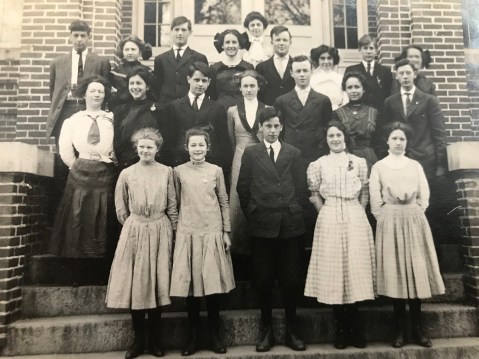
Montgomery County High School class, 1910. Photo by Lewis Reed
Back row: Edward Story, Lena Ricketts, Tom Young, Louise Larcombe, Miss Ford, Fred Hays, Lucius Lamar, name unknown, name unknown.
Middle Row: name unknown, name unknown, Jesse Wathen, Jesse Higgins, name unknown, name unknown, Mary Hyatt, name unknown, name unknown.
Front Row: Maude England, Rebecca Lamar, (first name unknown) Garrett, Helen Pumphrey, (first name unknown) Lehman.
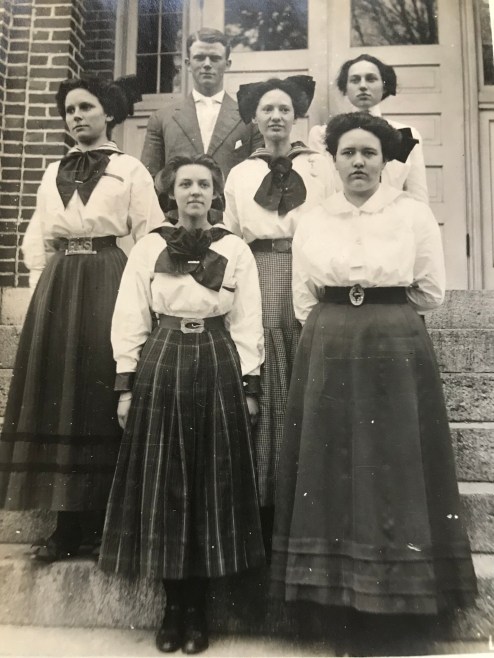
Montgomery County High School, Academic Department, 1910. Photo by Lewis Reed
Back: Harry S. Beall, Katherine Hughes
Middle: names unknown
Front: Edith Prettyman, Virginia Darby
From The Baltimore Sun, Thursday, May 26, 1910 newspaper:
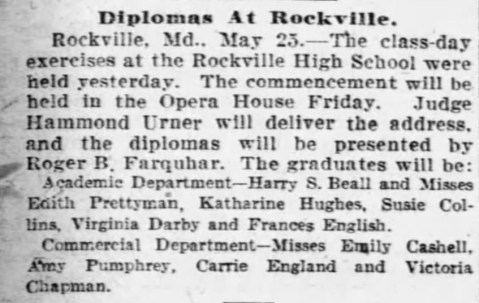
The Baltimore Sun, Thursday, 26 May 1910.
Old Rockville High School’s First Baseball Team
Inter-school athletics in Montgomery County began with a meeting, duly noted in the Sentinel of February 18, 1910, of the principals of the high schools at Rockville, Gaithersburg, Kensington, and Sandy Spring to formulate plans for a baseball league. Within a month, the athletic association of Rockville High School was formed with Roger J. Whiteford, principal, as manager of the baseball team, Edward Story, teacher, as assistant manager, and Jesse Higgins student, as captain.

Rockville High School First Baseball Team, 1910. Photo by Lewis Reed
Front: Billy Beck, Tom Young, Edward Storey, Harry Beall, Roy Warfield.
Back: Otis Hicks, Lucius Lamar, name unknown, name unknown, Jesse Higgins, name unknown, name unknown, Frederick Hays, Roger Whiteford
Holding pennant: Griffith Warfield
Announce Line-Up of High School Team. Special to The Washington Post, Sunday, March 13, 1910:
The line-up of the baseball team that will represent the Montgomery County High School this season has been decided upon, and the team will start the season as follows: Catcher. Harry Beall; Pitcher, Edward Story; First Base; Thomas Young; Second Base, Griffith Warfield; Third Base, Marshall Darby; Shortstop, Jesse Higgins; Left Field, Roland Garrett; Center Field, Frederick Hays; Right Field, Lucius Lamar; and Substitutes: Otis Hicks, Marshall Manion and William Beck.

Montgomery County High School 1910. Photo by Lewis Reed

Montgomery County High School 1910. Photo by Lewis Reed
On May 27, 1910, commencement was held in the Rockville Opera House. The major address of the graduation ceremony was given by Judge Hammond Urner. Then came the presentation of diplomas by Roger B. Farquhar and the seniors marched into the history of Montgomery County High School, as will their 2020 successors, all proud graduates.
Credit to: E. Guy Jewell, “Richard Montgomery High School.” The Montgomery County Story Vol. 24 (1981)
Other sources of information: Newspapers.com and Montgomery History
Reed Photo Collection: Transportation Before Cars
The story of transportation in Montgomery County is the saga of people constantly on the move. The difficulties people faced when they transported themselves or their goods from one place to another during the late 19th and early 20th century are almost impossible for us to comprehend today. Before the invention of trains and automobiles, animal power was the main form of travel. People were continually searching for new and better ways to transport people and goods as dependably and as fast as possible, and they started with the horse.
Many of the problems associated with the automobile today were common to the horse and carriage in the in the early 20th century: traffic jams, parking problems, noise, accidents, pollution. Of these, the most distressing was the last. While the horse emitted no exhaust, it did emit, often dropping excrement into the middle of the road. A typical horse produced more than 30 pounds of dung each day. Furthermore, horse-drawn transportation required constant attention and care, so much that wealthy Americans seldom managed horses themselves and often hired coachmen and grooms as intermediaries. The blacksmith was an important man, running a business like a modern car repair garage.
The following images from Lewis Reed’s collection illustrate various modes of transportation before highways and cars.
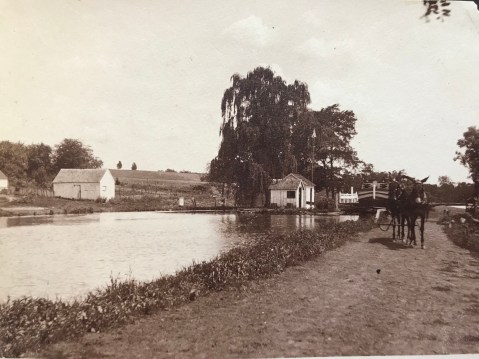
Mule provided power for canal boats traversing the 180 miles between Cumberland and Georgetown, 1914. Photo by Lewis Reed.
During the 19th century, the Chesapeake and Ohio Canal provided transportation for goods between Cumberland and the Chesapeake Bay. Mules were the preferred “engines” of the C&O Canal boat because they were cheaper to purchase than horses and were less prone to illness and injury. Mules adapted very well to life on a canal boat and could pull a 140-ton boat eight hours a day, seven days a week. Mules had both longer life spans and longer work lives than horses and could pull canal boats for twenty years if they were taken care of properly. To get a loaded boat going, the mules would have to walk until the line was taut, then put their weight into it, and step once the boat had moved, and repeat this process. Within 25 feet, the boat would be moving.
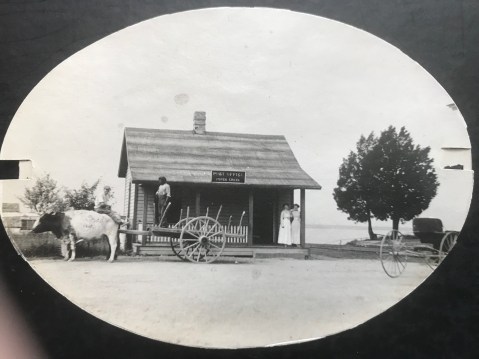
Popes Creek Post Office. Photo by Lewis Reed, ca. 1910
It’s hard to imagine a world without cars, buses, and trucks. But put yourself back in the early 20th century. Before the invention of trains and automobiles, animal power was the main form of travel. Horses, donkeys, and oxen pulled wagons, coaches, and buggies. Early settlers often used oxen to pull their big wagons. Oxen were slower than horses, but they could pull four times as much weight.
In this circa 1910 photograph two men pose with an ox-drawn wagon in front of the little Popes Creek Post Office on the Potomac River. Two elegantly dressed women with hats stand outside on the porch. Note the two-person horse buggy on the right. The Potomac River is visible in the background. The Popes Creek Post Office probably served as a social gathering place for the community.

A pair of yoked oxen pull a wagon in Point of Rocks, Maryland. Edgar Reed, second from left is seated on the railing. Photo by Lewis Reed, 1911.
Everyone’s heard the phrase, “as strong as an ox”. Oxen often were used as draft animals in the early 20th century. They supplied much of the power associated with agriculture and were used to haul heavy loads, plow fields, and for carrying goods. A two-animal team usually can manage several tons. Interesting fact: Oxen cost half as much as horses, required half the feed and could be eaten in an emergency.
Point of Rocks is a far as one can go on Route 28 to escape urbanization and see the way things once were along the rest of the route in Montgomery County.

Two ladies dressed in their Sunday best pose in a Runabout Carriage. Photo by Lewis Reed
The carriage became a precise and very visible marker of mid-century class status. People in society were judged by their mode of travel. Just as today we know the difference in class between a Kia and a Mercedes Benz, people could tell the rank of others by a glance at their horse and carriage. The carriage in this photo was known as a runabout, which was a light, open, horse-drawn vehicle with four large wheels. Similar to a buggy, the runabout was used for informal travel or “running about” on errands.
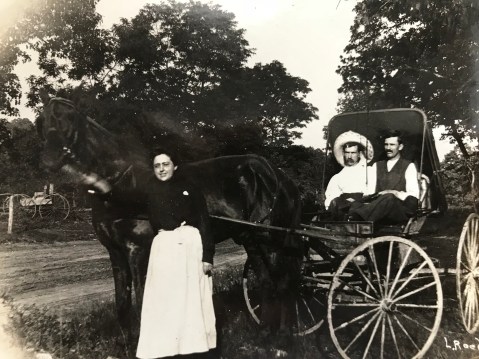
Early 20th century horse and buggy. Photo by Lewis Reed
By the early 20th century, the most popular vehicle in America was the buggy, a light, four-wheel carriage with or without a collapsible top that seated one or two people.
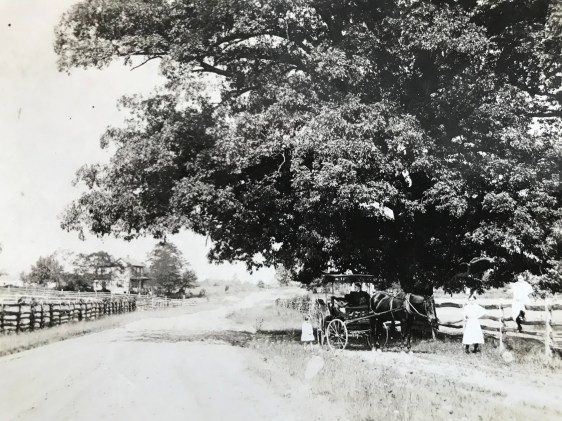
Hunting Hill Road near Rockville, ca. 1911. Photo by Lewis Reed
Buggies traversed rutted dirt roads across the Montgomery County countryside — sometimes their occupants needed a rest in the shade from the jolting motion of the carriage and the pounding heat of the sun.
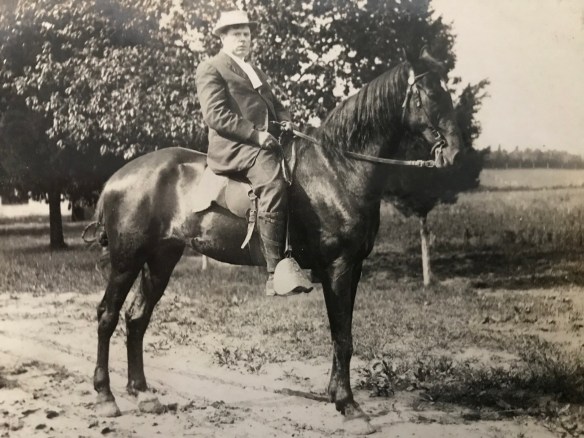
The most direct way to travel by horse was astride. Liveries provided horses for rent, which you could “drop off” at your destination, the way rental car companies work today. Photo by Lewis Reed
Less than a hundred years ago, before machines were invented, the horse was mans great partner.

Why is she wearing a headdress and carrying a rifle? Photo by Lewis Reed

Where in Maryland would that gigantic cactus be growing? Photo by Lewis Reed

Horse-drawn buggies, wagons, and automobiles all share the street and park in all directions in this circa 1914 street view. Trolley tracks are visible at the bottom left. Photo by Lewis Reed
From the late 1890s to the 1920s, carriages and automobiles overlapped on city streets, as shown in the above photo.

Young girl in a 2-wheeled pony cart. Photo by Lewis Reed
Youngsters, especially those born into wealthy families, needed to have experience riding and handling horses from a (sometimes very) early age.
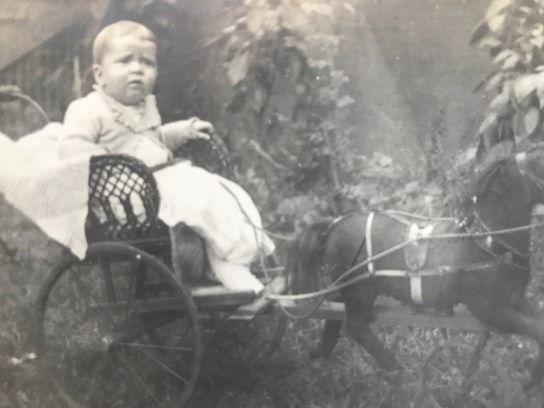
Horse drawn baby carriage. Photo by Lewis Reed
The demise of horse-drawn vehicles began in the late-nineteenth century with the gradual transition to other forms of transportation, particularly motorized streetcars and automobiles. The man most responsible for putting the world on wheels, Henry Ford, had disliked horses since one had dragged him around his farm as a 9-year-old. He exacted revenge with the introduction of his Model T in 1908.
Books

Related Resources


Copyright Notice

Reed Brothers Dodge History (1915-2012) by Jeanne Gartner is licensed under a Creative Commons Attribution-NonCommercial 3.0 Unported License.
 Reed Brothers Dodge History 1915 – 2012
Recent Comments