
Reed Brothers Dodge a Designated “Peerless Place”
Along with St. Mary’s Church (1813), King Farm (1925), Red Brick Courthouse (1891), and the B&O Railroad Station (1873), Reed Brothers Dodge (1915) has been designated as a “Peerless Place” by Rockville’s Historic Preservation organization.
Today, the former location of Reed Brothers Dodge is occupied by the Bainbridge Shady Grove Metro Apartments, and they, like Peerless, remain committed to preserving a part of the city’s automotive heritage by paying homage to a century of history at the new residential complex.
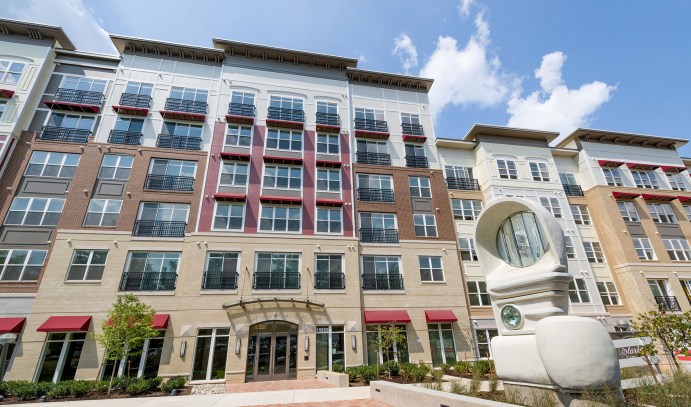
Bainbridge Shady Grove Metro Apartments now stands on the former site of the Reed Brothers Dodge dealership at 15955 Frederick Road. But a sculpture now installed on the property pays tribute to the oldest Dodge dealership in Maryland history. More than 20 feet high, and over 6 feet wide, the public art is inspired by 1939 Dodge headlamps, and the fender of a 1957 Dodge pickup truck.
Peerless Rockville Historic Preservation, Ltd. is an award-winning nonprofit, community-based organization founded in 1974 to preserve buildings, objects, and information important to Rockville’s heritage. Peerless Rockville advances its goals through education, example, advocacy, and community involvement.
Peerless Places have become Rockville’s special places. They provide us all with a flavor and scale that is at once historic, personal, comforting, and viable.
4 Years, 135 Posts & Thank You

Today marks the 4-year anniversary of this blog. It’s been an honor to share the history of Reed Brothers Dodge – whether you’ve read our blog, followed us on Twitter, or “liked” us on Facebook. I would like to thank those mentioned below, and many others, for their kind words and the visibility they have provided.
To help review the past year I thought I’d search around on the Internet and see what others have been saying about us.
Included among the posts on our Facebook page:
“I’m the curator of the Dodge Brothers exhibit at Meadow Brook Hall outside of Detroit…. I’ve been following the great history on your Facebook page and blog for a while”
“Want more information. Please post more!”
Online and in print:
- Norris-Banonis.com Three of Reed Brothers Dodge photographs were featured in the month of May 2015 Norris-Banonis Automotive Wall Calendar which features a 1952 Dodge Coronet. The main part of the calendar features a photograph of Lewis Reed and a small snippet of history.
1915: Lewis Reed opened a Dodge Dealership in Rockville, Maryland. When his brother Edgar returns home from WWI, he gives him 1/3 interest. Eventually, the Reed Brothers will carry Hudson, Oldsmobile, Goodyear Tires, and General Electric Appliances. They will also open the first Gulf brand gasoline station in the area.
At the bottom of the calendar, there is a photo of the 1936 Reed Brothers Dodge canopied Gulf Gas Station and Lewis Reed’s original 1915 Rockville Garage.

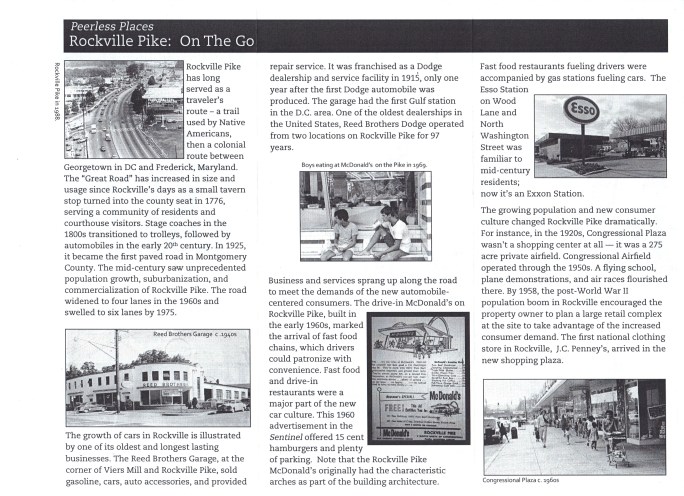
- Peerless Rockville: As a part of Peerless Rockville’s “On the Go: Rockville Pike and Car Culture” lecture series, Peerless Rockville Historian, Dr Teresa Lachin offered a glimpse into the history of Reed Brothers Dodge as one of the City’s oldest and longest lasting automobile businesses.
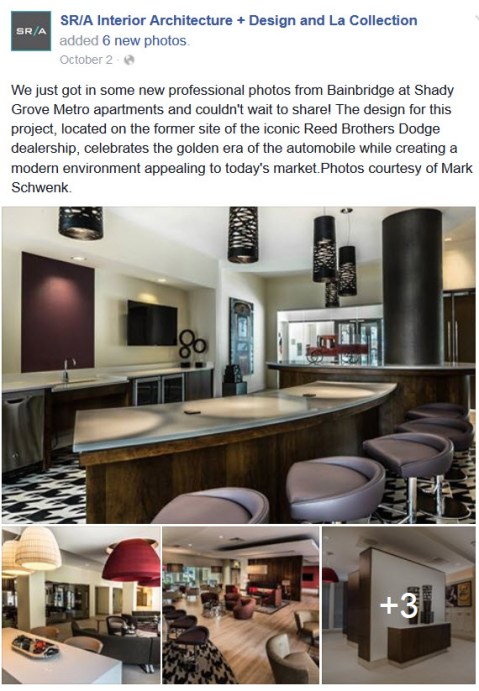
- SR/A Interior Architecture + Design and La Collection: With their reputation for the use of historically referenced materials and detailing, SR/A Interior Architecture and Design of Bethesda embarked on a challenge to pay tribute to a century of history at the Bainbridge Shady Grove Metro Apartments.

- Rockville Nights Blog: http://www.rockvillenights.com/2015/12/sculpture-commemorates-rockvilles.html – posted a blog entitled, “Sculpture commemorates Rockville’s legendary Reed Brothers Dodge (Photos)”

Blog Post Snippet
On National Television!
- History Channel’s American Pickers Hit Reed Brothers Dodge Blog! The television show that’s watched by about 2.7 million people on the History Channel each week found a 1927 photo of Reed Brothers Dodge on our blog and asked permission to use it in one of their episodes. The image was used in Season 7, Episode 34: “Can’t Catch a Break” when Mike and Frank find an old Dodge Brothers sign. Mike explains a bit of the history of the company and he used the photograph during his explanation.

Last, but certainly not least, I would like to thank YOU for stopping by. I appreciate your patronage, whether it be via our blog, Facebook, Twitter, Pinterest or other social media.

Peerless Rockville Newsletter Feature
It was 100 years ago in October 1915, that Lewis Reed signed a franchise agreement with brothers Horace and John Dodge in Detroit. Since then, the business that Lewis Reed founded grew and transformed into Rockville’s oldest family-owned and operated Dodge dealership.
Last October, I was invited to write a feature article for the Winter issue of Peerless Rockville’s Newsletter highlighting the 100th anniversary of Reed Brothers Dodge. Peerless Rockville Historic Preservation, Ltd. is an award-winning nonprofit, community-based organization founded in 1974 to preserve buildings, objects, and information important to Rockville’s heritage. Their official website can be found here.
Pictured below is page 3 of the newsletter of the Peerless Places series highlighting Reed Brothers Dodge. (click image to enlarge)

History of Dodge Logos
Many fascinating and mysterious logos have been used by Dodge throughout the past 100 years. Dodge used different logos depending on the model and vehicle purpose. Trucks, passenger cars and performance vehicles typically held different logos on grills. Below are the most notable emblems used by Dodge since its inception.
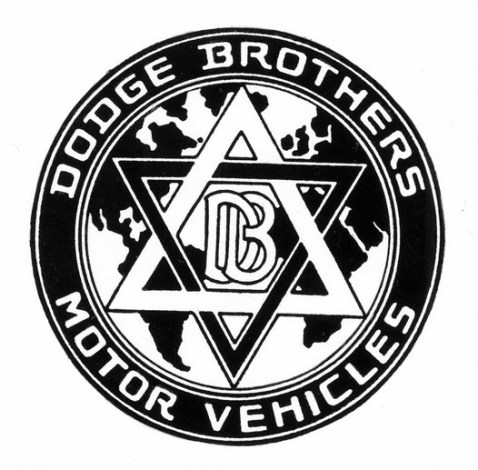
Dodge Brothers logo used from 1914 to 1927
Six-Pointed Star (1914-1938): When the Dodge brothers, Horace and John, built their first automobile in 1914, their final touch was a small enamel badge on the radiator with their company logo: a circle with two interlocking triangles forming a six-pointed star in the middle; an interlocked “DB” was at the center of the star, and the words “Dodge Brothers Motor Vehicles” encircled the outside edge. Although similar to the Star of David, the Dodge brothers were not Jewish. Although the “Brothers” was dropped from the name for trucks in 1929 and cars in 1930, the DB star remained in the cars until the 1939 models were introduced.
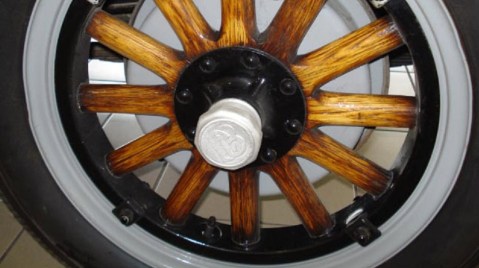
From 1928 Dodge Brothers Standard Six (intertwined “D” and “B”). Photo by Reed Brothers Dodge
 Ram: For 1932, Dodge cars adopted a leaping ram as the car’s hood ornament. Starting with the 1940 models the leaping ram became more streamlined and by 1951 only the head, complete with curving horns, remained. The 1954 model cars were the last to use the ram’s head before the rebirth in the 1980s. Dodge trucks adopted the ram as the hood ornament for the 1940 model year with the 1950 models as the last.
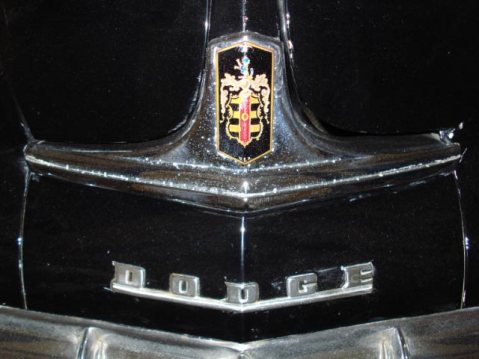
The hood of this 1946 Dodge Deluxe Fluid Drive Sedan is stamped with the Dodge coat of arms and “DODGE”. Photo by Reed Brothers Dodge
Crest: For 1941, Dodge introduced a crest, supposedly the Dodge family crest. The design had four horizontal bars broken in the middle by one vertical bar with an “O” in the center. A knight’s head appeared at the top of the emblem. Although the head would be dropped for 1955, the emblem would survive through 1957 and reappear on the 1976 Aspen. The crest would be used through to 1981 on its second time around, being replaced by the Pentastar for 1982. The knight’s head without the crest would be used for 1959.
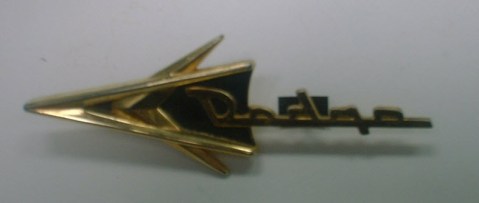
Forward Look
Forward Look (1955-1962): After the Dodge family crest was used between 1941-1957, Virgil Exner designed Dodge’s “Forward Look” logo: two overlapping boomerang shapes that suggested progress and forward motion. The design was heavily influenced by developing rocket propulsion technology and was named after the redesign campaign being used on the Chrysler Corporation’s vehicles.
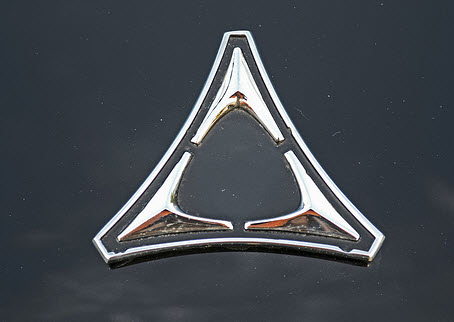
Fratzog
Fratzog (1962–1981): From 1962 to 1981, the Dodge emblem had a colorful internal label: It was called a fratzog. If you’re wondering what that word means (it sounds German, doesn’t it?), it’s totally meaningless. Three arrow shapes pointed inward to form a three-sided star. Not knowing what else to call the imaginative design, a Dodge designer made up the whimsical name.

Red Dodge Pentastar
Pentastar (1982-1992): For a decade, Dodge adopted Chrysler’s Pentastar logo on its vehicles, which had been used for corporate identification since 1962. To differentiate itself, Dodge’s Pentastar was red, while Chrysler-Plymouth’s was blue.
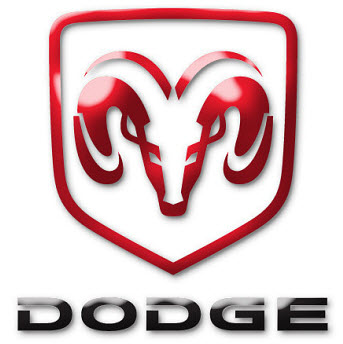
The Ram logo, used 1993–2010
Ram’s head (1993–2010): Dodge reintroduced the ram’s head hood ornament on the new 1973 Dodge Bighorn heavy duty tractor units. Gradually the ram’s head began appearing on the pickup trucks as Dodge began to refer to their trucks as Ram. The present iteration of the Ram’s-head logo appeared in 1993, standardizing on that logo in 1996 for all vehicles except the Viper, which uses the Viper’s Head.
 New Dodge logo (2010): When Ram Trucks was relaunched as its own brand in 2009 and used Dodge’s logo, Dodge was forced to replace its own. The present Dodge logo features several shades of silver and red colors. The Dodge inscription is all silver, but has a light hue at the top and dark, or rather grey, at the bottom. It stands for grandeur, dignity and sophistication. The two inclined stripes at the right side of the logo are painted red to symbolize passion and excitement, associated with the company’s vehicles. The new logo was unveiled in late May 2010.
Sources: Cartype, Wikipedia, Allpar, Dodge Brothers Club
November 14, 1914: The First Dodge Car

Horace Dodge (left rear) and John Dodge (right rear) in “Old Betsy” in front of John Dodge’s Boston Boulevard home, 14 November 1914.
One hundred and one years ago on this date –November 14, 1914 — the very first Dodge car, “Old Betsy”, rolled off the assembly line. On that day, the Dodge Brothers (Horace and John) were photographed riding in the rear seat of the first car to bear their last name. It cost $785, had a 110-inch wheelbase, and was powered by an L-head 4-cylinder engine that proved so reliable it was continued until 1920 with very little modification. Total production for 1914 was a mere 249 touring cars. The following year. Dodge offered a two-passenger roadster which also sold for $785 and the plant went into full production.
According to “The Dodge Brothers: The Men, the Motor Cars, and the Legacy” by Charles K. Hyde, here’s the full story:
The widely accepted history of the initial production of early Dodge Brothers automobiles in November 1914 is at odds with much of the evidence about the earliest Dodge Brothers cars. Automotive historians have thought that the first production car, later named “Old Betsy,” came off the assembly line at the Hamtramck factory on 14 November 1914. Guy Ameel, superintendent of final assembly for Dodge Brothers since the start of automobile production, served as John and Horace’s chauffeur that day. With the brothers in the back seat, Ameel stopped the first Dodge Brothers car in front of John Dodge’s mansion on Boston Boulevard in Detroit and a photographer recorded this important moment.
“Old Betsy” was more likely an experimental prototype car assembled several months before 14 November 1914 and not a production car at all…
The Dodge Brothers began an aggressive advertising campaign to promote their new automobiles and to attract potential dealers to sell their cars. Few people jumped onto the Dodge Brothers bandwagon earlier than Lewis Reed, and not many have lasted longer. Lewis Reed was an enterprising young man who put his future in the fledgling automobile industry. In 1915 he received his franchise to sell Dodge Brothers Motor Cars from John and Horace Dodge; less than one year after “Old Betsy” rolled off the assembly line. Lewis Reed and his brother Edgar, were the first to sell Dodge cars in Montgomery County, Maryland. That made Reed Brothers the oldest Dodge dealership under the same family ownership in Maryland, and one of the oldest in the entire nation.
The Beginning of Dodge | Chrysler Historical Video
Source: “The Dodge Brothers: The Men, the Motor Cars, and the Legacy“
Books

Related Resources


Copyright Notice

Reed Brothers Dodge History (1915-2012) by Jeanne Gartner is licensed under a Creative Commons Attribution-NonCommercial 3.0 Unported License.
 Reed Brothers Dodge History 1915 – 2012
Recent Comments