
The First Dodge Car
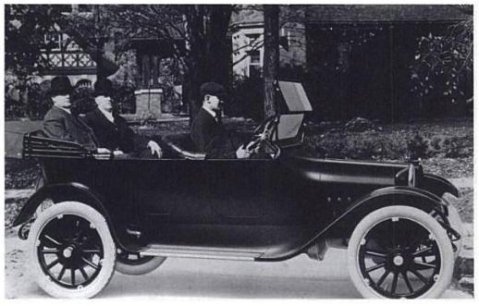
Horace Dodge (left rear) and John Dodge (right rear) in “Old Betsy” in front of John Dodge’s Boston Boulevard home, 14 November 1914.
One hundred and three years ago on this date – November 14, 1914 — the very first Dodge car, “Old Betsy”, rolled off the assembly line. On that day, the Dodge Brothers (Horace and John) were photographed riding in the rear seat of the first car to bear their last name. It cost $785, had a 110-inch wheelbase, and was powered by an L-head 4-cylinder engine that proved so reliable it was continued until 1920 with very little modification. Total production for 1914 was a mere 249 touring cars. The following year, Dodge offered a two-passenger roadster which also sold for $785 and the plant went into full production.
According to “The Dodge Brothers: The Men, the Motor Cars, and the Legacy” by Charles K. Hyde, here’s the full story:
The widely accepted history of the initial production of early Dodge Brothers automobiles in November 1914 is at odds with much of the evidence about the earliest Dodge Brothers cars. Automotive historians have thought that the first production car, later named “Old Betsy,” came off the assembly line at the Hamtramck factory on 14 November 1914. Guy Ameel, superintendent of final assembly for Dodge Brothers since the start of automobile production, served as John and Horace’s chauffeur that day. With the brothers in the back seat, Ameel stopped the first Dodge Brothers car in front of John Dodge’s mansion on Boston Boulevard in Detroit and a photographer recorded this important moment.
“Old Betsy” was more likely an experimental prototype car assembled several months before 14 November 1914 and not a production car at all…
The Dodge Brothers began an aggressive advertising campaign to promote their new automobiles and to attract potential dealers to sell their cars. Lewis Reed was an enterprising young man who put his future in the fledgling automobile industry. In 1915 he received his franchise to sell Dodge Brothers Motor Cars from John and Horace Dodge; less than one year after “Old Betsy” rolled off the assembly line. Lewis Reed and his brother Edgar, were the first to sell Dodge cars in Montgomery County, Maryland. That made Reed Brothers the oldest Dodge dealership under the same family ownership in Maryland, and one of the oldest in the entire nation.
Dodge Made a Car Just for Women
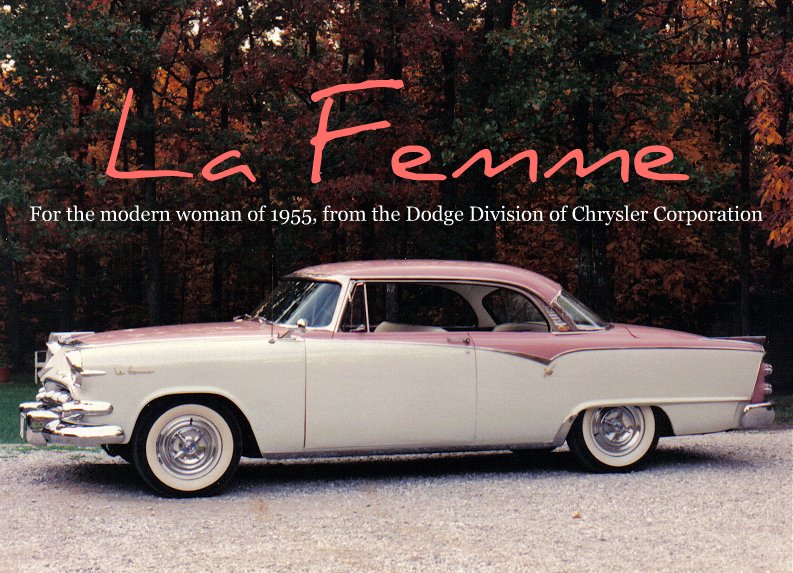 The Dodge La Femme stemmed from Chrysler’s marketing department’s observation that more and more women were taking an interest in automobiles during the 1950s, and that women’s opinions on which color car to buy was becoming part of the decision making process for couples buying an automobile. The La Femme was an attempt to gain a foothold in the women’s automobile market.
Dodge introduced the new La Femme option package in 1955: For $143, you could have the Custom Royal Lancer feminized, with rose paint, gold script, and a nauseating shade of Pepto-pink interior complete with rosebuds.
The accessories which came with the car as standard equipment were where things started getting weird. The car came with a calfskin purse in the same shade of pink as the car’s interior. There was a special compartment behind the passenger seat for this purse, where it could sit with the buckle facing outward. This buckle was large enough for owners to have their name engraved on them, and this is what they were encouraged to do. Inside the purse there was a makeup compact filled with pale pink powder, a lipstick holder, a gold-toned cigarette lighter and case, an imitation tortoiseshell comb, a cigarette lighter, a vanity mirror and silk change purse.
These accessories were all finished in gold-color metal and (you guessed it) pink. For those who wanted them, Dodge also offered an umbrella, boots, a cape (seriously?) and a hat, all matching the seat upholstery.
It went nowhere. La Femme became La Flop. Women stayed away in droves and men weren’t about to be seen driving around in the darling Rosebud. The Dodge La Femme was sold for two years in the U.S. — 1955 and 1956
(Line from a long-lost episode of “Leave it To Beaver”)
“Gee Wally…. all the guys are callin’ me a sissy…. a pink and white car and it says La Femme on the side …. I just can’t be driven to school in mom’s new car anymore …. Yeah, Beave …. I know what ya mean …. that’s why I ride with Eddie …. and besides, mom’s not all that thrilled with the car either!”
Info Source: Dodge La Femme Wikipedia
Plymouth Automobile First Introduced July 7, 1928
The logo featured a rear view of the ship Mayflower which landed at Plymouth Rock. However, the Plymouth brand name came from Plymouth Binder Twine, chosen by Joe Frazer (a 20th-century American automobile company executive employed in succession by Chrysler, Willys-Overland, Graham-Paige and Kaiser-Frazer Corporation).
The first Plymouth automobile debuted on July 7, 1928, to help Chrysler Corporation compete with Chevrolet and Ford in the entry-level market. The name was inspired by Plymouth Rock and the first Pilgrim colony in the United States, and the Mayflower ship was stamped on the radiator.
In 1928, Walter P. Chrysler took over after Horace and John Dodge died and Lewis Reed became an original member of the Chrysler family.
Plymouth went on to become Chrysler’s top-selling brand from 1930 to 1978.
Some notable Plymouths:
• Barracuda: The muscle car had a decadelong run from 1964 to 1974, though the last generation, 1970-74, is considered the true Mustang and Camaro competitor and remains a popular collector car today.
• Road Runner: Dubbed Plymouth’s “muscle car icon” by FCA, the Road Runner was introduced in 1968. It was based on the Plymouth Belvedere. Plymouth paid Warner Brothers $50,000 for the rights to use the Road Runner and Coyote characters throughout the car’s run, according to Ateupwithmotor.com. Chrysler’s engineering department modified the car’s horn to sound like the cartoon bird’s “beep-beep” as well.
• Superbird: Created to entice stock car racing’s Richard Petty back to Plymouth for NASCAR, the Superbird was a modified Road Runner hardtop with an iconic large wing and nose for aerodynamics.
• Voyager: Plymouth was also at center stage when Chrysler CEO Lee Iacocca introduced a new product in November 1983: front-wheel-drive minivans in the form of the Plymouth Voyager and Dodge Caravan.
Plymouth went defunct at the end of the 1999 model year in Canada and consequently, DaimlerChrysler decided to drop the make after a limited run of 2001 models. This was announced on November 3, 1999. Plymouths were sold at Reed Brothers until 1969, when the Plymouth brand was given to the Chrysler dealers.
Plymouth production ended on June 28, 2001, when the last car, a silver Neon, rolled off the line at a plant in Belvidere, Illinois.
Anyone grow up with a Plymouth in their driveway?
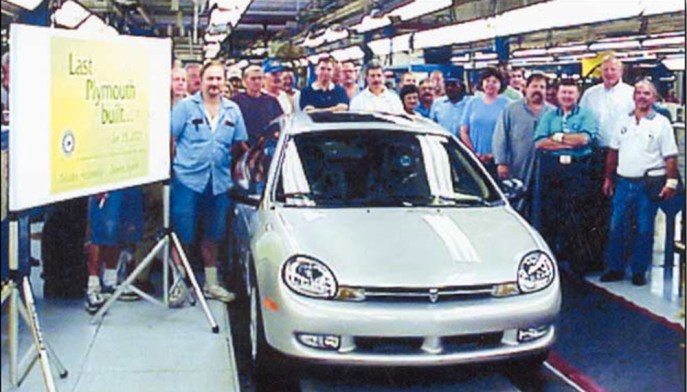
The last Plymouth Neon — and the last Plymouth — was built on June 28, 2001.
Reed Brothers Becomes an Original Member of Chrysler
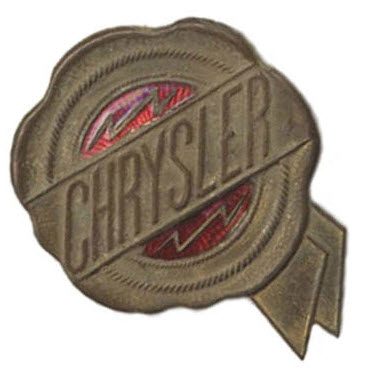
1930s Chrysler radiator “ribbon” emblem
May 28, 1928 marks an important milestone in the history of Chrysler. It was on this day in 1928 that Dodge Brothers, Horace and John Dodge, became a part of Chrysler. It was on this same date that Lewis Reed, founder of Reed Brothers Dodge in Rockville, Maryland also became an original member of the Chrysler family.
During 1920, the Dodge Brothers company lost its founding fathers. John Dodge died in January, and his younger brother Horace succumbed the following December. A New York investment banking firm paid the brothers’ widows, in a single cash payment, $146 million for the Dodge Brothers firm. Within three years, the bankers initiated negotiations, and on May 28, 1928, Walter P. Chrysler purchased Dodge Brothers, Inc. for $170 million, making it, at the time, the largest business transaction in history. When the transaction was complete, the Chrysler Corporation had grown five-fold overnight to become the third of Detroit’s “Big Three” automakers.
The first Plymouth was built in 1928 and Plymouths were sold at Reed Brothers until 1969, when the Plymouth brand was given to the Chrysler dealers.
Vintage Car Stuffing?
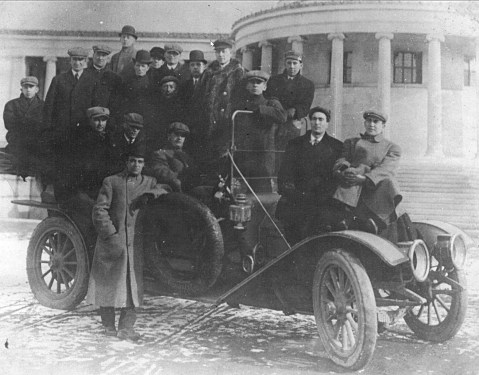
Photo by Lewis Reed
Ever want to see how sausage is made? Well, okay – maybe not… but this interesting photo taken by Lewis Reed some 100 plus years ago allows you to see how 18 men managed to cram themselves into a 1910-1911 Pierce Arrow Model 48 7-Passenger Touring. Pierce-Arrow Motor Car Company in Buffalo, New York, produced some of the finest automobiles made and was one of the most popular high-quality cars of the time.
Unfortunately, no other details about the photograph or the location is known, though the architecture looks like textbook Washington, D.C. neoclassical. If anyone can identify the building in the background, please leave me a comment.
Books

Related Resources


Copyright Notice

Reed Brothers Dodge History (1915-2012) by Jeanne Gartner is licensed under a Creative Commons Attribution-NonCommercial 3.0 Unported License.
 Reed Brothers Dodge History 1915 – 2012
Recent Comments