
Senate Resolution No. 10: A Historic Tribute to Lewis Reed and Reed Brothers Dodge
On February 8, 1967, the Senate of Maryland adopted Senate Resolution No. 10 to honor the life and legacy of Lewis Reed, founder of Reed Brothers Dodge, following his passing at the age of 79. This single-page resolution, recorded in the official proceedings of the Senate, recognized not only his long career in the automobile business, but also his broader contributions to the civic and economic life of Montgomery County.
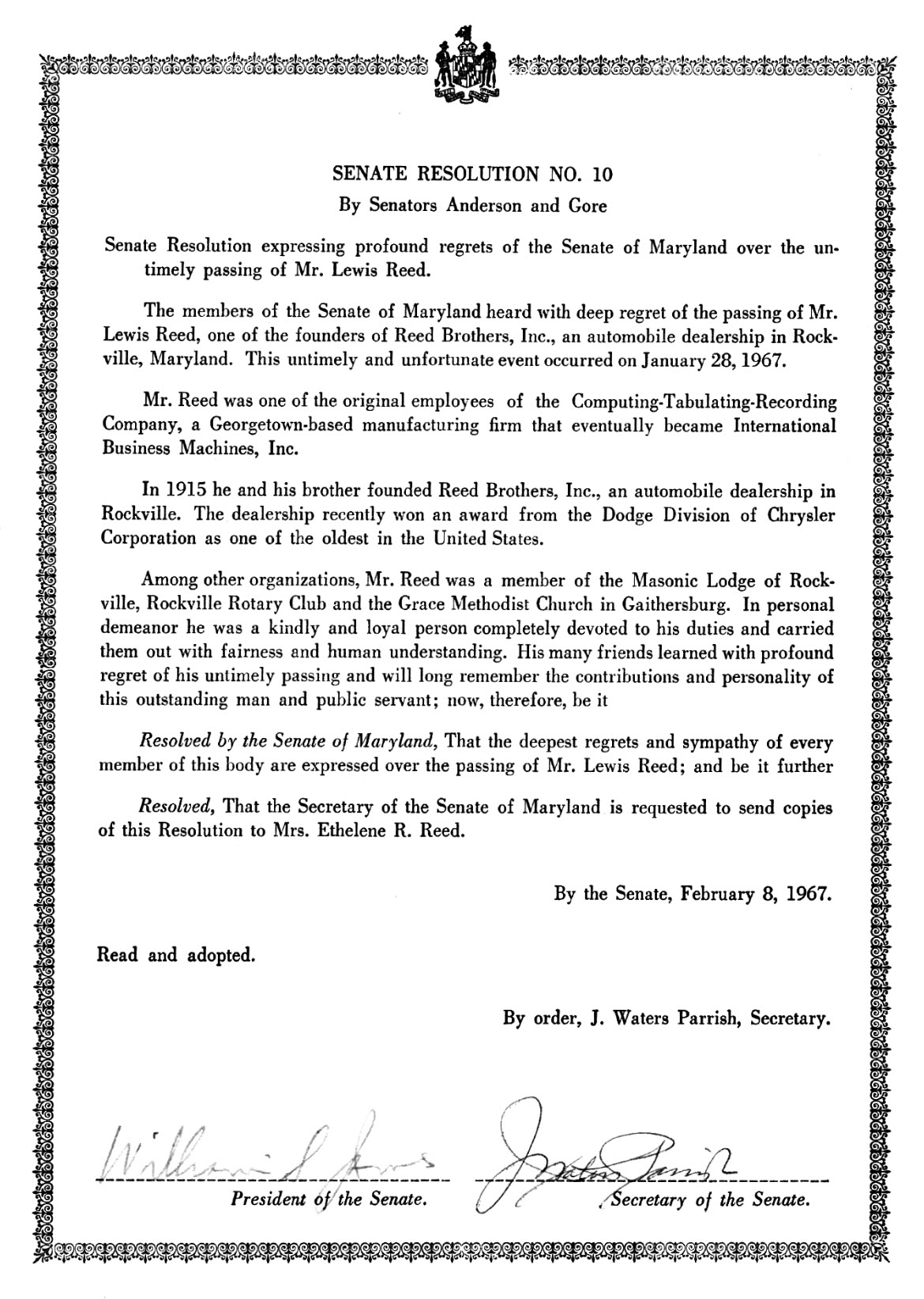
Senate Resolution No. 10, adopted by the Senate of Maryland on February 8, 1967, honoring the life and achievements of Lewis Reed, founder of Reed Brothers Dodge.
Lewis Reed’s story begins in October 1915, when he opened a new automobile agency in Rockville and chose to represent the then-young Dodge Brothers Motor Car Company. At that moment, Dodge had been producing automobiles for less than a year, yet Reed saw its potential and became the first Dodge dealer in Montgomery County and the earliest in the state of Maryland. This pioneering decision anchored a business that would endure for generations, evolving from the era of dirt roads and hand-cranked engines into the age of modern highways and high-compression engines.
Over the next five decades, Reed Brothers Dodge weathered profound change: two world wars, the Great Depression, postwar expansion, and the transformation of Rockville from a small town into a busy suburban center. Through these shifts, the dealership gained a reputation for fair dealing, continuity of family ownership, and steadfast adherence to the Dodge ideal of “𝘋𝘦𝘱𝘦𝘯𝘥𝘢𝘣𝘪𝘭𝘪𝘵𝘺.” Customers often returned across decades and generations, treating Reed Brothers as a trusted local institution rather than just a place to buy and service automobiles.
Yet Lewis Reed’s influence extended beyond the showroom floor. He was also one of Montgomery County’s earliest and most devoted photographers, documenting streetscapes, parades, farms, people, and everyday scenes that might otherwise have vanished without a trace. His images, many taken in and around Rockville, now serve as a visual time capsule, preserving a detailed record of the county’s transformation across the first half of the 20th century. In recognizing Lewis Reed, the Senate was, in effect, honoring both a businessman and an unofficial historian of the community.
Senate Resolution No. 10 is significant because it places Lewis Reed and Reed Brothers Dodge within the formal historical record of the State of Maryland. It acknowledges that a local automobile dealer, by virtue of long service, integrity, and civic commitment, could shape the character and memory of a place just as surely as a public official or institution. For those interested in local history, early motoring, or the story of Rockville’s growth, the resolution provides a brief but powerful summation of why Lewis Reed’s name still matters. He remains the only automobile dealer in Maryland to receive such recognition by a Senate resolution.
Spring of ’40: When Reed Brothers Turned Easter into an Auto Show
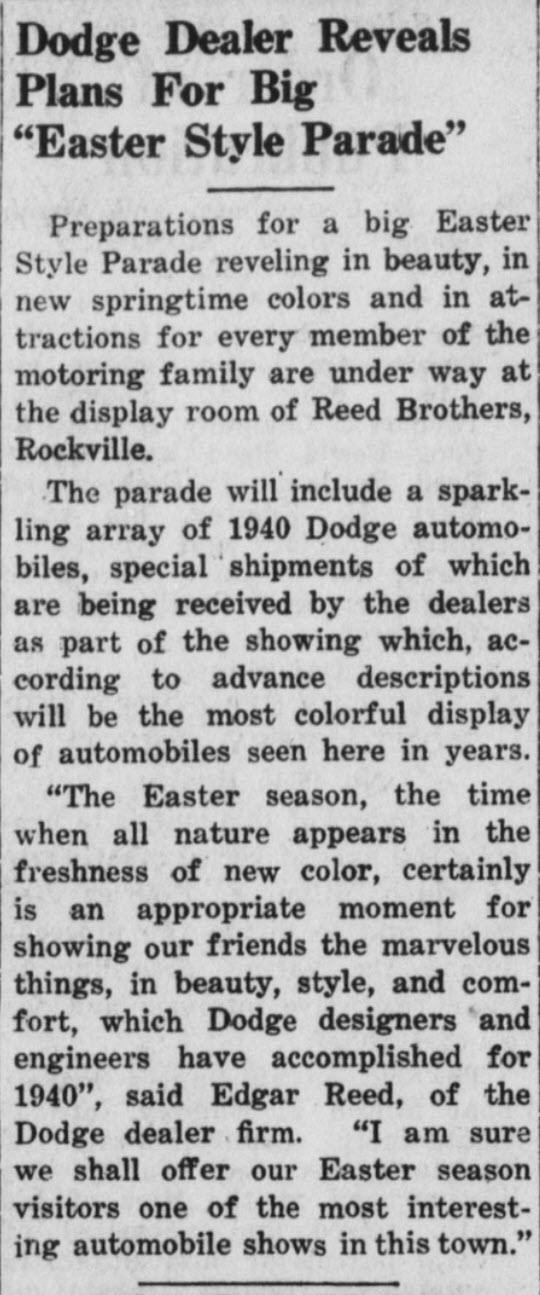
Montgomery County Sentinel, March 21, 1940
In March of 1940, as winter gave way to spring in Rockville, Maryland, Reed Brothers Dodge was preparing something far more ambitious than a typical seasonal promotion. According to The Montgomery County Sentinel, the dealership announced plans for a full-fledged “Easter Style Parade”; a vibrant showcase designed to celebrate both the arrival of spring and the latest in automotive design.
This was not a parade in the traditional sense, but rather an immersive showroom experience. Reed Brothers promised a “sparkling array” of brand-new 1940 Dodge automobiles, many arriving as part of special factory shipments. These cars, finished in fresh springtime colors and featuring the latest styling updates, were meant to dazzle visitors and highlight the evolution of the American automobile at the start of a new decade.
The language of the advertisement reflects an era when automobiles were marketed not just as transportation, but as expressions of beauty, comfort, and modern living. The display was crafted for the entire “motoring family,” underscoring how central the car had become to everyday life by 1940. Visiting a dealership was an event; something to experience, not just a transaction.
Edgar Reed himself captured the spirit of the occasion, noting:
I am sure we shall offer our Easter season visitors one of the most interesting automobile shows in this town.
Events like this helped define Reed Brothers Dodge as more than just a place to buy a car; they were a cornerstone of the Rockville community. Their showroom became a gathering place where residents could see the latest innovations, socialize, and share in the excitement of a rapidly changing world.
Looking back, this Easter promotion offers a fascinating snapshot of small-town America at a pivotal moment in history. The country was emerging from the Great Depression, industry was gaining momentum, and the automobile stood at the center of that progress. Yet within a year, the United States would be drawn into World War II, and the production of civilian automobiles would soon give way to the demands of the war effort.
That makes this 1940 “Easter Style Parade” all the more meaningful. It represents a brief window of optimism and growth; a time when the promise of new technology, fresh design, and a bright spring season could bring an entire community together under one roof.
Today, more than eight decades later, the story of Reed Brothers Dodge continues to resonate. This single advertisement is more than a promotion, it documents how a local dealership engaged its community, how automobiles were presented to the public, and how seasonal traditions were woven into the commercial life of a small but growing town.
Wishing all our readers and visitors to this blog a very Happy Easter!
Then & Now: The Leesburg, VA Passenger Station
The story of the Leesburg Passenger Station becomes even more vivid when viewed through the lens of Lewis Reed, the prolific early 20th-century photographer from Montgomery County, Maryland, whose work documented key moments and locations throughout the region. Reed’s images are renowned for their ability to capture everyday details of local life, including transportation scenes and important sites in Virginia and the greater Washington area.
Leesburg Passenger Station (THEN): When the Alexandria, Loudoun, & Hampshire Railroad (later W&OD) arrived on May 17, 1860, Leesburg realized a dream. A local newspaper praised the railroad, which “throws us within an hour or two’s ride of the cities of the seaboard, and opens up a new avenue of commerce and trade.” At first a single depot, located 0.2 mile east of here, served passengers and freight. In 1887 the railroad opened a separate passenger station here at King Street. It remained in use until passenger service ended in 1951.
Even as the passenger station itself vanished, Reed’s visual archives ensure its memory stays alive. His photographs remain a valuable bridge for comparing “then & now,” letting viewers step back in time and appreciate the evolution of Leesburg, one carefully developed print at a time. The continuing presence of Reed’s work in books and exhibits means the Leesburg Passenger Station is still seen and experienced today, long after trains have passed and the site has become part of the Washington & Old Dominion Trail.
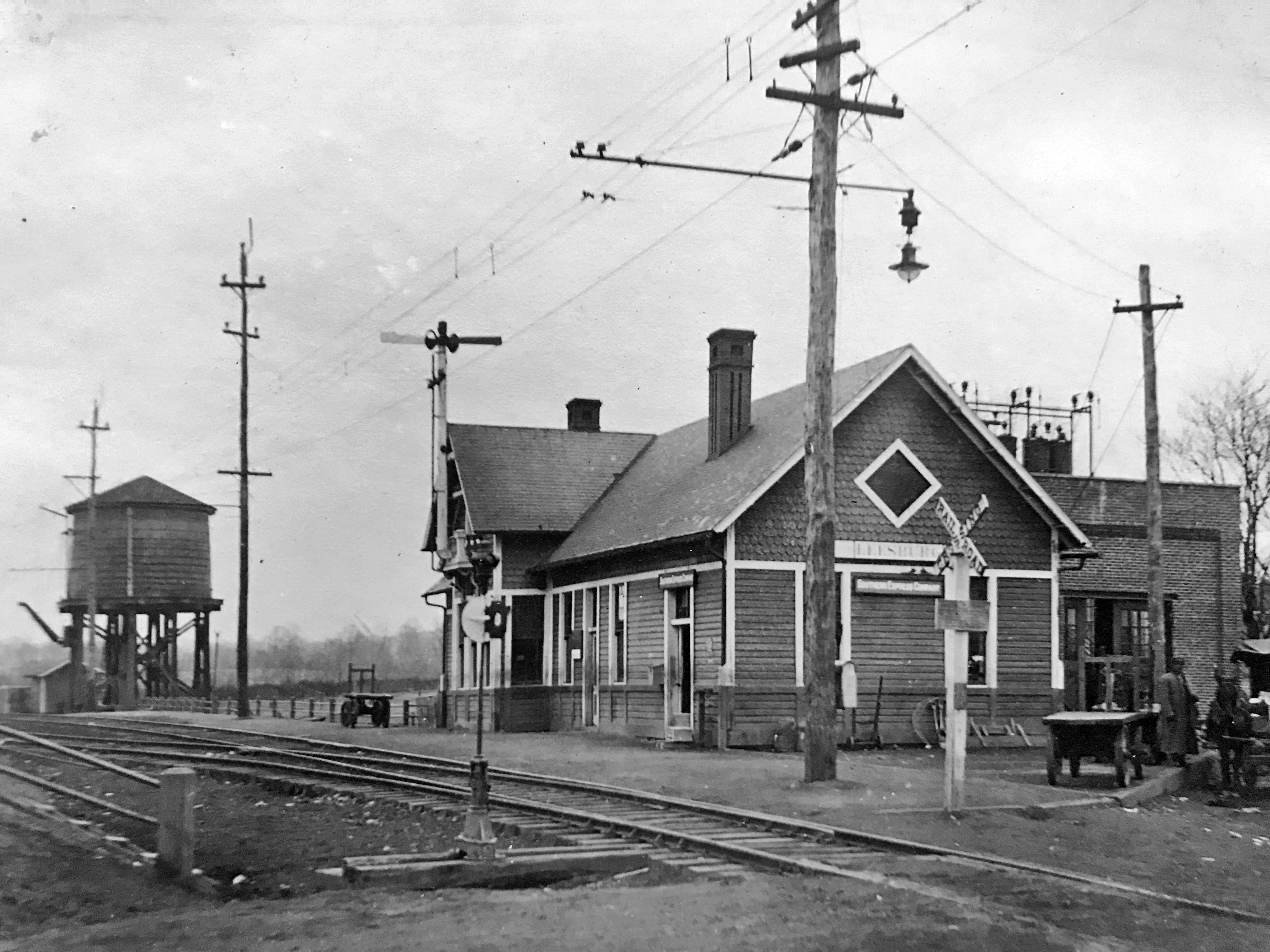
A historic photograph of the Leesburg Passenger Station captured by Lewis Reed showing the depot in its early 20th-century setting.
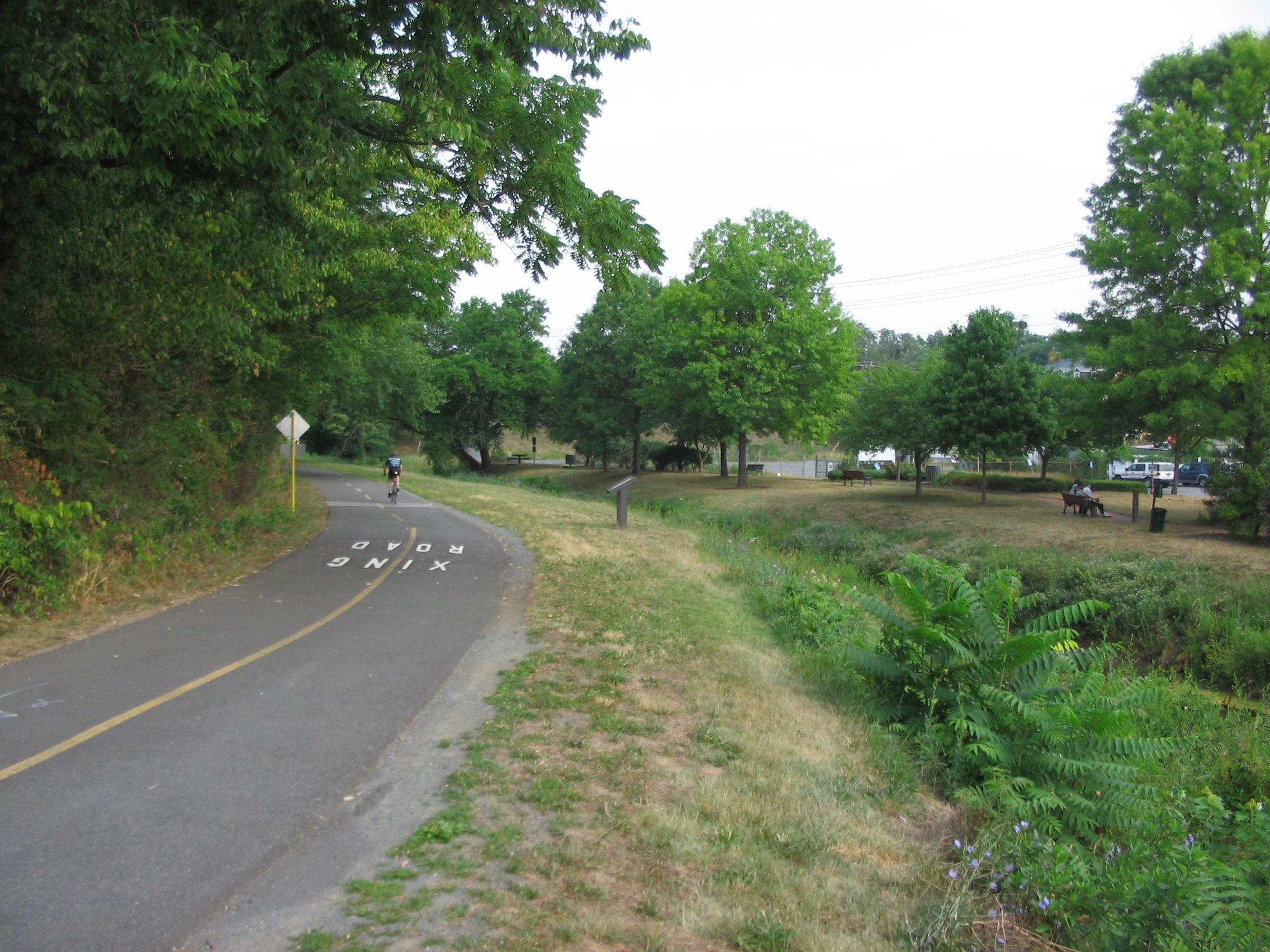
Leesburg Passenger Station Marker seen from King Street today.
The Leesburg Passenger Station remains a rare survivor of Loudoun’s rail era, an enduring symbol of how a small wooden depot could once shape the rhythm of a town. Its transformation from active rail stop to preserved trail-side icon connects past and present, reminding us that even as technology changes, the places that ground a community can still hold meaning.
Introducing the Second Edition of The Lewis Reed Photograph Collection (1898-1960)
Some photographs simply capture a moment. Others capture an entire world.

New Cover – Second Edition. An expanded 384-page volume featuring more than 2,500 historic photographs preserved by Lewis Reed, many published for the first time. A remarkable visual record of the early 20th century.
I am pleased to announce the release of the Second Edition of the Lewis Reed Photograph Collection (1898–1960), an expanded and refined visual archive documenting over six decades of life, landscape, and community in Montgomery County, Maryland and the surrounding Mid-Atlantic region.
More than a century ago, Lewis Reed began photographing the towns, farms, roads, and people around him with a camera and a deep curiosity about a world in rapid transition. What began as the hobby of a young motorcycle enthusiast traveling the back roads of Maryland soon grew into one of the most remarkable visual records of the region’s history.
Many of the photographs in this collection were created from glass-plate negatives and early prints; preserving rural crossroads, bustling town centers, early automobiles sharing roads with horse-drawn wagons, and landscapes that look entirely different today. These are images that might otherwise have been lost to time.
What’s New in the Second Edition
This expanded edition presents Lewis Reed’s photographs in thematic sections that highlight the full breadth of his work; from Maryland towns and landscapes to family portraits, travel scenes, and the early history of Reed Brothers Dodge, which Lewis founded in Rockville in 1915. The collection draws from more than 2,500 digitized photographs, each carefully researched to identify the places and people they depict.
Many images were identified through long conversations with Lewis Reed’s daughter, Mary Jane Reed Gartner, whose recollections helped bring these photographs back to life and restore the stories behind them.
Lewis Reed is remembered locally as the founder of Reed Brothers Dodge, but photography was a lifelong passion alongside his business career. His images document everything from the C&O Canal in operation to small-town parades, churches, farms, and early roadways. Taken together, they form one of the most extensive visual archives of Montgomery County during the period when rural communities were giving way to the modern suburban landscape we know today.
A Note on Pricing
This is a photo-intensive volume, approaching four hundred pages, and is printed on demand through Blurb.com, meaning each copy is produced individually rather than in large commercial print runs. The pricing reflects the actual cost of producing such a large photographic archive. This project was created primarily to preserve and share Lewis Reed’s historic photographs, not as a commercial publication.
Get Your Copy
The Lewis Reed Photograph Collection (1898–1960), Second Edition is available now through Blurb.com’s print-on-demand bookstore.
Or visit the collection page for more information: reedbrothersdodgehistory.com
To stay up to date with new posts and historical discoveries, subscribe to the Reed Brothers Dodge History blog and follow along as the story of Lewis Reed and Montgomery County’s past continues to unfold.
A Field, a Gun, and a Trap
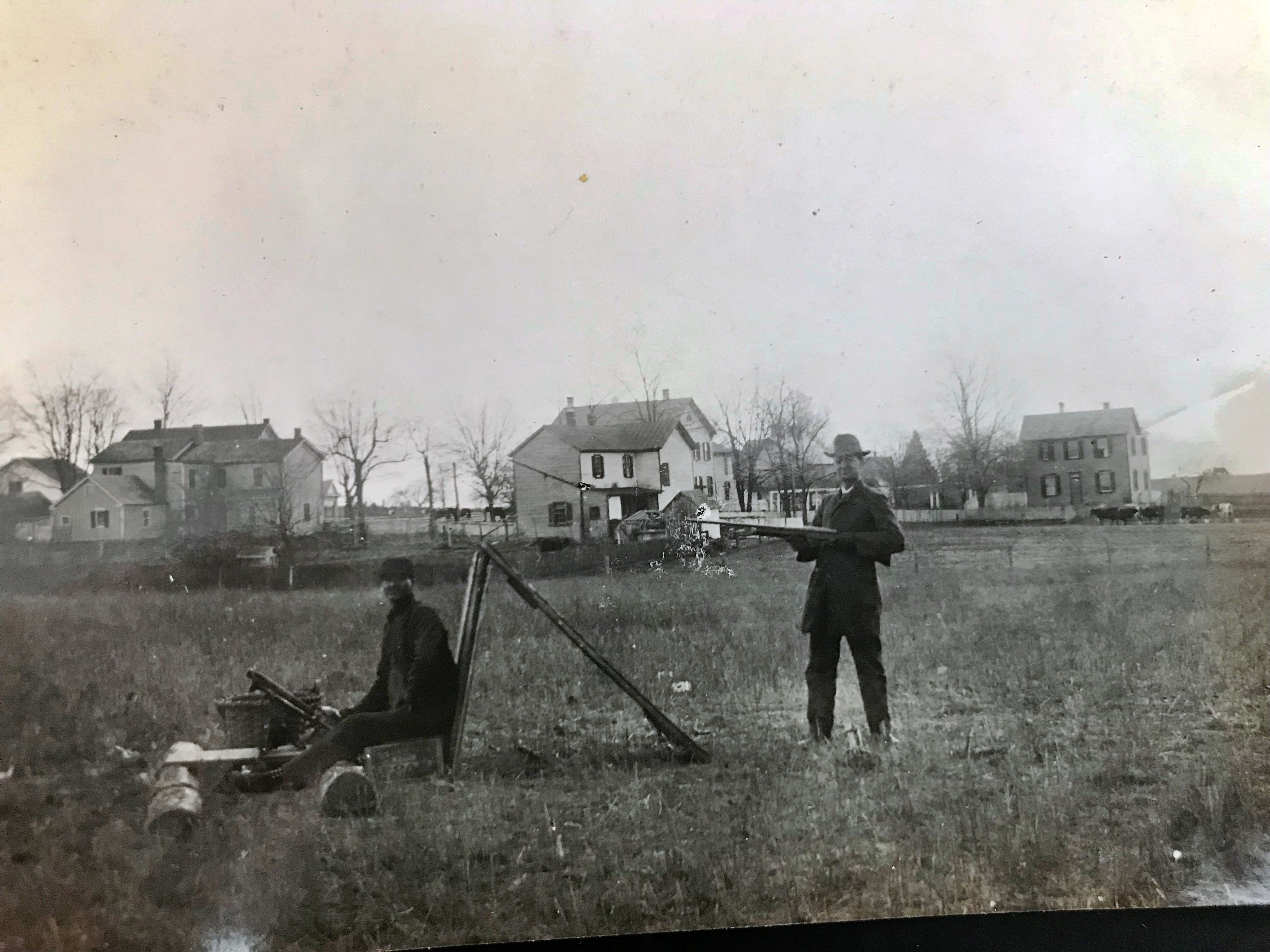
Early 1900s field trap shoot in Darnestown, Maryland, captured by Lewis Reed, showing one man poised with a shotgun while another readies the simple wooden trap amid farmhouses and open pasture.
In this photograph, two men stand in an open field bordered by modest frame houses and fenced pastures, a scene typical of small crossroads communities like Darnestown in the early 1900s. One man holds what appears to be a long gun, while the other sits beside a simple wooden rig that resembles the framework used to cock and release early manually operated target throwers or live‑bird traps
The proximity to grazing livestock suggest that this is not a formal gun club range but an improvised shooting ground on private farmland, which was common before purpose‑built trap clubs spread widely. Rural shooters often practiced in meadows or behind farmhouses, using homemade equipment and relying on a friend to work the trap while the shooter took position in front.
Darnestown in Reed’s era was a small but important crossroads in western Montgomery County with farms, mills, and the Andrew Small Academy serving the surrounding countryside. Later roadside historical markers that use Lewis Reed’s images emphasize how thoroughly he documented the community’s buildings and daily activities, making it likely that he also recorded local recreations such as shooting, fishing, or horse‑related events.
Clay target shooting gained popularity in the United States after the introduction of standardized targets and simple spring‑powered traps in the late 19th century, and Maryland farm communities were no exception. Scenes like this one, with neighbors gathering in an open field to test their marksmanship, reflect how shooting sports blended workday skills with weekend socializing in a largely agricultural landscape.
This image captures a rare glimpse of informal trap shooting at the moment when traditional rural life was beginning to intersect with modern leisure and sport. The combination of farmhouses, fence lines, cattle, and improvised equipment tells a layered story: of a county still rooted in agriculture, of residents embracing new pastimes, and of a photographer committed to preserving unscripted moments as carefully as grand events.
For historians, collectors, and local families, the photograph is more than a quaint scene; it is a visual document that anchors memories of people, place, and pastime in a specific landscape. As additional Reed negatives are identified and researched, images like this may help flesh out the early history of shooting sports in Montgomery County and deepen understanding of how communities like Darnestown spent their rare hours of leisure.
Books

Related Resources


Copyright Notice

Reed Brothers Dodge History (1915-2012) by Jeanne Gartner is licensed under a Creative Commons Attribution-NonCommercial 3.0 Unported License.


Recent Comments