
More Than Just Motors: The Enduring Link Between Reed Brothers Dodge and the MCPD
When you look back at the history of Montgomery County, Maryland, certain names are synonymous with the growth of the region. Reed Brothers Dodge is certainly one of them, but while we are often remembered as the first Dodge dealership in the area, our history is also deeply intertwined with the very foundation of the Montgomery County Police Department (MCPD). This connection wasn’t just about the cars and motorcycles; it was about the people who kept them on the road.

This is the first known photograph of the entire Montgomery County Police Force Motor Unit. Pictured left to right: Earl Burdine, Lawrence Clagett, Guy Jones, Chief Charles Cooley, Leroy Rodgers, and Oscar Gaither. Photo taken by Lewis Reed on July 4, 1922.
The relationship between Lewis Reed and the MCPD began on the department’s very first day of duty: July 4, 1922. On that historic morning, Chief Charles Cooley and his five original officers gathered at Reed Brothers Dodge to have their first official group photo taken. At the time, the department was a “mounted” unit on Harley-Davidson motorcycles. Because modern, branded dealerships didn’t exist yet, Reed Brothers served as a vital hub for sales and service. Lewis Reed and his brother Edgar were motorcycle enthusiasts who had founded Rockville’s Park Avenue Motorcycle Club a decade earlier in 1912, and their expertise made the dealership the natural home for the county’s early fleet. In those early days, each officer was allotted $300 a year for motorcycle upkeep, and our shop was where much of that vital work happened.
As the decades passed and the MCPD grew into a modern force, the need for expert maintenance grew with it. The department eventually established its own internal garage, but they didn’t have to look far to find the best talent to staff it. The “Reed Brothers standard” was so well-regarded that the police garage specifically recruited veteran mechanics from the dealership. By the late 1970s, two of our most skilled technicians, Ben McGowan and John Hall, transitioned from the service bays at Reed Brothers Dodge to work for the Montgomery County Police garage. Ben, an electrical and AC specialist, and John, a Maryland State Inspector and ASE-certified mechanic, brought a wealth of “under-the-hood” knowledge to the county.


This pipeline of talent from the dealership to the public sector highlights a beautiful piece of Rockville history. It shows that Reed Brothers Dodge was more than just a business; it was a training ground for the craftsmen who kept the county moving. When we see photos of those early 1922 officers on their Harleys or hear stories of the police fleet in the decades that followed, we aren’t just looking at machines. We are looking at the legacy of men like Lewis Reed, Ben McGowan, and John Hall– the hands that built, serviced, and supported the safety of our community for over a century.
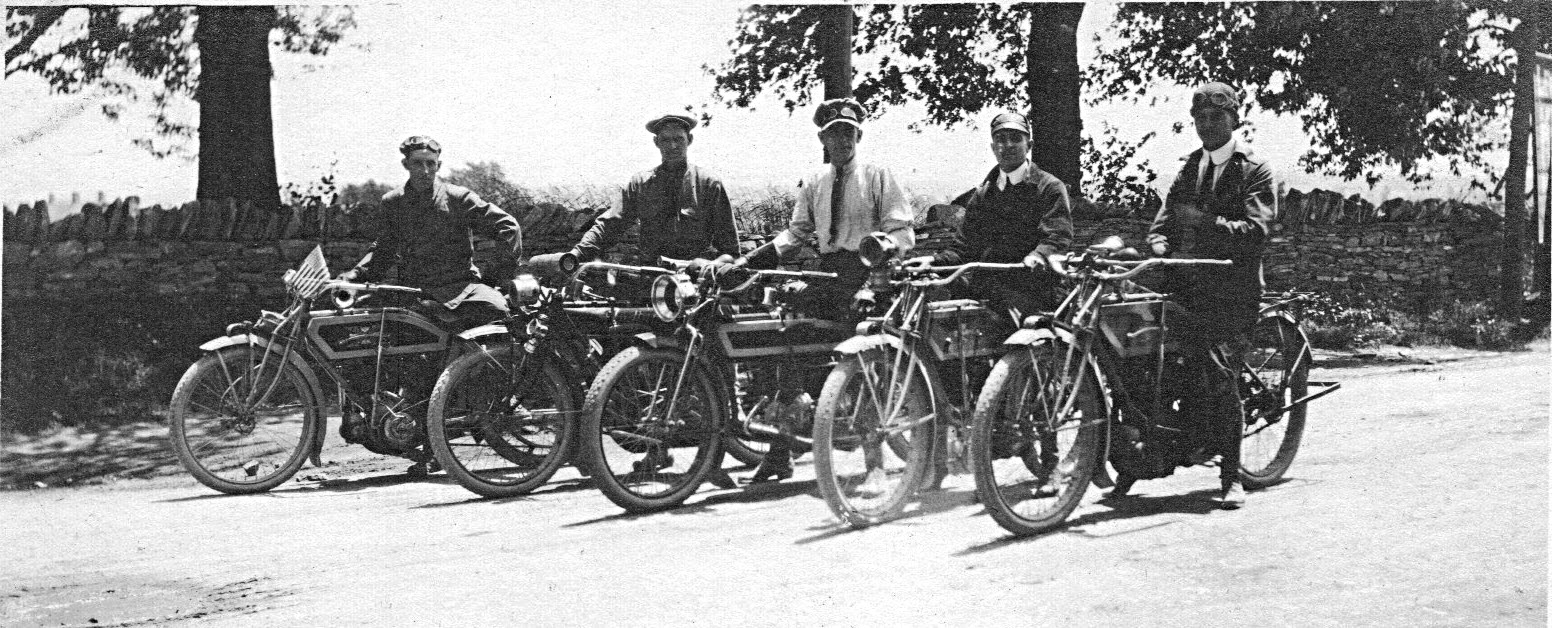
First motorcycle club in Rockville, Maryland. One Harley Davidson, one Indian, and Three Excelsior motorcycles on Park Avenue, 1912. Lewis Reed, far left.
As the curator of these archives and the granddaughter of Lewis Reed, I feel a great sense of pride in preserving these connections. Seeing the faces of men like Ben McGowan and John Hall reminds me that our family business was built on the shoulders of dedicated craftsmen who served their neighbors and their county. It is a legacy of service that I am honored to document and share with you today.
Then and Now: Hotel Cape May, 1919
People have been visiting Cape May, “the nation’s oldest seashore resort,” for longer than America has been a country. That makes Cape May the perfect place to look back on over 100 years ago and from today — then and now.
A bit of Hotel Cape May history: The Christian Admiral, formerly Admiral Hotel and Hotel Cape May, was a luxury beachfront hotel located in Cape May, New Jersey. Opened in 1908, as the Hotel Cape May, the ornate hotel was abandoned five years later due to bankruptcy. It was then sold at a Sheriff’s sale. The hotel was leased by the War Department as a hospital from 1918-1919 during WWI. Afterwards, it was again abandoned. In 1932, the Admiral Hotel company purchased it and renamed it the Admiral Hotel. They too went bankrupt in 1940. The military returned for WWII from 1941 to 1945 and afterwards it was once more sold at Sheriff’s sale. It opened and closed multiple times before being abandoned again in the 1950s. Reverend McIntire saved it from demolition in 1963, and operated it until his organization too, went bankrupt. The Christian Admiral never made a profit for any of its owners and was the cause of six bankruptcies. Nonetheless, it was a gorgeous hotel and one of the most recognizable and beloved buildings in Cape May. The people who liquidated McIntire’s organization shopped the hotel around, but it was deemed too far gone to save. Engineer estimates were $20 million and above, just to make it structurally sound and from $60-$80 million to restore it. The hotel was razed in 1996.
Hotel Cape May (THEN): The Christian Admiral Hotel, originally known as the Hotel Cape May, was erected in the Beaux-Arts style between 1905 and 1908. When opened on April 11, 1908, it was the world’s largest hotel. Completed behind schedule and over budget, Hotel Cape May was part of a development project intended to bring wealthy visitors to the city and rival East Coast resorts such as Newport, Rhode Island. During its existence it would undergo five bankruptcies and ownership changes.
Edgar was a partner with his brother Lewis Reed, in Reed Brothers Dodge. During WWI, Edgar served as a Sergeant in the U.S. Army Medical Corps from February 1918 to August 1919 and had been posted to GENERAL HOSPITAL NO. 11 in CAPE MAY, NEW JERSEY. The spirit of patriotic service which swept the country prompted many persons to offer their properties to the War Department for hospital purposes. These offers included buildings of every conceivable kind, such as department stores, private establishments, hospitals, and properties in large cities. It was found that many of these could be obtained and converted into hospitals much more expeditiously than barrack hospitals could be constructed, and at less cost.
The Surgeon General recommended that the War Department authorize the leasing of the Hotel Cape May for use as a general hospital on December 18, 1917. The Hotel Cape May was located on the Ocean Drive, at the eastern end of the city, and within 100 feet of the beach of the Atlantic Ocean. Opened first as GENERAL HOSPITAL NO. 16, the designation was changed to GENERAL HOSPITAL NO. 11, March 14, 1918. The enlisted personnel were quartered in tents which were located to the rear of the building.
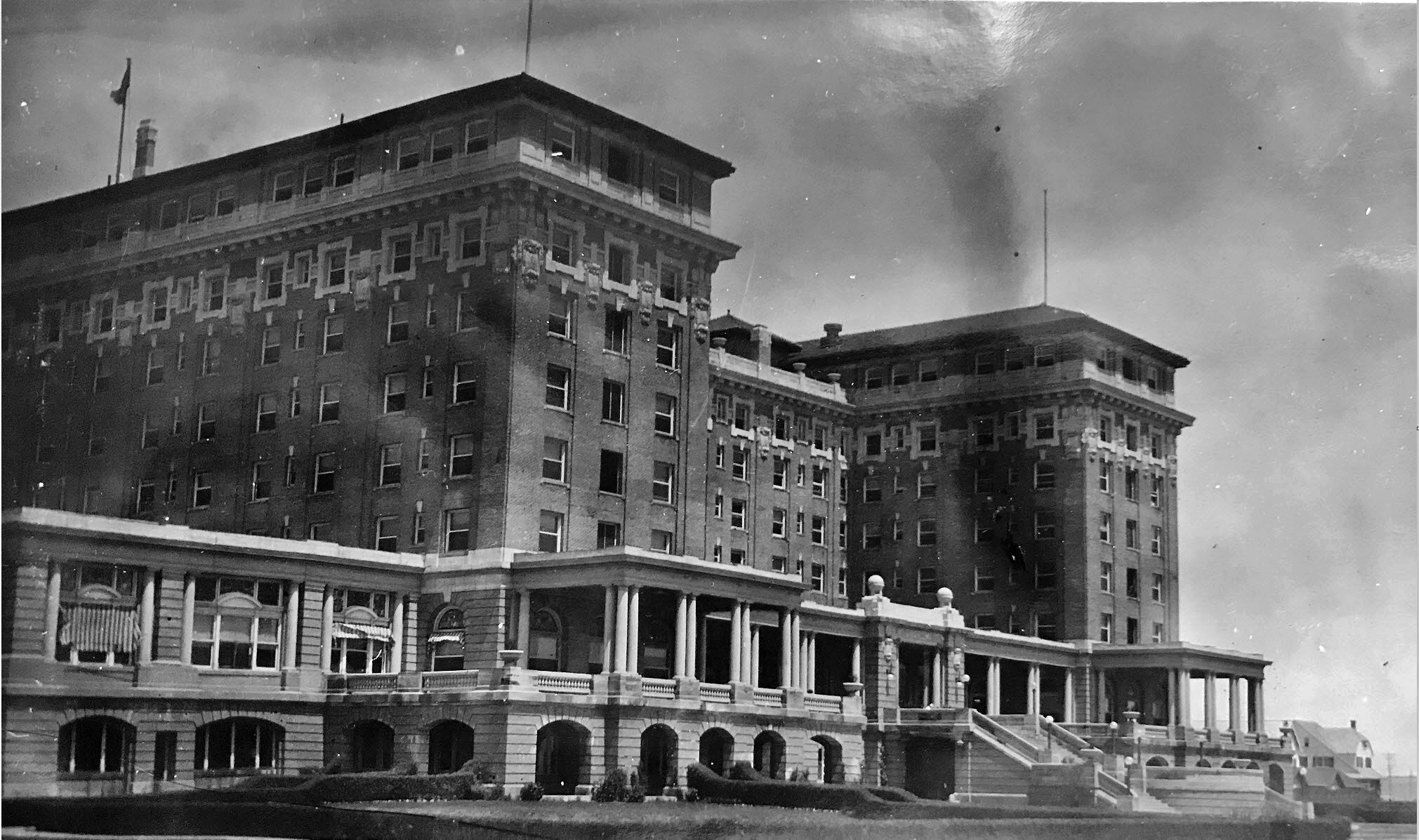
Hotel Cape May as it looked in 1919. Photo by Lewis Reed.
The Christian Admiral Hotel (NOW): In 1991, the hotel was closed by Cape May City officials. The hotel was demolished in 1996 and the site was reused for a development of single family homes. The demolition of the hotel placed the city’s National Historic Landmark status at risk.
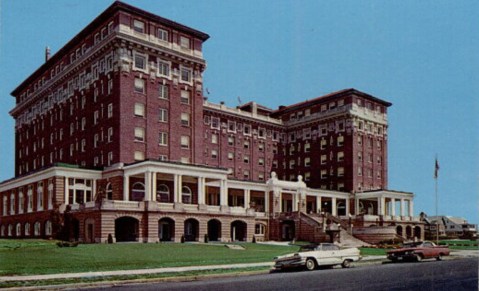
The Christian Admiral Hotel, late 1970s. Closed by Cape May City Officials, 1991 for want of tens of millions of dollars to bring up to modern codes. Destroyed: Feb, 1996.
New Year Greetings from Lewis and Edgar Reed, 1950
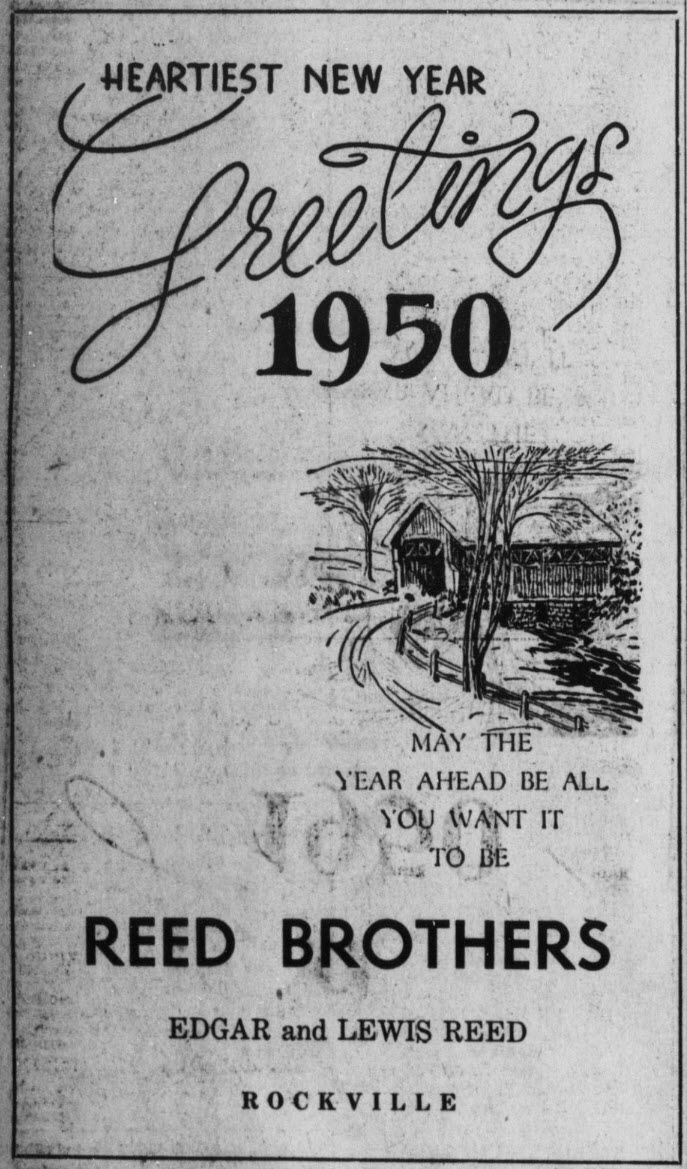
As another year begins, it feels fitting to look back at a New Year greeting shared more than seven decades ago. In the December 29, 1949 edition of the Montgomery County Sentinel, Edgar and Lewis Reed offered a warm message to the community:
“May the year ahead be all you want it to be.”
Simple and sincere, those words still resonate today. They reflect not only the spirit of the season, but also the long-standing connection the Reed family had with Montgomery County and the people they served. In that same spirit, I would like to extend my heartfelt thanks to all the visitors and followers of this blog. Your interest, comments, and support help keep this local history alive and meaningful.
Wishing you all a very Happy New Year, and every good wish for a safe, healthy, and prosperous 2026.

From Chauffeur to Dodge Dealer
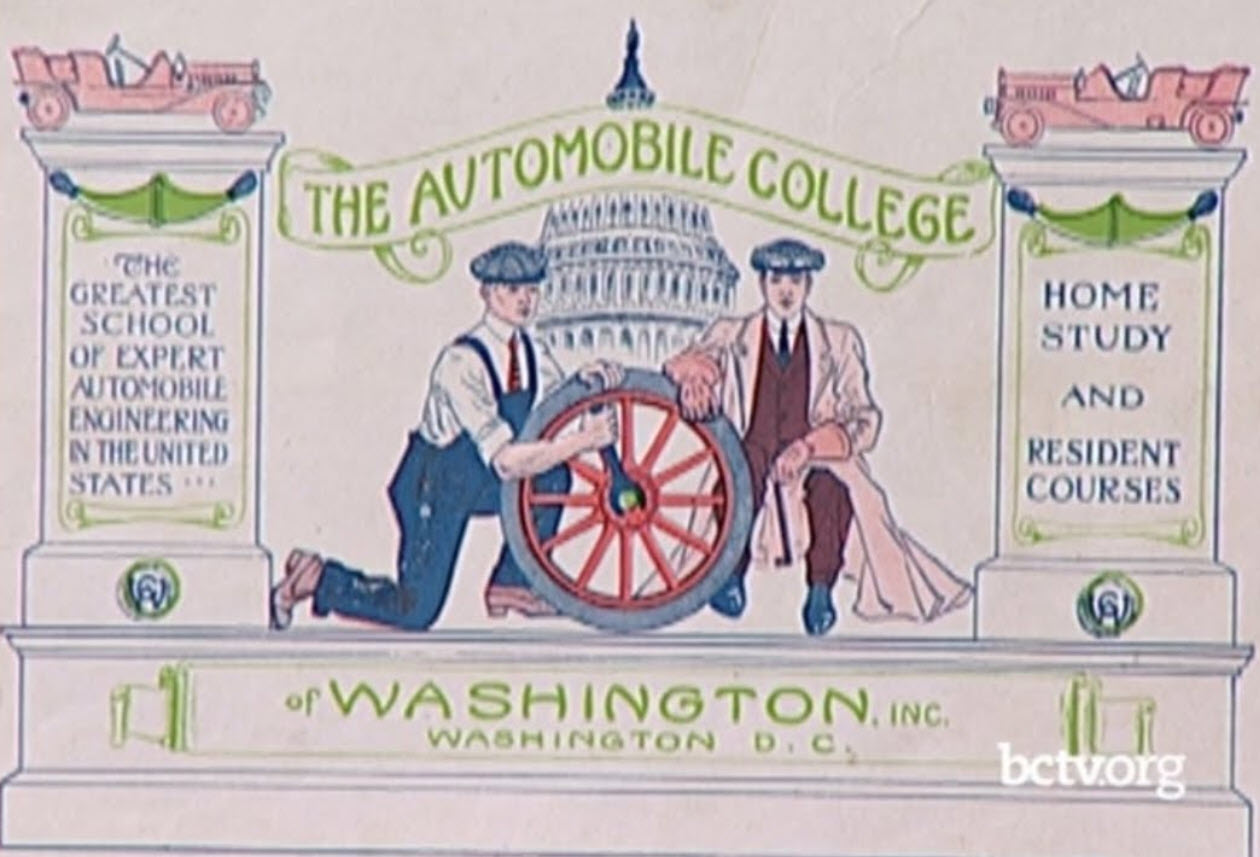 In the early 1900s, owning an automobile was a luxury few could afford, and operating one was no simple task. Early cars were finicky machines that required constant attention and mechanical knowledge. This gave rise to a unique profession: the chauffeur-mechanic. To meet the growing demand for this specialized role, schools began offering technical training in automobile operation and repair. One such institution was The Automobile College of Washington, founded in 1909 in Washington, D.C. Given the timing and location, it is likely that Lewis Reed received his early chauffeur and mechanical training at this institution, a step that helped pave the way for his later work with prominent manufacturers. In addition to the Automobile College of Washington, Lewis Reed received automotive training at the Pierce-Arrow factory in Buffalo, New York and the Dodge Hamtramck and Hudson Motor Car factories in Detroit, Michigan.
The school featured a fully equipped repair department and machine shop, complete with modern engines for hands-on learning. Students were trained on a variety of vehicles, including the Washington A-1 Touring Car, Pope Tribune, Peerless 35hp, Ricketts Model G 6-cylinder, and Mitchell 25hp, giving them practical experience with some of the era’s most advanced technology.
According to the 1910 census, 23-year-old Lewis Reed was employed as a machinist. Coming from a blacksmithing family background, he was already familiar with tools and machinery. As the automobile industry gained momentum, his mechanical aptitude made the transition to working with cars a natural one.

Two ladies with parasols are sitting in the landaulet section of an early Pierce-Arrow limousine, while chauffeur Lewis Reed tends to the motor. The rear portion of the limousine is partitioned from the driver with a glass shield, and covered by a convertible top, which you can see is currently in the lowered position behind the ladies. Photo taken circa 1910.
Early cars were temperamental, mechanically complex, and prone to breakdowns. As a result, the job of a chauffeur demanded not only driving ability but also technical knowledge. Their duties went beyond transportation; they were responsible for keeping the car running smoothly, diagnosing problems on the road, and performing regular upkeep. The role was seen as a respectable and skilled profession that required formal training.
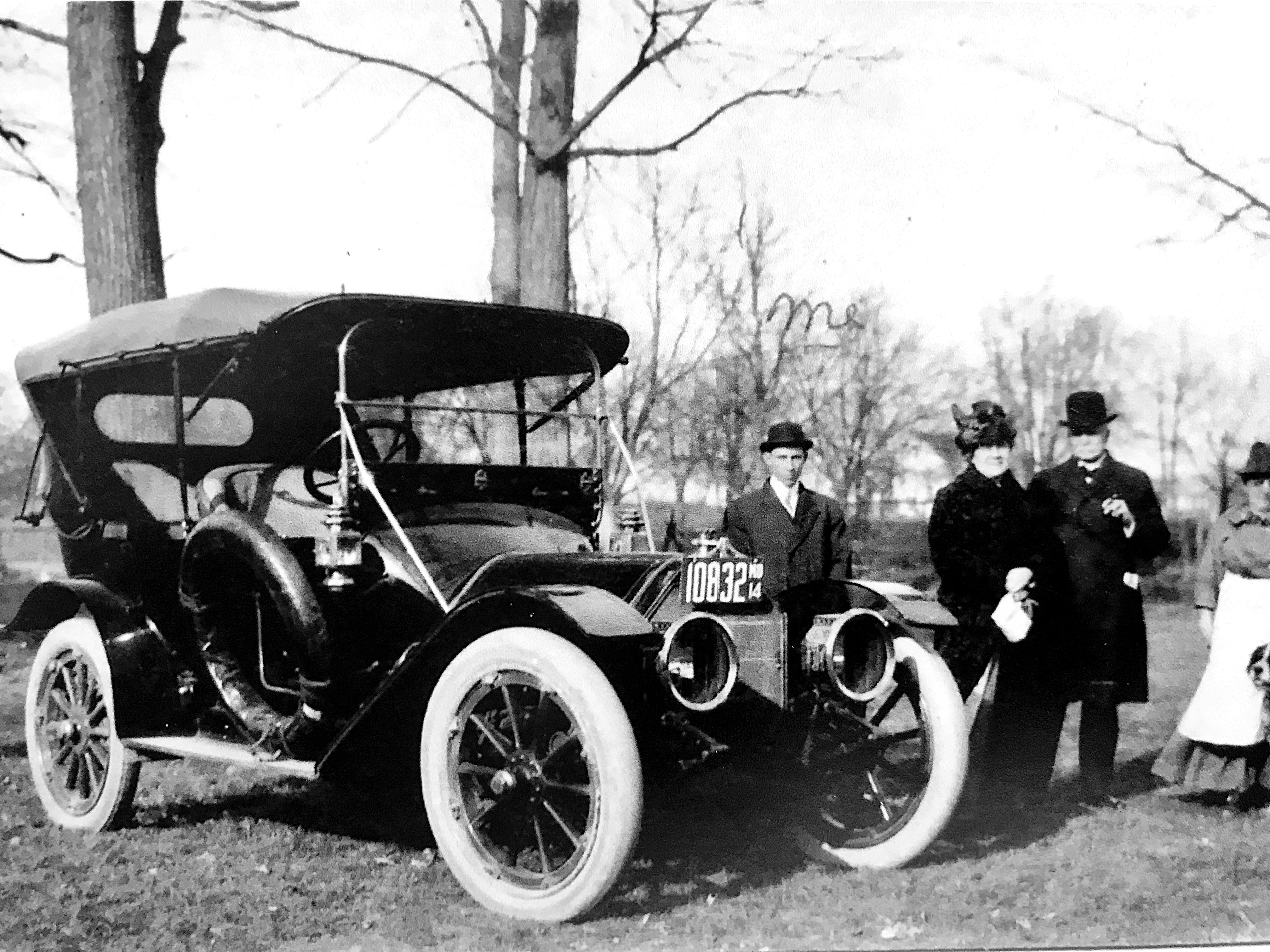
Chauffeur Lewis Reed (left) with unidentified family, 1914
Lewis Reed’s experience behind the wheel, and under the hood, lasted until about 1914, when he transitioned into the business of selling and repairing cars. The above image captures Lewis at a pivotal moment in his life, just before he transitioned from being a chauffeur-mechanic to becoming an automobile dealer. His time in this role not only reflects the expectations of early chauffeurs but also laid the groundwork for what would become a lifelong career in the auto industry.
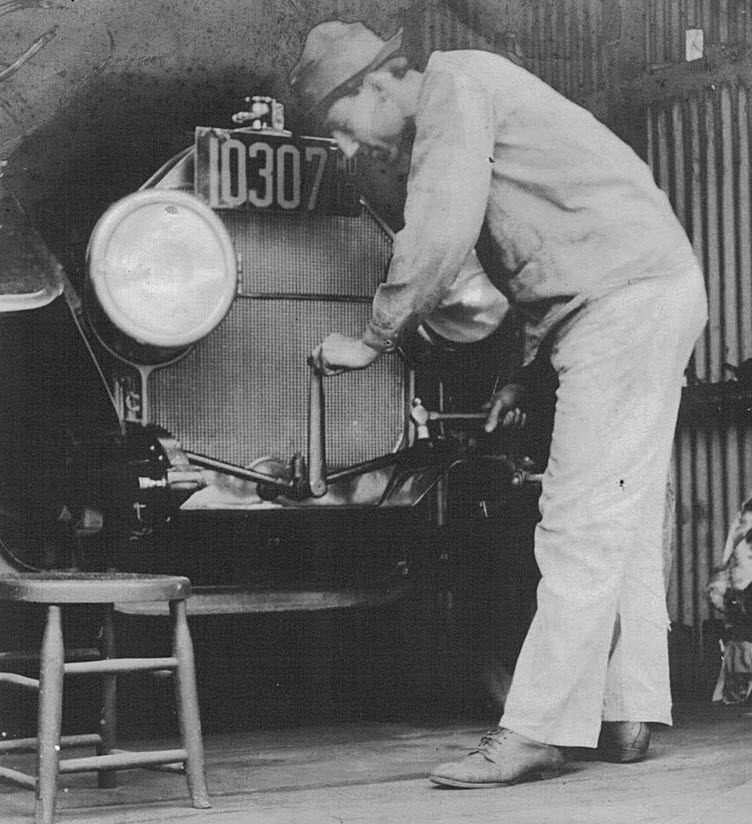
Lewis Reed hand cranking an old car. The hammer in Lewis Reed’s right hand is for straightening the hand crank. Apparently they can bend when starting big engines. The license plate is MD 10307 dated 1913.
The chauffeur-mechanic profession eventually faded as cars became more reliable and easier to operate. Lewis Reed’s experience as a chauffeur-mechanic in the early 1900s was more than just a job; it was the foundation of a lifelong career in the automobile industry. At a time when cars were still a novelty and required hands-on expertise, Reed’s skills and mechanical knowledge set him apart. His early years behind the wheel and under the hood gave him a unique understanding of the vehicles he would one day sell and service as a dealer.
“Greetings at Christmastide” to Our Friends and Readers

Montgomery County Sentinel. December 20, 1945
This Christmas ad from Reed Brothers of Rockville, published in the Montgomery County Sentinel in December 1945, reflects both the relief and renewed hope felt across America after the end of World War II. The war had officially ended just months earlier, and this holiday season carried deep emotional weight; gratitude, remembrance, and optimism for the future.
One detail that stands out is the use of the word “Christmastide.” Today, the term feels old-fashioned, but in the late 19th and early-to-mid 20th centuries it was still widely used in print. Christmastide refers not just to Christmas Day, but to the entire sacred and festive season surrounding Christmas, traditionally extending from December 25 through Epiphany in early January. The word carries a deeper sense of continuity, reflection, and spiritual meaning; something especially meaningful in a postwar world seeking comfort and renewal.
The poetic message in this ad– speaking of pine, holly, friendly voices, faith, hope, and gladness– captures the emotional heartbeat of Christmas in 1945. After years of rationing, separation, and uncertainty, families across Montgomery County and the nation were finally able to celebrate the season with returning loved ones and a renewed sense of peace.
Vintage advertisements like this don’t just sell a business; they preserve the language, values, and spirit of an era. This Reed Brothers Christmastide greeting is a reminder of how deeply meaningful that first postwar Christmas truly was.
As we look back on that historic Christmas season eight decades ago, we’re reminded that the true heart of the holidays shines brightest when times are most difficult. I would like to wish everyone who finds time during the course of your day to visit this blog a very Merry Christmas and a safe and healthy Happy New Year in 2026.
Warmest holiday wishes,
Jeanne Gartner
Blog Author
Books

Related Resources


Copyright Notice

Reed Brothers Dodge History (1915-2012) by Jeanne Gartner is licensed under a Creative Commons Attribution-NonCommercial 3.0 Unported License.
 Reed Brothers Dodge History 1915 – 2012
Recent Comments