
Trees of Christmas Past
With only a few days left until Christmas, I thought it might be fun to take a look at a couple of photos from Lewis Reed’s collection that show us what Christmas trees used to look like a century ago. In those days, there was not wide-spread agreement on exactly what a tree should look like, which made for a lot of creativity. Not surprisingly, they were very different than the perfectly shaped tress we have on display today.
The trees were big back then and always fresh. They went right to the ceiling and were very wide. Early Christmas trees were generally fastened onto a flat board surrounded with fence-rails, snow villages and carpeted with cotton blankets of snow. The tree in the photo below has an abundance of tinsel, which grew in popularity to the point that, by the 1920s, it was common to nearly cover the tree in the decorative material.
And what is tinsel exactly? Tinsel was designed to mimic the way ice looks, and the earliest tinsel was made from strips of real silver. It was only later that it became a Christmas tree decoration, employed to enhance the flickering of the candle flames. In the 1950s, tinsel became so popular that it was often used as a substitute for Christmas lights.
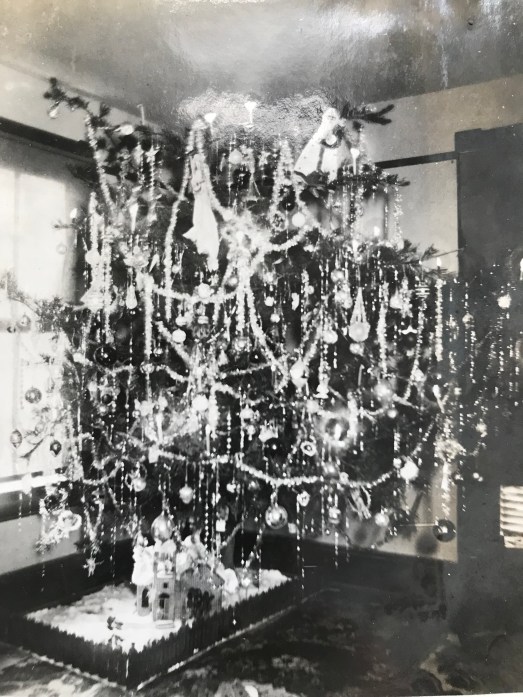
A small snow scene with what appears to be a miniature church is arranged at the foot of the Christmas tree. A popcorn garland adorns the tree. Photo by Lewis Reed
So, where did Washingtonians get their trees?
From The Evening Star, Washington, DC 23 December 1923:
Conduit Road on the long stretch between Glen Echo and Great Falls for many years has been a favorite hunting ground where hundreds and hundreds of families have customarily obtained scrub pine trees for Christmas week. Usually there is plenty of holly and some mistletoe to be found in the rugged and rolling hill lands which are the gateway to Great Falls.

No room for a star on the top of this tree! And just look at those big Santa and Angel dolls. Other fun little details are notable, including a miniature church with picket fence is arranged at the base of the tree. Photo by Lewis Reed
There’s a fine art to decorating Christmas trees that’s been developing since over 100 years ago. People consider lights, garland, ornaments, skirt, and more. But one thing that’s hard to resist sometimes is just filling every available space with decorations. Clearly, that was the case years ago too. What I like about these trees is that they are so randomly shaped and even misshapen. Folks back then didn’t trim them down to a more aesthetically pleasing symmetry like we do today.
Today, most Christmas trees are artificial and very symmetrical. Stringing lights and hanging ornaments are used mostly for decorating, since large bare spots are a thing of the past. Branches are clicked into place and limbs can be fanned out to accommodate whatever decorations you choose to add. Tinsel is long gone and lights now come in all types of sizes and styles. Tree lights can be set to not blink or programmed to flash in whatever sequence fits your mood. You have the control of exactly how you want your tree to look. It is a far cry from the trees of Christmas past.
The Legendary Lake House Hotel of Horror, Then & Now
With Halloween just around the corner, I thought it would be fun to feature a photograph that Lewis Reed took of the Saylorsburg Lake House Hotel, now the site of Hotel of Horror. The aging Lake House Hotel in Saylorsburg, Pennsylvania, once a vibrant Poconos retreat, was a popular hotel for the region’s tourists who were looking for fun on nearby Saylors Lake. During the hotel’s heyday, its staff was booking rooms a year in advance. Today, the former hotel’s fame is generated from its annual Halloween haunted-house attraction.
Lake House Hotel (THEN): The legend of the Lake House Hotel spans more than two-hundred years. According to local folklore, during World War II, many of the employees at the Lake House were called to assist in the Pennsylvania National Guard, leaving the local asylum with one lone security guard to watch over the entire building. The inmates escaped, made their way to the hotel and took it over. The insane patients performed experiments on the guests. What was once a renowned resort for the rich and famous, became a torture chamber.
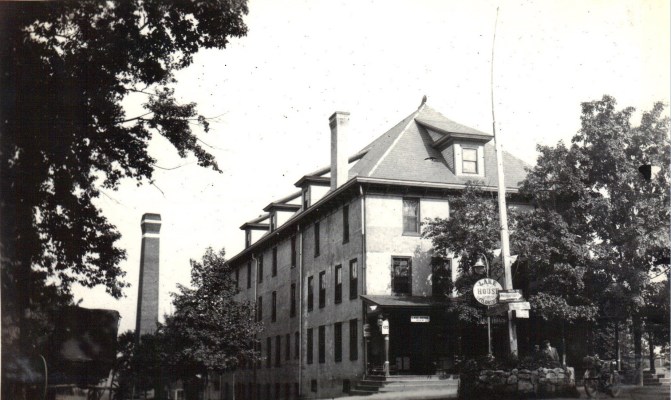
Saylorsburg Lake House Hotel. Photo taken by Lewis Reed, 1915.
Hotel of Horror (NOW): The hotel was purchased in 1990 and turned into an Antique Co-Op, and then in 1992 saw its first haunted house attraction. This 2021 season will celebrate the 29th year that the Hotel of Horror has been fascinating and horrifying legions of fans from the far reaches of the United States and even internationally. To all the readers of this blog: Have a spooky, enjoyable and very safe Halloween!
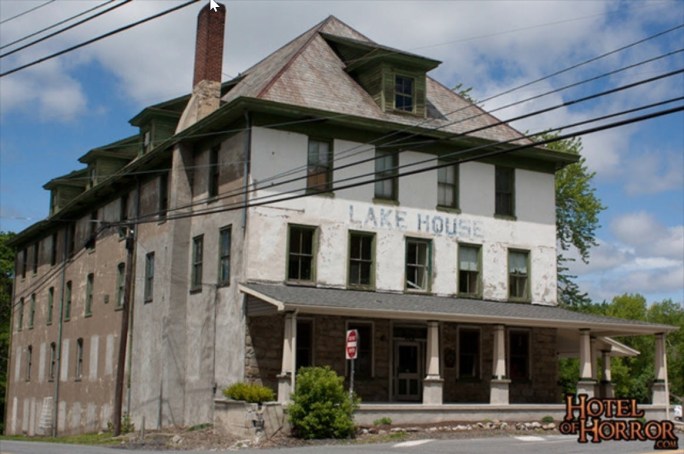
Welcome to The Hotel of Horror, The Pocono Mountains Premier Haunted House Attraction
Exploring Community Life in 20th Century MoCo
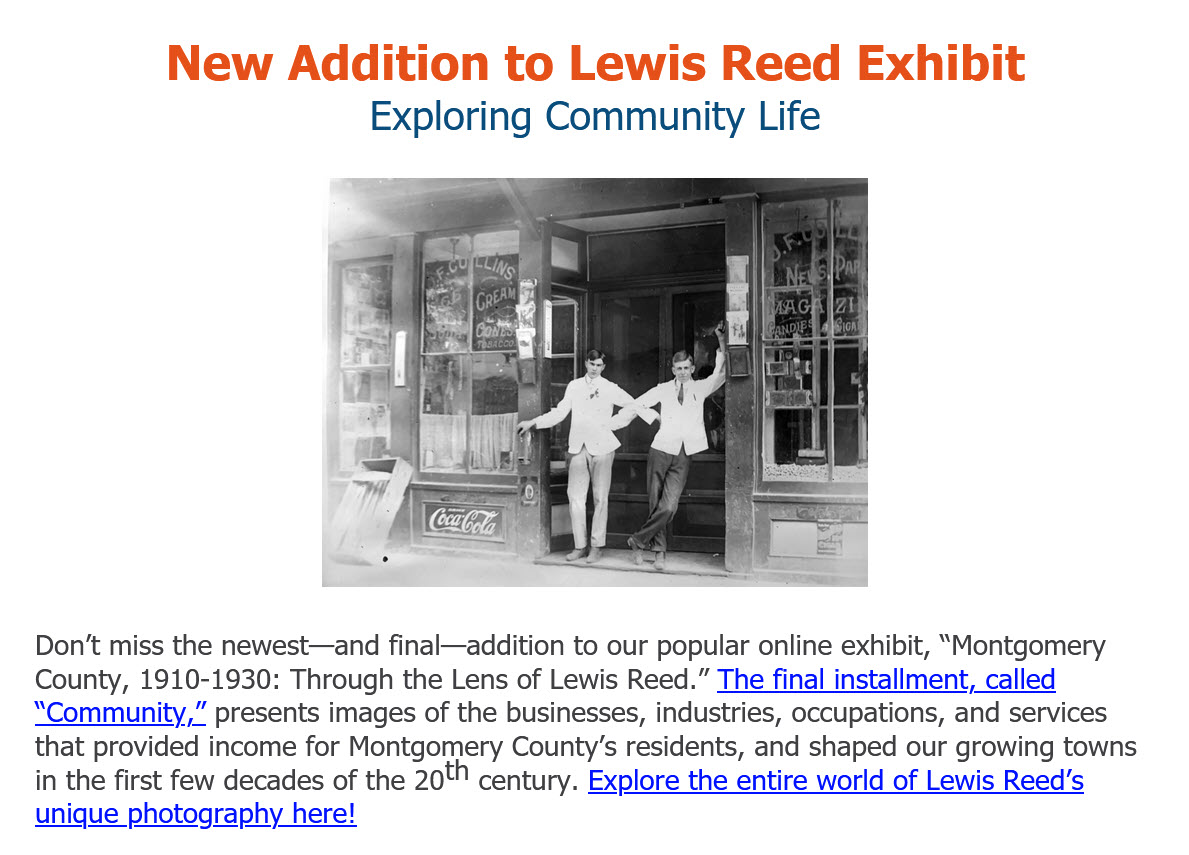 The newest—and final—addition to Lewis Reed’s online exhibit, “Montgomery County, 1910-1930: Through the Lens of Lewis Reed” has just been published.
Bromo-Seltzer Tower: Then & Now
Baltimore and the surrounding area sure has changed a lot in its centuries-long history. But many traditions and landmarks from decades ago are still around today, give or take a few variations. In this “Then & Now” feature, I have combined one of Lewis Reed’s original photograph’s for “then” and matched it with a corresponding contemporary shot for “now”. In the following photographs, you can see the difference 100 years can make.
So… you’re the inventor of a popular headache remedy living in the city of Baltimore around 1910. You have a factory on Lombard Street, a few blocks from the harbor. You want to create something memorable for the city. Of course, you also want to promote that headache remedy…
What do you do?
If you are Captain Isaac Emerson, inventor of Bromo-Seltzer, you hire a well-known architect and build a massive clock tower next to your factory.
Bromo-Seltzer Tower (THEN): When it was built in 1911, the 15-story Emerson Tower—better known locally as the Bromo-Seltzer Tower—was the tallest building in Baltimore. The tower was inspired by the Palazzo Vecchio in Florence, Italy, and took its name from Captain Isaac Edward Emerson, the inventor of Bromo-Seltzer, a popular cure for headaches and indigestion. Until 1936, the tower was topped by a 51-foot illuminated Bromo-Seltzer bottle that was supposedly visible from twenty miles away.
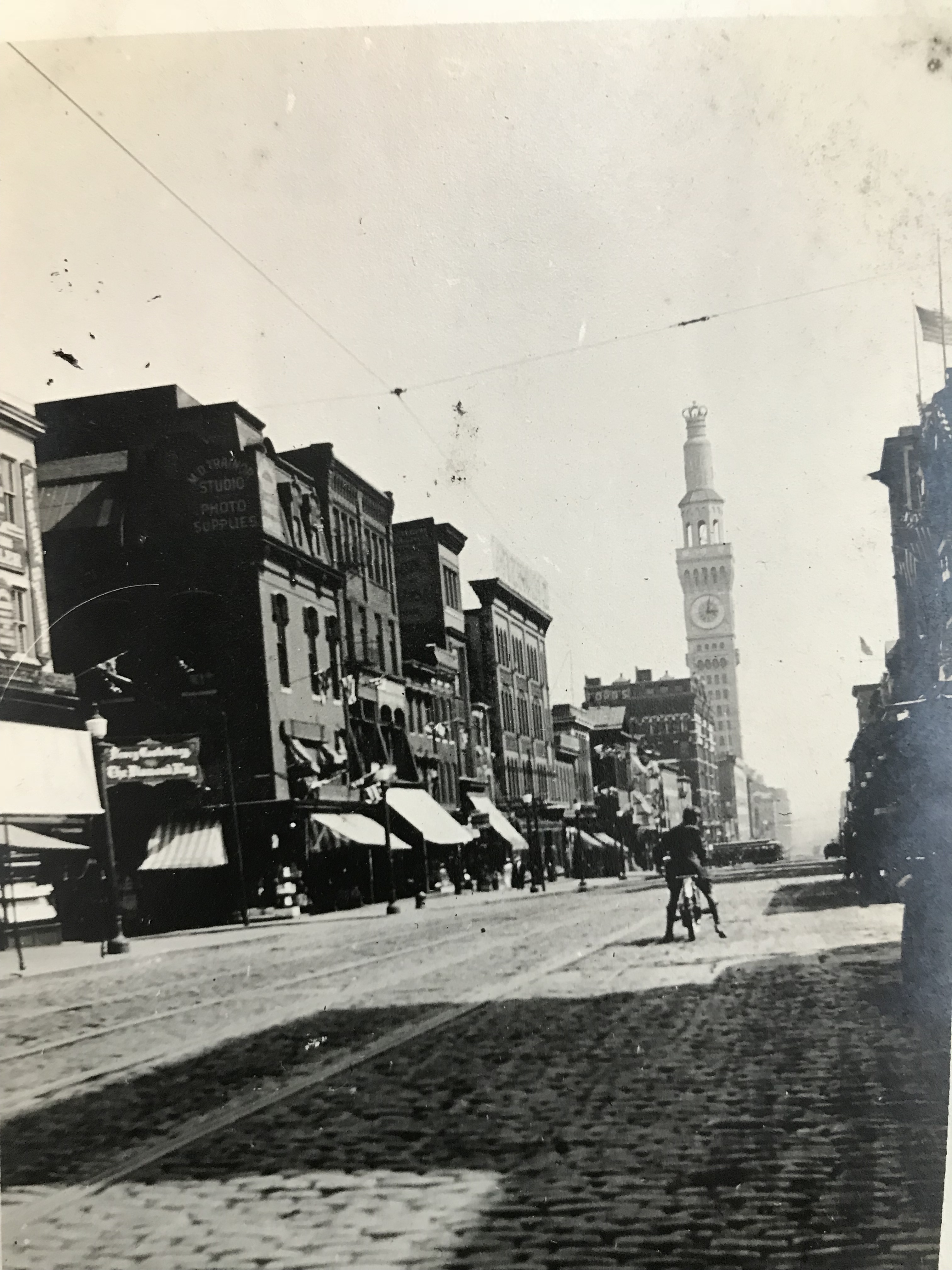
Bromo-Seltzer Tower, Baltimore, Maryland. Photo by Lewis Reed, 1914
Bromo-Seltzer Tower (NOW): The Bromo Seltzer Arts Tower has been transformed into studio spaces for visual and literary artists. Inside the Tower is the Emerson/Maryland Glass Museum which houses the largest collection of Bromo Seltzer and Maryland Glass bottles in existence. The Emerson Bromo-Seltzer Tower was placed on the National Register of Historic Places in 1973.

Bromo Seltzer Arts Tower today
Can’t Find Your Car? Frederick Fair Parking Lot, 1914
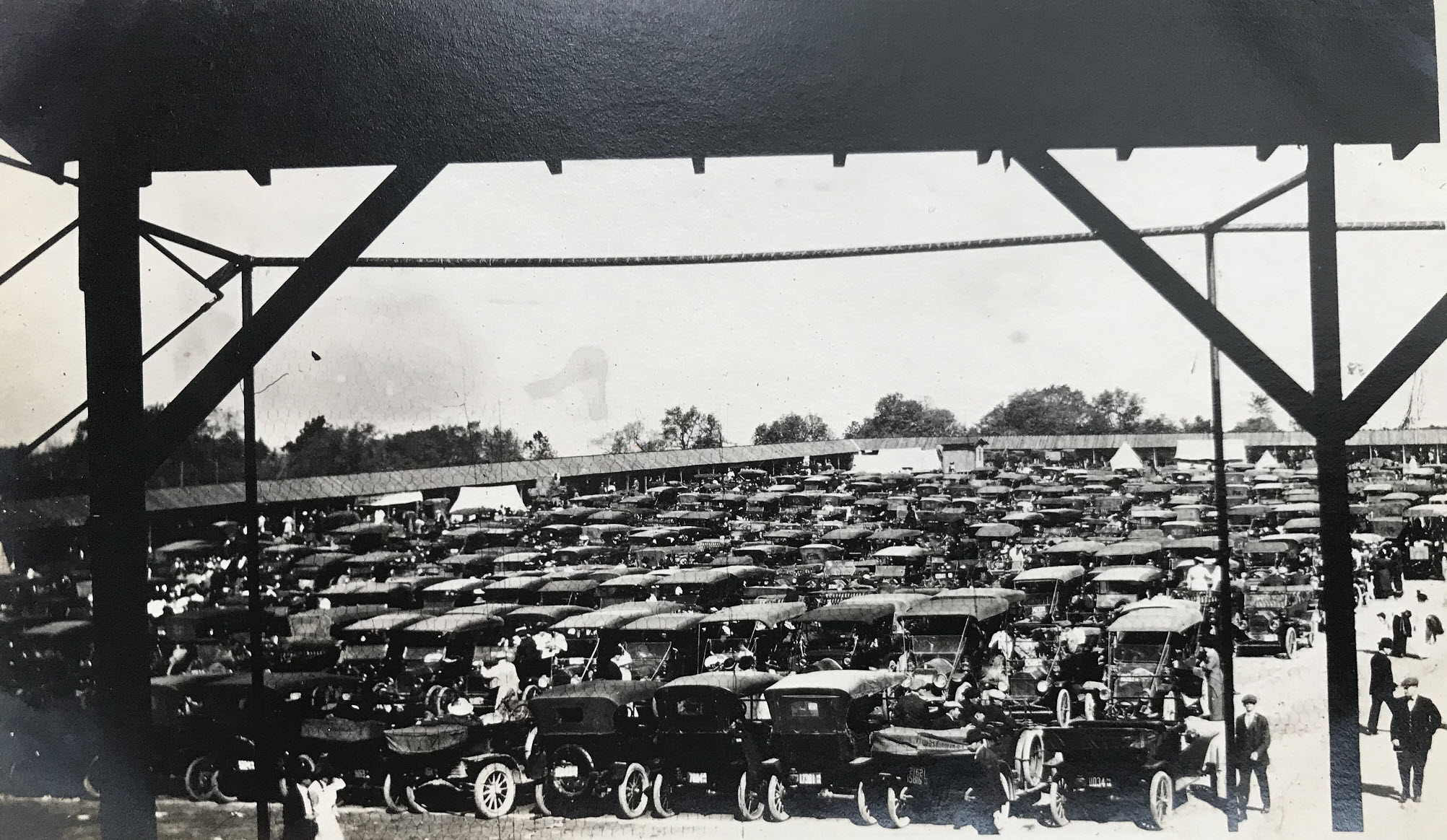
This fascinating scene of hundreds of cars parked in the Frederick Fair parking lot was taken by Lewis Reed in 1914. What is fascinating to me is, with all of these early cars painted in black, how on earth would you find your car in the parking lot?
Can’t find your car, sir? Apparently not a new phenomenon as seen in this 1914 photo of the Great Frederick Fair parking lot, especially since the majority of cars were of only one paint color, your basic black.
This week (September 17-25) marks the 159th edition of the Great Frederick Fair, the largest and greatest county fair in the State of Maryland. There have been many changes since the first fair was held in 1822 when it was known as the Cattle Show and Fair: that was a two-day event, now it’s nine days. The location has changed and so has the name. Today, the Frederick County Fair is officially named the Great Frederick Fair. It’s been held in May, October and November, but now (and for many years) takes place in September — rain or shine.
Fair entertainment has certainly evolved over the years. In 1888, May Lillie, an “expert girl shot with a rifle” from the back of a running mustang, performed. In the early 1900s, acrobatic bears and monkeys, high-wire acts and vaudeville performers took the stage. In 1950, the highlight of the “Irish Horan and the lucky Hell Drivers” show was a “stock convertible catapulted from a giant cannon.” In 1965, it was Jack Kochman’s Hell Drivers performing stunts with cars.
The Thursday of the 1911 fair was noted as a record day with 15,000 people in attendance, 100 autos and 1,000 carriages, according to “The Great Frederick Fair” book. Today, fair attendance can range from 210,000 to 250,000 people during the nine-day fair.

Newspaper ad advertising The Great Frederick Fair. THE DEMOCRATIC ADVOCATE OCTOBER, 1914
Source: Frederick News-Post
Books

Related Resources


Copyright Notice

Reed Brothers Dodge History (1915-2012) by Jeanne Gartner is licensed under a Creative Commons Attribution-NonCommercial 3.0 Unported License.
 Reed Brothers Dodge History 1915 – 2012
Recent Comments