
Lewis Reed Photo: Old Car Wreck

Photo by Lewis Reed
This photo taken by Lewis Reed in the early 1920s was not picked for its shock value, but for the history it contains of an era long since gone. During the 1920s a drivers license wasn’t needed in most states. It was the wild west when it came to driving. Poorly maintained roads, uneducated drivers, and speeds approaching 40 mph was the perfect combination for some really bad accidents. The photograph sure hits home with just how fragile those early cars were.
1920s: Dodge Dealers Tackle Snowy Goshen Road in Gaithersburg
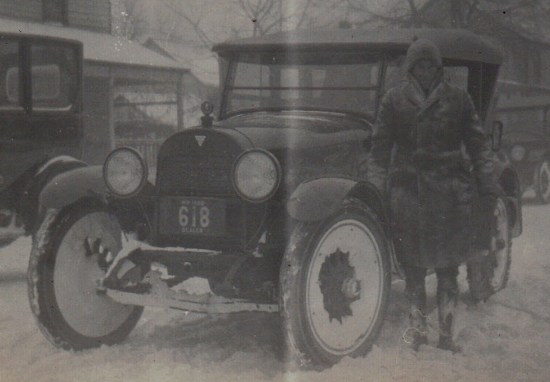
Circa 1920 Hudson Six with Maryland Dealer License Plate on front. There weren’t heaters in these old cars, so motorists had to really bundle up. Photo by Lewis Reed
These previously unpublished photos from Lewis Reed’s album are what appears to be a caravan of circa 1920s cars all with Dealer license plates slowly making their way along a snowbound Goshen Road in rural Gaithersburg. The radiator badge on the front of the car in the above image identifies it as a Hudson. The only indication of where these photos were taken was a small piece of paper tucked behind one of the photos that was labeled “Goshen Road – outside Gaithersburg”.
Early motorists weren’t afraid to drive in the snow simply because they didn’t have 4-wheel drive and electronic assistance; they just got out and did it. In the spirit of the upcoming weekend snow storm, here are a few photos that recall the beauties and trials of winters past, from Lewis Reed’s collection.

Dealer car stopped (stuck?) on snowbound Goshen Road. Note the trailing cars slowly making their way up the hill. Although no tire chains are in evidence, they might have been useful coming up that hill. Photo by Lewis Reed
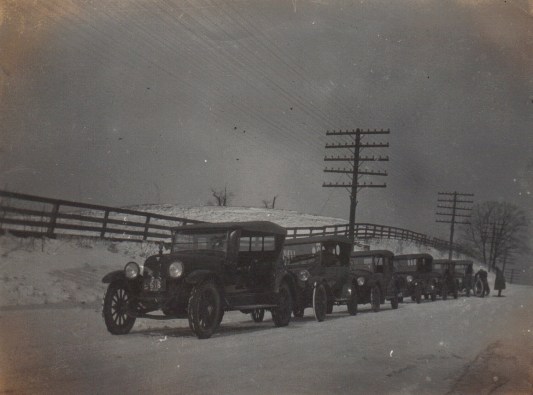
Line of Dealer cars stopped on Goshen Road. The car at the rear appears to be getting a helping hand to change a flat tire. Photo by Lewis Reed

Dealer in a circa 1920 Oldsmobile stopped along Goshen Road outside Gaithersburg. Photo by Lewis Reed
Lewis Reed’s Rockville Garage sold more than just Dodges. During the early years, Reed Brothers represented several franchise nameplates along with Dodge, including Oldsmobile, Hudson and Essex. The Hudson and Oldsmobile were sold at Reed Brothers from roughly 1917 through 1921.
Who would dare go out in these conditions today without an AWD SUV and heated seats?
Peerless Rockville Newsletter Feature
It was 100 years ago in October 1915, that Lewis Reed signed a franchise agreement with brothers Horace and John Dodge in Detroit. Since then, the business that Lewis Reed founded grew and transformed into Rockville’s oldest family-owned and operated Dodge dealership.
Last October, I was invited to write a feature article for the Winter issue of Peerless Rockville’s Newsletter highlighting the 100th anniversary of Reed Brothers Dodge. Peerless Rockville Historic Preservation, Ltd. is an award-winning nonprofit, community-based organization founded in 1974 to preserve buildings, objects, and information important to Rockville’s heritage. Their official website can be found here.
Pictured below is page 3 of the newsletter of the Peerless Places series highlighting Reed Brothers Dodge. (click image to enlarge)

Lewis Reed Photo: Early 1900s Tabulating Machine Company Delivery Truck

Early 1900s Tabulating Machine Company Delivery Truck. Photo by Lewis Reed
Before becoming interested in automobiles, Lewis Reed was one of the original employees of the Computing-Tabulating-Recording Company, a Georgetown-based manufacturing firm that eventually became International Business Machines, Inc. It was created in 1911 by Charles R. Flint through the consolidation of four companies: The Tabulating Machine Company, International Time Recording Company, Computing Scale Company of America, and the Bundy Manufacturing Company. Located in Endicott it was renamed International Business Machines (IBM) in 1924.
Note that the writing on the side of the truck is in reverse.. I have no idea why.
Source: Wikipedia
History of Dodge Logos
Many fascinating and mysterious logos have been used by Dodge throughout the past 100 years. Dodge used different logos depending on the model and vehicle purpose. Trucks, passenger cars and performance vehicles typically held different logos on grills. Below are the most notable emblems used by Dodge since its inception.
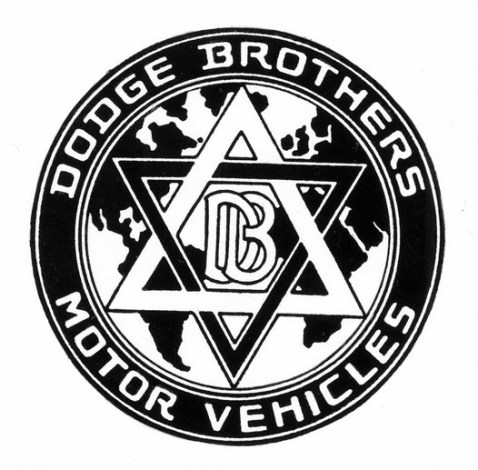
Dodge Brothers logo used from 1914 to 1927
Six-Pointed Star (1914-1938): When the Dodge brothers, Horace and John, built their first automobile in 1914, their final touch was a small enamel badge on the radiator with their company logo: a circle with two interlocking triangles forming a six-pointed star in the middle; an interlocked “DB” was at the center of the star, and the words “Dodge Brothers Motor Vehicles” encircled the outside edge. Although similar to the Star of David, the Dodge brothers were not Jewish. Although the “Brothers” was dropped from the name for trucks in 1929 and cars in 1930, the DB star remained in the cars until the 1939 models were introduced.
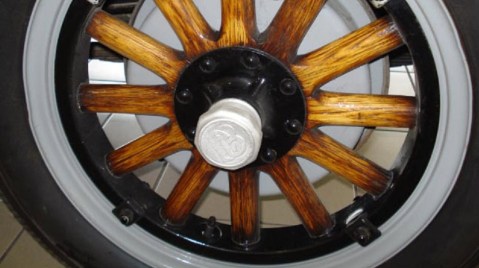
From 1928 Dodge Brothers Standard Six (intertwined “D” and “B”). Photo by Reed Brothers Dodge
 Ram: For 1932, Dodge cars adopted a leaping ram as the car’s hood ornament. Starting with the 1940 models the leaping ram became more streamlined and by 1951 only the head, complete with curving horns, remained. The 1954 model cars were the last to use the ram’s head before the rebirth in the 1980s. Dodge trucks adopted the ram as the hood ornament for the 1940 model year with the 1950 models as the last.
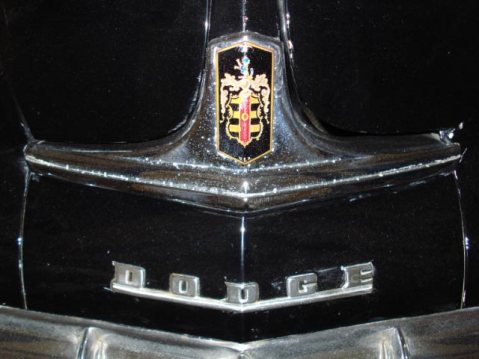
The hood of this 1946 Dodge Deluxe Fluid Drive Sedan is stamped with the Dodge coat of arms and “DODGE”. Photo by Reed Brothers Dodge
Crest: For 1941, Dodge introduced a crest, supposedly the Dodge family crest. The design had four horizontal bars broken in the middle by one vertical bar with an “O” in the center. A knight’s head appeared at the top of the emblem. Although the head would be dropped for 1955, the emblem would survive through 1957 and reappear on the 1976 Aspen. The crest would be used through to 1981 on its second time around, being replaced by the Pentastar for 1982. The knight’s head without the crest would be used for 1959.
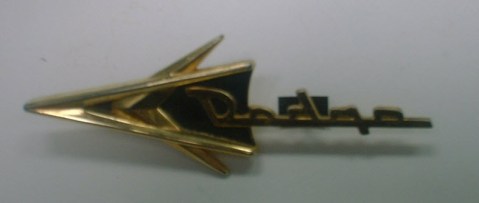
Forward Look
Forward Look (1955-1962): After the Dodge family crest was used between 1941-1957, Virgil Exner designed Dodge’s “Forward Look” logo: two overlapping boomerang shapes that suggested progress and forward motion. The design was heavily influenced by developing rocket propulsion technology and was named after the redesign campaign being used on the Chrysler Corporation’s vehicles.
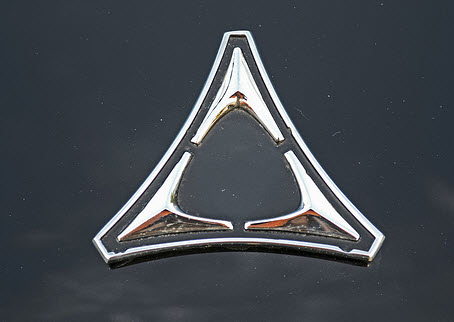
Fratzog
Fratzog (1962–1981): From 1962 to 1981, the Dodge emblem had a colorful internal label: It was called a fratzog. If you’re wondering what that word means (it sounds German, doesn’t it?), it’s totally meaningless. Three arrow shapes pointed inward to form a three-sided star. Not knowing what else to call the imaginative design, a Dodge designer made up the whimsical name.

Red Dodge Pentastar
Pentastar (1982-1992): For a decade, Dodge adopted Chrysler’s Pentastar logo on its vehicles, which had been used for corporate identification since 1962. To differentiate itself, Dodge’s Pentastar was red, while Chrysler-Plymouth’s was blue.
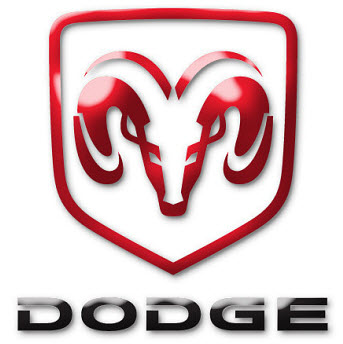
The Ram logo, used 1993–2010
Ram’s head (1993–2010): Dodge reintroduced the ram’s head hood ornament on the new 1973 Dodge Bighorn heavy duty tractor units. Gradually the ram’s head began appearing on the pickup trucks as Dodge began to refer to their trucks as Ram. The present iteration of the Ram’s-head logo appeared in 1993, standardizing on that logo in 1996 for all vehicles except the Viper, which uses the Viper’s Head.
 New Dodge logo (2010): When Ram Trucks was relaunched as its own brand in 2009 and used Dodge’s logo, Dodge was forced to replace its own. The present Dodge logo features several shades of silver and red colors. The Dodge inscription is all silver, but has a light hue at the top and dark, or rather grey, at the bottom. It stands for grandeur, dignity and sophistication. The two inclined stripes at the right side of the logo are painted red to symbolize passion and excitement, associated with the company’s vehicles. The new logo was unveiled in late May 2010.
Sources: Cartype, Wikipedia, Allpar, Dodge Brothers Club
Books

Related Resources


Copyright Notice

Reed Brothers Dodge History (1915-2012) by Jeanne Gartner is licensed under a Creative Commons Attribution-NonCommercial 3.0 Unported License.
 Reed Brothers Dodge History 1915 – 2012
Recent Comments