
Happy New Year 2018
 I would like to wish all the visitors and subscribers to this blog a Happy New Year and all the best for a happy, healthy and successful 2018. Thank you all for your support and for being loyal readers throughout the past year. Cheers!
Merry Christmas & Happy Holidays!

Reed Brothers Dodge Showroom, 2007
I would like to take this time to wish all the readers who find time in their hectic schedule to visit this blog a very Happy Holiday Season. Wherever your holiday celebration takes you, I wish all of you a safe, relaxing time spent with family and friends.
Business longevity is something to celebrate and share, and it’s an absolute honor and privilege for me to share the history of Reed Brothers Dodge with all of you!
To all of you who have stopped in to visit , whatever your faith, wherever you live – Happy Holidays,
Jeanne Gartner
Blog Author
Adopt-a-Dodge: Supporting the Preservation of the Dodge Brothers Legacy

Meadow Brook Hall purchased the 1925 Dodge Brothers Depot Hack from a Dodge Brothers Club member in 2014. Photo courtesy of Meadow Brook Hall
To show support to preserving the Dodge legacy, the author of this blog has “adopted” a Dodge car — a 1925 Dodge Brothers Depot Hackney — one of the historic vehicles in the Meadow Brook Hall Dodge Brothers automobile collection.

The inscription on the Adoption Certificate reads:
adopted by Jeanne Gartner in memory of her grandfather, Lewis Reed, who founded Reed Brothers Dodge in Rockville, Maryland in October 1915.
Depot Hackneys, later called station wagons, were designed to transport tourists and luggage from train stations to area hotels. Several companies made the wooden bodies, which would be installed on the chassis of different brands of cars. This truck is a very rare piece of Dodge history. Today, we call this type of vehicle a Taxi, which is what the word Hackney means. “Hack” is an abbreviated form of Hackney.
Madelyn Rzadkowolski, Curator at Meadow Brook Hall added, “The 1925 Depot Hack needs some work so your contribution in memory of your grandfather will really make a difference. Among other things, it needs new tires… two of them went flat last weekend when we were winterizing the cars.”
The vehicle was adopted for a period of one year, beginning November 14, 2017 through November 13, 2018 (November 14 is the anniversary of the day John and Horace Dodge revealed their first car in 1914). The adoption will help Meadow Brook make necessary repairs, provide preventative maintenance and pay insurance for the Depot Hack, ensuring it’s there to inspire, educate and “drive” this and future generations. Lewis Reed is a perfect and most fitting parent.

1925 Dodge Brothers Depot Hack. Photo courtesy Meadow Brook Hall

Meadow Brook Magazine, Fall 2017
MEADOW BROOK HALL in Rochester Hills, Michigan was the estate of one of the world’s wealthiest and influential women of her time, Matilda Dodge Wilson. Matilda was the wife of John F. Dodge, co-founder of the Dodge Brothers Motor Car Company. Named a National Historic Landmark in 2012, MEADOW BROOK HALL strives to preserve and interpret its architecture, landscape, and fine and decorative art so that visitors may be entertained, educated and inspired by history.
47 Years Ago Today: New Facility Grand Opening
 Today marks forty seven years since the Grand Opening of Reed Brothers Dodge new showroom and service facility. When the state widened the roads in 1970, Lee Gartner purchased 4.37 acres of land from Eugene Casey and relocated Reed Brothers Dodge to a new state-of-the-art showroom and Dodge/Chrysler/Jeep service complex on Route 355 at 15955 Frederick Road in Rockville Maryland.
Turning out to honor the company were several hundred dignitaries, officials, businessmen and friends. The new building, a complete automotive sales and service facility marked Reed Brothers 55th year of selling Dodge’s. The state-of-the-art dealership contained the newest customer-focused features throughout which combined technology and comfort.
The new dealership provided a modern new vehicle showroom, 30 service bays, a comprehensive detail and car wash area, Parts Department, Body Shop, the newest technologies to service customer’s vehicles and provided customers with a convenient location to purchase and service their vehicle needs.
Design and construction of the new dealership was managed by the Glen Construction Company.

 Photos taken at the Grand Opening. (click photos to scroll through gallery)


Happy Birthday Lewis Reed!


Lewis Reed was born in Darnestown, Maryland on November 25, 1887 and was the founder of Reed Brothers Dodge. When Lewis Reed opened his car dealership in October 1915, he never knew he was starting a family tradition that would be carried out for 97 years and three generations. He founded what would become the oldest Dodge dealership under the same family ownership in the state of Maryland, and one of the oldest in the entire nation.
In 1914, Lewis Reed became a partner in Rockville Garage, a business he purchased in 1918. His brother Edgar joined the business in 1919 upon his return from World War I, and the name became Reed Brothers Dodge. Lewis Reed was the first to sell Dodge cars in Montgomery County, Maryland and his company was the first Gulf gas dealer in the Washington, D.C. area. During the early years, Reed Brothers represented several franchise nameplates along with Dodge, including Oldsmobile, Hudson and Essex. The Hudson and Oldsmobile were sold at Reed Brothers from roughly 1917 through 1923.
Initially, Reed Brothers sold Oldsmobile and Hudson along with Dodge. The first Plymouth was built in 1928 and Plymouths were sold at Reed Brothers from 1930 until 1969, when the Plymouth car was given to the Chrysler dealers. In 1928, when Walter P. Chrysler took over after Horace and John Dodge died, Lewis Reed became an original member of the Chrysler family. By 1929, when the stock market crashed and Great Depression began, nobody could afford to buy cars. Like most other businesses, the Great Depression hit hard and Reed Brothers had to rely on its Service Department to make ends meet.
Before becoming interested in automobiles, Lewis Reed was one of the original employees of the Computing-Tabulating-Recording Company, a Georgetown-based manufacturing firm that eventually became International Business Machines, Inc. He received his automotive training at the Pierce-Arrow factory in Buffalo, New York, the Dodge Hamtramck and Hudson Motor Car factories in Detroit, Michigan, and the Washington Auto College.
When World War I broke out, Lewis Reed along with many other patriotic men joined the war effort. He did his bit in World War I by working at the Navy Yard in Washington DC as a torpedo tester.
Lewis Reed was very active in his community and in his church. He was a member of the Gaithersburg Grace Methodist Church, where he served as a member and Chairman of the Board of Stewards, a Lay Leader and President of the Men’s Bible Class. He was a charter member and Past President (Feb 1933 – Feb 1937) of the Gaithersburg-Washington Grove Volunteer Fire Department and a member of the advisory board of the Rockville branch of the First National Bank of Maryland. Lewis Reed belonged to the Masonic Lodge of Rockville, the Pentalph Chapter of the Eastern Star and the Rockville Rotary Club. He was a Rotarian for 34 years and also had served as President of that group.
Active in the dealership daily until the day of his death, Lewis Reed died on January 28, 1967 at the age of 79. Shortly after his death, the Senate of Maryland passed SENATE RESOLUTION NO. 10 honoring the well-known Rockville automobile dealer for his personality and outstanding contributions. The resolution was sponsored by Senator Thomas M. Anderson, Jr and Senator Louise Gore. At the time of his death, he was in negotiations with the State Roads Commission on the Commission’s proposal to take over a portion of his business property for construction of an interchange at Rockville Pike, Hungerford Drive and Veirs Mill Road.
In recognition, the state of Maryland named the connector street behind the original location, “Dodge Street,” commemorating Reed Brothers’ presence from 1914-1970. When the state widened the roads in 1970, the dealership relocated to Route 355 at the Shady Grove Metro.
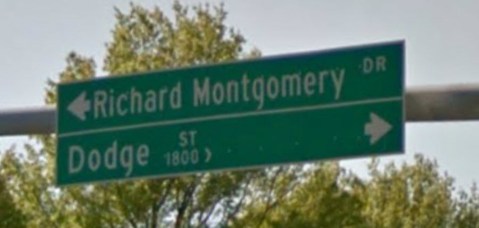 When you look back and consider what has taken place in the world in the past 100 years or so, you gain a perspective of what Lewis Reed faced. He overcame a lot of obstacles throughout his life. He steered his dealership through World War I, The Great Depression and World War II. When Reed Brothers had no new cars to sell for three and a half years and many dealers went bankrupt, he converted his car showroom into a display room and sold GE washing machines and other appliances. Reed Brothers Dodge occupied two locations, the original at the Veirs Mill Road and Rockville Pike intersection and the second at 15955 Frederick Road in front of the Shady Grove Metro.
Lewis Reed set an outstanding example through his success, but more importantly through his sacrifices and commitment to the community he served. Today, Bainbridge Shady Grove Metro Apartments pays homage to the oldest Dodge dealership in Maryland with commemorative art on the former site of the iconic Reed Brothers dealership.
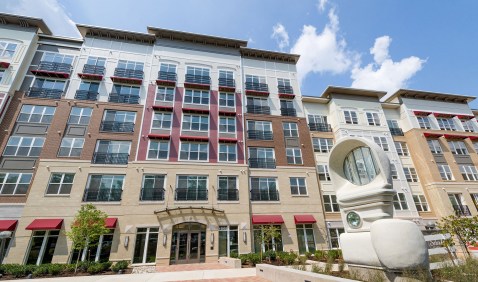
Bainbridge Shady Grove Metro Apartments now stands on the former site of the Reed Brothers Dodge dealership at 15955 Frederick Road. But a sculpture now installed on the property pays tribute to the oldest Dodge dealership in Maryland history. More than 20 feet high, and over 6 feet wide, the public art is inspired by 1939 Dodge headlamps, and the fender of a 1957 Dodge pickup truck.
Books

Related Resources


Copyright Notice

Reed Brothers Dodge History (1915-2012) by Jeanne Gartner is licensed under a Creative Commons Attribution-NonCommercial 3.0 Unported License.
 Reed Brothers Dodge History 1915 – 2012
Recent Comments