
Rockville B&O Railroad Station, Early 1900s

Rockville B&O Train Station early 1900s. On the left, a horse-drawn carriage has just left the station. Photo by Lewis Reed
Built in 1873, the station was one of several stops along the route between Washington’s Union Station and Point of Rocks where the Metropolitan Branch joined the B&O Main Line of the railroad. Along the route of the railroad were twenty-six stations. In the early days people came to the stations on foot, on horseback, in buggies. Some wives took their commuting husbands to the station in the buggy in the morning and then met the train as it came through in the evening.

Lewis Reed using a tripod and five-by-four box camera to shoot photos of an arriving B&O train.
While the station helped to spur Rockville’s early growth, development pressures would later threaten its existence. In the mid-1970s Metro’s original plans for the Rockville Metro Station and the final phase of construction on the Red Line called for the demolition of the B&O Station which by then was disused and in disrepair. However, Peerless Rockville, then only one year old, brought the station’s plight to the attention of the City and Metro, ultimately negotiating a compromise—the station and its freight house would not be demolished, but instead would be relocated so that a new tenant could be found to occupy the historic buildings, while allowing the Metro construction to continue as planned.
In 1981, the 400-ton station carefully was lifted off of its foundation, moved approximately 30 feet to the south, and reoriented 180 degrees so that the train platform which originally faced the tracks now faced Church Street and the Wire Hardware Store.
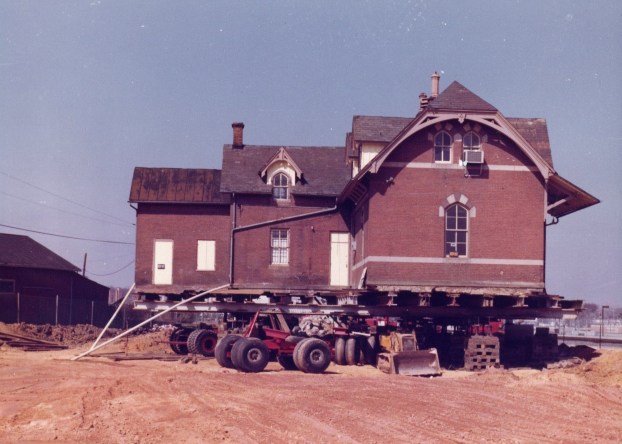
Relocating the 400-ton Passenger Station, 1981. Photograph by John Spano via Peerless Rockville
Reed Brothers Dodge & Plymouth Service Repair Invoice
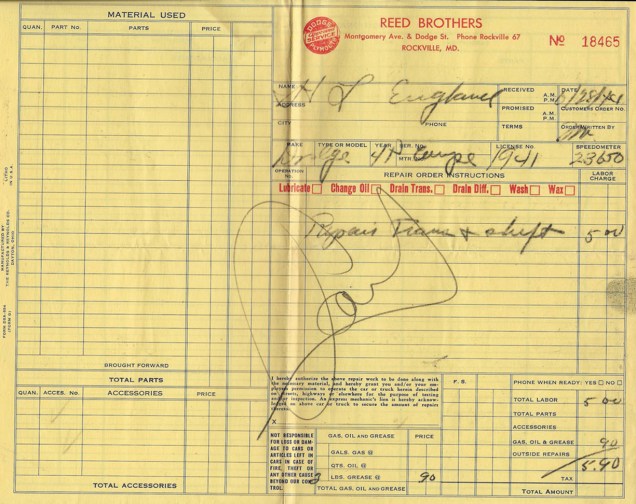
Reed Brothers Dodge & Plymouth Service Repair Invoice – June 28, 1944
If you’ve had an automobile repaired recently, you might enjoy seeing this Reed Brothers Dodge Service Invoice No.7577 dated June 28, 1944. Reed Brothers address at the time was 600 East Montgomery Avenue Rockville. The fact that the phone number was just ’67′ gives a real feeling of how different life was back then.
H.L. England’s name is on the invoice and his car was a 1941 Dodge Coupe. Harrison L. England was active in land development of older Rockville, including Lincoln Park and Croydon Park. He was born in a building known as Hungerford Tavern on N. Washington Street and operated a business under the name of Suburban Properties. His father was John G. England, the first mayor of Rockville.
In 1930, Reed Brothers added the Plymouth line. The first Plymouth was built in 1928 and Plymouths were sold at Reed Brothers until 1969, when the brand was given to the Chrysler dealers.
Check out the invoice… $5.00 labor and 90 cents parts for a total of $5.90!
Lewis Reed Shows Off His “Photoshopping” Skills… 100 Years Ago
If you take a look at the state of photography today, such as the advances of digital cameras and the artful image manipulation by Photoshop, it is easy to forget that back in the 1900s photographers couldn’t just go into a computer program and change their images any way they wanted. They did what they could with the tools they had. Double image exposure was one tool Lewis Reed had in his photography tool belt. He was doing crazy things to images and creating humorous effects over 100 years ago. With double exposure technique, you could create certain effects like placing the same person on both sides of a picture simultaneously. Photographs were pieced together in the darkroom from separate photographs.
Below are eight (circa 1920s) photographs from Lewis Reed’s collection that will make you do a double take. No digital manipulation here. (click on photos to enlarge)

A double exposure image of Lewis Reed’s brother, Edgar, seated on both sides of a table.
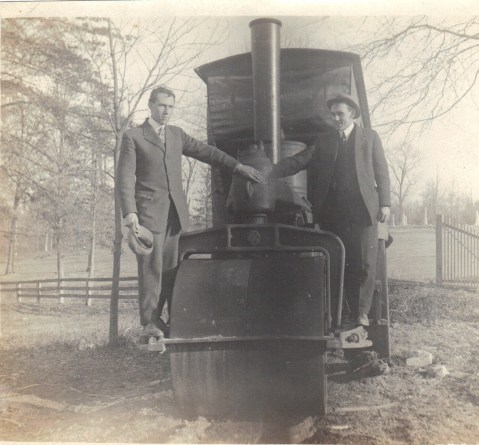
Lewis Reed standing on both sides of a steamroller

Another double exposure wonderment. Wanna Fight?

Oh No! What on earth are they doing? I don’t know, but this one is epic.
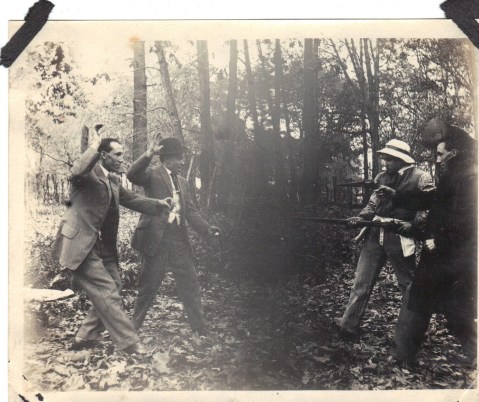
Don’t Shoot! Lewis Reed is standing both front left and front right in this photo
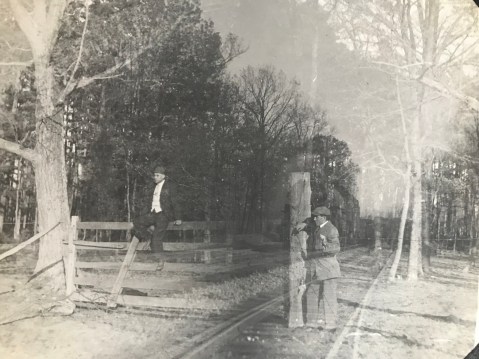
Surrealistic, ghost-like effect of Lewis Reed standing next to a tree in the middle of train track.

More “photoshop” fun. Lewis Reed pushing the same man in baby carriage on both sides of the photo.
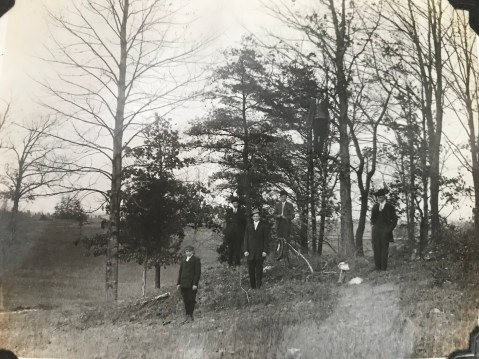
It’s a bird, it’s a plane .. no, it’s a man up in a tree!
The Reed Family (Blacksmithing in Darnestown c. 1870)

Philip Reed outside of his Blacksmith Shop in Darnestown, Maryland c. early 1900s. Photo by Lewis Reed
Philip Reed (1845-1918), father of Lewis Reed, was an early settler in Darnestown, Maryland. He was a Blacksmith. Blacksmiths were once important members of the Darnestown community. They provided a vital trade that continued up to the mid-20th century. Born in Darnestown, Maryland on March 17, 1845, he was raised in a family that survived on knowledge and hard work. In 1870, at age 25, his occupation is listed as a Cabinet Maker and Blacksmith. Darnestown residents of that time included a doctor, a merchant, a blacksmith and a wheelwright. It seems Philip Reed may not have considered his primary occupation as a Wheelwright, but I do know that he had a Blacksmith shop on his land and he worked with both cabinet maker and blacksmith skills.
A blacksmith is a metal worker who creates objects from iron or steel by heating the metal and using tools to hammer, bend, and cut it. Civil war armies used blacksmiths to shoe horses and repair things such as wagons, horse tack, and artillery equipment.
A wheelwright is someone who makes and repairs wheels. Early wagon and cart wheels were made of solid wood, but increasingly had iron parts, such as hubs and rims. It would not be unusual for one man to be both a blacksmith and a wheelwright, for wheelwrights were sometimes described as a cross between a carpenter and a blacksmith.

Reed farmhouse and blacksmith shop in Darnestown, MD (Route 118). Photo by Lewis Reed
1940s Full Service Gulf Station
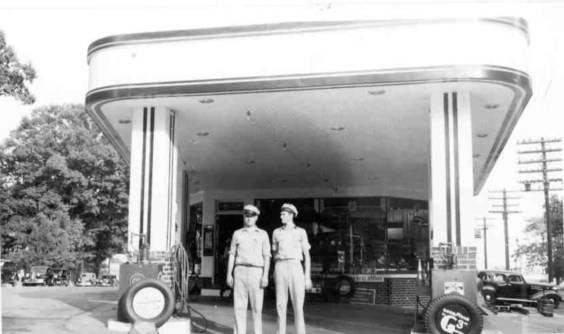
Reed Brothers Dodge Canopied Gulf Gasoline Station circa 1940
This is a previously unpublished photo of Reed Brothers Dodge full service Gulf Gasoline Station with two gas station attendants standing in front. Professional service was very important in the first half of the twentieth century, so it was common for gas station attendants to wear the company uniform.
Reed Brothers Dodge was the first Gulf gasoline dealer in the Washington, D.C. area. In 1915, they began selling gas at their original location in Old Rockville at the triangle at Veirs Mill Road and Rockville Pike. Their first gas station consisted of a single pump. Later, in addition to gas, they carried a full line of Gulf lubricants, Goodyear tires, Willard batteries, complimentary road maps, free air and water, and many other well known brands of merchandise to meet their patrons needs. Reed Brothers discontinued offering this product line when they relocated to their new facility in November 1970.
Books

Related Resources


Copyright Notice

Reed Brothers Dodge History (1915-2012) by Jeanne Gartner is licensed under a Creative Commons Attribution-NonCommercial 3.0 Unported License.
 Reed Brothers Dodge History 1915 – 2012
Recent Comments