
How Reed Brothers Started & Survived Almost a Century
It was 103 years ago, in October 1915, that Lewis Reed signed a franchise agreement with brothers Horace and John Dodge in Detroit. He was just 27 years old. Since then, the business grew and transformed into the oldest Dodge dealership in Maryland history and one of the oldest in the entire nation. In 1914, Lewis Reed became a partner in Rockville Garage, a business he purchased in 1918. His brother Edgar joined the business in 1919 upon his return from World War I, and the name became Reed Brothers Dodge.

This photograph of the original 1915 Rockville Garage shows a 1916 Model 44 Oldsmobile parked in front. The original owners of Rockville Garage are standing in front. From left: Roy Warfield – Lewis Reed – Griffith Warfield.
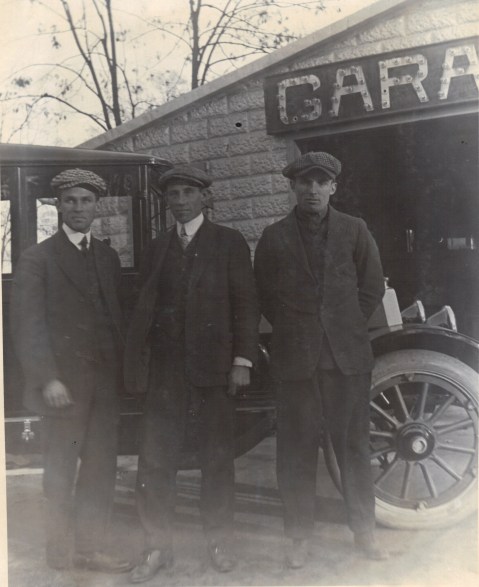
1916 – Original owners of Rockville Garage. From left: Roy Warfield – Lewis Reed – Griffith Warfield.
A mechanical aptitude was necessary to be a dealer in the early 1900’s. When cars were shipped to the dealer from the manufacturer, they arrived partially assembled in railroad boxcars. It was the dealer’s responsibility to unpack and assemble the cars at the rail yard and drive them back to the dealership. Mechanics were often needed to repair the new cars if they broke down along the way. Lewis Reed was an expert auto mechanic. He received his automotive training at the Pierce-Arrow factory in Buffalo, New York, the Dodge Hamtramck and Hudson Motor Car factories in Detroit, Michigan and the Washington Auto College.

1916 – The first shop force of Rockville Garage (from left: Lewis Reed, (first name unknown) Long and Phillip Reed.
The Great Depression
In 1928, when Walter P. Chrysler took over after Horace and John Dodge died, Lewis Reed became an original member of the Chrysler family. By 1929, when the stock market crashed and Great Depression began, no one could afford to buy cars. Like most other businesses, the Great Depression hit hard and Reed Brothers had to rely on its Service Department to make ends meet. But, the dealership survived through these lean times.
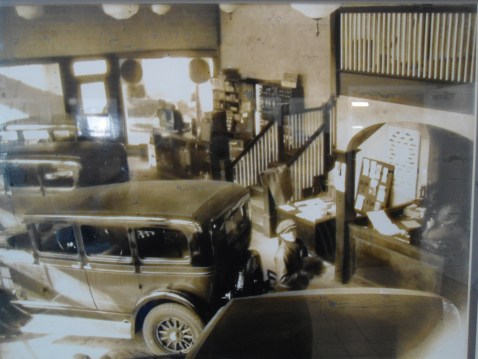
Late 1920s New Car Showroom
This new car showroom above is filled with late 1920s Dodge Brothers new car models. The showroom faced the triangle at Veirs Mill Road and Rockville Pike (now known as Veterans Park) which gave the dealership maximum visibility to the largest volume of cross traffic. Behind the large plate glass windows and an awning above was the product — the new car.
There were no salesman’s desks in the showroom until after World War II. Lewis Reed allotted specific sales territory to his salesmen in four different directions from the dealership. The salesmen spent all day in the outlying areas of Poolesville, Rockville, Barnesville and Spencerville demonstrating cars to potential customers. At that time, Reed Brothers was selling about eight new cars a month and most sales resulted from knocking on people’s doors. It was direct person to person sales contact, relationship building and trust – all built and sealed on a handshake. Three of the four salesmen at the time were Francis O. Day, Raleigh S. Chinn and Benjamin J. Thompson.
United States Enters World War II
Reed Brothers faced another setback during World War II. All U.S. car manufacturers stopped production in order to concentrate on military equipment. Reed Brothers had no new cars to sell for three plus years. Many car dealers went bankrupt at this time. Lewis Reed converted his car showroom into a display room and sold GE washing machines and other large appliances to fill the gap. At this time, Reed Brothers had in their employ eight Veterans of World War II.
The Customers
Ask anyone who has been in the car business for a while how they create lasting customer relationships. They’ll tell you it’s through conversation. In Lewis Reed’s day, a customer would come into the showroom and sit for hours and talk about local sports teams, the weather or family. But they’d never mention an automobile. Then, the customer would come back, maybe talk a second day. And on the third day, they’d get down to talking about a car. But it was all cautious, deliberate and very polite.

Lewis Reed (right) in new car showroom talking with a customer
The Cars
New car introduction was always one of the most exciting times at Reed Brothers. It was a once-a-year celebration that everyone looked forward to attending. For the salesman, it meant additional car sales. To the dealership, it was another method to reach out to hundreds of current and potential customers, not only for new car sales, but also to advertise the dealership’s other services. Many sales were made during new car introduction by those customers who had to be the first on their block to own one of the new models.
To attract drive-by motorists, large signs were placed in the showroom windows hyping the new year models: Dart, Lancer and Polara. Back in the day, there was tremendous brand loyalty. Customers who bought Dodges, usually bought them for life. In fact, many former customers traded every year and would buy a car on the spot. In the 1960s, new car introduction was a much more important part of the American automotive buying habit.

1961 – Lewis Reed (left) and James Gartner, Salesman, stand in front of the new car showroom
Setbacks
Reed Brothers Dodge successfully navigated through numerous Chrysler setbacks during the 1970’s and 80’s, including the first Chrysler Bailout, the sale of Chrysler to Daimler, and the sale to the private equity firm Cerberus. Reed Brothers met the challenges of gasoline shortages, high interest rates, severe inflation, and weakening consumer confidence which drove Chrysler into financial crisis. This survival is testimony that the dealership not only conquered setbacks, but often rebounded to reach new levels of success.
When you look back and consider what has taken place in the world in the past 100 years or so, you gain a perspective of what Lewis Reed faced. He overcame a lot of obstacles throughout his life. He steered his dealership through World War I, The Great Depression and World War II. When Reed Brothers had no new cars to sell for three and a half years and many dealers went bankrupt, he converted his car showroom into a display room and sold GE washing machines and other appliances.
Transformation
Chrysler filed for Chapter 11 bankruptcy protection. Chrysler terminated 789, or about 25% of its dealerships by June 9. The cuts resulted in an estimated 38,000 job losses. Whether a franchise was run by a second- or third-generation dealer, or is older than even Chrysler itself, didn’t seem to matter when Chrysler decided to cut dealerships ranks during their 2009 bankruptcy process. After almost 95 years selling Dodges, Reed Brothers was one of the 15 dealerships in Maryland and 789 dealerships nationwide notified by Chrysler that their franchise agreement would not be renewed.
During this time when many car dealers had to close their doors, Reed Brothers made behind-the-scenes tweaks to withstand the economic downturn and the loss of their franchise. The signs standing outside on Rockville Pike still said Reed Brothers Dodge, but inside, a new business was forming: Reed Brothers Automotive.
A business landmark in the Rockville area since 1915, Reed Brothers underwent a change in its structure – and its name – but still catered to the local community as it had for decades. Reed Brothers changed its name from Reed Brothers Dodge to Reed Brothers Automotive, and continued on as a used car dealer and repair shop until 2012.
Legacy
Over 100 years later, the only name that remains familiar to Rockville car buyers is Lewis Reed. Reed Brothers Dodge was one of the longest running automobile dealers in Montgomery County Maryland, serving Rockville and the area for over 97 years. Along with St. Mary’s Church (1813), King Farm (1925), Red Brick Courthouse (1891), and the B&O Railroad Station (1873) — Reed Brothers Dodge (1915) — became a “Peerless Place” in 2015, the year marking its 100th Anniversary. Today, Bainbridge Shady Grove Metro Apartments pays homage to the oldest Dodge dealership in Maryland history with commemorative art on the former site of the iconic Reed Brothers dealership.
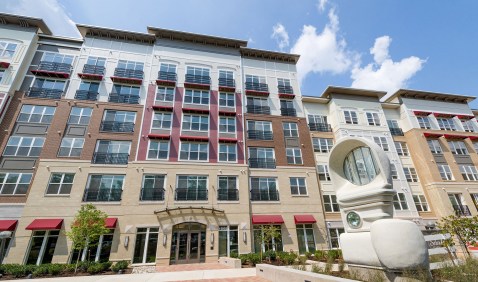
Bainbridge Shady Grove Metro Apartments now stands on the former site of the Reed Brothers Dodge dealership at 15955 Frederick Road. But a sculpture now installed on the property pays tribute to the oldest Dodge dealership in Maryland history. More than 20 feet high, and over 6 feet wide, the public art is inspired by 1939 Dodge headlamps, and the fender of a 1957 Dodge pickup truck.
Bainbridge Shady Grove Metro lives up to its motto: “Great Stories Start Here.”
Reed Brothers Baseball Team, 1920
Rockville’s first experience with baseball was during the Civil War on the fields where Richard Montgomery High School now stands. It was known as “Camp Lincoln” because of the Union encampment there, and Federal soldiers helped popularize the new game they brought from the North. One little known part of the history of the grounds is that during the Civil War, President Abraham Lincoln was afraid that Maryland would secede from the Union and that the District of Columbia would thus be bordered on both sides by Confederate states. He used the land of the fairgrounds for tents to maintain up to 10,000 Federal soldiers at a time in order to do his utmost to keep Maryland, especially via the major thoroughfare of Rockville Pike, within the Union.
After the Civil War, those fields – known as the Rockville Fairgrounds – continued to be a popular place for baseball. At the dawn of the 20th century, Reed Brothers Dodge had their own company baseball team that played on those same fields. The photos below were taken by Lewis Reed on a field at the Rockville Fairgrounds in the early 1920s.
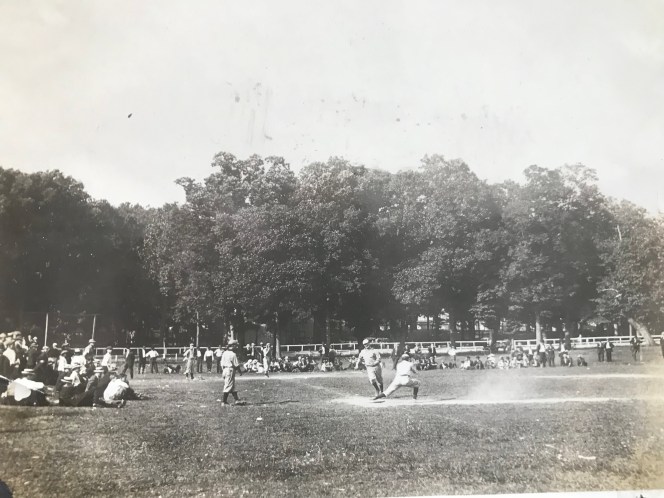
Reed Brothers Dodge Baseball Team on field at Rockville Fairgrounds, circa early 1920s. Photo by Lewis Reed
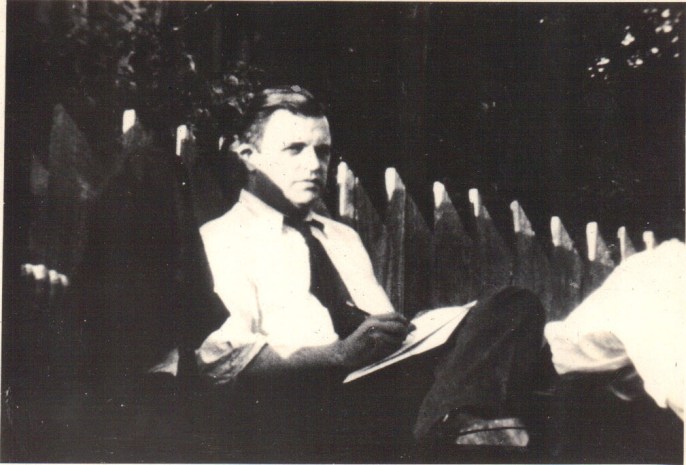
Leo (Pat) Murray (Parts Department Manager), keeping score. Photo by Lewis Reed

Reed Brothers Dodge Baseball Team on field at Rockville Fairgrounds, circa early 1920s. Photo by Lewis Reed
Note the player with the five finger glove in the photo above. Out of all of these photos, this is the only glove that can be seen on a player. The use of gloves wasn’t original to the first years of the game; needing a padded glove was viewed as pretty wimpy. (According to this article in the Smithsonian Magazine, one of the first players to wear a glove tried – and failed – to find one that would be invisible to fans.) By the 1880s gloves were accepted equipment, however, and soon inventors and manufacturers were coming up with new and improved gloves (more padding, deeper webbing…)

Reed Brothers Dodge Baseball Team, circa early 1920s. This photo was taken at Welsh Field, which is the site of the County Office Building. The house in the background was in right field. Photo by Lewis Reed
Lewis Reed: Enters 1936 Amateur Photo Contest
The Star published a series of pictures reproduced from photographs taken by local amateurs. The pictures were selected and judged each week and the best one chosen on its merits and published the following Sunday. Lewis Reed submitted his photo, “Sunset Over the River”, in the Washington Star Best Snapshots of the Week in The Star’s Amateur Contest. There was no indication where the photo was taken, but I’m guessing it was probably on the Potomac River, Maryland. At the time, Lewis Reed would have been 49 years old. There was no mention of whether or not he won a prize for his photograph, but I’m not surprised he entered this contest. He was a passionate photographer and always had his camera with him.
The full page image below is from the Sunday Gravure Section of The Washington Star newspaper. When looking at the top of the page, I wondered what the term “Gravure” meant, so I “googled” it. Turns out gravure refers to the special newspaper sections of photographs which were printed with this process starting around the late 1800s. In the 1930s, newspapers published relatively few photographs and instead published separate gravure sections in their Sunday editions. These sections were devoted to photographs and identifying captions, not news stories.

Full page image from The Sunday Star, Washington, D.C. – Gravure Section – June 28, 1936.

“Sunset Over the River” taken by Lewis Reed in 1936
Lewis Reed was a well-known photographer in Montgomery County and many of his photographs are now part of the Montgomery County (Maryland) Historical Society photo archives. His photography has appeared in highly regarded history books such as, “Montgomery County: Two Centuries of Change” by Jane C. Sween, “Montgomery County (Then & Now)” by Mark Walston, “Montgomery County (MD) Images of America”, by Michael Dwyer, “Rockville: Portrait of a City” by Eileen S. McGuckian, and “Gaithersburg: History of a City”. His photographs have been featured in the Norris-Banonis Automotive Wall Calendar, on the national television show, American Pickers, and on television’s most watched history series, American Experience on PBS.
Happy 96th Birthday, Mom!

Mary Jane (Reed) Gartner
Today is a very special post in honor of my mother, Mary Jane (Reed) Gartner – 96 years young today! Not everyone lives long enough to celebrate their 96th birthday, so I’m thrilled to report that my mother is marking this momentous occasion today.
One of the most important things that I ever adopted to help me in achieving my goals were those I learned from my mother (Lewis Reed’s daughter). My mom taught me that I can do anything I set my mind to and that anything worth doing is worth doing well. With her as my inspiration, I have been able to fearlessly reinvent myself as my life and times have changed. I cannot express my gratitude for her in words, whose unconditional love has been my greatest strength. My mom has always motivated me to be successful, encouraged me in all of my pursuits, and instilled in me the belief that I can achieve whatever it is that I desire. Her motto is one that I still live by to this day, “There is no such thing as can’t.” Instead of giving myself reasons why I can’t, I give myself reasons why I can.
Thanks mom, for showing me that anything is possible through hard work and perseverance, and for the 68 years of love and support you have given me.
Happy Birthday Wishes from your eldest! I love you!!!
Evolution of Reed Brothers Gas Stations
Before the advent of the service station more than a century ago, fueling up was an adventure for our ancestors. Pioneering motorists had to take a bucket to the general store, hardware dealer, drugstore or local refinery and fill up from a gasoline barrel. In 1905, gas pumps begin to replace the bucket and funnel method for refueling. Early gas pumps were generally deployed curbside in front of general stores, pharmacies, hardware shops and even blacksmith shops.
Reed Brothers Dodge was the first Gulf gasoline dealer in the Washington, D.C. area. In 1915, they began selling gas at their original location in Old Rockville at the triangle at Veirs Mill Road and Rockville Pike. Their first “gas station” consisted of a single pump. Motorists in Rockville could stop at Lewis Reed’s Rockville Garage to buy Fisk tires and auto supplies, and then fill up at the single pump at the curb. Later, in addition to gas, they carried a full line of Gulf lubricants, Firestone and Goodyear tires, Willard batteries, complimentary road maps, free air and water, and many other well known brands of merchandise to meet their patrons needs.

1915 — Motorcyclists filling up at Rockville Garage first “gas station” – a single pump. Photo by Lewis Reed
In circa 1917, Reed Brothers became an authorized Texaco Filling Station and sold Texaco gasoline, also from a single pump. The photo below is the original Rockville Garage located at the intersection of Veirs Mill Road and Rockville Pike. To the right is a Texaco Gasoline Filling Station sign. One very tall Texaco branded fuel pump can be seen in this photo along with two Texaco Petroleum refueling trucks.

1917 — Original Rockville Garage with 2 story addition. Note the Texaco Filling Station signage and the Texaco Petroleum fuel truck refilling the single pump in front. Photo by Lewis Reed
At some point prior to 1920, Reed Brothers Dodge changed over from selling Texaco and became a Gulf Gasoline dealer. By this time, gasoline retailers had determined that placing gas pumps on an “island” in front of the station, where drivers could approach from either side, provided the most efficient station layout. Reed Brothers got a new facelift and remodel in 1921, and an island with three new modern gas pumps were added. Visible pumps like these, used a graduated glass cylinder to show customers the quality and quantity of gas being purchased. Glass globes, like Good Gulf, usually topped the pumps and advertised the company’s brand and name.

1921 — Reed Brothers Dodge got a new facelift and remodel. Note the island with three new Gulf gas pumps. Photo by Lewis Reed
The first uniformed gas station attendants appeared at Reed Brothers around 1920. The Gulf station included a manager and four attendants. Attendants worked long hours in all weather, possessed a thorough knowledge of service requirements for various automobile makes and models, improvised quick repairs on the spot, provided directions to lost travelers, and did it all with a smile. The four men dressed in uniforms and caps in the photo below were Gulf Gasoline Station attendants. Three of the original gas station attendants were Walter (Bud) Beall, Otis Beall and John Burdette.

Rockville Garage Sales & Service Staff circa 1920s. Photo by Lewis Reed
In the 1920s, the Gulf Refining Co. adopted a brick and tile roof station with canopy supported by four brick columns covering two front driveways. Below are architectural changes in the Reed Brothers Dodge front that were taken in the late 1920s. A modern drive-through canopy was added along with new gasoline pumps. A close-up view can be seen of the new gasoline pump-island with four pumping units along with the motor oil dispensers used at that time. The old pump island can be seen to the left along with a new “That Good Gulf Gasoline” sign.

Late 1920s — That Good Gulf Gasoline drive-through filling station with canopy and gasoline pumps were added in the late 1920s. Photo by Lewis Reed
Below is a circa 1940 photo of Reed Brothers Dodge full service Gulf Gasoline Station with two gas station attendants standing in front. Professional service was very important in the first half of the twentieth century, so it was common for gas station attendants to wear the company uniform.
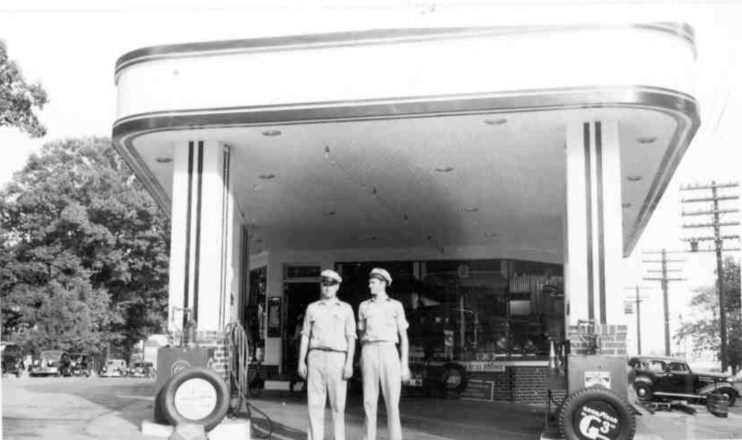
1940 — Reed Brothers Dodge canopied full service Gulf Gas Station. Photo by Lewis Reed
Reed Brothers Service Station provided restrooms for the traveling public. Patrons wanted clean and safe facilities. In addition to the Gulf signage there is a small, barely visible sign below that promotes, “Clean Rest Rooms” which assured the traveler that the restrooms were well maintained.

1936 — Reed Brothers Dodge canopied Gulf Gas Station. A closer look reveals the price of gasoline as 15 cents. On the right attached to a telephone pole is a sign pointing the way to Olney. In addition to the Gulf signage there is a small, barely visible sign below that promotes, “Clean Rest Rooms”. Photo by Lewis Reed
Due to changes in the highway, Reed Brothers began an extensive remodeling and rebuilding program. Two-thirds of the original location at the junction of then Route 240 and Veirs Mill Road was razed and a modern Gulf Service Station was erected.
The photo below is a circa 1968 photo of the Reed Brothers Dodge Gulf Gasoline station. The famous Gulf “ice box” design dates back to late 1930’s and there were probably more of these built than any single one of the later Gulf designs. A Coca Cola machine is visible in front of the white Dodge Dart parked in front of the service bay. The sign in the grass to the right of the blue ’58 Plymouth (Belvedere?) reads, “We’re Making Deals on Gulf Tires”.
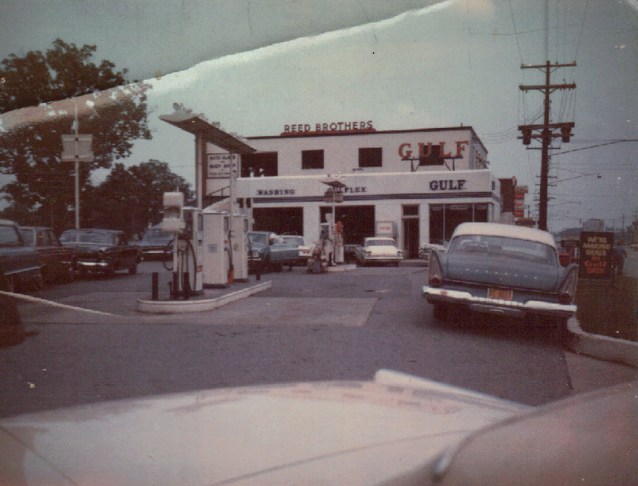
1960s — Reed Brothers Dodge Full Service Gulf Station. Photo by Lewis Reed
Reed Brothers Dodge discontinued offering Gulf Gasoline when they relocated to their new facility in November 1970.
Books

Related Resources


Copyright Notice

Reed Brothers Dodge History (1915-2012) by Jeanne Gartner is licensed under a Creative Commons Attribution-NonCommercial 3.0 Unported License.
 Reed Brothers Dodge History 1915 – 2012
Recent Comments