
A Tribute To My Father On His Birthday

Today marks the birthday of my late father, Ernest Lee Gartner. If he were still around he would be 99 years old today. Much of my passion and drive stems from the life and business lessons I learned from my father. In this special post, I thought I would take a moment to reflect on his influence in my life that has helped make me into the person I am today.
My father was a kindhearted, stubborn, difficult, witty, and an amazingly savvy businessman. My dad gave me his strong points and showed me the blueprint for how to be successful: including a strong work ethic and instilling within me the belief that I can achieve whatever it is that I desire.
I learned from his example and internalized his high expectations. He went to work every day until the day he died. Some people might have called him a workaholic, but he never gave anything less than 100% to his job. He has handed down his natural leadership abilities, which have helped me achieve a number of career “firsts” while I was in the Air Force, and ultimately reach the top enlisted position as the first female Command Chief of a premier Air Force unit.
What I learned from my father that made me a better person was his example of always trying to learn more. He was invested in self-improvement and always read books, magazines and newspapers. This was a great influence growing up and helped me put ongoing time into learning. Ask questions when you don’t understand something and don’t be afraid to seek out more information. Looking back, researching solutions to problems was a completely natural process for me thanks to my father’s example.
My father taught me that I can do anything I set my mind to and that anything worth doing is worth doing well. It’s great advice I still live by today. His example made a lasting impact on me and I have to credit him for my constant quest for knowledge and excellence.
My father’s greatest gift to me was the drive to persevere. He taught me courage in the face of adversity, more than any other human being I have ever met. Lee Gartner successfully navigated Reed Brothers Dodge through numerous Chrysler setbacks, including the first Chrysler Bailout, the sale of Chrysler to Daimler, and the sale to the private equity firm Cerberus. He applied his 30+ years experience with Reed Brothers to meet the challenges of gasoline shortages, high interest rates, severe inflation, and weakening consumer confidence which drove Chrysler into financial crisis. This survival is testimony that he not only conquered setbacks, but often rebounded to reach new levels of success. He was a hard worker, he was the type that persevered.
I will always remember my dad as a successful businessman whose persistent energy was always there for family, but in equal measure for the public he served. He was smart and also honest and dependable – characteristics that kept Reed Brothers Dodge at the pinnacle of auto dealerships throughout his career.
I never had a chance to tell my dad how much I admired him, but I remain proud of him and his accomplishments. Lee Gartner continued what Lewis Reed built from the ground up and helped make Reed Brothers Dodge into a successful family business that lasted almost a century.
My dad set a standard of excellence and provided a set of values for my life that I still follow today. Dad, this is for you.. Happy Birthday!
Montgomery History Online Exhibit: Montgomery County 1900-1930: Through the Lens of Lewis Reed

Opened January 7, 2020
Curated by Jeanne Gartner and Sarah Hedlund
Discover Montgomery County in the early 20th century through the remarkable photography of Lewis Reed, founder of Reed Brothers Dodge. An avid photographer and pioneering automobile dealer, Reed documented the region during his motorcycle journeys across Maryland, capturing the transformation of transportation, daily life, recreation, and community scenes from 1900 to 1930. His photographs offer an intimate window into the people, places, and moments that defined the county and shaped broader American history.
This online exhibition was carefully curated by Jeanne Gartner, granddaughter of Lewis Reed and co-owner of Reed Brothers Dodge, in collaboration with Sarah Hedlund, Archivist and Librarian at Montgomery History. Jeanne’s curatorial vision was instrumental in organizing these photographs into thematic galleries that illuminate Reed’s artistic legacy and documentary purpose, from the evolution of transportation and leisure pursuits to innovative photographic techniques and local economic growth.
Together, these images form a vital portrait of Montgomery County over a century ago, revealing Lewis Reed’s deep appreciation for his community and his enduring commitment to preserving its history for future generations.
View the full exhibition online: https://sites.google.com/view/lewis-reed-photography/home
Rare Images of Early Rockville from Lewis Reed’s Collection
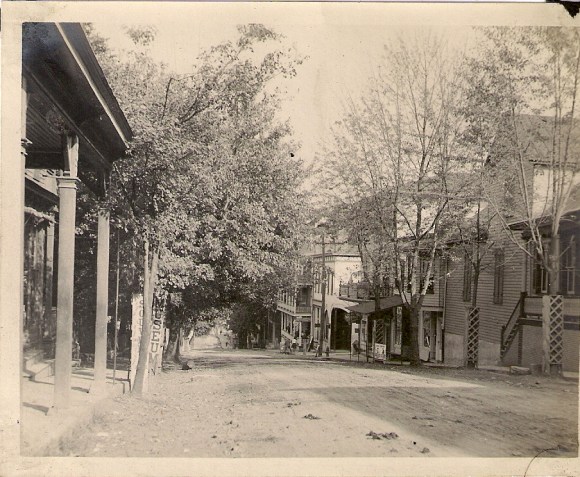
This photograph was marked only “Rockville.” Note that the sidewalks are board planks elevated from street level. Photo by Lewis Reed ca, 1912
What makes Rockville such an interesting place? It’s interesting history! Old photos have an amazing way of showing us what life was like years ago and depicting how our communities once looked. You might not realize how much things have changed until you look back and see what it looked like in the past.
A bit of Rockville history: More than 250 years ago, land grants to European settlers formed the nucleus for today’s Rockville, Maryland. By the 1750s local farmers were transporting tobacco to market in Georgetown down a road formerly used by Indians. The tiny settlement was designated as the seat of the new Montgomery County in 1776. Known as Rockville by 1803, the town’s life centered on Courthouse activity. More homes and shops were built, and the town of nearly 600 was incorporated in 1860. The dynamics that created Rockville in the 18th and 19th centuries are still the same ones attracting newcomers today: the presence of county government, a favorable location close to the nation’s capital, converging transportation routes that bring people here, and identity as an independent municipality.
Take a journey back in time through the lens of Lewis Reed and see what Rockville looked like more than one hundred years ago. As always, click the photos to get a better look.

North side of East Montgomery Avenue near the courthouse, ca. 1914. Note the trolley car on the left. Photo by Lewis Reed
Shops sold groceries, baked goods, sewing machines, hats, lumber, and hardware. Families lived above their stores, renting rooms to others.

Court House Triangle. The large white house behind the Confederate Statue is the Hicks House. The Montgomery House Hotel is to the right of the Hicks House, just out of the image. Photo by Lewis Reed, 1914
On September 28, 1917 a draft for World War I began and the first 40 men reported for duty at the Montgomery County Court House in Rockville, Maryland. In the photograph below, cars are parked around the court house during the speech-making in the court room to drafted men. Montgomery County’s first recruits left Rockville by train for Camp Meade, Maryland on this same day. They each received a package of smoking tobacco and a rousing send-off from two thousand people after speeches at the courthouse, dinner at the Montgomery House Hotel, and a parade to the depot. About 160 Rockville men served in the eighteen-month war. One of those men was Rockville resident, Edgar Reed. Edgar was fortunate enough to survive World War I and to settle back in Rockville and enjoy a successful life and career in the automobile business.

Montgomery County Court House. Photo by Lewis Reed, 1917.
Notice that most of the cars in the above photo have two license plates: at this time, you needed a separate tag to drive a car in the District of Columbia. There is also horse dung in the dirt road (E. Montgomery Avenue), suggesting buggies had been by recently as well. Barely visible in the background left is the Maryland National Bank building, which was demolished during urban renewal in the late 1960s.

Suburban Electrical Company on Montgomery Avenue in Rockville. Photo by Lewis Reed, ca.1914
The upper story of this building was the living quarters of Mr and Mrs B. F. Hicks. The building was later acquired by W. Valentine Wilson, who tore it down and replaced is with the “SECO” for Mr Wilson’s Suburban Electric Company. The ground floor was made into a moving picture theater.

W. Hicks General Store on Montgomery Avenue Rockville. Photo by Lewis Reed, ca. 1914
Washington Hicks operated this general or dry goods store in Rockville from the late 19th century until 1940. His son W. Guy Hicks continued to run the store until his retirement in the late 1950s. The photo above shows the storefront in 1914.

H. Reisinger Lunch Room on Montgomery Avenue Rockville 1914. Photo by Lewis Reed, ca. 1914
H. Reisinger Bakery, Confectionery, Ice Cream and Lunch Room, 5 and 10-cent Bargain Store on Montgomery Avenue, Rockville.
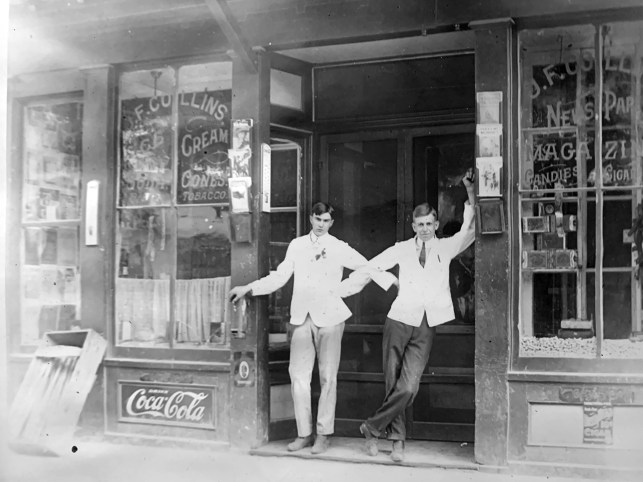
Clerks at J. F. Collins General Store on East Montgomery Avenue. Photo by Lewis Reed, ca, 1914
On a bleak night in February 1921, a pistol shot was fired while others yelled, “Fire!”. From John Collin’s store on East Montgomery Avenue — beloved by local children for Cracker Jacks and penny candy — flames reached toward the sky. Volunteers arrived with buckets while others operated the hose reels and hook and ladder truck. The main street was saved with help from men and equipment of Washington, D.C., but Collins’s store was a smouldering ruin. A few weeks later, fifty concerned townspeople elected officers of the newly formed Rockville Volunteer Fire Department.

Rockville looking east down Montgomery Avenue at Perry Street (now Maryland Avenue); Vinson’s Pharmacy is on the corner. Photo by Lewis Reed, ca. 1906.
Most roads in Montgomery County, even those running though towns, were dirt. In the photo above, taken in downtown Rockville, a delivery wagon can be seen at the curb, as well as advertisements for Coca-Cola, which would have been a product only 20 years old at that time, having been invented and trademarked in 1887. Trolley tracks bisect Montgomery Avenue. Today, the view down this street ends with stairs to the pedestrian overpass, which leads over Hungerford Drive into the Rockville Metro Station.
The drugstore was built in the 1880s and was run by Robert William “Doc” Vinson from 1900 until his death in 1958. The drugstore was also a popular gathering place for city politicians, and that President Woodrow Wilson once personally traveled there to buy Wolfhound tablets. The building was torn down in 1962, and replaced with an office building during Rockville’s “urban renewal”.

Vinson’s Drug Store Fearon’s Pharmacy (as named in the window; also Owen’s and Vinson’s at other times). L to R Tom Talbott, Wardlow Mason, Otho Talbott, unknown, Dr. Fearon. Photo by Lewis Reed, ca. 1898.

Rockville Town Hall. Photo by Lewis Reed, 1912
Rockville Town Hall was incorporated in 1881 to “improve the educational, moral, scientific, literary and social condition of the community. Stock sold at ten dollars per share raised most of the six thousand dollars needed to erect a handsome two-story brick building on Montgomery Avenue. The Town Hall opened on Tuesday evening, July 18,1882. For the next half century, the Town Hall operated as a small-town cultural center, with a four hundred-seat auditorium on the second floor, a stage, balcony, and dressing rooms, a ticket office on the lower level and seven leased offices. The community used the facility for visiting lectures, theatrical and musical performances, dances, and other suitable “instruction and amusement”.

Rockville Court House. Photo by Lewis Reed, ca. 1914
For most of Montgomery County’s history, a single building, familiarly known as “The Courthouse,” served all functions of local government. The Red Brick Courthouse is the county’s third on this site, constructed in 1891 at a cost of $50,000. Roads were crude, daily trains connected county commuters and farmers with the nation’s capital, and trolley tracks were planned between Rockville and Georgetown. The county’s 27,185 residents visited the courthouse as litigants and jurors, to pay taxes, buy dog tags, probate wills, obtain marriage and business licenses, record deeds, speak to County Commissioners, and request law enforcement from the Sheriff. Designated a historic building on July 19, 1965 by the Montgomery County Historical Society.

St Marys Catholic Church. Photo by Lewis Reed, c. 1914.
Founded in 1813, historic St. Mary’s Church led the way for Catholics in Montgomery County. The cemetery in front of the chapel is the final resting place of literary legend F. Scott Fitzgerald and his wife Zelda.
Sources:
75 Years of Rockville, Maryland
As remembered by William F. Prettyman
Rockville: Portrait of a City by Eileen S. McGuckian
Merry Christmas and Best Wishes for a Happy New Year!

Reed Brothers Dodge Showroom, 2007
I would like to wish everyone who finds time in their hectic schedule to visit this blog a very Merry Christmas and a prosperous New Year in 2020. I appreciate all of you for your continued support and making Reed Brothers Dodge History one of the places you visit during the course of your day.
Wherever your holiday celebration takes you, I wish all of you a safe, relaxing time spent with family and friends.
Merry Christmas & Happy New Year!
Jeanne Gartner
Blog Author
Montgomery History Tuesday Talks Lecture Series
Mark your calendars for my upcoming Tuesday Talk on January 7, 2020! My PowerPoint presentation is approx 40 minutes in length and will follow the dealership’s 97-year historic timeline. More than 100 photographs are featured, 70 of them rare, historic images taken by the dealership’s founder, Lewis Reed.
The presentation will coincide with a new online exhibit about Reed Brothers Dodge, launching on Montgomery History’s website on January 7.

Books

Related Resources


Copyright Notice

Reed Brothers Dodge History (1915-2012) by Jeanne Gartner is licensed under a Creative Commons Attribution-NonCommercial 3.0 Unported License.
 Reed Brothers Dodge History 1915 – 2012
Recent Comments