
The First Dodge Automobile Debuted in 1914

Horace Dodge (left, rear) and John Dodge (right, rear) take delivery of the first Dodge automobile on Nov. 14, 1914.
One hundred and seven years ago on this date –November 14, 1914 — the very first Dodge car, “Old Betsy”, rolled off the assembly line. On that day, the Dodge Brothers (Horace and John) were photographed riding in the rear seat of the first car to bear their last name. It cost $785, had a 110-inch wheelbase, and was powered by an L-head 4-cylinder engine that proved so reliable it was continued until 1920 with very little modification. Total production for 1914 was a mere 249 touring cars. The following year Dodge offered a two-passenger roadster which also sold for $785 and the plant went into full production.
According to “The Dodge Brothers: The Men, the Motor Cars, and the Legacy” by Charles K. Hyde, here’s the full story:
The widely accepted history of the initial production of early Dodge Brothers automobiles in November 1914 is at odds with much of the evidence about the earliest Dodge Brothers cars. Automotive historians have thought that the first production car, later named “Old Betsy,” came off the assembly line at the Hamtramck factory on 14 November 1914. Guy Ameel, superintendent of final assembly for Dodge Brothers since the start of automobile production, served as John and Horace’s chauffeur that day. With the brothers in the back seat, Ameel stopped the first Dodge Brothers car in front of John Dodge’s mansion on Boston Boulevard in Detroit and a photographer recorded this important moment.
“Old Betsy” was more likely an experimental prototype car assembled several months before 14 November 1914 and not a production car at all…

The Dodge Brothers
The Dodge Brothers began an aggressive advertising campaign to promote their new automobiles and to attract potential dealers to sell their cars. Few people jumped onto the Dodge Brothers bandwagon earlier than Lewis Reed, and not many have lasted longer.

A Dodge Brothers Coupe ad from by Reed Brothers. Montgomery County Sentinel. December 24, 1920
Lewis Reed received his franchise to sell Dodge Brothers Motor Cars from John and Horace Dodge in October 1915; less than one year after the first Dodge Model-30 rolled off the assembly line for $785. He was just 27 years old. Since then, the business grew and transformed into the oldest Dodge dealership in Maryland history and one of the oldest in the entire United States.
A Veterans Day Tribute to Edgar Reed
Veterans Day is a time to recognize the veterans in our lives — to honor their service for our country and show them that we appreciate their sacrifices made in our behalf. World War I began 103 years ago and later ended on November 11, 1918. In commemoration of Veterans Day, this very special post is in honor of the contributions Sergeant Edgar Reed made for our country during World War I.

Edgar Reed, partner with brother Lewis, in Reed Brothers Dodge. Photo taken ca. 1918 by Lewis Reed.
Edgar was a partner with his brother Lewis Reed, in Reed Brothers Dodge. I never got to know my great uncle Edgar like the rest of the Reed family, because he passed away the year after I was born. My mother told me she took me to the hospital right after I was born to meet Edgar, but of course, I have no recollection of that. I do, however, feel like I know him through all of the family stories and photographs I have spent archiving over the last ten years.

Edgar, center. Photo taken ca. 1918 by Lewis Reed.

Edgar at Hotel Cape May, New Jersey during World War I. Photo by Lewis Reed, 1918
On September 28, 1917 a draft for World War I began and the first 40 men reported for duty at the Montgomery County Court House in Rockville, Maryland. In the photograph below, cars are parked around the court house during the speech-making in the court room to drafted men. Montgomery County’s first recruits left Rockville by train for Camp Meade, Maryland on this same day. They each received a package of smoking tobacco and a rousing send-off from two thousand people after speeches at the courthouse, dinner at the Montgomery House Hotel, and a parade to the depot. About 160 Rockville men served in the eighteen-month war. One of those men was Rockville resident, Edgar Reed.

Montgomery County Court House. Note two tags on the cars; it was necessary to have DC as well as Maryland tags if the car was to be driven in DC. Photo by Lewis Reed, 1917.
Edgar Reed (1890–1951) was born in Darnestown, Maryland on October 17, 1890. On February 26, 1918 at the age of 27 years old, Edgar was enlisted into the U.S. Army as a Private. At this time, he lived on Montgomery Avenue in Rockville. He had been employed by R.W. Vinson, Rockville druggist for eight years.
On April 27, 1918, Edgar was promoted to the rank of Private First Class, and on February 14, 1919, he was promoted to Sergeant. According to “Maryland Military Men, 1917-1918”, Edgar served as a Sergeant in the U.S. Army Medical Corps from February 1918 to August 1919. He had been posted to GENERAL HOSPITAL NO. 16, NEW HAVEN, CONNECTICUT and GENERAL HOSPITAL NO. 11, CAPE MAY, NEW JERSEY.
The spirit of patriotic service which swept the country prompted many persons to offer their properties to the War Department for hospital purposes. These offers included buildings of every conceivable kind, such as department stores, private establishments, hospitals, and properties in large cities. It was found that many of these could be obtained and converted into hospitals much more expeditiously than barrack hospitals could be constructed, and at less cost.
The Surgeon General recommended that the War Department authorize the leasing of the Hotel Cape May in New Jersey for use as a general hospital on December 18, 1917. The Hotel Cape May was located on the Ocean Drive, at the eastern end of the city, and within 100 feet of the beach of the Atlantic Ocean. Opened first as GENERAL HOSPITAL NO. 16, the designation was changed to GENERAL HOSPITAL NO. 11, March 14, 1918. The enlisted personnel were quartered in tents which were located to the rear of the building.
At eleven o’clock on the eleventh day of the eleventh month in 1918, World War I fighting came to an end when an armistice between Germany and the Allied nations went into effect. On August 4, 1919, Edgar was transferred to the Demobilization Center at Camp Lee, Virginia and was honorably discharged on August 6, 1919.
Pictured below is Edgar Reed’s World War I draft card, signed and dated June 5, 1917.


Below is Edgar Reed and friends returning home on the train after the war ended wearing the World War I “Victory Medal” on their lapels.
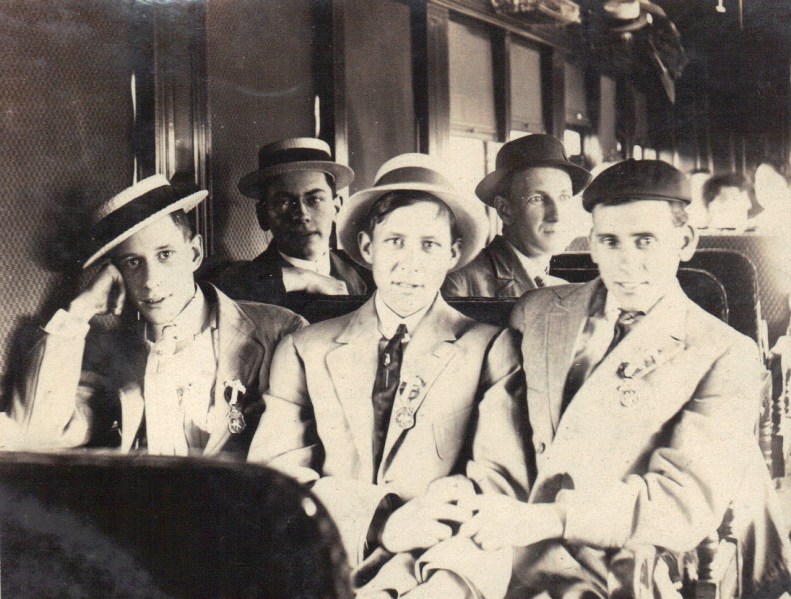
Edgar Reed, right. Photo by Lewis Reed.

This photo captures the moment Edgar Reed (left) and friends arrived home from World War I. Photo by Lewis Reed.
Edgar was fortunate enough to survive World War I and to settle back in Rockville and enjoy a successful life and career in the automobile business. After returning from the war in 1919, Edgar joined his brother in the business and the name changed to Reed Brothers Dodge. Edgar was in the automobile business with his brother, Lewis, for 35 years until his death in 1951.
So while we honor all who served this Veterans Day, on this day, I salute you Edgar Reed, and thank you for your service to our country.
Sources:
U.S. Army Office of Medical History
Ancestry.com
Maryland Military Men, 1917-1918
The Legendary Lake House Hotel of Horror, Then & Now
With Halloween just around the corner, I thought it would be fun to feature a photograph that Lewis Reed took of the Saylorsburg Lake House Hotel, now the site of Hotel of Horror. The aging Lake House Hotel in Saylorsburg, Pennsylvania, once a vibrant Poconos retreat, was a popular hotel for the region’s tourists who were looking for fun on nearby Saylors Lake. During the hotel’s heyday, its staff was booking rooms a year in advance. Today, the former hotel’s fame is generated from its annual Halloween haunted-house attraction.
Lake House Hotel (THEN): The legend of the Lake House Hotel spans more than two-hundred years. According to local folklore, during World War II, many of the employees at the Lake House were called to assist in the Pennsylvania National Guard, leaving the local asylum with one lone security guard to watch over the entire building. The inmates escaped, made their way to the hotel and took it over. The insane patients performed experiments on the guests. What was once a renowned resort for the rich and famous, became a torture chamber.
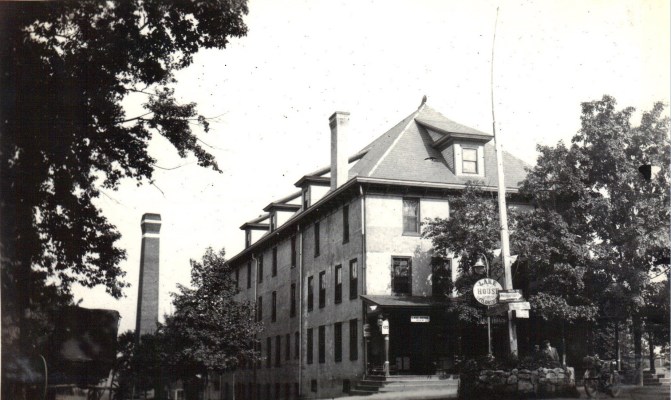
Saylorsburg Lake House Hotel. Photo taken by Lewis Reed, 1915.
Hotel of Horror (NOW): The hotel was purchased in 1990 and turned into an Antique Co-Op, and then in 1992 saw its first haunted house attraction. This 2021 season will celebrate the 29th year that the Hotel of Horror has been fascinating and horrifying legions of fans from the far reaches of the United States and even internationally. To all the readers of this blog: Have a spooky, enjoyable and very safe Halloween!
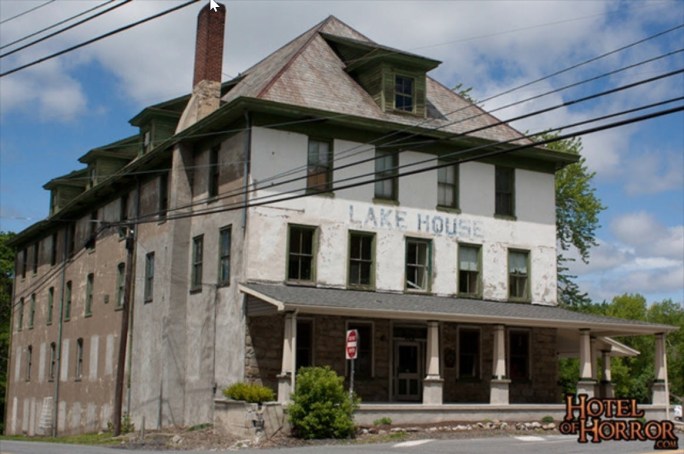
Welcome to The Hotel of Horror, The Pocono Mountains Premier Haunted House Attraction

1935 Auto Body Repair & Fender Repair Addition
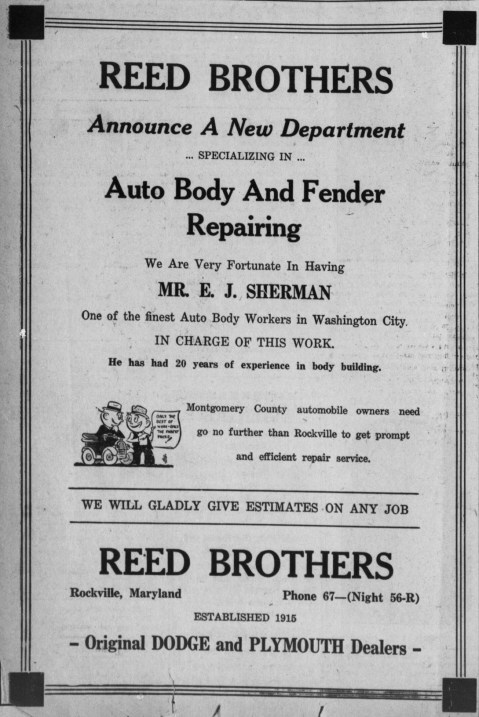
Montgomery County Sentinel, February 14, 1935
Reed Brothers Announce New Department of Auto Body and Fender Work
Reed Brothers Dodge and Plymouth dealers of Rockville, have inaugurated a new department of auto body and fender repairing under the direction of E.J. Sherman, who has had 20 years of experience along this line. Edgar Reed pointed out that this new department will enable automobile owners to get a satisfactory and economical service in Rockville, whereas, they have in the past been obliged to go to Washington or Baltimore for such work.
With a surge in automobile purchases in the early 1900’s, and an equal amount of car accidents and breakdowns, Reed Brothers began offering collision repair services. Just as the automobile has gone through numerous transformations over the last century, so has the auto body repair industry. When Henry Ford first mass produced the car in 1908, it was so new and unlike any other means of transportation at the time, that no one, outside of the few people who designed and built the old Model T Fords, was really qualified to do repairs. In the early years, many people turned to a machinist or even a bicycle repair shop for car repairs. As the popularity of the automobile grew, so did the demand for experienced and reliable mechanics and auto body specialists.
By the 1920s, there were a great deal of cars on the roads, which meant that manufacturers and dealerships needed to provide drivers with the means of repairing their vehicles in the event of a collision or breakdown. To meet this demand, manufacturers started making standardized parts that could easily replace damaged components of a vehicle. Dealerships were now able to employ mechanics that were able to easily repair vehicles using the prefabricated parts provided by the manufacturers. This method of auto repair lasted into the 1930s and 40s, though production and demand for repairs did hit a major decline at this time due to the Great Depression and World War II.
By the 1970s, Reed Brothers Auto Body Shop used state of the art equipment in the repair and refinishing process on all vehicles. Reed Brothers had computer downloaded specifications for practically every vehicle made and they color matched all paints in-house, with world renowned Spies Hecker paint and mixing system. The skilled “plastic surgeons” of the automobile world, their technicians were all formally trained professional with ASE and I-CAR, which kept them up to the minute with the latest technology.
Exploring Community Life in 20th Century MoCo
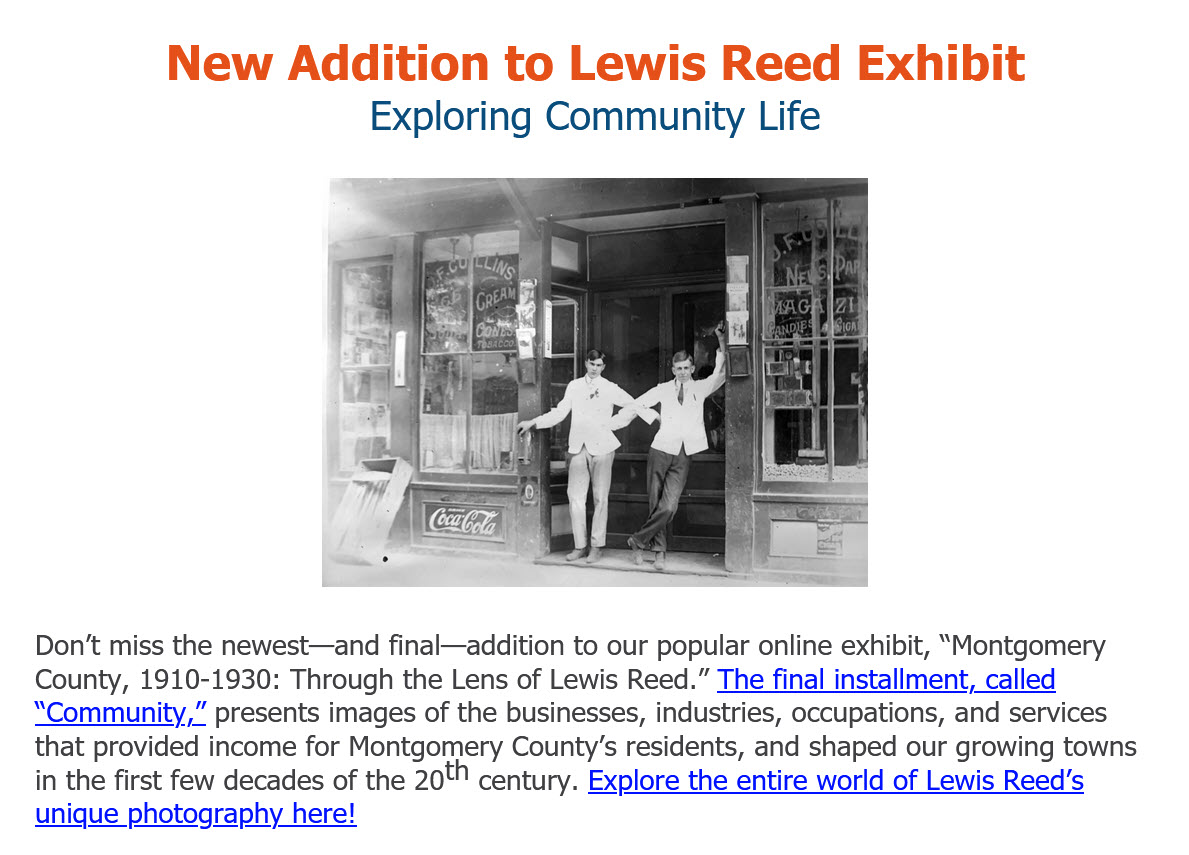 The newest—and final—addition to Lewis Reed’s online exhibit, “Montgomery County, 1910-1930: Through the Lens of Lewis Reed” has just been published.
Books

Related Resources


Copyright Notice

Reed Brothers Dodge History (1915-2012) by Jeanne Gartner is licensed under a Creative Commons Attribution-NonCommercial 3.0 Unported License.
 Reed Brothers Dodge History 1915 – 2012
Recent Comments