
Point of Rocks Maryland, 1911

Point of Rocks, 1911. Photo by Lewis Reed
In 1835, the community of Point of Rocks, originally known as Trummelstown, was laid out at the foot of the Catoctin Mountains along the route of the C&O Canal and the B&O Railroad in order to provide dwellings for workers building the railroad and canal. The community was soon thereafter renamed for a nearby notable geographic feature of projecting rocks formed at the point where the Catoctin mountain range reached the Potomac River. This feature is no longer visible today, as it has been largely removed to accommodate the construction of the railroad and Point of Rocks Tunnel. The coming of the transportation routes and the construction of an adjacent bridge crossing and railroad spur over the Potomac River in 1852 lead to the growth of the town. By 1858, dwellings, a store, a hotel and a number of warehouses and flour mills that received grain from northern Virginia farmers for transport to Washington were located along the north side of the railroad.
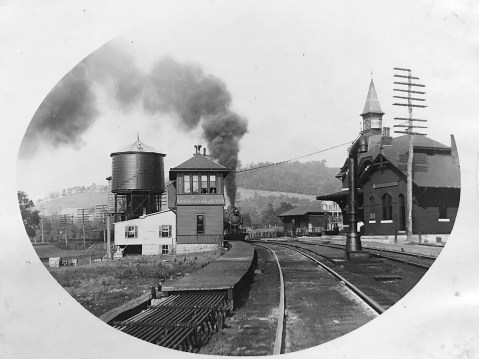
Point of Rocks Railroad Station, 1911. Photo by Lewis Reed
The growth of the Point of Rocks area was further prompted by the erection of the largest iron forge in the tri-state area on the opposite bank of the Potomac in Loudoun County, Virginia. In the mid-19th century, the operation employed over 250 men, many of whom crossed over the bridge from Maryland. The town also served passenger traffic on the railroad and became one of a number of resort towns along the Potomac River. By 1873, warehouses, hotels, and other commercial building lined both sides of the railroad and canal in an area south of the present-day village. In 1873, a location about a mile to the southeast of Point of Rocks became the junction of the B&O Railroad’s Metropolitan Branch and the Old Main Line passenger trains. The station name was first Point of Rocks, then changed to Washington Station in 1876, and reverted back to Point of Rocks in 1923.
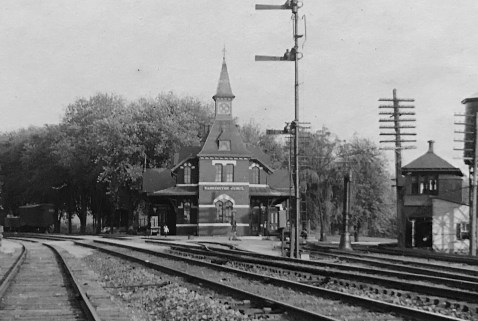
Point of Rocks Railroad Station, 1911. Photo by Lewis Reed
The growth of the low-lying village was inhibited throughout the 19th and 20th centuries by several floods. By 1910, few remnants of the original village remained, with most of the village now being located on higher ground. In 2009, the earliest extant buildings date to the late 19th century.

Books

Related Resources


Copyright Notice

Reed Brothers Dodge History (1915-2012) by Jeanne Gartner is licensed under a Creative Commons Attribution-NonCommercial 3.0 Unported License.
 Reed Brothers Dodge History 1915 – 2012
Recent Comments