
September 7, 1979: The First Chrysler “Bailout”
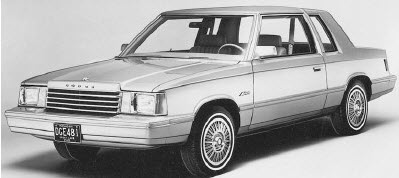
In the early 1980s, the Dodges Aries-K inspired Chrysler’s renaissance.
In 1979, Chrysler was at death’s door and petitioned the U.S. government for $1.5 billion in loan guarantees to avoid bankruptcy. It made gas guzzlers that nobody wanted to buy and it asked for $1.5 billion to keep itself going until a fleet of more fuel efficient cars could take up the sales slack. It was by far the largest government bailout in US history. On September 7, 1979 Chrysler formally petitioned the U.S. government for the loans, and on December 20, 1979 Congress ratified the appropriation in the “Chrysler Corporation Loan Guarantee Act,” which President Carter subsequently signed into law. It was an extremely painful period for Chrysler, but Reed Brothers survived the first Chrysler Bailout and resurgence under Lee Iacocca.
The K-Cars, the Dodge Aries and Plymouth Reliant, were, quite literally, the cars that saved Chrysler from the abyss in 1980. Their only real savior other than the K-Car was a government bailout. Though it came after bankruptcy, they managed to save the company with it by 1983. The K-Cars were inexpensive, reliable, and they delivered economical transportation for 6 people at an affordable price. Sales from the K-Car enabled Chrysler to emerge from bankruptcy and evolve into a profitable company.
Reeling from the combined effects of a recession and a global energy crisis, in 1979 Chrysler was forced to seek government loan guarantees. Meanwhile, Chrysler chairman Lee Iacocca took the company’s case straight to the people in a series of television commercials. Looking straight into the camera, the legendary auto executive pitched the company’s new K-cars with total conviction, asserting, “America, if you can find a better car, buy it.”
Buyers took up Iacocca’s challenge, flocking to the showrooms to buy their own K-cars. Nearly one million Aries were sold (and another million Reliants), allowing Chrysler to pay off its loans a full seven years early. Soon Iacocca was back on the airwaves with another ad campaign. This one was called “The Pride Is Back.”
These models were soon followed by what would become a home run product for Chrysler: minivans.
Nearly thirty years later, in 2008, Chrysler would receive billions in a new bailout from the U.S. government in the aftermath of the financial crisis that decimated automotive sales over the following few years. In 2009, Chrysler files for Chapter 11 bankruptcy protection. On May 14, 2009, Chrysler left 789 dealerships, about a quarter of its dealer base, out in the cold by rejecting their franchise agreements and giving them about a month to sell all their remaining new cars, factory parts and service equipment.
Whether a franchise is run by a second- or third-generation dealer, or is older than even Chrysler itself, didn’t seem to matter when Chrysler decided to cut dealerships ranks during their 2009 bankruptcy process. After almost 95 years selling Dodges, Reed Brothers was one of the 15 dealerships in Maryland and 789 dealerships nationwide notified by Chrysler that their franchise agreement would not be renewed. Chrysler was acquired in total by Fiat in 2014.
Source: Chrysler
Rare, Historical Photos: 1912 Grading of Massachusetts Ave Washington, DC
Washington, DC is an amazing city with a fascinating history. Massachusetts Avenue intersects every major north–south street and passes numerous Washington, DC landmarks. It is a landmark itself, long considered the northern boundary of the downtown as well as home of Washington’s Embassy Row.
Massachusetts Avenue is tied with Pennsylvania Avenue as the widest road in the District, at 160 feet. The two roads run in parallel through much of the city, Massachusetts about seven blocks north of Pennsylvania. Massachusetts Avenue was long Washington’s premier residential street, as Pennsylvania was once its most sought-after business address. Both streets were named after states with prominent roles in the American Revolution: Massachusetts and Pennsylvania.
Below are some extremely rare, historical photographs that Lewis Reed took of Massachusetts Avenue as it was being graded in 1912. As always, click on the photos to get a better look.
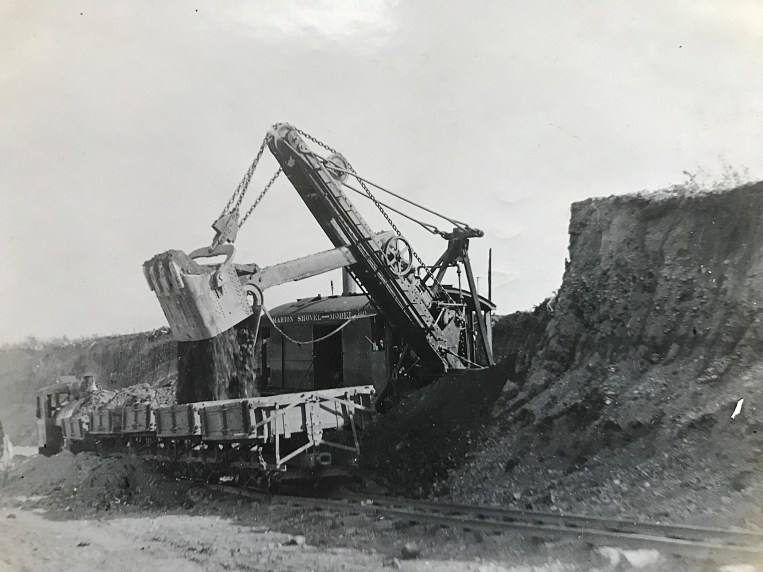
Marion Shovel Model 60 in action cutting a high bank of dirt on Massachusetts Ave. Photo by Lewis Reed, ca.1912

A Bucyrus steam shovel loading dirt onto a railway car. Photo by Lewis Reed, ca. 1912.
A steam shovel is a large steam-powered excavating machine designed for lifting and moving material such as rock and soil. It is the earliest type of power shovel or excavator. Steam shovels played a major role in public works in the 19th and early 20th century.
When digging at a rock face, the operator simultaneously raises and extends the dipper stick to fill the bucket with material. When the bucket is full, the shovel is rotated to load the railway car. Steam shovels usually had a three-man crew: engineer, fireman and ground man.
The track of Massachusetts Avenue was paved in the early 1870s. It was extended beyond Boundary Road (now Florida Avenue) in the 1880s, and beyond Rock Creek up to the District line after 1900. The section between Sheridan Circle and Scott Circle became known as “Millionaires’ Row”.

Hill Grading Massachusetts Avenue, Washington DC. The Washington Monument and many other landmarks can be seen in the background. Photo by Lewis Reed, ca. 1912
The Great Depression forced many to relinquish their homes on Millionaires’ Row. After World War II, Massachusetts Avenue was seen as less fashionable than newer areas such as upper 16th Street. Many residences were sold and demolished to make way for office buildings, particularly around Dupont Circle and to its east. Many others, however, survived as embassies and society houses; the former ‘Millionaires’ Row is today well known as Embassy Row.
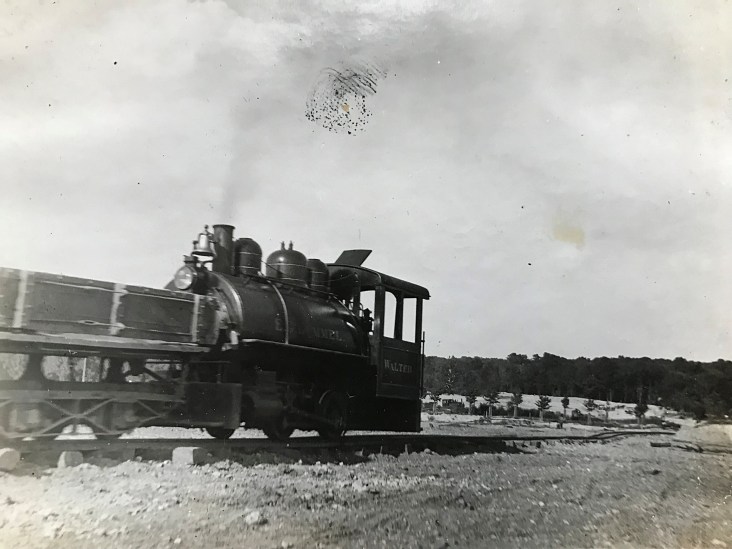
An early steam locomotive is hauling away dirt. Photo by Lewis Reed, ca. 1912
Source: Wikipedia
Artist’s Rendering of New Formalist-Influenced Reed Brothers Dodge Dealership

After 55 years at the original location at the triangle at Veirs Mill Road and Rockville Pike, Lee Gartner purchased 4.37 acres of land from Eugene Casey and relocated Reed Brothers Dodge to a new state-of-the-art showroom and Dodge/Chrysler/Jeep service complex on Route 355 at 15955 Frederick Road in Rockville Maryland.
The new building, a complete automotive sales and service facility marked Reed Brothers 55th year of selling Dodge’s. The state-of-the-art dealership contained the newest customer-focused features throughout which combined technology and comfort. Design and construction of the new dealership was managed by the Glen Construction Company of Gaithersburg.
In 1948, General Motors produced their first guide to help shape the look of their auto dealerships. Entitled, “Planning Automobile Dealer Properties“, the guide provided ideas and building layouts “for car sales, administration and personnel, service, parts and accessories, and store front details—including everything from the showroom to the janitor’s closet.” Based on the success of this model, other car brands also adopted strict design standards for their dealerships.
The Reed Brothers Dodge dealership in Rockville (1970), demolished in 2012, was an example of a dealership with a New Formalist influence. Hand-drawn architectural rendering by Cooke Brackett, Washington, D.C.
Character-defining elements of auto dealerships representative of this Period include, but are not limited to:
- One story
- Rectangular form with secondary service areas
- Flat roofs are most prevalent
- Large expansive showroom windows and minimal windows at service areas
- Extensive use of corporate branding including street signs, rooftop signs, and various brand color schemes
- Set back from, and parallel to, the adjoining major roadway
First Rockville Auto Races, August 25, 1923
From The Evening Star (Washington, DC) 24 August 1923
ROCKVILLE AUTO RACES LISTED FOR TOMORROW
Speed records will be placed in jeopardy at Rockville Fair tomorrow afternoon when a half score of professional drivers will compete in a seven-event program.
Featuring the program is the record trials in which Frank Ripple, Canadian speed star and dirt track champion will drive his 140 horsepower aeroplane motor in an effort to hang up some new marks. Every driver on the track will be eligible to enter the time events, but speed fans look to Ripple.
Two foreign machine and six American-built cars are listed to start.
Early action shots like the ones in this post are rare, however, the following photographs were taken by Lewis Reed at the Rockville Fairgrounds in 1923. The photographs were from the first incarnation of the Fair, held by the Montgomery County Agricultural Society (1846-1932) in Rockville, and often known simply as the “Rockville Fair.”
THE FIRST RACE
From The Baltimore Sun, August 27, 1923:
This is the first year that a Rockville Fair has continued through Saturday. The extra day was added this time as an experiment, the management believing that by substituting new features the additional day could be made a success. Automobile races, the first ever held at Rockville, were the day’s principal attraction and they attracted a good-sized crowd.
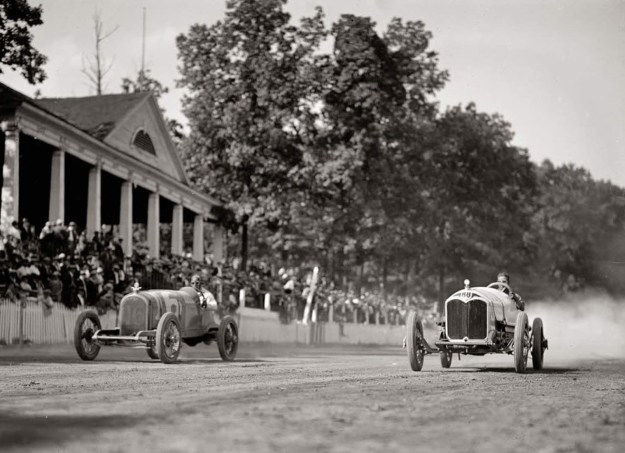
Rockville drew huge crowds for auto races. Rockville Fair, August 25, 1923. Photo by Lewis Reed

Dusty Action – 1923 photo of the exciting auto races at Rockville Fair. Five racers are just coming around the bend on this dirt track with their tires spinning up dust in their wake. Photo by Lewis Reed

Race car drivers deep in dust round a turn at the Rockville Fair auto races. Print made from a Lewis Reed glass negative.
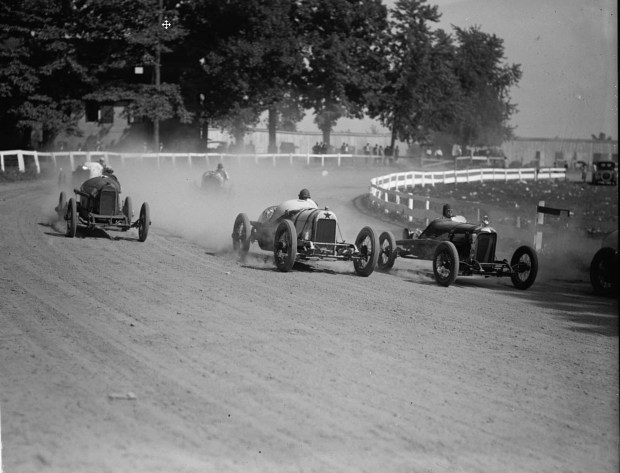
High-powered race cars rounding a wide, sweeping curve at the Rockville Fair auto races, August 25, 1923. Print made from a Lewis Reed glass negative

Two-man race car. Some early race cars included both a driver and a ‘riding mechanic’. One of the key jobs of the second man in a race car was to look backward and alert the driver to what was going on behind him. Photo by Lewis Reed
Early race car drivers were required to have a riding mechanic, otherwise it was voluntary. Riding mechanics, who in addition to being lookouts, kept an eye on tire wear and would even hop out of the car and run back through the infield to get fuel.
This photograph was featured as a part of the ‘London Array’ Series of Impossible Engineering that was broadcast on January 24, 2019 on Discovery’s Science Channel. The photograph was used on the program that featured a segment on the development of the race car.
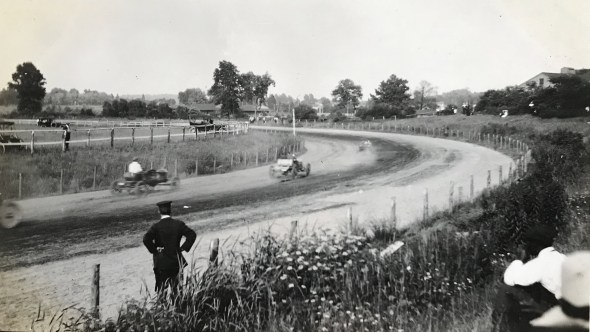
More dirt track action. Skinny tires make for slippery turns. Photo by Lewis Reed.
ALONG WITH AUTO RACES, AUTO POLO DEBUTED AT THE ROCKVILLE FAIR

From The Washington Post, August 25, 1923
Note in the program above, that in addition to racing, there were two auto polo events.
WHAT ON EARTH IS AUTO POLO?
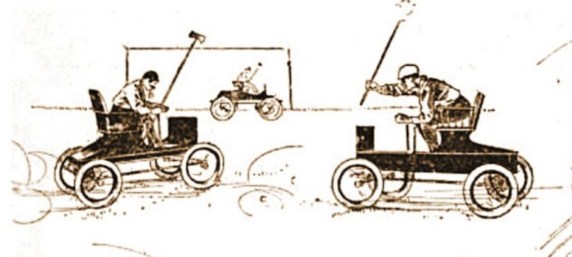
Given that early automobiles were marketed as replacement horses, it was inevitable that the game of auto-polo would be invented. The idea of playing polo with cars had been tossed around starting in about 1900. It took 10 years, and the Ford Model T, to make it practical.
In 1912, some people thought it would be a good idea to strip the bodies off Model Ts, and put together some two-car teams to whack a ball around with mallets. On July 12, they did just that, playing with oversized croquet mallets and a two-pound, basketball-sized ball. Two cars took the field, and two more tended their respective goals.
From The Daily News, Frederick, Maryland, August 24, 1923:
Thousands of people attended the Fair on Thursday, which was the biggest day of the week, at least from the attendance standpoint. By two-o’clock the grandstand was so crowded that even standing room was at a premium. The racing events of the afternoon were unusually good. As special grandstand features there were auto polo and stunt riding.
Any form of safety was completely absent, unless you count the occasional presence of a hat. The cars were protected with roll bars in back and around the radiator, but the drivers, not so much. The game consisted of five 10-minute periods. It was hard on drivers, cars, and the field. There was no limit on car substitutions, and as many as a half-a-dozen per team might be demolished during the game, along with the stands, goalposts, referees (on foot on the field) and anything else that got in their way.

1922 auto polo match in Los Angeles. The referees job is very dangerous as the cars careen about the field and smash into each other. Google stock image.
All we hope is that this lunatic game will not spread.Automobile Topics, Nov. 16, 1912
AUTO RACES MARK END OF 5-DAY ROCKVILLE FAIR
From The Sunday Star, Washington, DC, August 26, 1923:
Thrilling automobile races brought the annual Rockville Fair to a close this afternoon. The sport was as innovation so far as Rockville was concerned.
Seven high-powered cars, operated by some of the crack drivers of the country, participated. The events ranged from one to ten miles in distance, and some fast time was made. Excepting that of Thursday, the largest crowd of the five days was on hand.
Auto Polo Credit: May 2010 issue of Hemmings Motor News
Reed Brothers Third Annual Goodyear Dealers Zeppelin Race Winner July-August 1931
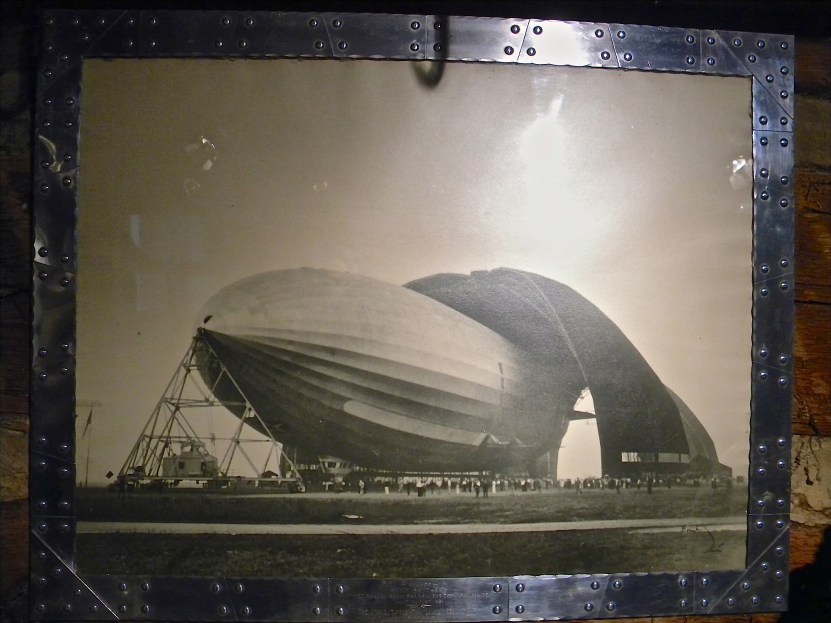
MARGARET BOURKE-WHITE, 1931 REED BROTHERS THIRD ANNUAL GOODYEAR DEALERS ZEPPELIN RACE WINNER
In 1931, the Goodyear Zeppelin Company produced a series of framed prints as rewards for Goodyear dealers as prizes for high sales. Sales was based on a two months quota, and participated in by thousands of dealers all over the country. The print shows the maiden launch of the USS Akron leaving the Goodyear Zeppelin air dock at Akron, Ohio. The engraved plaque at the bottom center of the frame reads, “Winner – Reed Brothers, Third Annual Goodyear Dealers Zeppelin Race. July – August 1931.” This frame is made of duralumin used in the girder construction of the United States Airship “AKRON” built by the Goodyear Zeppelin Corporation”. The print is signed in the lower right-hand corner by the famed 20th century photographer, Margaret Bourke-White. During the early years of the Depression, Goodyear was one of Bourke-White’s most important clients. She made this image of the airship Akron when it was removed from its hangar for the first time.
Built in 1929, the almost unbelievably huge Goodyear air dock in Akron, Ohio, was created as a space where blimps, airships, and dirigibles could be constructed. Evidently building such a massive space created problems, such as indoor rain, and putting the whole thing on rollers so that it could expand and contract with the seasons.
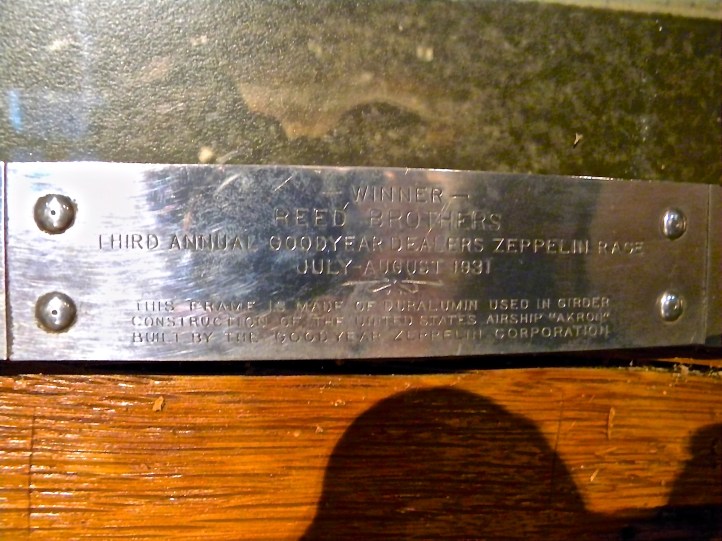
Inscription Plaque
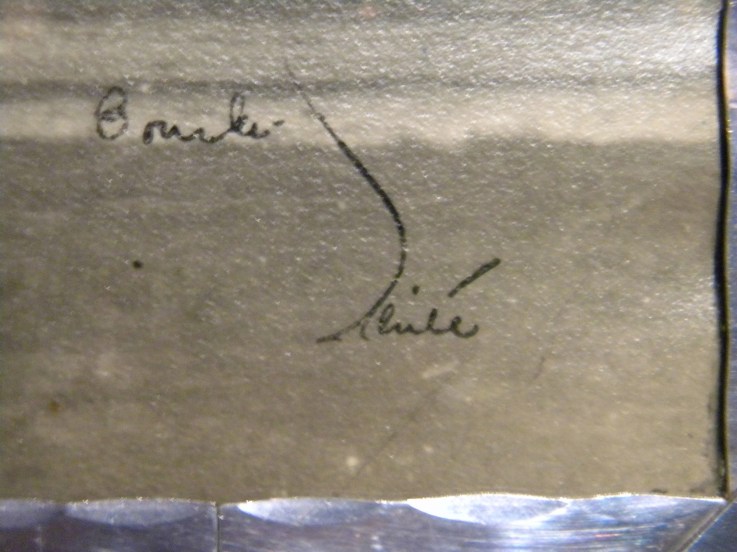
Photo is signed in the lower right corner by famed 20th century photographer, Margaret Bourke White
The USS Akron, first of a class of two 6,500,000 cubic foot rigid airships, was built at Akron, Ohio. Commissioned in late October 1931, she spent virtually all of her short career on technical and operational development tasks, exploring the potential of the rigid airship as an Naval weapons system. During the remainder of 1931 and the early part of 1932, the Akron made flights around the eastern United States and over the western Atlantic, including one trial of her capabilities as a scouting unit of the fleet. While beginning a trip to the New England area, Akron encountered a violent storm over the New Jersey coast and, shortly after midnight on 4 April 1933, crashed tail-first into the sea. Only three of the seventy-six men on board survived this tragic accident. During the search for other possible survivors, the Navy non-rigid airship J-3 also crashed, killing two more men.
Note: Margaret Bourke-White (1904 1971) is best known as the first foreign correspondent to be permitted to take photographs of Soviet industry, the first female war correspondent, and the first female correspondent permitted to work in war zones.
40th Anniversary with Goodyear
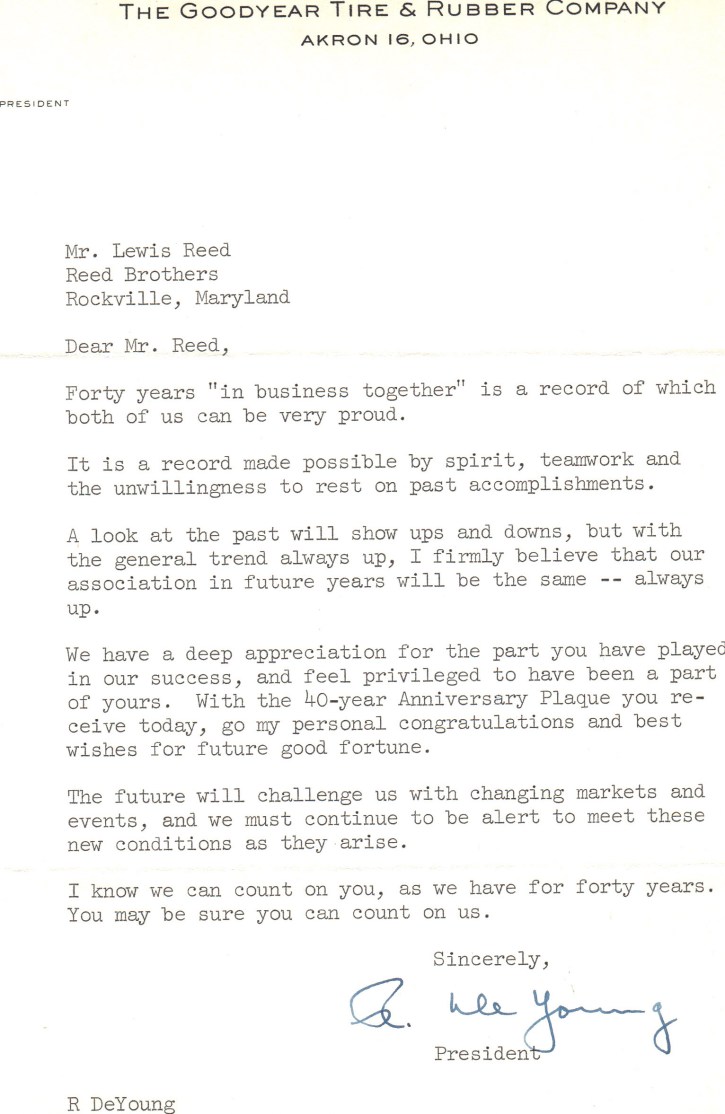
Lewis Reed was recognized by Goodyear Tire & Rubber Co. for reaching his 40th year as a Goodyear dealer. Reed Brothers Dodge began selling Goodyear tires in the 1920s. Below is a letter from Russell DeYoung thanking Lewis Reed for his 40 years “in business together”.
Books

Related Resources


Copyright Notice

Reed Brothers Dodge History (1915-2012) by Jeanne Gartner is licensed under a Creative Commons Attribution-NonCommercial 3.0 Unported License.
 Reed Brothers Dodge History 1915 – 2012
Recent Comments