
September 7, 1979: The First Chrysler “Bailout”
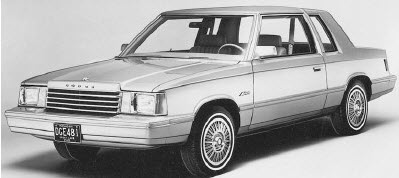
In the early 1980s, the Dodges Aries-K inspired Chrysler’s renaissance.
In 1979, Chrysler was at death’s door and petitioned the U.S. government for $1.5 billion in loan guarantees to avoid bankruptcy. It made gas guzzlers that nobody wanted to buy and it asked for $1.5 billion to keep itself going until a fleet of more fuel efficient cars could take up the sales slack. It was by far the largest government bailout in US history. On September 7, 1979 Chrysler formally petitioned the U.S. government for the loans, and on December 20, 1979 Congress ratified the appropriation in the “Chrysler Corporation Loan Guarantee Act,” which President Carter subsequently signed into law. It was an extremely painful period for Chrysler, but Reed Brothers survived the first Chrysler Bailout and resurgence under Lee Iacocca.
The K-Cars, the Dodge Aries and Plymouth Reliant, were, quite literally, the cars that saved Chrysler from the abyss in 1980. Their only real savior other than the K-Car was a government bailout. Though it came after bankruptcy, they managed to save the company with it by 1983. The K-Cars were inexpensive, reliable, and they delivered economical transportation for 6 people at an affordable price. Sales from the K-Car enabled Chrysler to emerge from bankruptcy and evolve into a profitable company.
Reeling from the combined effects of a recession and a global energy crisis, in 1979 Chrysler was forced to seek government loan guarantees. Meanwhile, Chrysler chairman Lee Iacocca took the company’s case straight to the people in a series of television commercials. Looking straight into the camera, the legendary auto executive pitched the company’s new K-cars with total conviction, asserting, “America, if you can find a better car, buy it.”
Buyers took up Iacocca’s challenge, flocking to the showrooms to buy their own K-cars. Nearly one million Aries were sold (and another million Reliants), allowing Chrysler to pay off its loans a full seven years early. Soon Iacocca was back on the airwaves with another ad campaign. This one was called “The Pride Is Back.”
These models were soon followed by what would become a home run product for Chrysler: minivans.
Nearly thirty years later, in 2008, Chrysler would receive billions in a new bailout from the U.S. government in the aftermath of the financial crisis that decimated automotive sales over the following few years. In 2009, Chrysler files for Chapter 11 bankruptcy protection. On May 14, 2009, Chrysler left 789 dealerships, about a quarter of its dealer base, out in the cold by rejecting their franchise agreements and giving them about a month to sell all their remaining new cars, factory parts and service equipment.
Whether a franchise is run by a second- or third-generation dealer, or is older than even Chrysler itself, didn’t seem to matter when Chrysler decided to cut dealerships ranks during their 2009 bankruptcy process. After almost 95 years selling Dodges, Reed Brothers was one of the 15 dealerships in Maryland and 789 dealerships nationwide notified by Chrysler that their franchise agreement would not be renewed. Chrysler was acquired in total by Fiat in 2014.
Source: Chrysler

6 responses to “September 7, 1979: The First Chrysler “Bailout””
Leave a reply to Jonathan B. Richards II Cancel reply
Books

Recent Comments
 | Reed Brothers on Then and Now: Commander Hotel… |
| Reed Brothers on Then & Now: New Occidental… |
 | Courtney Wells on Then & Now: New Occidental… |
 | Mark Brezler on Then and Now: Commander Hotel… |
| Reed Brothers on From Chauffeur to Dodge D… |
| Reed Brothers on 90 Year Brouchure |
 | Anthony Belson on 90 Year Brouchure |
 | Michelle on From Chauffeur to Dodge D… |
 | ptkernan on Snapshots in Time: Reed Brothe… |
| Reed Brothers on Winter’s Harvest: Ice-Cutting… |
Related Resources


Copyright Notice

Reed Brothers Dodge History (1915-2012) by Jeanne Gartner is licensed under a Creative Commons Attribution-NonCommercial 3.0 Unported License.
 Reed Brothers Dodge History 1915 – 2012
We had a 1982 Dodge Aries. Ran the wheels off! It lasted until our son wrecked it in 1993. No injuries.
Hi Patrick, The K’s were good cars and would run forever. I’m betting quite a lot of them became hand-me-downs from parents.
Thanks for stopping in!
~Jeanne
Hello, Jeanne Gartner,
Thank you for posting this excellent item regarding the bankruptcy filings by Chrysler in 1979 and after. It is sad that the long and historic connection of the Reed Brothers Dodge dealership was terminated by Chrysler but in retrospect perhaps it was the best way to end this automotive saga.You might be interested to know that many U.S. Postal Service rural mail delivery carriers utilized the K Cars on their routes with excellent results.
I hope you are enjoying a quiet Labor Day and are staying well in these perilous times. Best Regards, Jonathan (Jack) Richards at Chesterfield, MO. Please be advised that I have a new telephone #, viz. Area 314/680-7937.
Hello Jonathan, I am so glad you enjoyed the post. I had no idea that the postal service used K-cars, however, I am not surprised because there was also a station wagon version of the K-car. I didn’t care for them too much back in the day; too boxy. I was at the age where I preferred a more sporty look! HA!
I appreciate you reading and commenting!
Be well my friend,
Jeanne
The auto bailout story should be taught in all high schools, in part because it is intertwined with the U.S.A.’s dependancy on foriegn oil and consumer taste in vehicles and the economy. In 1979 Wisconsin’s senator William Proxmire warned bailing out Chrysler would set a bad precidence, and he was a democrat. Certaintly for true conservatives it was the kind of government intervention they dispised, my father included. They understand that when companies make poor choices that the stronger competitors have earned the right to take over that market share. In the case of 1979, with oil prices surging and car buyers demanding better fuel economy, the Japanese brands were in position to expand production and teach Americans how to build better engines and cars. Tariffs on foreign cars would surpress their influence too keep them in check, at least for a while. So Chrysler struggled to build sensible family cars until pressured to do so and then came the minivan idea. Those were marketed on the idea of families toting more stuff where ever they travelled. Fuel economy and reliabilty were poor, costing families far more to own and operate than a good sedan. And in 2009 we would see them get bailed out yet again, for the 3rd time. And for GM the auditors were sent in too late, only to find the “books cooked”. So what’s the lesson here for our young people, because society cannot afford to have this cycle continue to repeat?
Hi Allen,
Thank you very much for taking the time to leave your thought provoking comment. You’ve touched on a lot of important points. The auto bailouts really do offer valuable lessons–for business, government, and the public–and you’re absolutely right that young people could learn a lot from studying them. The decisions made by automakers, the government’s role, and how consumers reacted all played a part in shaping what happened. As you said, when companies don’t adapt, especially in times of change like rising fuel prices or competition from abroad, they risk falling behind. And while bailouts can keep jobs and industries alive, they don’t fix the deeper problems unless real change follows.
Thanks again for sharing your insights. It’s clear this history still has a lot to teach us.
Best Regards,
Jeanne