
1918: Rockville Garage Displaying New Cars at Rockville Fair Grounds
An annual County Fair used to be held for four days in the month of August at the old Fairgrounds of Rockville, Maryland. Families came from every section of the Montgomery County in wagons and carriages, and stayed for the duration of the Fair. Harness racing was one of the main attractions, but the Fair also provided other events such as horse pulls, games of chance, showing of prized livestock and poultry, needlework, homegrown produce, baked and canned goods. A building called the Exhibit House displayed the prize-winning entries of the various categories.
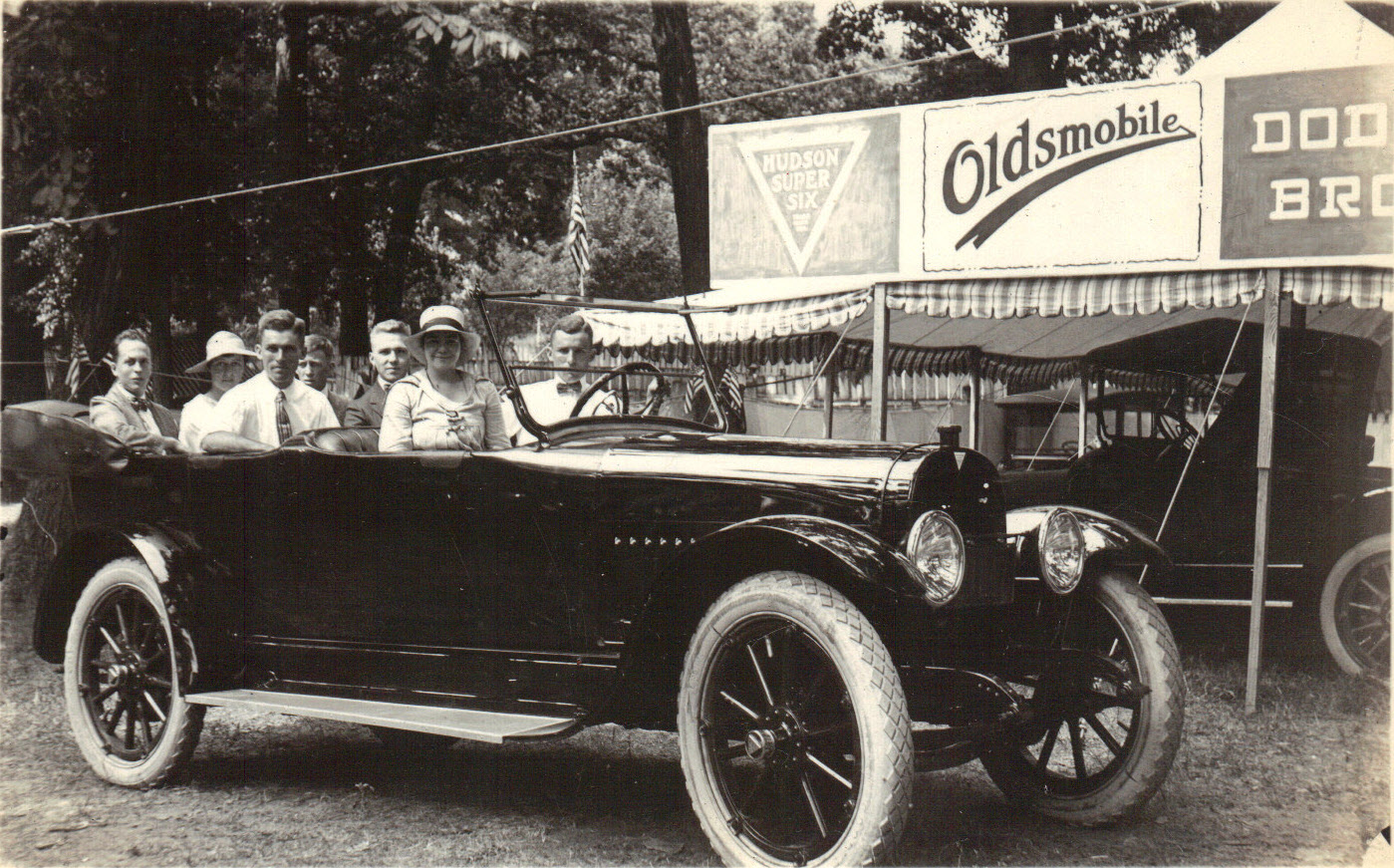
The Fair also gave automobile dealers the opportunity to display their new models. Below is new car show time as fair-goers get their first glimpse at the latest models that Rockville Garage had to offer. Initially, Reed Brothers sold Oldsmobile and Hudson, along with Dodge.

1918 – Hudson Super Six, Oldsmobile, and Dodge Brothers Motor Cars on display. Lewis Reed in drivers seat.

1918 – Rockville Garage displaying their new models at the Rockville Fair Grounds
Anybody for a demonstration drive?

1918 – At Your Service Rockville Garage. Lewis Reed on the left
Source: History PDF
Suicide Doors
Reed Brothers Dodge owned a 1928 Dodge Brothers Standard Six with rear-hinged suicide doors.

1928 Dodge Brothers Standard Six
So why are these doors called suicide doors? Did someone commit suicide with one? What’s suicidal about a door?
The theory is that the forward motion of the car could cause the door to fly open, possibly causing the unlucky person sitting next to the door to be pulled out of the car, or the door itself could be ripped from its hinges. It’s debatable as to whether this was speculation or reality, but cars of this era did not have seat belts, so there was nothing to hold a passenger in the car.
The term “suicide doors” was therefore placed on vehicles with the rear-hinged door configuration, the theory being that anyone inside was on a suicide mission because of the design.
Lewis Reed As Chauffeur
To be a successful motorist in the early 1900s, you needed to have mechanical skills. Alternatively, you simply hired someone who did. Rather than learn to do it themselves, wealthy people employed private chauffeurs not only to drive, but also maintain and repair their large, expensive automobiles. Chauffeurs would be in charge of everything to do with the owner’s motor vehicle including repairs, maintenance and cleaning: this meant that early personal chauffeurs had to be skilled mechanics. Lewis Reed worked as a chauffeur early in his life, receiving some of his training at the Pierce-Arrow factory in Buffalo, New York, whose cars he is pictured with below.
Pierce-Arrow was one of the most prestigious makers of luxury automobiles in the early 20th century. Their models could easily cost ten times the price of a standard touring car.

Chauffeur Lewis Reed (left) in the 1914 photo above poses with an unidentified family and their Pierce-Arrow Model 48.
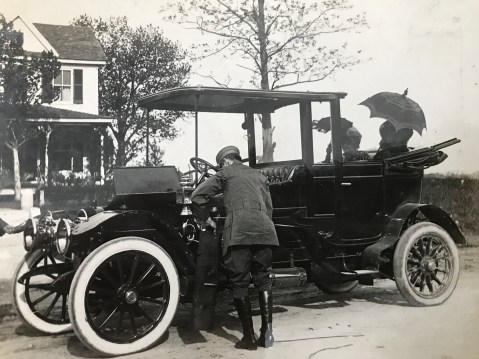
Two ladies with parasols are sitting in the landaulet section of an early Pierce-Arrow limousine, while chauffeur Lewis Reed tends to the motor. The rear portion of the limousine is partitioned from the driver with a glass shield, and covered by a convertible top, which you can see is currently in the lowered position behind the ladies.
Books

Related Resources


Copyright Notice

Reed Brothers Dodge History (1915-2012) by Jeanne Gartner is licensed under a Creative Commons Attribution-NonCommercial 3.0 Unported License.
 Reed Brothers Dodge History 1915 – 2012
Recent Comments