
Sculpture Milestone Celebration!
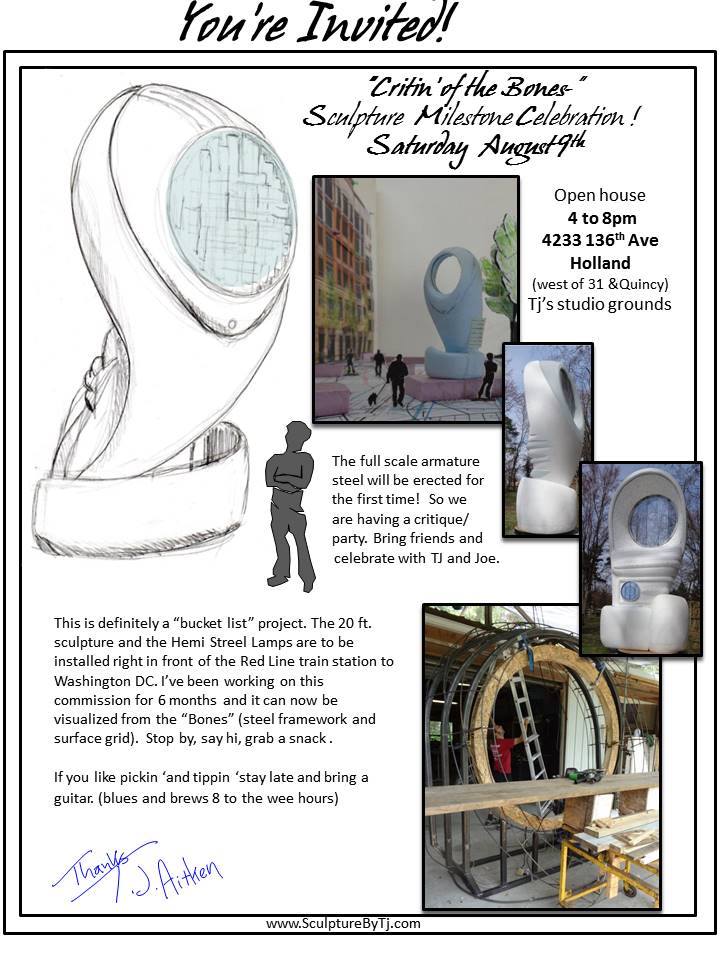
The “Light Dodger,” sculpture by Tj Aitken has hit a major milestone and is planning a celebration! The full scale armature will be erected for the first time!
The 20-foot sculpture and the Hemi Street Lamps are to be installed next spring at Bainbridge Shady Grove Apartments at the entrance to the Shady Grove Metro Station to commemorate Reed Brothers Dodge and the dealership’s history.
Not Just a Dodge Dealer
Lewis Reed’s Rockville Garage sold more than just Dodges. During the early years, Reed Brothers represented several franchise nameplates along with Dodge, including Oldsmobile, Hudson and Essex. The Hudson and Oldsmobile were sold at Reed Brothers from roughly 1917 through 1921.
In 1930. Reed Brothers added the Plymouth line. The first Plymouth was built in 1928 and Plymouths were sold at Reed Brothers until 1969, when the brand was given to the Chrysler dealers.
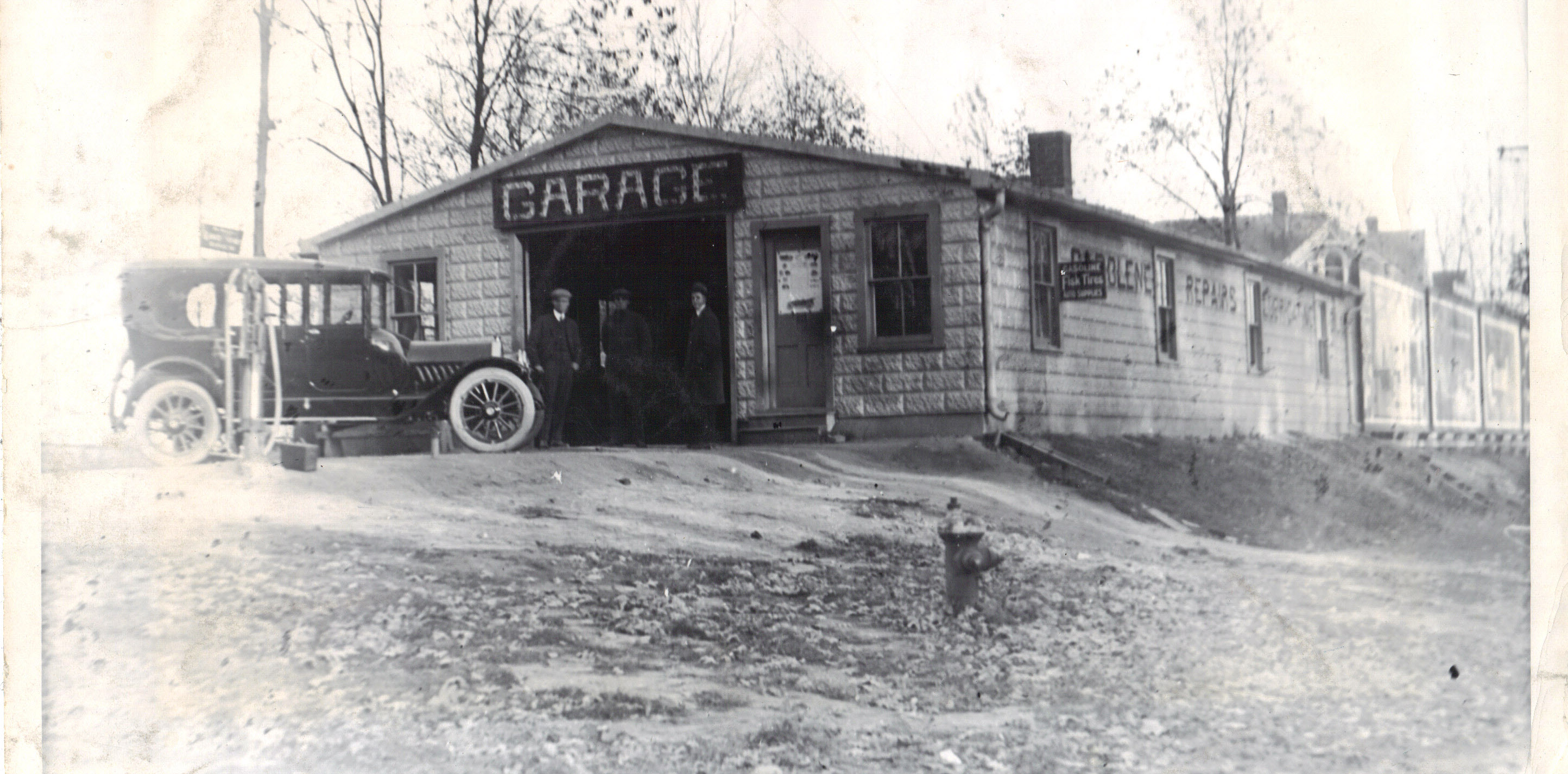
This photograph of the original 1916 Rockville Garage shows a 1916 model 44 Oldsmobile with V8 and sedan body parked in front. The original owners of Rockville Garage are standing in front. From left: Roy Warfield – Lewis Reed – Griffith Warfield.
Below is new car showtime as fair-goers get their first glimpse at the latest models that Rockville Garage had to offer. Identified by the triangle logo on the grill and the number of passengers seated in it, the car below appears to be a 1918 Hudson Super Six Seven Passenger Touring.
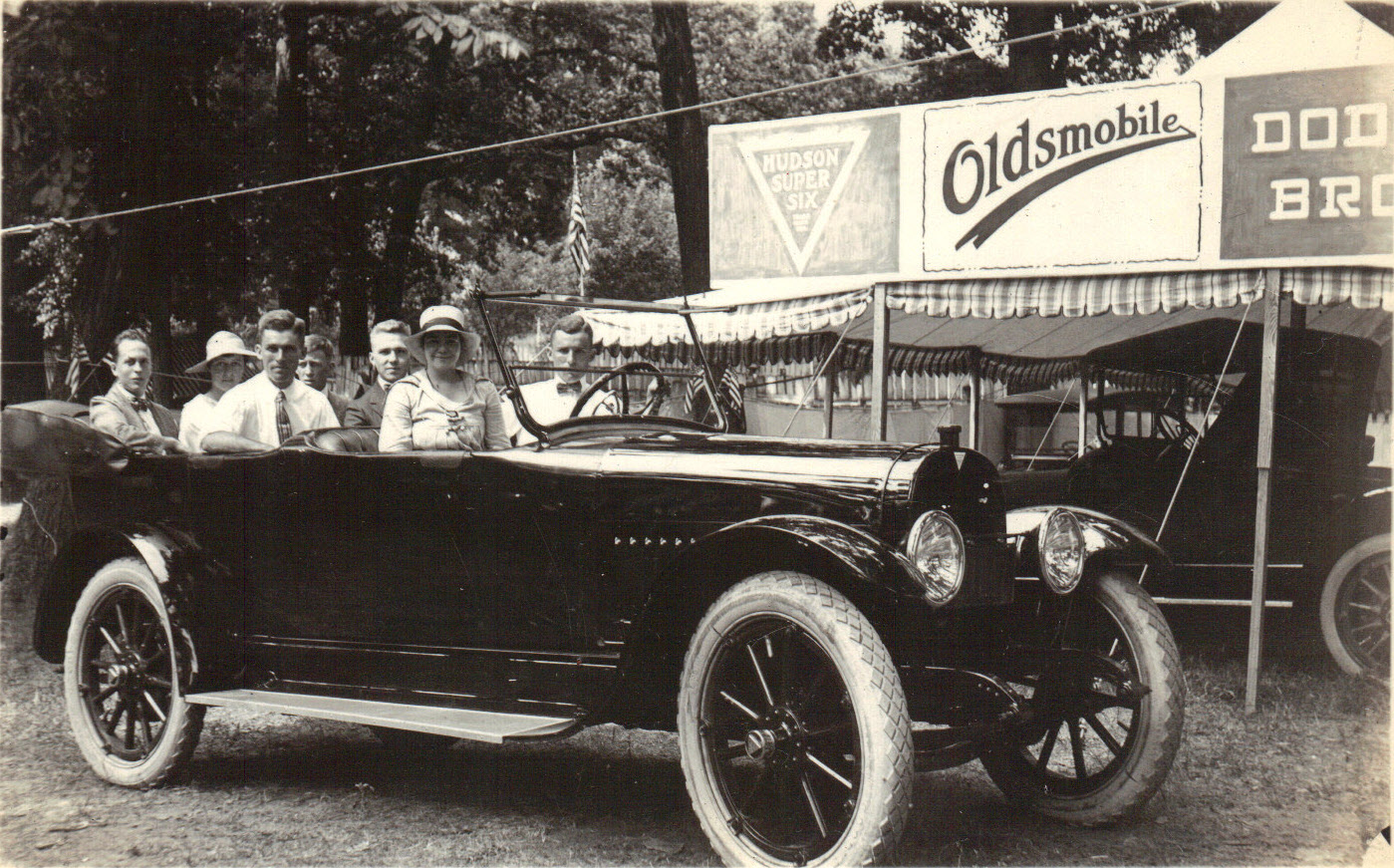
Anybody for a demonstration drive? 1918 Hudson Super Six Seven Passenger Touring
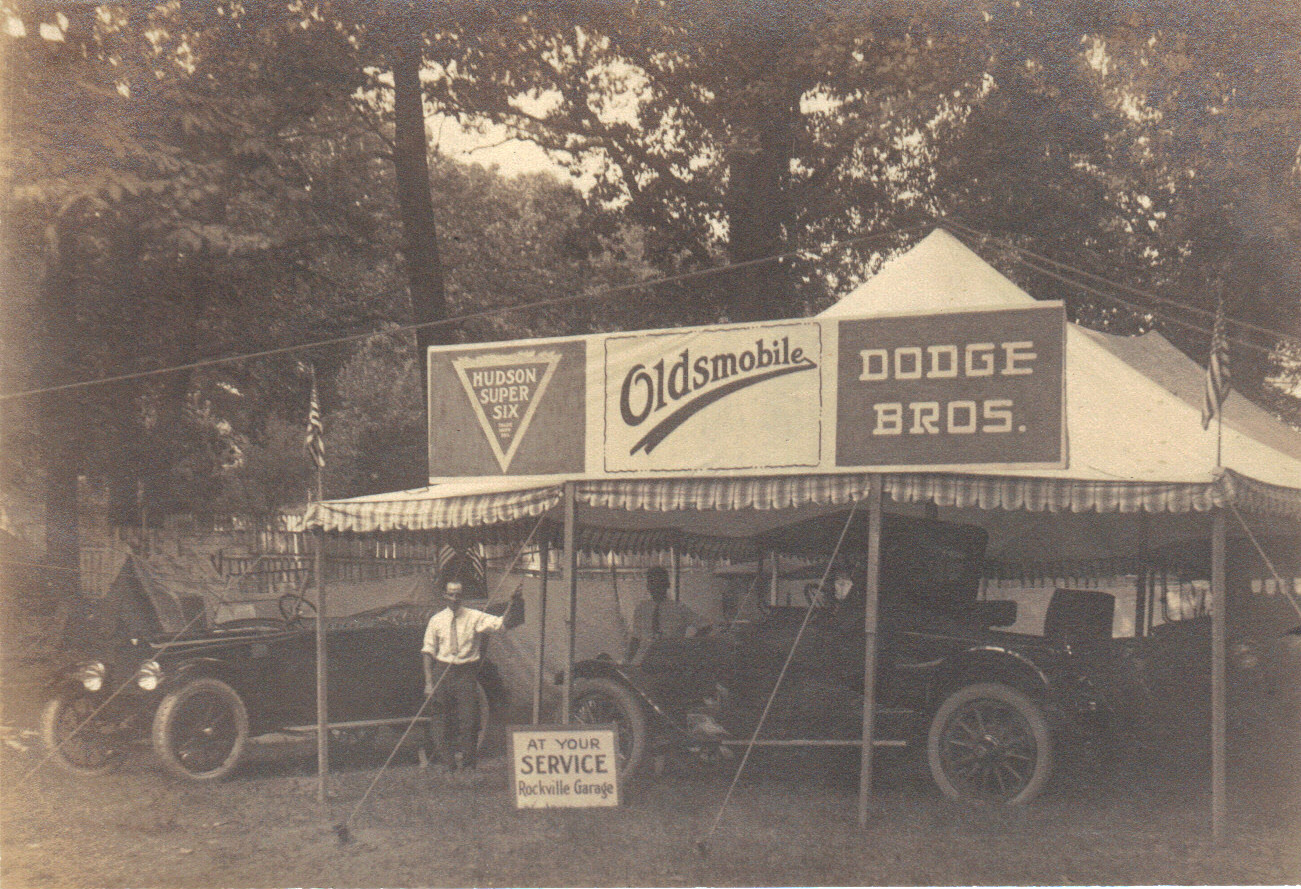
Hudson Super Six, Oldsmobile, and Dodge Brothers Motor Cars on display
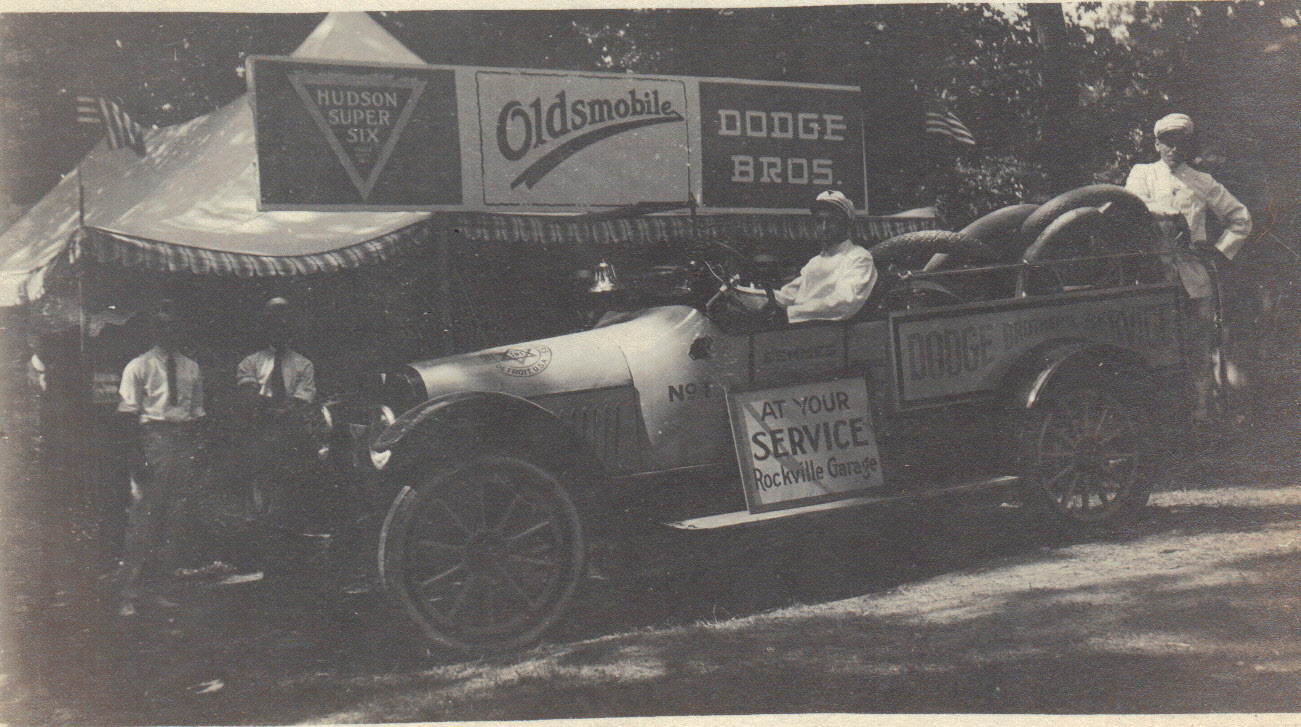
Rockville Garage, 1918 – Hudson Super Six, Oldsmobile, and Dodge Brothers Motor Cars on display at Rockville Fairgrounds. Lewis Reed is seated in the drivers seat of the Rockville Garage Service Truck.
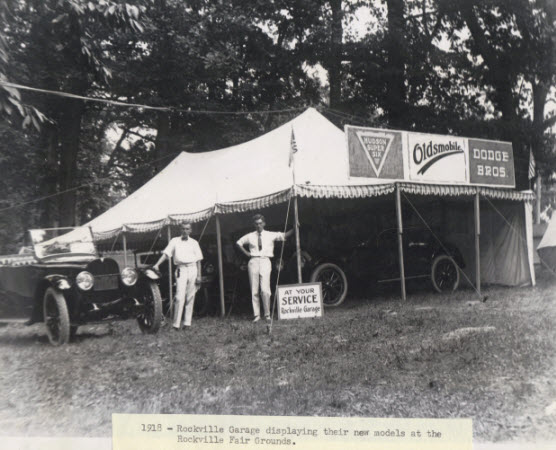
1918 Rocvkille Fair Grounds
The first advertisement below, distributed by the Oldsmobile Sales Company in the Sunday, June 29, 1919 edition of The Washington Post is probably one of the first ads in which the Rockville Garage appeared. Dealers are listed in fine print at the bottom: note Rockville Garage, Rockville, Md, highlighted in yellow. (click on image to enlarge)

Washington Post 1919
July 4, 1922: First MCPD Posing in Front of Reed Brothers Dodge
This blog entry is posted today to commemorate the anniversary of the Montgomery County Police Department. It was 93 years ago on July 4, 1922 that the MCPD was first established. In those days, Montgomery County was farm country, sparsely populated, automobiles sharing dirt roads with horse-drawn wagons. But it was changing into a proper suburb, and there needed to be a police department.
Posing in front of Reed Brothers Dodge on July 4, 1922 Chief Charles Cooley, center, and his men of the first mounted unit of the Montgomery County Police Force, were on their first day of duty. (click image to enlarge)
The MCPD consisted of five officers and a Chief. Each of the officers was issued a Harley-Davidson motorcycle, a .38 Smith & Wesson handgun, a black jack, law book and was allotted $300.00 a year for the upkeep of their motorcycle.

Pictured left to right: Earl Burdine, Lawrence Clagett, Guy Jones, Chief Charles Cooley, Leroy Rodgers, and Oscar Gaither. Photo by Lewis Reed
Source: Montgomery County, Two Centuries of Change by Jane Sween
“Light Dodger” Project to Commemorate Reed Brothers Dodge
Titled “Light Dodger,” the sculpture by Tj Aitken will stand 19 feet high and will have stained glass lens components over 6 feet in diameter. Currently being fabricated in Michigan – the home of its accomplished sculpture, Tj Aitken – it is slated to be installed March 2015 at Bainbridge Shady Grove Apartments at the entrance to the Shady Grove Metro Station on the Red Line to Washington, DC.
The project will commemorate Reed Brothers Dodge and focus on the dealership’s history to turn the brunt of the complex into a prominent residential landmark in Rockville.

Bainbridge wanted an artist who could design something modern, abstract but still using the automotive theme. Tj presented many alternatives after studying the Dodge line and history for the former Reed Brothers Dodge site.
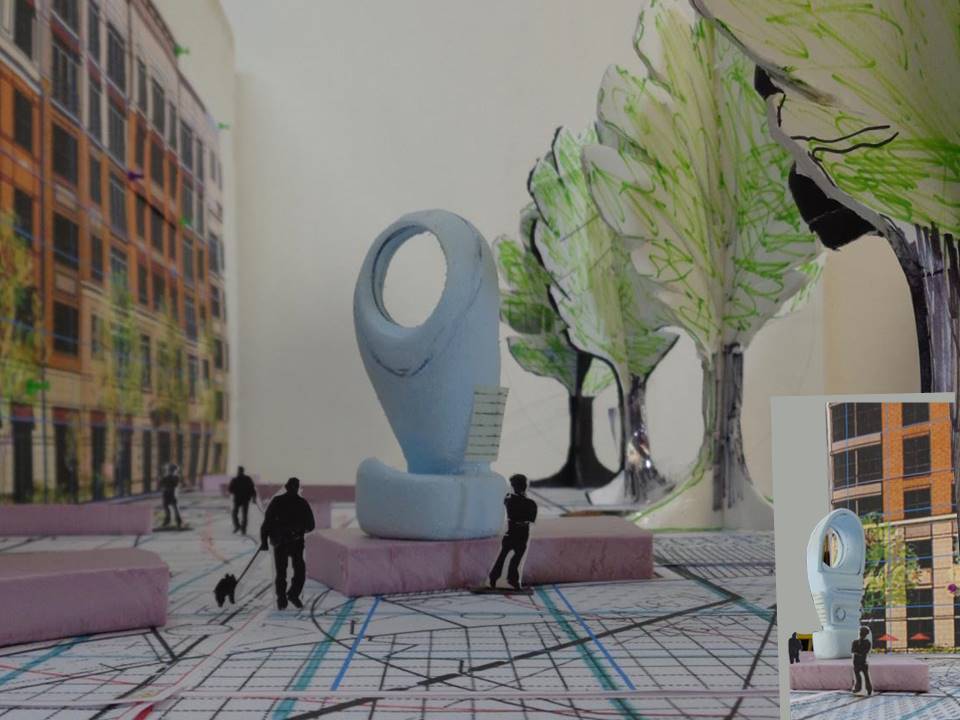
Site Model Miniature
A large concrete sculpture was chosen titled “Light Dodger” which melds the design of two classic lamp and fender designs from the Dodge line into one three dimensional work of art. Aficionados will recognize the ’39 Dodge and the ’57 Dodge pick up in the sculpture which is currently being constructed in concrete.

Studies for Hemi Street Lamp
Along with the Light Dodger, a set of “Hemi street lamps” will grace the curving walkway. These functional lamps are based on the famous Hemi piston. They will be flaked by head gasket graphics along the walkway that winds along the building promenade towards the metro train station.
About Tj Aitken
Tj Aitken is an Installation artist and established Industrial Design Consultant. He creates public sculptures and has had commissions and exhibitions in many cities. Tj grew up near Detroit, worked assembly, die models, show prototypes, and then did a sculpture BFA in ‘77. In the 80’s his Colorado studio cast museum replicas and his work. ‘87 back in Michigan, he managed 3D auto design and became a Design Director, while sculpting art privately. Living in Europe in the 90’s and lecturing at the University of Hertfordshire School of Art and Design he began developing the ideas for Art Savvy. He worked in Milan, Cologne, Munich, and Coventry. These years allowed him to study the art masters in Paris, Amsterdam, Florence and Rome and gave him a new perspective on Americans and their relation to art. His work on aesthetics has been validated in studies published by the University of Michigan in 2004. He taught thousands how to understand beauty and craftsmanship in industry at companies like Johnson Controls, General Motors, Avery Dennison, Newell Rubbermaid, and Tata of India. He holds design and process patents and his materials have been translated into 5 languages. He has been a conference speaker on “Quantifying Aesthetics” at the Harvard “Front End of Innovation,” The Innovation Network, and the Creative Problem Solving Institute’s annual conferences.
Website: Sculpture by Tj
Minivan – How It All Began
 Minivans… you must have heard about them. Back in 1983 — when Ronald Reagan was president — the economy was far from robust and Chrysler was on death’s doorstep (talk about déjà vu). Chrysler needed a home run, and Lee Iacocca, who was running the company at the time, gambled that the first wave of baby boomers who were starting families would likely want something roomier and far more practical than the traditional family hauler, the station wagon.
Mentioning “family car” in 1983 would have conjured up a station wagon. I remember getting carsick while sitting in the rear-facing third row torture chamber, cut off from the rest of the family and their forward-looking vantage point. The tail-gunner position, however, was a great way to test out new hand gestures and making silly faces on following motorists. Do you have any idea how impossible it is to win the alphabet license plate or billboard game when you’re the last one to see everything? I spent many a family car trips never once seeing where we were going, only where we’d been. “Oh, look, there WAS the Bay Bridge. There WAS a bear. There WAS the most incredible thing ever except … whoops, now it’s gone. Too bad.” Indeed, how soon we forget that the minivan, when it debuted 30 years ago, was such a welcome replacement for the station wagon.
Iacocca practically bet the company on the fact that a new automotive segment dubbed “the minivan” — a front wheel drive small van built on the K-car platform — would catch on with the boomers. It was a $660-million gamble, only made possible by money acquired earlier from Washington’s $1.5-billion bailout of Chrysler.
It soon turned out that Iacocca’s gambit wasn’t merely a home run — the Dodge Caravan/Plymouth Voyager turned out to be a bases-loaded grand slam.
On November 2, 1983, the first minivan rolled down the assembly line in Windsor. These 1984 model-year Dodge Caravan and Plymouth Voyager models quickly appeared in dealerships alongside the Dodge Aries and Plymouth Reliant K-cars.Along the way, Chrysler has developed countless minivan firsts and toppled countless competitors that imitated them — and it remains just about the last one standing — as Chrysler just passed its 30th anniversary in the minivan market.
Now that I think about it, maybe facing backward so much during my formative years is why I tend to look backward too much in life and get nostalgic for silly things like rear-facing station wagon seats and minivans.
Sources: Autoevolution & Allpar
Books

Related Resources


Copyright Notice

Reed Brothers Dodge History (1915-2012) by Jeanne Gartner is licensed under a Creative Commons Attribution-NonCommercial 3.0 Unported License.
 Reed Brothers Dodge History 1915 – 2012
Recent Comments