
Remember Full Service Gas Stations?

1940s Reed Brothers Dodge full service Gulf gasoline station with two attendants posing in front. Professional service was very important in the first half of the 20th century, so it was common for gas station attendants to wear the company uniform. Photo by Lewis Reed
Do you remember full service gas stations? I sure do. As a baby boomer growing up in the 60s, I remember Reed Brothers Dodge when it was a full service gasoline station. Reed Brothers was the first to sell Gulf gasoline to the motoring public in the Washington, D.C. area. In 1915, they began selling gas at their original location in Old Rockville at the triangle at Veirs Mill Road and Rockville Pike. Their first “gas station” consisted of a single pump. Reed Brothers Dodge offered full service gasoline for 55 years until they relocated to their new facility in 1970.

Circa 1957, Marvin Shultz pumps gas into a truck at Reed Brothers Gulf Gas Station. Marvin began as Manager of Reed Brothers full service Gulf Gasoline and Service Station when it was located at its original location at the intersection of Veirs Mill Road and Rockville Pike. Photo courtesy of the Shultz family.
The uniformed attendant would greet the customer by name, fill the car up with gas, wipe the windshield, check the tire pressures and check under the hood. Back then, getting a tank of gas could take up to 10-15 minutes per person. I used to love to hear the bell ding after every gallon pumped. Gulf had orange foam balls you could place on your car’s antenna and they also gave away things like pens, key chains, calendars and road maps. But for the most part, gas stations today resemble convenience stores more than a one-stop haven for all things automotive. Some changes are for the better, but there are some amenities that are missed.
The first uniformed gas station attendants appeared at Reed Brothers Dodge around 1920. The Gulf station included a manager and four attendants. Attendants worked long hours in all weather, possessed a thorough knowledge of service requirements for various automobile makes and models, improvised quick repairs on the spot, provided directions to lost travelers, and did it all with a smile. The men dressed in uniforms and caps in the photo below were Gulf Gasoline Station attendants. Three of the original gas station attendants were Walter (Bud) Beall, Otis Beall and John Burdette.

Reed Brothers Dodge Sales & Service staff and Gulf Gasoline Attendants, circa 1920s. Photo by Lewis Reed
Gas station attendants used to be as well-dressed as police officers and firefighters, right down to the snappy hat and bow tie. The uniform shirt usually had the company logo stitched on one breast pocket and the employee’s embroidered nameplate on the other. The attendant also had a roll of fives and singles in his shirt pocket so that he could make change.
Black rubber hoses used to snake across the pavement. They were hooked up to a bell inside the building and the “ding” signaled for an attendant to dash over to the driver’s window and ask, “Fill ‘er up? Every attendant had a huge rag hanging out of his back pocket that he used to wipe the oil dipstick. Then, much like a sommelier proffering a sample of a vintage wine, he’d present the dipstick to the driver for his inspection. He would then use his squeegee to carefully clean those panoramic windshields of the era with just a few expert swipes. All this whether the customer had purchased 50 cents worth or a tank full of gas.
In earlier times, lost motorists could pull into any service station and get detailed, accurate directions. The attendant would often mark on a road map as a visual aid and then let the driver take it with him, free of charge. In fact, it was expected that gas stations in any given area had a rack full of complimentary road maps. Gulf was the first oil company to use maps to promote its pump attendants as courteous, helpful, and reliable sources of local tourist information, as seen in this 1933 ad. However, you won’t find many road maps available today thanks to navigation provided by smartphones, Garmin and other built-in-car GPS systems.

Reed Brothers Service Station provided restrooms for the traveling public. Patrons wanted clean and safe facilities. In addition to the Gulf signage there is a small, barely visible sign below that promotes, “Clean Rest Rooms” which assured the traveler that the restrooms were well maintained. Gulf was the first oil company to promote clean restrooms as a customer benefit.
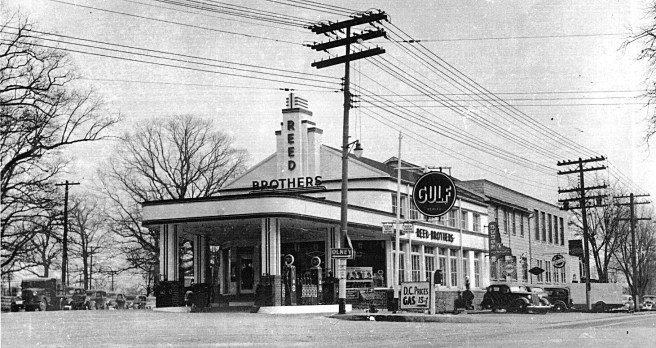
1936 — Reed Brothers Dodge canopied Gulf Gas Station. A closer look reveals the price of gasoline as 15 cents. On the right attached to a telephone pole is a sign pointing the way to Olney. In addition to the Gulf signage there is a small, barely visible sign below that promotes, “Clean Rest Rooms”. Photo by Lewis Reed
We’ve come a long way since these times. We pull up, pump our own gas, stick a plastic card in a machine and go. No human contact required. That’s progress, one supposes.
November 14, 1914: First Dodge Automobile Built

Horace Dodge (left, rear) and John Dodge (right, rear) take delivery of the first Dodge automobile on Nov. 14, 1914.
One hundred and four years ago on this date –November 14, 1914 — the very first Dodge car, “Old Betsy”, rolled off the assembly line. On that day, the Dodge Brothers (Horace and John) were photographed riding in the rear seat of the first car to bear their last name. It cost $785, had a 110-inch wheelbase, and was powered by an L-head 4-cylinder engine that proved so reliable it was continued until 1920 with very little modification. Total production for 1914 was a mere 249 touring cars. The following year. Dodge offered a two-passenger roadster which also sold for $785 and the plant went into full production.
According to “The Dodge Brothers: The Men, the Motor Cars, and the Legacy” by Charles K. Hyde, here’s the full story:
The widely accepted history of the initial production of early Dodge Brothers automobiles in November 1914 is at odds with much of the evidence about the earliest Dodge Brothers cars. Automotive historians have thought that the first production car, later named “Old Betsy,” came off the assembly line at the Hamtramck factory on 14 November 1914. Guy Ameel, superintendent of final assembly for Dodge Brothers since the start of automobile production, served as John and Horace’s chauffeur that day. With the brothers in the back seat, Ameel stopped the first Dodge Brothers car in front of John Dodge’s mansion on Boston Boulevard in Detroit and a photographer recorded this important moment.
“Old Betsy” was more likely an experimental prototype car assembled several months before 14 November 1914 and not a production car at all…

The Dodge Brothers
The Dodge Brothers began an aggressive advertising campaign to promote their new automobiles and to attract potential dealers to sell their cars. Few people jumped onto the Dodge Brothers bandwagon earlier than Lewis Reed, and not many have lasted longer.
Lewis Reed received his franchise to sell Dodge Brothers Motor Cars from John and Horace Dodge; less than one year after “Old Betsy” rolled off the assembly line. He was just 27 years old. Since then, the business grew and transformed into the oldest Dodge dealership in Maryland history and one of the oldest in the entire nation.
Rockville Garage Hudson Motor Car Ads (1919-1920)
The advertisements in this post do more than just simply pitch a product, they capture a moment in history. A moment in history when Lewis Reed’s Rockville Garage represented several franchise nameplates along with Dodge, including Oldsmobile, Hudson, and Essex. The Hudson and Oldsmobile were sold at Reed Brothers from roughly 1917 through 1923.
Hudson introduced the Essex brand in 1919. The Essex was intended to compete with Ford and Chevrolet for budget-minded buyers. The Essex offered one of the first affordable sedans and by 1925 the combined Hudson and Essex sales made Hudson the third largest automobile manufacturer in the United States.
Prior to the advent of television and radio advertising, print media was the most popular form of advertising and most car ads were black and white. The following ads distributed by the Lambert Automobile Company in The Baltimore Sun newspaper advertises the Hudson and Essex automobiles.
In addition to franchise car dealers, there were also factory stores. In the early days, the factory stores did the national advertising. A factory store, also known as a branch store or branch dealer, was a dealership owned and run by the manufacturer. A list of area Dealers was placed in fine print at the bottom of the ads. Rockville Garage, Rockville, Md, is highlighted in yellow on each of these ads.

The Baltimore Sun 2 March 1919
By the 1920s, Hudson and Essex Motor Car advertisements featured elegant architectural borders with static drawings of their cars; some ads never pictured people during this period.

The Baltimore Sun 30 May 1920

The Baltimore Sun 29 Aug 1920
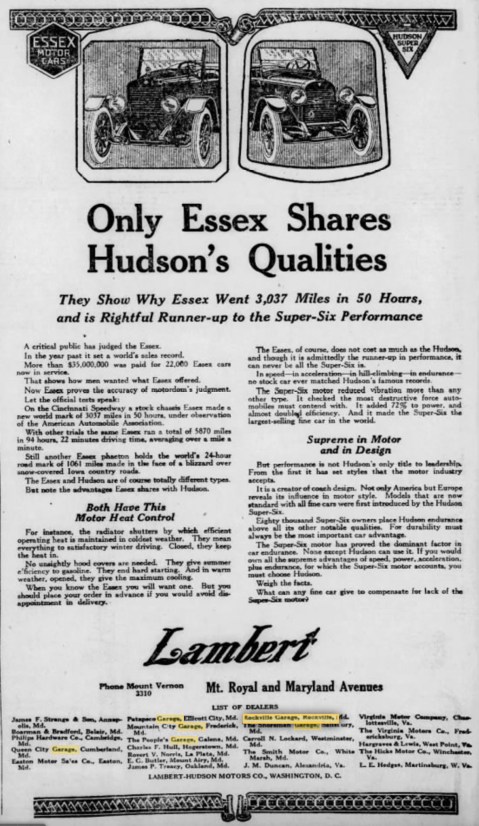
The Baltimore Sun 25 Jan 1920
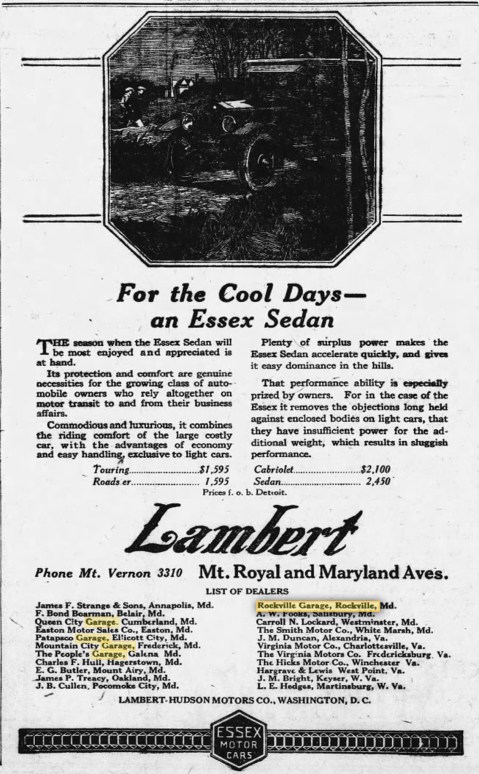
The Baltimore Sun 24 Oct 1920

The Baltimore Sun 21 Nov 1920

The Baltimore Sun 17 Oct 1920

The Baltimore Sun 13 Jun 1920

The Baltimore Sun 10 Oct 1920

The Baltimore Sun 1 Feb 1920

The Baltimore Sun 3 Oct 1920
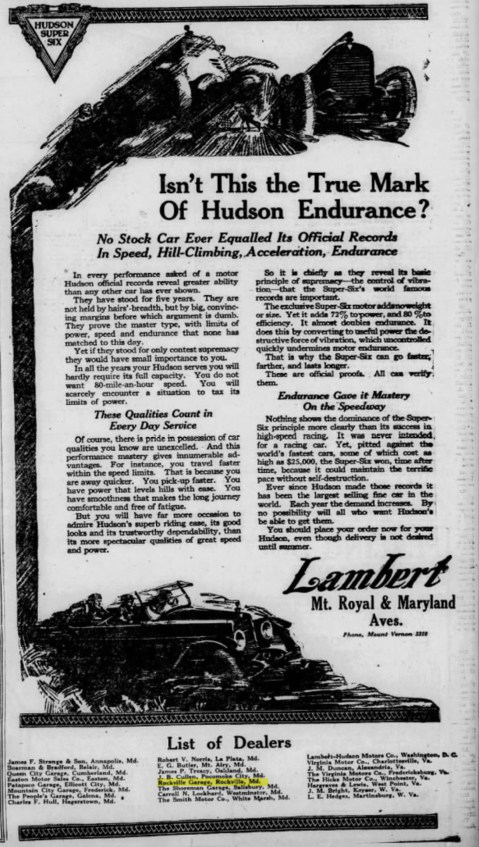
The Baltimore Sun 28 Mar 1920
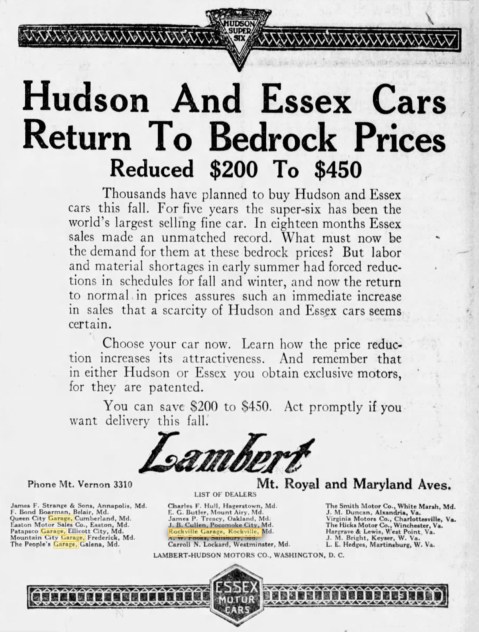
The Baltimore Sun 30 Sep 1920

The Baltimore Sun 5 Mar 1922
A lot of old newspapers have found their way online and with digital archival, it’s easier to take a trip back through old newspapers than ever before. These ads were found on NewspaperARCHIVE.com, the largest historical newspaper database online.
47 Years Ago Today: New Facility Grand Opening
 Today marks forty seven years since the Grand Opening of Reed Brothers Dodge new showroom and service facility. When the state widened the roads in 1970, Lee Gartner purchased 4.37 acres of land from Eugene Casey and relocated Reed Brothers Dodge to a new state-of-the-art showroom and Dodge/Chrysler/Jeep service complex on Route 355 at 15955 Frederick Road in Rockville Maryland.
Turning out to honor the company were several hundred dignitaries, officials, businessmen and friends. The new building, a complete automotive sales and service facility marked Reed Brothers 55th year of selling Dodge’s. The state-of-the-art dealership contained the newest customer-focused features throughout which combined technology and comfort.
The new dealership provided a modern new vehicle showroom, 30 service bays, a comprehensive detail and car wash area, Parts Department, Body Shop, the newest technologies to service customer’s vehicles and provided customers with a convenient location to purchase and service their vehicle needs.
Design and construction of the new dealership was managed by the Glen Construction Company.

 Photos taken at the Grand Opening. (click photos to scroll through gallery)


Happy Birthday Lewis Reed!


Lewis Reed was born in Darnestown, Maryland on November 25, 1887 and was the founder of Reed Brothers Dodge. When Lewis Reed opened his car dealership in October 1915, he never knew he was starting a family tradition that would be carried out for 97 years and three generations. He founded what would become the oldest Dodge dealership under the same family ownership in the state of Maryland, and one of the oldest in the entire nation.
In 1914, Lewis Reed became a partner in Rockville Garage, a business he purchased in 1918. His brother Edgar joined the business in 1919 upon his return from World War I, and the name became Reed Brothers Dodge. Lewis Reed was the first to sell Dodge cars in Montgomery County, Maryland and his company was the first Gulf gas dealer in the Washington, D.C. area. During the early years, Reed Brothers represented several franchise nameplates along with Dodge, including Oldsmobile, Hudson and Essex. The Hudson and Oldsmobile were sold at Reed Brothers from roughly 1917 through 1923.
Initially, Reed Brothers sold Oldsmobile and Hudson along with Dodge. The first Plymouth was built in 1928 and Plymouths were sold at Reed Brothers from 1930 until 1969, when the Plymouth car was given to the Chrysler dealers. In 1928, when Walter P. Chrysler took over after Horace and John Dodge died, Lewis Reed became an original member of the Chrysler family. By 1929, when the stock market crashed and Great Depression began, nobody could afford to buy cars. Like most other businesses, the Great Depression hit hard and Reed Brothers had to rely on its Service Department to make ends meet.
Before becoming interested in automobiles, Lewis Reed was one of the original employees of the Computing-Tabulating-Recording Company, a Georgetown-based manufacturing firm that eventually became International Business Machines, Inc. He received his automotive training at the Pierce-Arrow factory in Buffalo, New York, the Dodge Hamtramck and Hudson Motor Car factories in Detroit, Michigan, and the Washington Auto College.
When World War I broke out, Lewis Reed along with many other patriotic men joined the war effort. He did his bit in World War I by working at the Navy Yard in Washington DC as a torpedo tester.
Lewis Reed was very active in his community and in his church. He was a member of the Gaithersburg Grace Methodist Church, where he served as a member and Chairman of the Board of Stewards, a Lay Leader and President of the Men’s Bible Class. He was a charter member and Past President (Feb 1933 – Feb 1937) of the Gaithersburg-Washington Grove Volunteer Fire Department and a member of the advisory board of the Rockville branch of the First National Bank of Maryland. Lewis Reed belonged to the Masonic Lodge of Rockville, the Pentalph Chapter of the Eastern Star and the Rockville Rotary Club. He was a Rotarian for 34 years and also had served as President of that group.
Active in the dealership daily until the day of his death, Lewis Reed died on January 28, 1967 at the age of 79. Shortly after his death, the Senate of Maryland passed SENATE RESOLUTION NO. 10 honoring the well-known Rockville automobile dealer for his personality and outstanding contributions. The resolution was sponsored by Senator Thomas M. Anderson, Jr and Senator Louise Gore. At the time of his death, he was in negotiations with the State Roads Commission on the Commission’s proposal to take over a portion of his business property for construction of an interchange at Rockville Pike, Hungerford Drive and Veirs Mill Road.
In recognition, the state of Maryland named the connector street behind the original location, “Dodge Street,” commemorating Reed Brothers’ presence from 1914-1970. When the state widened the roads in 1970, the dealership relocated to Route 355 at the Shady Grove Metro.
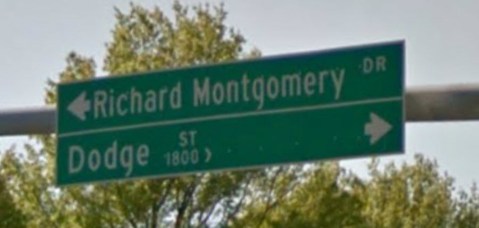 When you look back and consider what has taken place in the world in the past 100 years or so, you gain a perspective of what Lewis Reed faced. He overcame a lot of obstacles throughout his life. He steered his dealership through World War I, The Great Depression and World War II. When Reed Brothers had no new cars to sell for three and a half years and many dealers went bankrupt, he converted his car showroom into a display room and sold GE washing machines and other appliances. Reed Brothers Dodge occupied two locations, the original at the Veirs Mill Road and Rockville Pike intersection and the second at 15955 Frederick Road in front of the Shady Grove Metro.
Lewis Reed set an outstanding example through his success, but more importantly through his sacrifices and commitment to the community he served. Today, Bainbridge Shady Grove Metro Apartments pays homage to the oldest Dodge dealership in Maryland with commemorative art on the former site of the iconic Reed Brothers dealership.
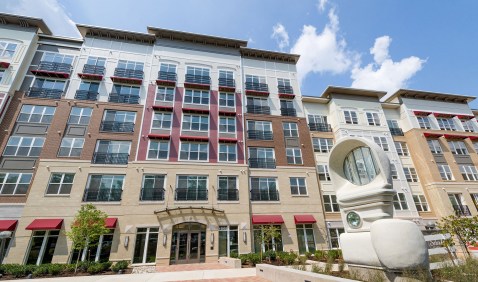
Bainbridge Shady Grove Metro Apartments now stands on the former site of the Reed Brothers Dodge dealership at 15955 Frederick Road. But a sculpture now installed on the property pays tribute to the oldest Dodge dealership in Maryland history. More than 20 feet high, and over 6 feet wide, the public art is inspired by 1939 Dodge headlamps, and the fender of a 1957 Dodge pickup truck.
Books

Related Resources


Copyright Notice

Reed Brothers Dodge History (1915-2012) by Jeanne Gartner is licensed under a Creative Commons Attribution-NonCommercial 3.0 Unported License.
 Reed Brothers Dodge History 1915 – 2012
Recent Comments