
From Horsepower to Headlines: Reed Brothers’ Early Auto Ads
Advertisements do more than just simply pitch a product, they capture a moment in history. The following early auto ads placed in local newspapers by Rockville Garage/Reed Brothers Dodge do more than mirror the evolution of automotive technology and related advertisement, they present a snapshot of the motoring experience.
Auto ads at the end of the 19th century were similar to the printing technology at that time. Especially at the start of the century, the vintage car prints didn’t have any vehicle image on them and most used black and white paper. But as soon as the 20th century started, vehicles started to appear on the ads with a lot of font style variation. The history of branding begun at the start of the century. However, they used a uniform approach of black and white images, and more focus was on the safety and speed of the car.
The first ever car advertisement in 1898 featured the headline “Dispense With a Horse” and simply sold the benefits of the Winton Motor Carriage. The ad showed that it’s not costly to maintain, its speed is 20 mph, and it had no odor. In the end, the ad compared it with the horse saying that a horse would never be able to do these tasks.
The first ever car advertisement by the Rockville Garage was placed in The Washington Herald less than 20 years later. During the early years, Reed Brothers represented several franchise nameplates along with Dodge, including Oldsmobile, Hudson, and Essex. The Hudson and Oldsmobile were sold at Reed Brothers from roughly 1917 through 1923. Through the years the ads have definitely improved from a timeless, artistic aspect; however the older ads definitely transport you back to a simpler time, both in the car world and in American history.
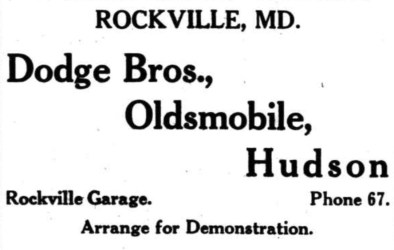
The Washington Herald, Monday, March 5, 1917
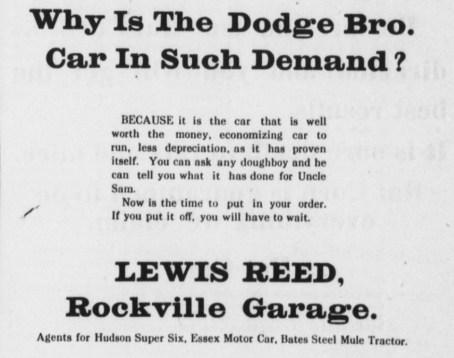
The Montgomery County Sentinel. May 02, 1919
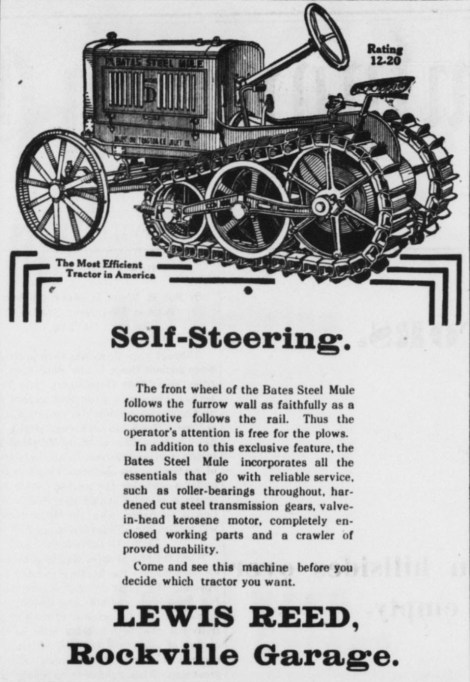
The Montgomery County Sentinel. June 20, 1919
World War I, and the food shortage that came along with it, was a defining moment in history and a direct cause of the rise of the lightweight tractor. — Rick Mannen, editor, Antique Power.
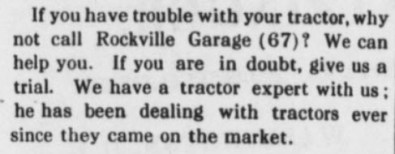
The Montgomery County Sentinel, April 18, 1919
A demonstration of The Bates Steel Mule Tractor will be given on the farm of J.B. Diamond, Jr., near Gaithersburg, on December 3rd and 4th by the Rockville Garage.
Upside Down to Prove Its Strength
We make this test at our store to show the strong, rigid body construction of the Hudson and Essex Coaches. In this position it is supporting a crushing load of 2700 pounds. Come see it. Test the doors and windows, which operate with ease, showing a total absence of body strain.
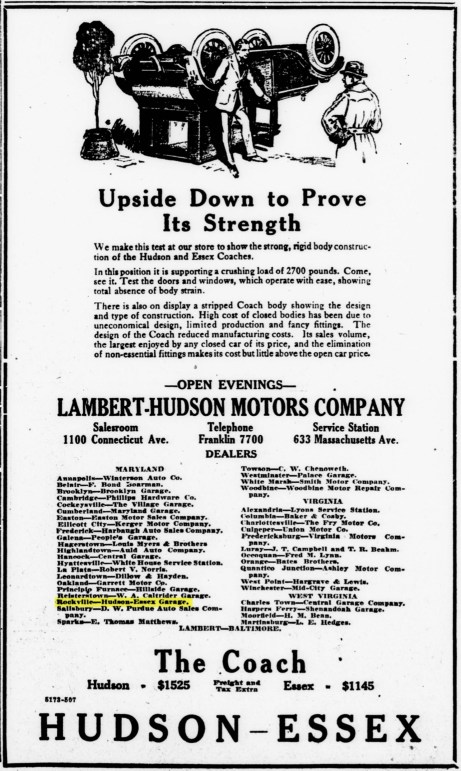
Rockville Garage Hudson-Essex Advertisement: The Evening Star, Washington DC, March 1, 1923
Dependability, The Dependables (1920s-1967)
Capitalizing on their reputation, the Dodge Brothers used their name, “Dodge Brothers” followed by “Reliable, Dependable, Sound” to market their products. Devoted Dodge customers raved about the rugged construction, quality, and power of their vehicles. Buyers consistently commented that this was a car that could be depended upon. In a Dodge marketing stroke of genius, Theodore MacManus coined the word “dependability.” Dodge was using the term in advertising from around 1914, and by the 1930’s, the word was appearing in dictionaries, and soon found its way into common, everyday usage.
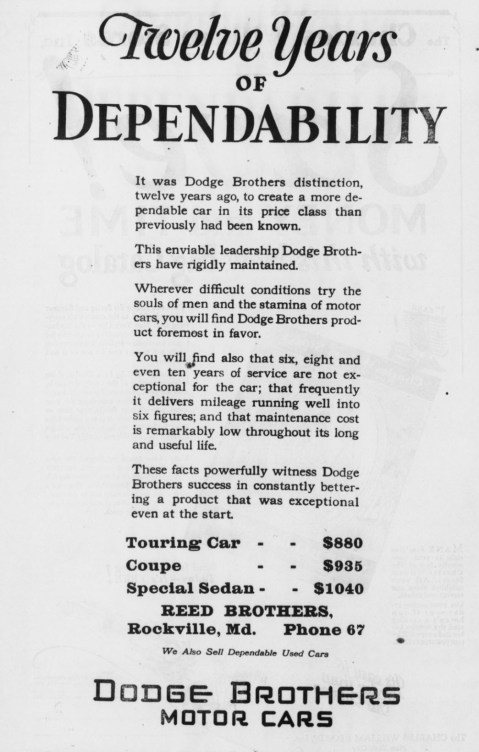
Montgomery County Sentinel. Feb 25, 1927
Dodge “Punishment Pit” – Torture Makes Them SAFER!
Rather than trying to compete with other manufactures with claims of mechanical prowess, Dodge tried a different approach in 1933 with their “Show Down” Plan.
Did you know that Dodge Brothers corporation had a “punishment pit”? This pit was a new type of automobile proving ground that was regarded as the quickest and most satisfactory way of finding out how an automobile can stand up under treatment of the most severely abnormal sort. Before Dodge introduced its latest models, some of the test cars were tortured in the punishment pit for as long as 600 hours.
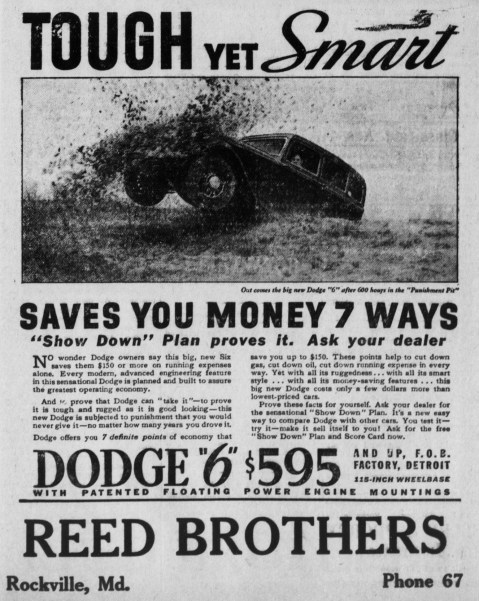
The Montgomery County Sentinel. August 24, 1933
The 1930s seemed to be the last great age of the publicity stunt for automobiles. Radio had already made inroads, and within a decade or two television would become the next great medium to reach the masses, but in the 1930s promoting new cars to a nationwide audience still took some creativity, something that Dodge had plenty of.
The Dodge Boys White Hat Specials (late 1960s)
In the late ’60’s, The Dodge Boys “White Hat Specials” were part of Dodge’s marketing and advertising campaigns. In these ads, the Dodge sales people, “the Dodge Boys,” were referred to as “good guys in white hats” and portrayed as friendly, helpful, and customer-oriented, as well as able to “beat the competition to the draw.”
Here are clips from a two-page ad that Reed Brothers ran in The Gaithersburg Gazette on Thursday, August 26, 1965 to promote their 50th anniversary. The title of the ad reads: “The Dodge Boys and Reed Brothers celebrate a 50 Year Success, 1915 to 1965! If you need a New or Used Car, come in today and cut yourself a “Slice of Savings…”
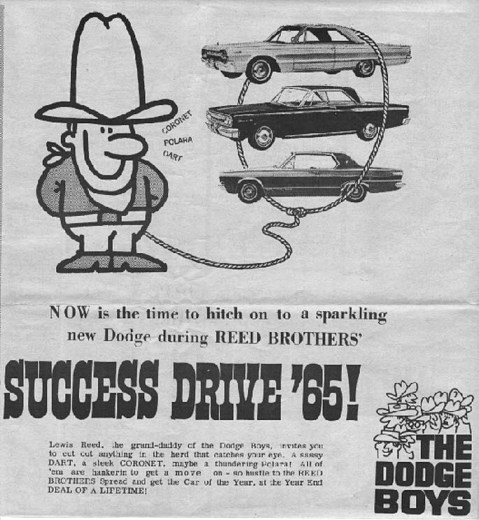
The Gaithersburg Gazette. Thursday, August 26, 1965
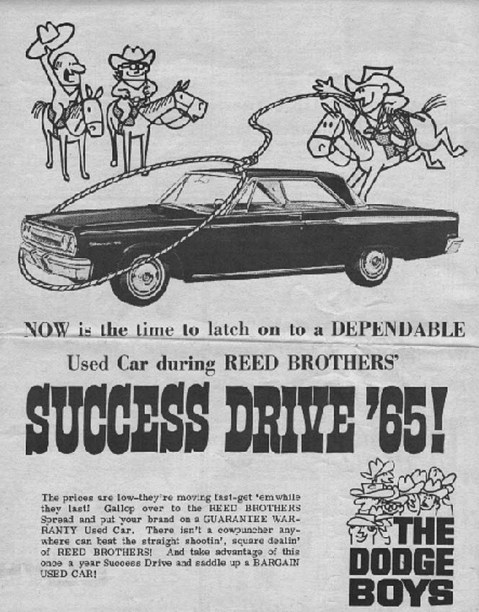
The Gaithersburg Gazette. Thursday, August 26, 1965
Ricketts Garage “Auto Hire” Billhead, May 7, 1914
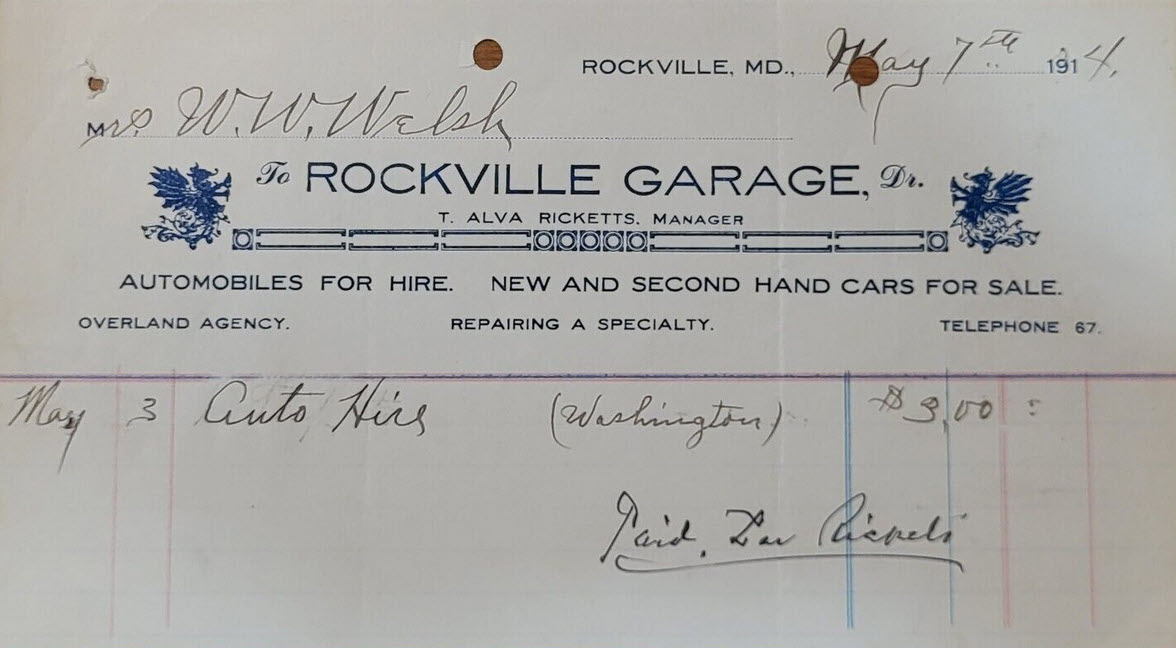
Ricketts’ Garage “Auto Hire” Billhead, May 7, 1914
Many early car dealerships grew out of existing garages. Reed Brothers Dodge evolved out of the Rockville Garage. Shown above is Ricketts’ Rockville Garage “Automobiles for Hire” and “New & Second Hand Cars for Sale” billhead receipt recently found on eBay. The receipt, dated May 7, 1914 is made out to W.W. Welsh (William Wallace Welsh) and is signed for by Lee Ricketts. Leonidas “Lee” Ricketts and sons, Raymond, Emory, and Thomas Alva (who went by “Alva”) ran the local Overland Agency at the Veirs Mill Road/Rockville Pike location from 1914-1915.
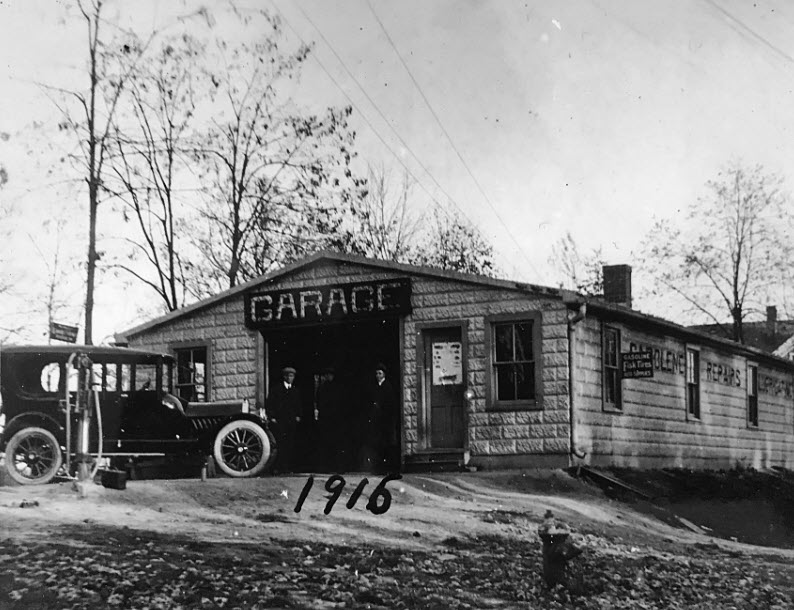
Original Rockville Garage building at the intersection of Veirs Mill Rd and Rockville Pike, 1916.
Origins of the Rockville Garage from The Montgomery County Sentinel. May 20, 1914:
Mr. Alva Ricketts has purchased the vacant lot opposite the fair grounds, in this town, from Mr. Benjamin Haney and will in the course of a few days erect upon it a garage, in which will be kept his autos for the accommodation of the traveling public.
The Overland Agency was short-lived: by July of 1915, Lewis Reed and brothers Robert L. and Griffith Warfield established Rockville Garage after acquiring the building from the Ricketts family. An employee of Rockville Garage in 1915, Lewis Reed purchased a one-third interest from the Warfield brothers in January 1916. Three years later, the Warfield’s conveyed the balance of the property and Lewis became sole owner. In August of 1919, Lewis Reed’s brother Edgar joined the business, and the name of the company was changed to Reed Brothers Dodge.
Rockville Garage Dealer of Bates Steel Mules

Montgomery County Sentinel, June 20, 1919
To survive the early days in the automobile business, most dealerships sold several makes of cars. During the early years, Reed Brothers represented several franchise nameplates along with Dodge, including Oldsmobile, Hudson, and Essex. The Hudson and Oldsmobile were sold at Reed Brothers from roughly 1916 through 1923. In addition to automobiles, the Rockville Garage also sold Bates Steel Mules, “the most efficient tractor in America.”
The Bates Steel Mule Tractor, sold in 1919 by Lewis Reed’s Rockville Garage, was designed at the dawn of the steel-wheeled tractor era to pull any horse-drawn implement the farmer owned. I had never even heard of such a thing until I came across this advertisement from the Montgomery County Sentinel.
So, I did some digging online and found the Steel Mule was a product of the Joliet Oil Tractor Company of Joliet, Illinois. First produced about 1913 the Bates Steel Mule was an odd looking tractor with two wheels set wide in front but only a single, low, crawler track centered under the rear. It was promoted as a powerful replacement for a team of horses when used to draw conventional horse-drawn farm machinery. Joliet was one of dozens of small companies vying for a spot in the lucrative small tractor market between 1910 and 1920. Its first tractor debuted in 1913. One of its key selling features was that a farmer could use it to pull his horse-drawn equipment. The Bates Steel Mule originally sold for $1,500, the equivalent of more than $27,000 today.

Montgomery County Sentinel, April 18, 1919
World War I, and the food shortage that came along with it, was a defining moment in history and a direct cause of the rise of the lightweight tractor. — Rick Mannen, editor, Antique Power.
Today’s tractors have come a long way in the past 100 years. Current models are equipped with revolutionary technology, including self-driving models, GPS, luxury cabs, Dolby sound systems, and increased horsepower and versatility.
105 Years Ago: Rockville’s First Gulf “Gas Station”
Curbside gasoline pumps were the predecessor to today’s contemporary fuel pumps. Before the advent of curbside pumps, gasoline was pumped from storage barrels, then hand poured into the automobile from tins. In 1901, a new underground container system was patented. The system used underground holding tanks which allowed the storage and subsequent distribution of gasoline to the surface via a curbside pump. It is considered the first vehicle fuel dispenser.
One hundred and five years ago, Rockville Garage began selling gas at their original location in Old Rockville at the triangle at Veirs Mill Road and Rockville Pike. It was a perfect site for the filling station due to being on a high visibility corner which gave the dealership maximum visibility to the largest volume of cross traffic. Their first “gas station” consisted of a single pump and one small tank. Rockville Garage dispensed gasoline produced by the Gulf Oil Co. and later offered Texaco gasoline as well. Reed Brothers is credited as the first Gulf gasoline dealer in the Washington, DC area.
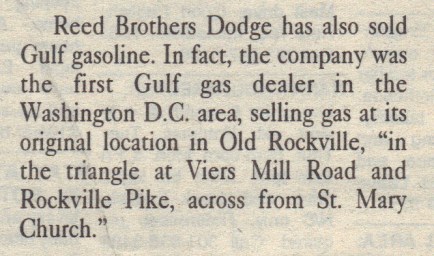
Clipped from The Frederick News-Post, Thursday, May 8, 1997
Rockville’s First Gulf “Gas Station” – A Single Pump
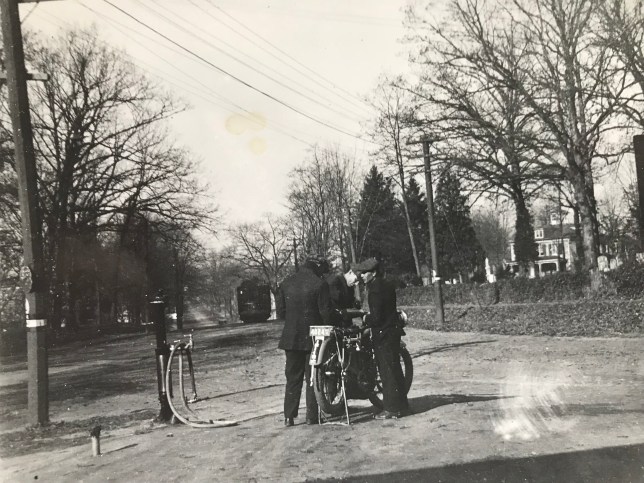
1915 Rockville Garage First Gas Station – A Single Pump. View looking west on Main Street of Rockville showing early trolley car. Originally printed from one of Lewis Reed’s glass negatives, this 1915 black-and-white photograph provides insight for understanding and preserving early U.S. petroleum history.
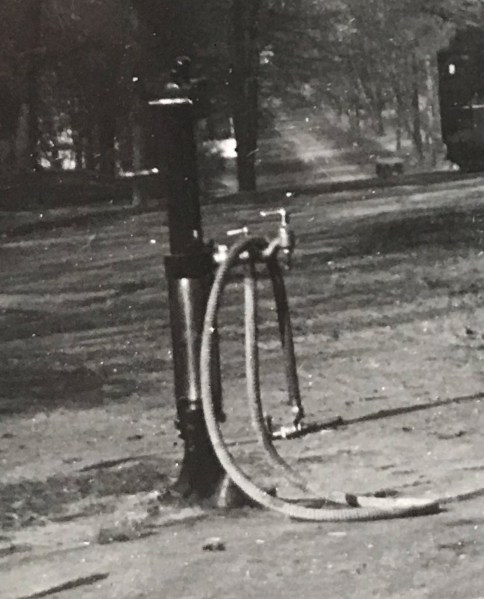
Close-up of the curbside pump in front of Lewis Reed’s Rockville Garage. The pump was mounted just inside the entrance and was served by one small storage tank buried beneath the ground.
The close-up image above illustrates the utilitarian design of the early gas pumps. These early pumps were roughly four feet tall and were supplied with a hose for dispensing fuel directly to the automobile. Although hardly an ideal system, pumps and underground tanks along the curb were an improvement over the earliest filling stations where gasoline was poured from hand containers. This curbside pump would remain in use until roughly 1917.

November 1915 Rockville Maryland Sanborn Map, Sheet 5 (zoomed in)
The zoomed-in image of the November 1915 Sanborn map shows the one-story Rockville Garage at the junction of Rockville & Georgetown Turnpike and Washington Road. These maps are quite specific, not only in representing graphically the dimensions of buildings and spaces around them, but also in the details of the construction materials and activities that took place there. Notes on this map indicate that the garage had a 15-car capacity as well as a single gasoline pump. They also noted the buried gas tank and where it was located with a small circle.

The same view today, fondly known as “the mixing bowl.”
Upside Down to Prove Its Strength
The advertisement in this post does more than just simply pitch a product, it captures a moment in history. A moment in history when Lewis Reed’s Rockville Garage represented several franchise nameplates along with Dodge, including Hudson and Essex. The Hudson and Essex were sold at Reed Brothers from roughly 1917-1923. Rockville–Hudson-Essex–Garage, is highlighted in yellow in the ad below. In addition to franchise car dealers, there were also factory stores. In the early days, the factory stores did the national advertising. A factory store, also known as a branch store or branch dealer, was a dealership owned and run by the manufacturer. A list of area Dealers was placed in fine print at the bottom of the ads.
The upside down coach on the dealers sales floors to demonstrate strength and sturdiness of construction is what proved effective in selling the Hudson and Essex.
We make this test at our store to show the strong, rigid body construction of the Hudson and Essex Coaches. In this position it is supporting a crushing load of 2700 pounds. Come see it. Test the doors and windows, which operate with ease, showing a total absence of body strain.

Rockville Garage Hudson-Essex Advertisement: The Evening Star, Washington DC Thursday, March 1, 1923
Hudson introduced the Essex brand in 1919. The Essex was intended to compete with Ford and Chevrolet for budget-minded buyers. The Essex offered one of the first affordable sedans and by 1925 the combined Hudson and Essex sales made Hudson the third largest automobile manufacturer in the United States.
The Hudson Motor Company, assisted by advertising a stripped Coach body and a chassis, and by a display of the individual parts that go into the Hudson and Essex cars, resulted in the sale of 75 Hudson and Essex cars the first 10 days. During its production run, the Essex was considered a small car and was affordably priced. The Essex is generally credited with starting a trend away from open touring cars design toward enclosed passenger compartments. By 1922 the Essex Motor Company was dissolved and the Essex officially became a product of Hudson.
In 1923, the big news was the demonstration the values the Hudson and Essex purchasers received. The advertisement below demonstrates the strength of the rigid body construction of the Essex Coach.
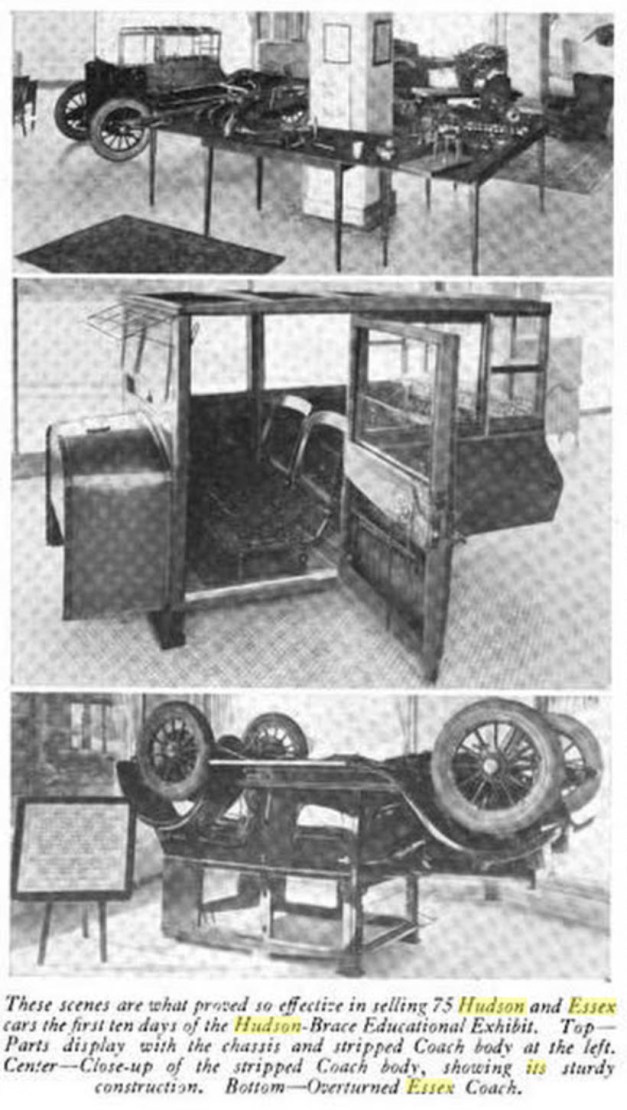
From The Hudson Triangle, Detroit Michigan, December 1, 1922.
Books

Related Resources


Copyright Notice

Reed Brothers Dodge History (1915-2012) by Jeanne Gartner is licensed under a Creative Commons Attribution-NonCommercial 3.0 Unported License.
 Reed Brothers Dodge History 1915 – 2012
Recent Comments