
Early Car Starters: How Did Old Cars Start?

Lewis Reed hand cranking an old car. The hammer in Lewis Reed’s right hand is for straightening the hand crank. Apparently they can bend when starting big engines. The license plate is MD 10307 dated 1913.
Today, we take the starting of automobiles for granted. Simply place the key in the ignition, turn, and VROOM, the engine starts. Vintage cars from from the 1900s and 1910s were comparatively archaic and limited in their mechanical features. Even starting these old relics was difficult because the process involved a number of complicated steps that the driver had to perform in the correct order.
However, this was not always the case. Hand cranks were the most common type of engine starters in the early days of the automobile. Cars in the early parts of the century had to be started by hand. This was accomplished by turning a crank, usually located in the front of the automobile. The driver would literally “crank the engine” by turning the handle, which would allow the process of internal combustion to begin. After a given number of cranks, the engine would begin to run on its own, and the crank could be removed.
Although hand crank starters were simple and reliable, they suffered from a handful of drawbacks. The main issue with this method of starting an engine is that it is inherently dangerous to the operator. For instance, if an engine kicks back during the cranking process, the operator could get TKO’d by the hand crank. Although many of these cranks used overrun mechanism, there was also a potential for injury if the handle continued to turn after the engine started running.
The other main issue with hand crank starters is that it took a certain degree of physical effort to turn them. That meant anyone who lacked the necessary physical strength or dexterity was incapable of starting a vehicle equipped with this type of starter.
By 1920, nearly all manufacturers were producing cars equipped with starters making it easy for anyone, regardless of physical abilities, to start a car by pressing a button mounted on the dash or floor. An ignition on and starter engage switch operated by a key was introduced by Chrysler in 1949.
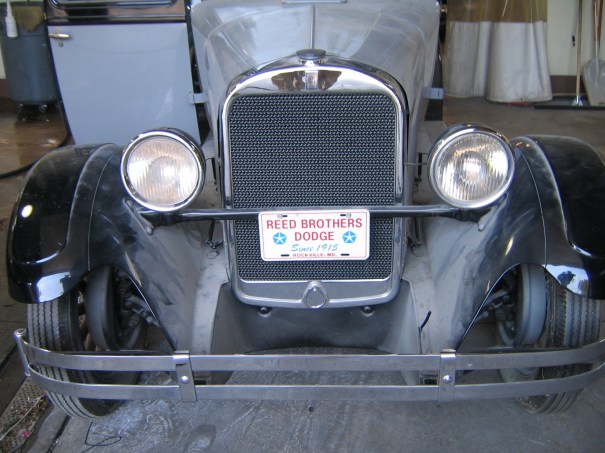
1928 Dodge Brothers Standard Six had both hand crank and starter. I’m assuming the crank was a backup in case the starter failed. The crank hole cover can be seen just below the front grill. Photo by Reed Brothers Dodge
Several new mechanical innovations were included in the 1946 Dodge Deluxe models. Among them were the introduction of the famous Fluid-Drive, a push-button starter system. The dash-mounted button on the 1946 Dodge Deluxe pictured below activated a solenoid, which in turn engaged the starter. For the first time since 1928 there was no provision made to manually hand crank the engine.

The push button starter on this 1946 Dodge Deluxe Fluid Drive was located on the far left, below the instrument gauges. Photo by Reed Brothers Dodge.
Reed Photo Collection (1898-1960)
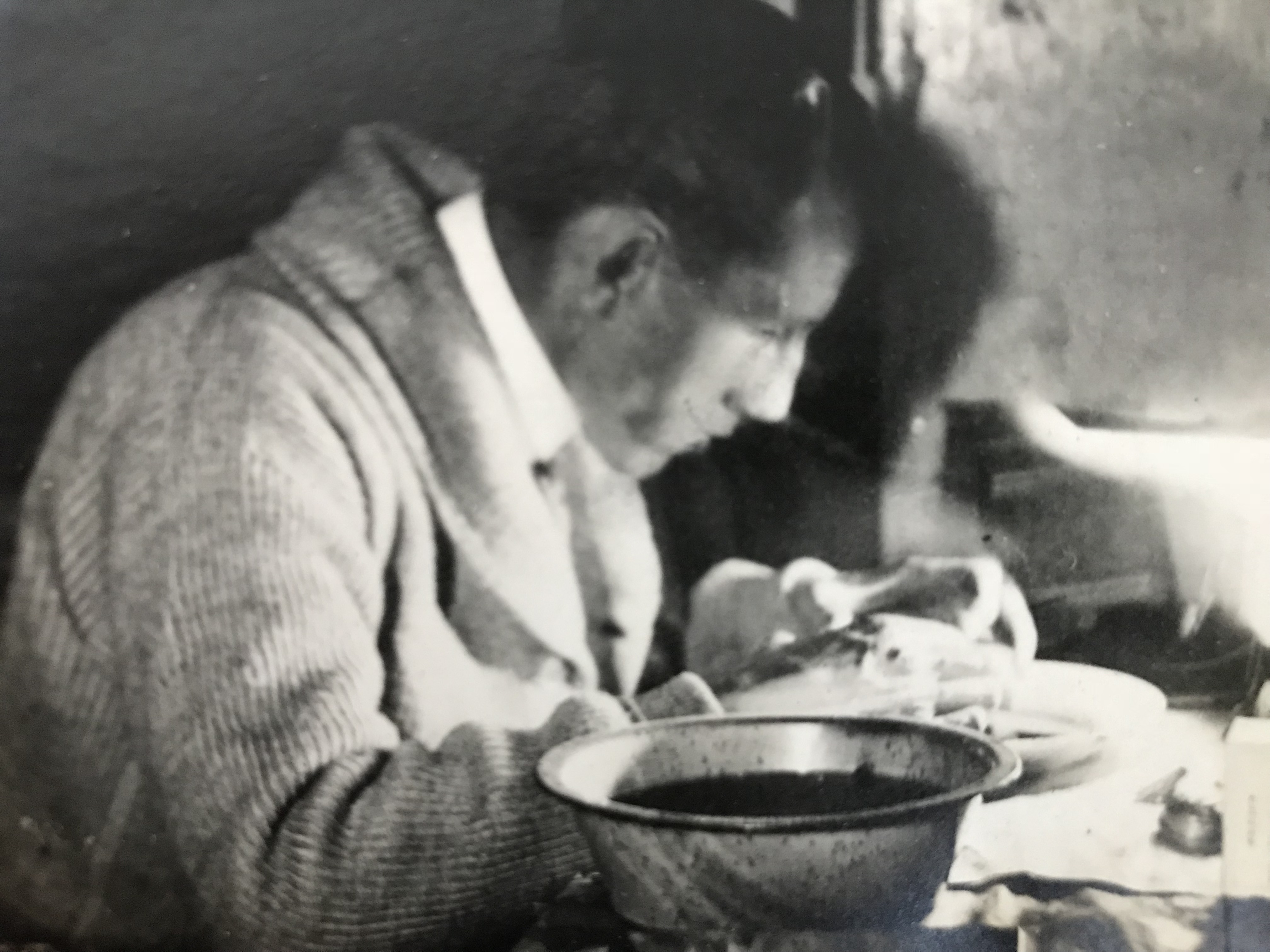
Lewis Reed, founder of Reed Brothers Dodge, was one of the most prolific photographers in Montgomery County at the turn of the 20th century. A self-taught photographer, he used a darkroom set up in his kitchen, sometimes working late at night to develop the negatives.
About This Collection:
Since launching this blog, it has been possible to explore an extraordinary archive: Lewis Reed’s photographs, taken across Maryland, Washington, DC, Virginia, and well beyond. The Reed Photo Collection (1898-1960) highlights the images that have been researched and identified, gathered into 200+ blog posts that offer vivid glimpses of everyday life more than a century ago.
Featured subjects range from the Black Rock Grist Mill, Rockville Water Tower, and C&O Canal to the 1939-1940 New York World’s Fair, Rockville Fair dirt track races, trolley cars, the Wright Brothers’ airplane, and the Quebec Bridge, once called the “Eighth Wonder of the World.” Particularly striking are the images documenting the devastation of the 1936 Gainesville, Georgia tornado, one of the deadliest in U.S. history; many photographs in this collection have never before appeared in print.
Lewis Reed’s legacy
Lewis Reed’s photographs have become an essential visual resource for local historians and have appeared in respected publications as well as historical television programs, including American Pickers, Science Channel’s Impossible Engineering, Maryland Public Television, and the PBS American Experience series.
In Montgomery County, his work is woven into the landscape: if you see a historical marker by the roadside, there is a good chance it features one of his images. His photographs appear on markers such as the Andrew Small Academy and Origins of Darnestown markers, the Baltimore & Ohio Railroad Station marker in Gaithersburg, From Trolley to Trail in Bethesda, the African American Heritage Walking Tour in Rockville, and the 19th Century Crossroads marker in Darnestown, as well as on an interpretive sign along the trail at Watters Smith Memorial State Park in West Virginia.
Early photographic “special effects”
One especially intriguing part of the collection is Lewis Reed’s experimentation with manipulated images. Long before digital cameras and Photoshop, he was creating imaginative “special effects,” a full century ahead of his time. His techniques included hand-tinting, double exposures, applied handwork, and playful compositions that introduce ghostly figures into the frame, all achieved with the limited tools of the early twentieth century. These experiments reveal not only technical skill but also a remarkable sense of creativity and humor.
Preserving historical authenticity
All images presented here are scanned from prints made from Lewis Reed’s original glass plate negatives, which were commonly used from the 1880s through the late 1920s. No digital retouching or alteration has been applied, preserving the photographs as faithfully as possible and maintaining their historical character.
Click here to step back in time and explore the lives, places, and stories captured through Lewis Reed’s camera.
A Photo You Will Have To Look At Twice

Grafton Reed, Bernie Hanshew, and Lewis Reed (standing) by a circa 1914 Excelsior Motorcycle. There is something else unusual in this picture… can you spot it?
Have you ever come across a picture that you had to look at twice just to make sure you were not crazy? Well I have… and the photo above is one of them. When I came across this photograph in Lewis Reed’s album, I had to look at it several times to make sure I was not “seeing things”. There is something surprising in this photograph, and when I finally figured out what it was, it put a big smile on my face.
Can you spot the unusual object in this photo?
OK, give up?

It’s a Doll!
One of the many things I admired about my grandfather was his sense of humor.
Kensington VFD Firetruck Truck from Reed Brothers Dodge

This photo was on the Kensington VFD web page. The trucks in front appear to be c. 1920s.
I was doing some online research and stumbled upon the Kensington (Maryland) Volunteer Fire Department’s web page. Their history is quite amazing, actually. Especially when I realized that their first truck was purchased from Reed Brothers Dodge. It was not a complete truck when purchased, however.
From the Kensington Volunteer Fire Department’s “History” webpage:
1922 was the birth of the Kensington Volunteer Fire Department. With little money, a Dodge truck was purchased from Reed Brothers Dodge in Rockville. A custom fire body was then built and fitted on the truck by Jacobs Brothers in Gaithersburg who ran the Wheelwright Shop on East Diamond Avenue. To raise money, the volunteers held carnivals. The Fire Department incorporated in 1925, and two years later moved into a permanent home in the basement of the National Guard Armory.

Photo of a c. 1920 Dodge fire truck
Lewis Reed later became a charter member and President (Feb.1933 – Feb 1937) of the Gaithersburg – Washington Grove Volunteer Fire Department.
And They’re Off! Rockville Fair Dirt Track Racing
This special post is a collection of early dirt track race photos that were taken by Lewis Reed at the Rockville Fair in the early 20th century. Held by the Montgomery County Agricultural Society (1846-1932) in Rockville, Maryland, the fair was known simply as the “Rockville Fair.” The fair’s oval dirt track was used for bicycles, harness races and later, cars.
Since the mid-19th century, an annual county fair was held in Montgomery County for four days in the month of August. Families came in wagons and carriages to the Rockville Fairgrounds and stayed for the duration. Like many fairgrounds, the Rockville Fairgrounds included an oval track. Fairground race tracks, typically one-mile or half-mile dirt racing ovals with wide, sweeping curves and grandstands for spectators, were easily adapted for bicycles, harness racing, and the sport of car racing.
Early action shots like these were difficult to take and are fairly rare, however, all of the photographs below were taken by Lewis Reed at the Rockville Fairgrounds in the early 1910-1920s. The fairgrounds were just outside Rockville, about where Richard Montgomery High School is today. The Fair lasted four days, from August 21st to the 24th, and drew visitors from local counties, Washington, and Baltimore. As always, click the photos to get a better look.
Bicycle Racing
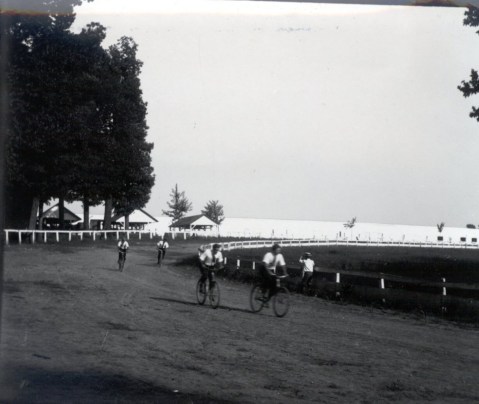
This circa 1915 photo of an early bicycle race at the Rockville Fairgrounds gives a sense of just how popular the sport was at the time. Photo by Lewis Reed
Harness Racing
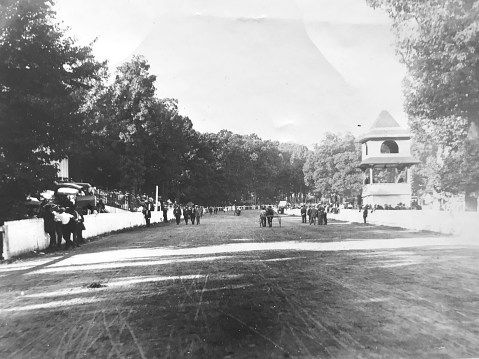
Harness race at the Rockville Fair, circa 1910. All those throngs of people had plenty to see. Photo by Lewis Reed
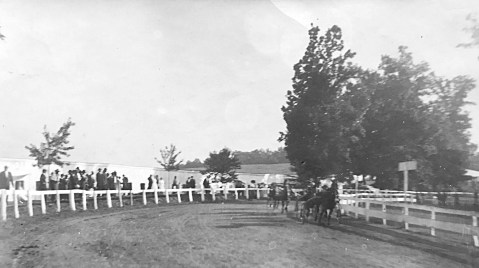
Harness racers rounding the bend on the racetrack, Rockville Fairground circa 1910. Photo by Lewis Reed
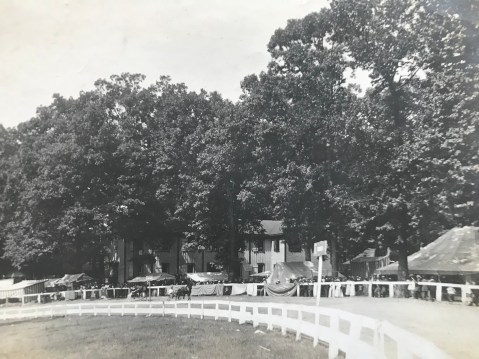
Bend on the harness racetrack, Rockville Fairground circa 1910. Photo by Lewis Reed
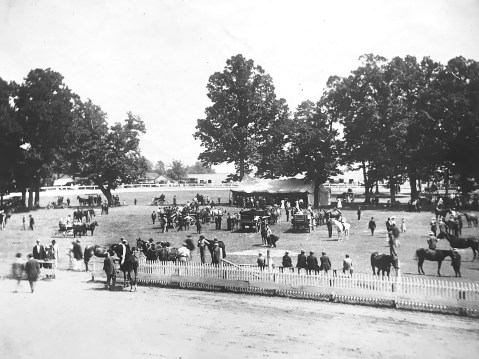
Crowds at the racetrack, Rockville Fair. Photo by Lewis Reed

Harness race at the Rockville Fair, circa 1910. Same vantage point as auto race photo below. Photo by Lewis Reed
Harness racing was one of the main attractions, but after the introduction of the automobile in the early 20th century, auto races took over…
Auto Racing
The photos below depict auto races at the Rockville fairgrounds. The photo of a harness race above was taken from approximately the same vantage point as the auto race below, which you don’t see very often in pictures from that era.
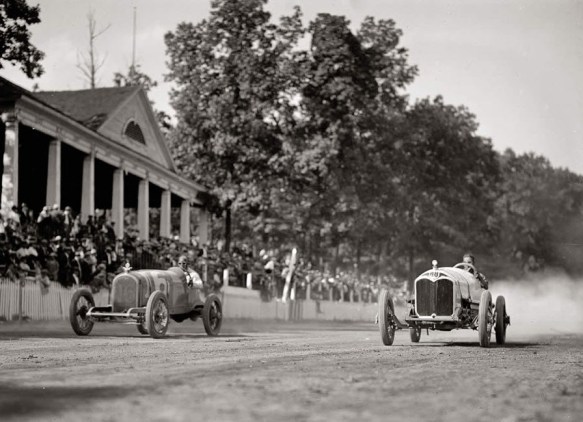
Rockville drew huge crowds for auto races. Rockville Fair, August 1923. Photo by Lewis Reed

Dusty Action – 1923 photo of the exciting auto races at Rockville Fair. Five racers are just coming around the bend on this dirt track with their tires spinning up dust in their wake. Photo by Lewis Reed

This race car is a total mystery…what on earth is it? It appears to be a two-man race car. Photo by Lewis Reed

More dirt track action. Photo by Lewis Reed
Below is a 1923 Washington Post ad for an auto race at the Rockville Fair.

Rockville Fair Race Ad
A football field was designed within the oval of the old Fair racetrack in 1946.
Books

Related Resources


Copyright Notice

Reed Brothers Dodge History (1915-2012) by Jeanne Gartner is licensed under a Creative Commons Attribution-NonCommercial 3.0 Unported License.


Recent Comments