
Montgomery County Fairgrounds in the Snow, ca. 1910

Montgomery County Fairgrounds. Photo by Lewis Reed, ca. 1910
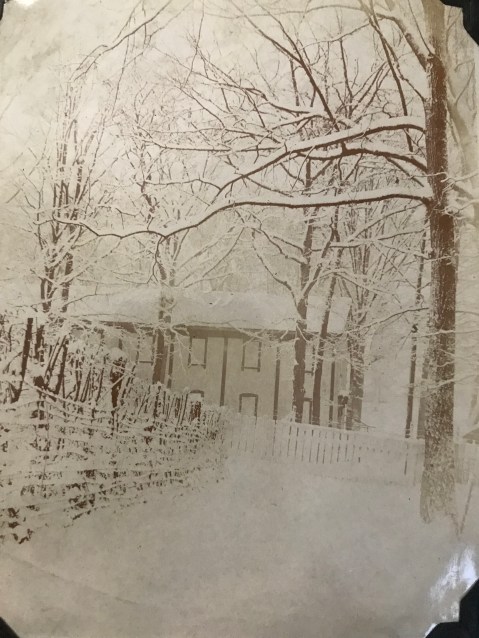
Montgomery County Fairgrounds Chicken House. Photo by Lewis Reed, ca. 1910
These snowy images of the Montgomery County Fair were taken by Lewis Reed, ca. 1910. From 1846-1932, the Montgomery County Fair took place in Rockville with competitions, entertainment, and food that attracted people from Montgomery County and Washington, DC.
Halpine / Lenovitz Store at 1600 Rockville Pike, 1910

Halpine / Lenovitz General Store at Rockville Pike and Halpine Road, 1910. Photo taken by Lewis Reed.
The Halpine Store, also known as the Lenovitz General Store, was built on Rockville Pike in 1898, taking advantage of the prime location on the trolley and railroad lines and the Pike. The store sold food, gasoline and other items to locals and Pike travelers. There is a young African American man standing in front of the store. Note the telephone or telegraph poles, and the trolley tracks paralleling the road. The nearby Halpine railroad station also brought customers to the area, and the store became the social/community gathering place for the Halpine area.
The proprietors, Benjamin and Anna Lenovitz, lived on the second floor. The building burned in 1923 and a new fire-resistant brick building was rebuilt in its place. This building, at 1600 Rockville Pike, became a Radio Shack, selling computers and electronics.
Source: Maryland Historical Trust
Huckleberry Finn?
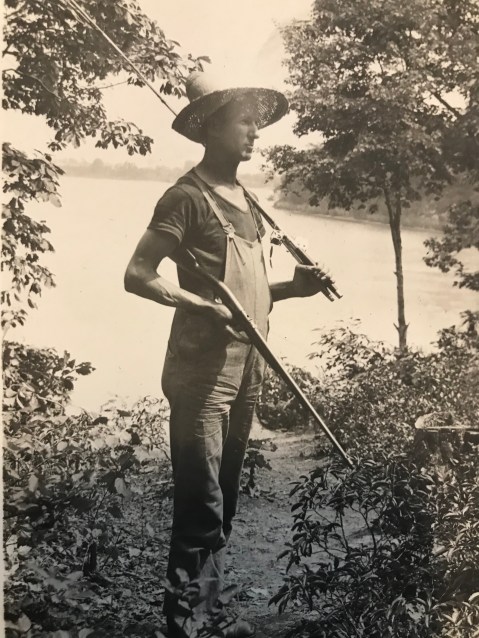
An adult Huckleberry Finn look-alike poses at Pope’s Creek, Maryland on the Potomac River. Photo by Lewis Reed, ca. early 1900s.
Pope’s Creek is located on the shore of a north-south section of the Potomac River north of and in sight of the Harry Nice Memorial Bridge. Lewis Reed was an avid fisherman and frequently fished and camped at Pope’s Creek with friends and family.
Near here, John Wilkes Booth was rowed across the river, a week after he assassinated President Abraham Lincoln.
Martin Thompson House on Darnestown Road, 1907

Route 28, Darnestown Road Circa 1907 – Martin Thompson House, owned by Lewis Reed’s maternal grandfather. Photo by Lewis Reed.
The home in the photo was owned by James Martin Thompson (1825–1902), Lewis Reed’s maternal grandfather. It was then called “Pleasant Hills”, which was located just opposite of the Thomas Kelly farm. In the early days, it was common practice for a family to give a name to their property. The house was accessed from Darnestown Road by a long tree-lined drive.
Route 28, in Darnestown is depicted in this photo before paving. What is now Route 28 is one of the earliest roads in the county, and was one of the main ways farmers in Poolesville, Darnestown, Dickerson, and Barnesville reached the courthouse in Rockville. Darnestown Road has existed since before the Civil war, and it remained a mud path for years into the automobile age.
Most houses in the Darnestown “Pleasant Hills” area were not very large and most were made of wood rather than brick. According to the 1860 Federal Census, Martin Thompson’s occupations were listed as Carpenter and Farmer living in Darnestown, Montgomery County, Maryland.
This photograph won an honorable mention in a contest sponsored by Rotary International for Lewis Reed.
On the Self-Publishing Horizon … Again!
I’m excited to announce that for the last year or so, I’ve been thinking about self-publishing a photo book specific to my grandfather, Lewis Reed, with a working title of, “Lewis Reed Photograph Collection (1898-1960).” Looking back at photography from the past is a fascinating experience for me, and with a newfound interest in history, the curious part of me wants to learn more: When was the picture taken? Where? What is it? Who’s in it? The majority of his photos are more than 100 years old and many are lacking labels and/or dates, which requires quite a bit of research and a little photo detective work on my part.
With that in mind, I will be frequently spotlighting photographs that may not directly pertain to the history of Reed Brothers Dodge, but will have a lot to do with it’s founder, Lewis Reed. I will not try to be an historian; I will post photos and supply a few paragraphs of context. Many photographic images in this collection have never before been seen publicly in print and will be available in this book for the first time.
I’ve been sitting on this post for a few weeks, timid to hit the ‘publish’ button. Likely because the size of the project is overwhelming and committing to it is a bit daunting (although exciting at the same time). It doesn’t help that as the ambition of my projects and goals increase, so too, can self-doubt. Below is the Draft Table of Contents for the book, which I’m sure will see some revisions as I progress.
Having said that, I will be switching my focus and time to mostly photo identification and researching/writing for the book.
Time to get to work!
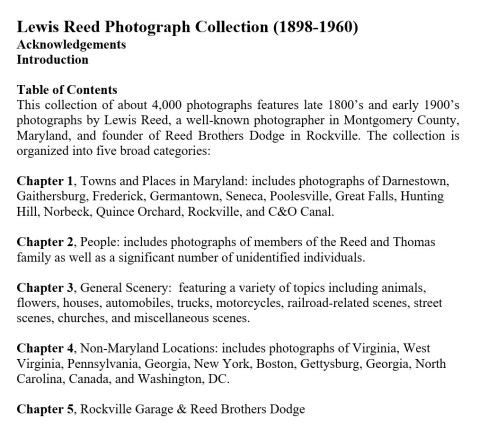
Draft Table of Contents
Books

Related Resources


Copyright Notice

Reed Brothers Dodge History (1915-2012) by Jeanne Gartner is licensed under a Creative Commons Attribution-NonCommercial 3.0 Unported License.


Recent Comments