
From Horsepower to Headlines: Reed Brothers’ Early Auto Ads
Advertisements do more than just simply pitch a product, they capture a moment in history. The following early auto ads placed in local newspapers by Rockville Garage/Reed Brothers Dodge do more than mirror the evolution of automotive technology and related advertisement, they present a snapshot of the motoring experience.
Auto ads at the end of the 19th century were similar to the printing technology at that time. Especially at the start of the century, the vintage car prints didn’t have any vehicle image on them and most used black and white paper. But as soon as the 20th century started, vehicles started to appear on the ads with a lot of font style variation. The history of branding begun at the start of the century. However, they used a uniform approach of black and white images, and more focus was on the safety and speed of the car.
The first ever car advertisement in 1898 featured the headline “Dispense With a Horse” and simply sold the benefits of the Winton Motor Carriage. The ad showed that it’s not costly to maintain, its speed is 20 mph, and it had no odor. In the end, the ad compared it with the horse saying that a horse would never be able to do these tasks.
The first ever car advertisement by the Rockville Garage was placed in The Washington Herald less than 20 years later. During the early years, Reed Brothers represented several franchise nameplates along with Dodge, including Oldsmobile, Hudson, and Essex. The Hudson and Oldsmobile were sold at Reed Brothers from roughly 1917 through 1923. Through the years the ads have definitely improved from a timeless, artistic aspect; however the older ads definitely transport you back to a simpler time, both in the car world and in American history.
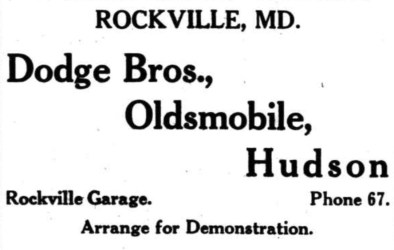
The Washington Herald, Monday, March 5, 1917
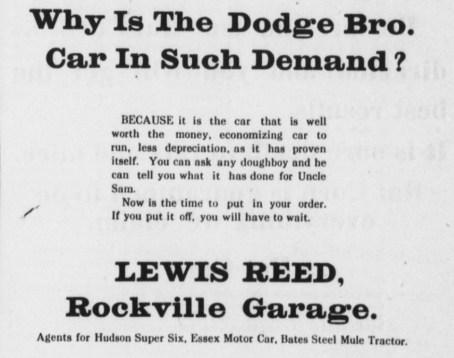
The Montgomery County Sentinel. May 02, 1919
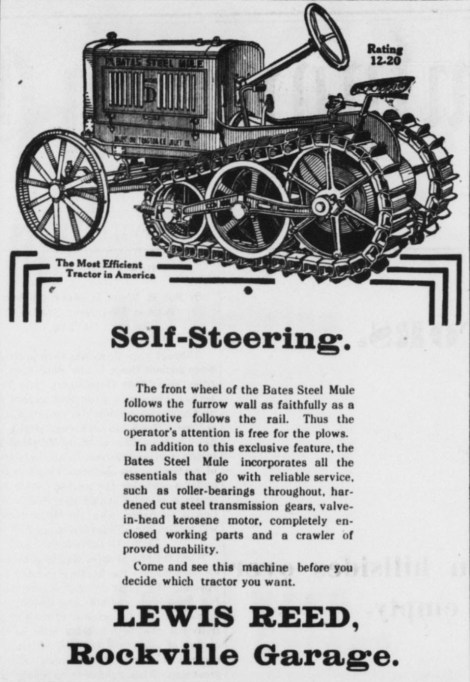
The Montgomery County Sentinel. June 20, 1919
World War I, and the food shortage that came along with it, was a defining moment in history and a direct cause of the rise of the lightweight tractor. — Rick Mannen, editor, Antique Power.
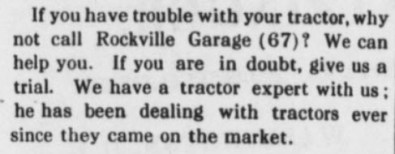
The Montgomery County Sentinel, April 18, 1919
A demonstration of The Bates Steel Mule Tractor will be given on the farm of J.B. Diamond, Jr., near Gaithersburg, on December 3rd and 4th by the Rockville Garage.
Upside Down to Prove Its Strength
We make this test at our store to show the strong, rigid body construction of the Hudson and Essex Coaches. In this position it is supporting a crushing load of 2700 pounds. Come see it. Test the doors and windows, which operate with ease, showing a total absence of body strain.
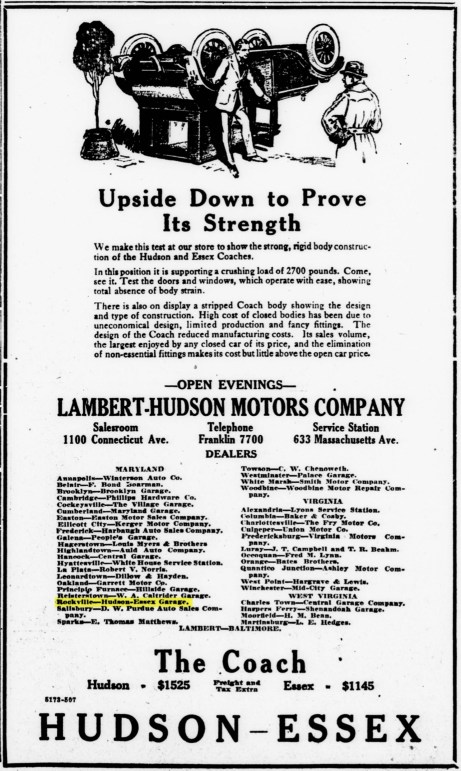
Rockville Garage Hudson-Essex Advertisement: The Evening Star, Washington DC, March 1, 1923
Dependability, The Dependables (1920s-1967)
Capitalizing on their reputation, the Dodge Brothers used their name, “Dodge Brothers” followed by “Reliable, Dependable, Sound” to market their products. Devoted Dodge customers raved about the rugged construction, quality, and power of their vehicles. Buyers consistently commented that this was a car that could be depended upon. In a Dodge marketing stroke of genius, Theodore MacManus coined the word “dependability.” Dodge was using the term in advertising from around 1914, and by the 1930’s, the word was appearing in dictionaries, and soon found its way into common, everyday usage.
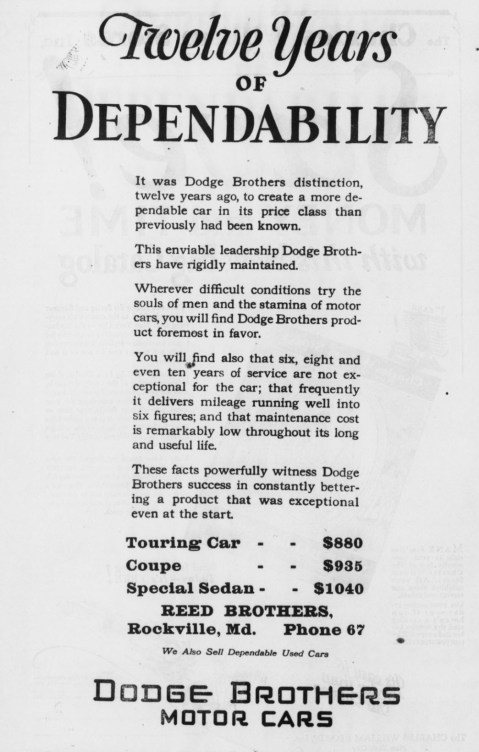
Montgomery County Sentinel. Feb 25, 1927
Dodge “Punishment Pit” – Torture Makes Them SAFER!
Rather than trying to compete with other manufactures with claims of mechanical prowess, Dodge tried a different approach in 1933 with their “Show Down” Plan.
Did you know that Dodge Brothers corporation had a “punishment pit”? This pit was a new type of automobile proving ground that was regarded as the quickest and most satisfactory way of finding out how an automobile can stand up under treatment of the most severely abnormal sort. Before Dodge introduced its latest models, some of the test cars were tortured in the punishment pit for as long as 600 hours.
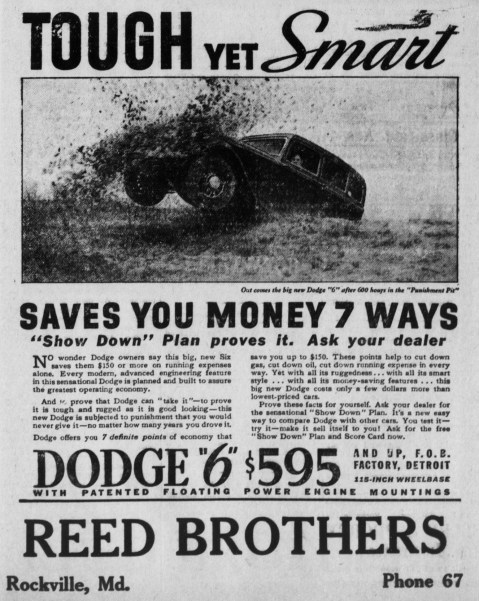
The Montgomery County Sentinel. August 24, 1933
The 1930s seemed to be the last great age of the publicity stunt for automobiles. Radio had already made inroads, and within a decade or two television would become the next great medium to reach the masses, but in the 1930s promoting new cars to a nationwide audience still took some creativity, something that Dodge had plenty of.
The Dodge Boys White Hat Specials (late 1960s)
In the late ’60’s, The Dodge Boys “White Hat Specials” were part of Dodge’s marketing and advertising campaigns. In these ads, the Dodge sales people, “the Dodge Boys,” were referred to as “good guys in white hats” and portrayed as friendly, helpful, and customer-oriented, as well as able to “beat the competition to the draw.”
Here are clips from a two-page ad that Reed Brothers ran in The Gaithersburg Gazette on Thursday, August 26, 1965 to promote their 50th anniversary. The title of the ad reads: “The Dodge Boys and Reed Brothers celebrate a 50 Year Success, 1915 to 1965! If you need a New or Used Car, come in today and cut yourself a “Slice of Savings…”
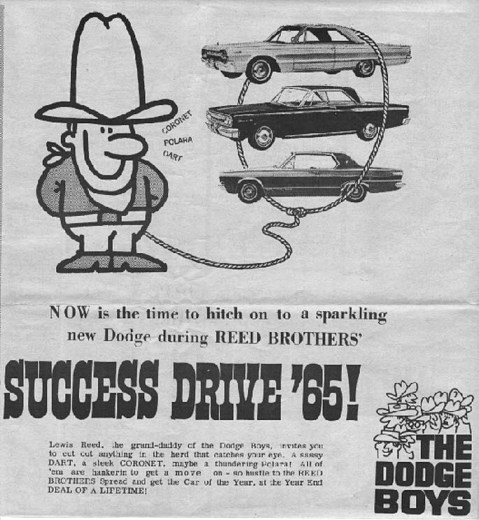
The Gaithersburg Gazette. Thursday, August 26, 1965
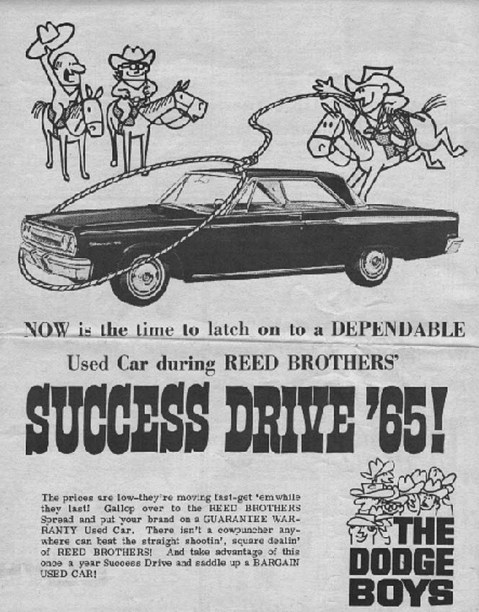
The Gaithersburg Gazette. Thursday, August 26, 1965
More Than Just Motors: The Enduring Link Between Reed Brothers Dodge and the MCPD
When you look back at the history of Montgomery County, Maryland, certain names are synonymous with the growth of the region. Reed Brothers Dodge is certainly one of them, but while we are often remembered as the first Dodge dealership in the area, our history is also deeply intertwined with the very foundation of the Montgomery County Police Department (MCPD). This connection wasn’t just about the cars and motorcycles; it was about the people who kept them on the road.

This is the first known photograph of the entire Montgomery County Police Force Motor Unit. Pictured left to right: Earl Burdine, Lawrence Clagett, Guy Jones, Chief Charles Cooley, Leroy Rodgers, and Oscar Gaither. Photo taken by Lewis Reed on July 4, 1922.
The relationship between Lewis Reed and the MCPD began on the department’s very first day of duty: July 4, 1922. On that historic morning, Chief Charles Cooley and his five original officers gathered at Reed Brothers Dodge to have their first official group photo taken. At the time, the department was a “mounted” unit on Harley-Davidson motorcycles. Because modern, branded dealerships didn’t exist yet, Reed Brothers served as a vital hub for sales and service. Lewis Reed and his brother Edgar were motorcycle enthusiasts who had founded Rockville’s Park Avenue Motorcycle Club a decade earlier in 1912, and their expertise made the dealership the natural home for the county’s early fleet. In those early days, each officer was allotted $300 a year for motorcycle upkeep, and our shop was where much of that vital work happened.
As the decades passed and the MCPD grew into a modern force, the need for expert maintenance grew with it. The department eventually established its own internal garage, but they didn’t have to look far to find the best talent to staff it. The “Reed Brothers standard” was so well-regarded that the police garage specifically recruited veteran mechanics from the dealership. By the late 1970s, two of our most skilled technicians, Ben McGowan and John Hall, transitioned from the service bays at Reed Brothers Dodge to work for the Montgomery County Police garage. Ben, an electrical and AC specialist, and John, a Maryland State Inspector and ASE-certified mechanic, brought a wealth of “under-the-hood” knowledge to the county.


This pipeline of talent from the dealership to the public sector highlights a beautiful piece of Rockville history. It shows that Reed Brothers Dodge was more than just a business; it was a training ground for the craftsmen who kept the county moving. When we see photos of those early 1922 officers on their Harleys or hear stories of the police fleet in the decades that followed, we aren’t just looking at machines. We are looking at the legacy of men like Lewis Reed, Ben McGowan, and John Hall– the hands that built, serviced, and supported the safety of our community for over a century.
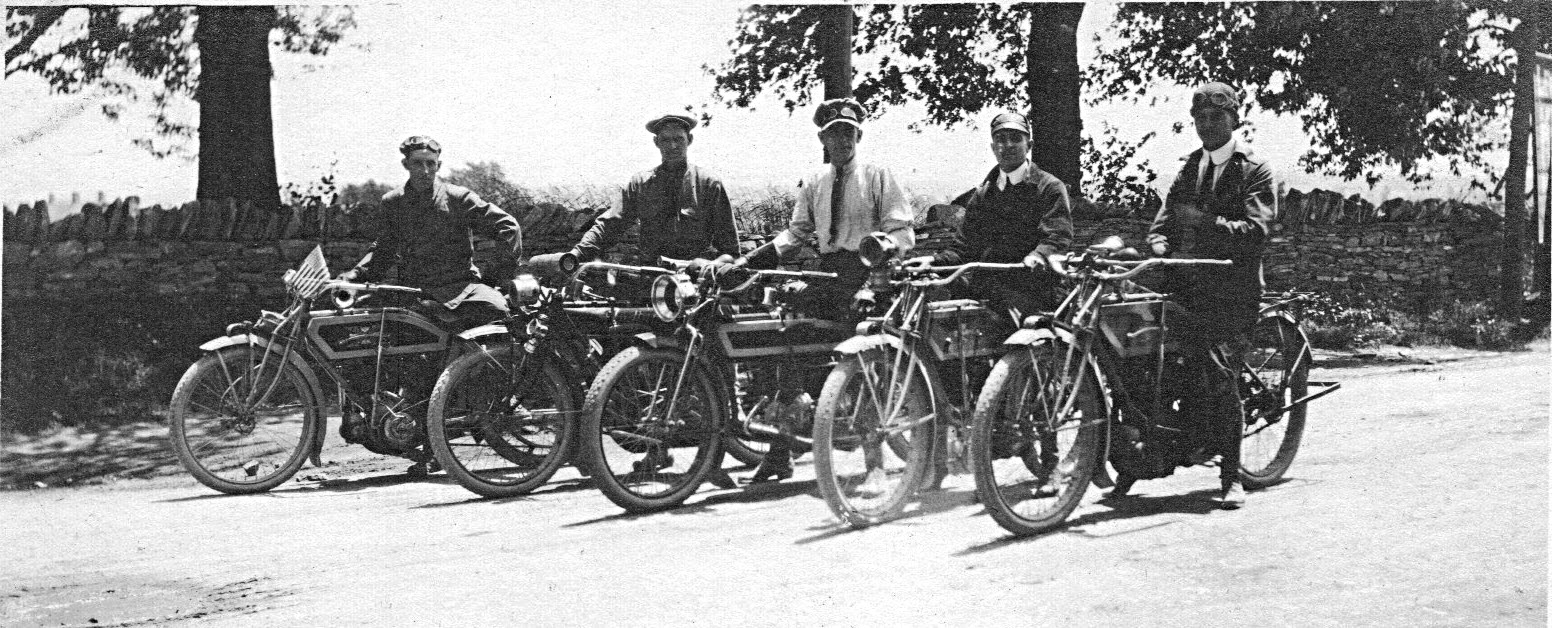
First motorcycle club in Rockville, Maryland. One Harley Davidson, one Indian, and Three Excelsior motorcycles on Park Avenue, 1912. Lewis Reed, far left.
As the curator of these archives and the granddaughter of Lewis Reed, I feel a great sense of pride in preserving these connections. Seeing the faces of men like Ben McGowan and John Hall reminds me that our family business was built on the shoulders of dedicated craftsmen who served their neighbors and their county. It is a legacy of service that I am honored to document and share with you today.
Snapshots in Time: Reed Brothers Dodge Then and Now
Reed Brothers Dodge occupies a distinctive place in Montgomery County’s commercial and transportation history, operating as a family-run dealership for nearly a century and weathering profound shifts in American life. Established in 1915 by automobile pioneer Lewis Reed and later joined by his brother Edgar, the firm grew from a modest Rockville garage into one of the nation’s oldest continuously operated Dodge dealerships, surviving two world wars, economic downturns, and repeated upheavals in the auto industry. “Snapshots in Time: Reed Brothers Dodge Then and Now” examines this trajectory through paired historical and contemporary images, inviting readers to view the dealership not simply as a business, but as a long-running institution that helped drive Montgomery County’s transition from rural crossroads to modern suburb. (click images to enlarge)


The black-and-white photograph on the left shows Lewis Reed’s original Rockville Garage in 1915, located at the intersection of Veirs Mill Road and Rockville Pike. In the early days of the automobile, many dealerships evolved from existing repair garages, and Rockville Garage was no exception. That same year, Lewis Reed became a partner with Robert L. and Griffith Warfield. The Warfield brothers later purchased the building in July 1915 from Lee Ricketts and Sons, who had operated the local Overland agency. The business continued under the Rockville Garage name until, shortly after Edgar Reed joined his brother, it was renamed at the suggestion of the late Judge Edward Peter.
The image on the right is a 1970 artist’s rendering of the new Reed Brothers Dodge dealership, representing a pivotal moment in the company’s history. After 55 years at the original downtown triangle location, Lee Gartner purchased 4.37 acres from Eugene Casey and relocated the business to a modern facility at 15955 Frederick Road in Rockville. Featuring a contemporary showroom and a full Dodge, Chrysler, and Jeep service complex, the new site marked the beginning of a new era, while carrying forward a legacy that began nearly six decades earlier in a modest corner garage.


The black and white photograph above, taken by Lewis Reed, shows the original Reed Brothers Dodge dealership nearly 80 years ago… and on the right is the same location today, now known as Veterans Park. In the 1970s, the site was briefly called Francis Scott Key Memorial Park, before being permanently rededicated as Veterans Park in 1988 to honor those who served. During the late 1960s, the State of Maryland acquired the property to widen Route 355. The remaining portion of land was donated to the City of Rockville, and a small street created behind the dealership was named “Dodge Street”—a lasting tribute to the more than 50 years Reed Brothers Dodge called that location home. What was once a center of automotive innovation has been transformed into a quiet place of remembrance, but the legacy of Reed Brothers Dodge remains forever etched in the street signs and stories of Rockville’s past.


These photographs show the intersection of King Farm Boulevard and Frederick Road; the site where Reed Brothers Dodge stood proudly for more than 40 years. The image on the left, captured by Google Street View in April 2012, shows the dealership just before it closed its doors for the last time.
Today, the legacy of Reed Brothers Dodge continues in a new form. On the right, the property is now home to The Reed, a rebranded apartment complex that pays tribute to the site’s deep roots in local history. In early 2025, the familiar Bainbridge name officially disappeared from 15955 Frederick Road in Rockville. Along with the signage, the apartment complex underwent a complete rebranding, now honoring the legacy of the Reed family and the dealership that once stood there. Though the building is gone, the memory of Reed Brothers Dodge remains deeply rooted in the landscape and spirit of the community.


The black and white photograph above was taken by Lewis Reed in 1915, looking west from the site of his original Rockville Garage. Visible in the image is the dealership’s very first “gas station”—a single pump. In the distance, an early trolley car makes its way along Main Street (now Rockville Pike), part of a transit line that operated from 1900 to 1935, running past Reed Brothers Dodge. Also visible in the background is the historic St. Mary’s Cemetery, a landmark that still exists today.
Fast forward to the present, and the same view seen on the right looks dramatically different. The once-quiet corridor has evolved into what locals now affectionately call “the mixing bowl,” a complex web of modern roads, traffic signals, and constant motion. While the landscape has changed, the photo offers a rare window into the early days of Rockville’s automotive and transit history.


The “then” photograph above was taken by Lewis Reed in 1953 at the corner of East Montgomery Avenue and Dodge Street. It captures the newly constructed building, which housed the showroom along with the parts and service departments. When the State of Maryland widened the surrounding roads in 1970, the connector street behind the dealership’s original location was officially named “Dodge Street,” a nod to the many years Reed Brothers Dodge operated there—from 1915 to 1970.
The “now” image on the right is a Google Maps view of the same location, captured in 2016—64 years later—showing just how dramatically the area has changed over time.


Both of the “then and now” images above are Google Maps Street View photographs taken just ten years apart. The image on the left shows Reed Brothers Dodge in 2007, while the image on the right captures the same site after its transformation into the Bainbridge Shady Grove Metro Apartments.
In early 2025, the familiar Bainbridge name officially disappeared from 15955 Frederick Road in Rockville. Along with the signage, the apartment complex underwent a complete rebranding. Today, the property is known simply as The Reed, a name that pays tribute to the site’s deep roots in local history.


The 1917 photo on the left is the original Rockville Garage located at the intersection of Veirs Mill Road and Rockville Pike, 100 years ago. Note the unpaved dirt road on Rockville Pike and trolley tracks running past the Rockville Garage. Both photographs were taken by Lewis Reed on the Rockville Pike side of the dealership.
On the right, is the same location 50 years later of the Reed Brothers Dodge Gulf Gasoline station. Due to changes in the highway, Reed Brothers began an extensive remodeling and rebuilding program. Two-thirds of the original location at the junction of then Route 240 and Veirs Mill Road was razed and a modern Gulf Service Station was erected.


On the left is a mid-1960s view from the corner of Veirs Mill Road and Dodge Street showing the new building for Reed Brothers Service Department. On the right is a Google street view image of the same location today, 50 years later.


The photograph on the left shows a side view of the Rockville Garage, including its two-story addition to the original shop, taken nearly a century ago. The first floor housed the service department, while the upper level was used for parts storage. A tall chimney, likely connected to a coal furnace, provided heat, and the abundance of windows flooded the workspace with natural light for servicing early automobiles. By this time, Firestone Tire signage had replaced the earlier Fisk brand sold at Rockville Garage in 1915.
The photograph on the right was taken in 1968 from the same location, roughly 50 years later. By then, major highway changes had dramatically altered the site. Nearly two-thirds of the original property at the junction of what was then Route 240 and Veirs Mill Road had been razed, making way for a modern Gulf service station.


The beginning and the end at 15955 Frederick Road: 1970 and 2013.
The photograph on the left shows the dealership’s newly completed building in 1970, following its move from the original location at the triangle formed by Veirs Mill Road and Rockville Pike. This modern facility marked Reed Brothers Dodge’s 55th year of selling Dodge vehicles and signaled a new chapter for the business.
The image on the right was taken on May 16, 2013. The building stands vacant, photographed on the very day demolition began, bringing nearly a century of automotive history at this location to a close.


The photograph on the left shows rows of beige and baby-blue cars lined up neatly in the side lot. Just across the road stands King Farm, dominated by its large barn painted with the words “Milk for Thompson’s Dairy,” long before the land was transformed into a dense mixed-use community. At the time, Lawson King’s dairy cows grazed in fields only a few feet from the roadway. At its height, King Farm was the area’s largest milk producer and had remained in agricultural use for nearly 75 years before development was approved in 1996.
The image on the right was taken from the same vantage point in 2009, more than three decades later. The familiar barn still rises in the background, but the surrounding fields are gone, replaced by the streets, buildings, and neighborhoods of what is now known as King Farm.
Looking at these images side by side, it’s clear that progress doesn’t erase history, it builds on it. Streets may widen, buildings may disappear, and businesses may move on, but traces of what once was are still there for those who know where to look. Lewis Reed’s photographs give us a rare anchor to the past, allowing today’s landscape to be seen with new eyes. In comparing then and now, we’re reminded that Rockville’s story is not just about change, but about continuity, memory, and the people who lived and worked along these streets long before us.
The Dodge Brothers’ First Car and the Birth of Reed Brothers Dodge
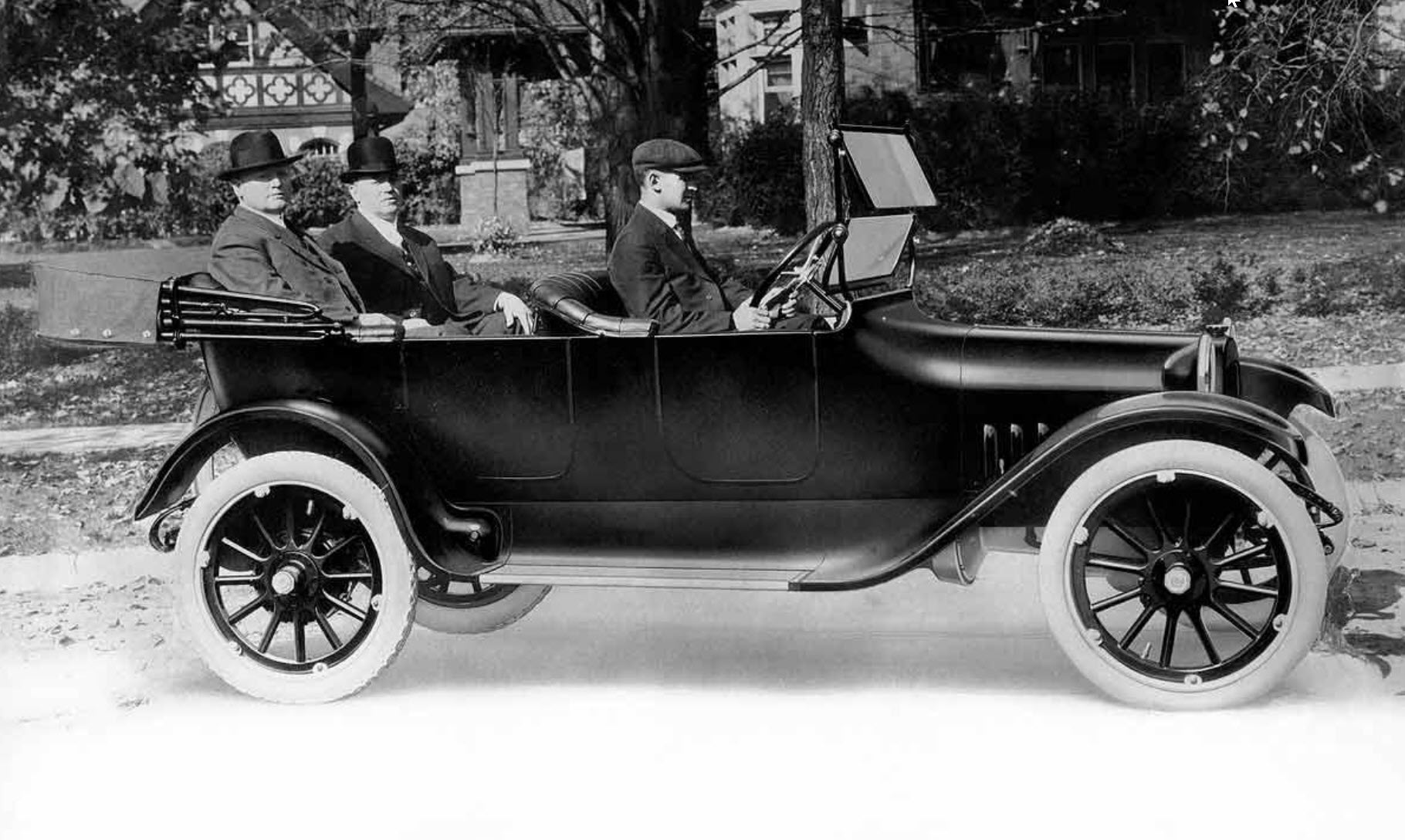
Horace (left, rear) and John Dodge (right, rear) shown in the first Dodge Model 30-35 on November 14, 1914 marking the beginning of the Dodge Brothers automobile legacy.
In 1914, the Dodge Brothers, John and Horace, made automotive history when they introduced their first automobile: the Dodge Model 30-35. What began as a bold move from building parts for Henry Ford’s Model T to designing a car of their own would forever change the American automobile industry, and soon after, shape the legacy of a small family dealership in Rockville, Maryland known as Reed Brothers Dodge.
The Car That Started It All
Before the Dodge Brothers built their own car, they were already well-known in Detroit as trusted machinists and suppliers of quality automobile parts. Their reputation for precision and durability earned them a major role in producing engines, transmissions, and axles for the Ford Motor Company. But by 1913, the brothers were ready to make their mark under their own name.
Interestingly, Lewis Reed shared that same mechanical foundation. The 1910 U.S. Census lists a 23-year-old Lewis Reed working as a machinist in Montgomery County, Maryland, developing the same kind of technical skill and hands-on craftsmanship that defined the Dodge Brothers’ early success. Like John and Horace Dodge, Reed’s mechanical aptitude and curiosity about the emerging world of automobiles would soon set him on an entrepreneurial path of his own.
When the Dodge Brothers Model 30-35 debuted in November 1914, it was a sensation. Unlike the bare-bones Ford Model T, the Dodge offered steel body construction instead of wood, an electric starter and lights, a 12-volt electrical system (twice the voltage of most competitors), and a powerful 35-horsepower engine. It was marketed as “the dependable Dodge,” and it lived up to that promise: rugged, reliable, and beautifully built.
Priced slightly higher than the Model T, the Dodge appealed to middle-class buyers who wanted quality and innovation without extravagance. Within a year, Dodge was the fourth-largest car manufacturer in the United States.
A New Dealership Takes Root in Rockville
That same year, in 1915, Lewis Reed, a young man from Rockville, Maryland, saw an opportunity in the rapidly growing automobile market. He became one of the nation’s first Dodge Brothers dealers, founding what would become Reed Brothers Dodge.
Operating out of a modest garage at the intersection of Veirs Mill Road and Rockville Pike, Lewis Reed began selling and servicing the new Dodge automobiles. His timing could not have been better: America was embracing the automobile, and the Dodge Brothers’ new car was among the most sought-after models on the road.
Lewis’s brother Edgar Reed joined the business a few years later, in 1919, helping expand operations as the dealership grew. Together, the Reed brothers built a family business grounded in service, honesty, and the same “dependable” spirit that defined the Dodge brand.
Lewis Reed, an early automobile enthusiast and skilled photographer, documented much of those early years. His images of the original Dodge touring cars, early showrooms, and Rockville’s unpaved roads offer a rare and fascinating glimpse into the dawn of motoring in Montgomery County.
A Legacy of Dependability
From that first 1914 Dodge to the final vehicles sold under the Reed Brothers Dodge name nearly a century later, the same spirit of innovation and reliability endured. Both the Dodge Brothers and the Reed Brothers shared a philosophy rooted in craftsmanship, honesty, and community, a partnership that would last through generations.
Today, the story of the Dodge Brothers’ first car and the birth of Reed Brothers Dodge stands as a testament to American ingenuity and small-town enterprise: two brothers in Detroit who built a car that made history, and two brothers in Rockville who helped keep that history alive.
Reed Brothers Car Stories: The 1928 Dodge That Started at $100
Where every car has a story — and every story has a little Reed Brothers history.
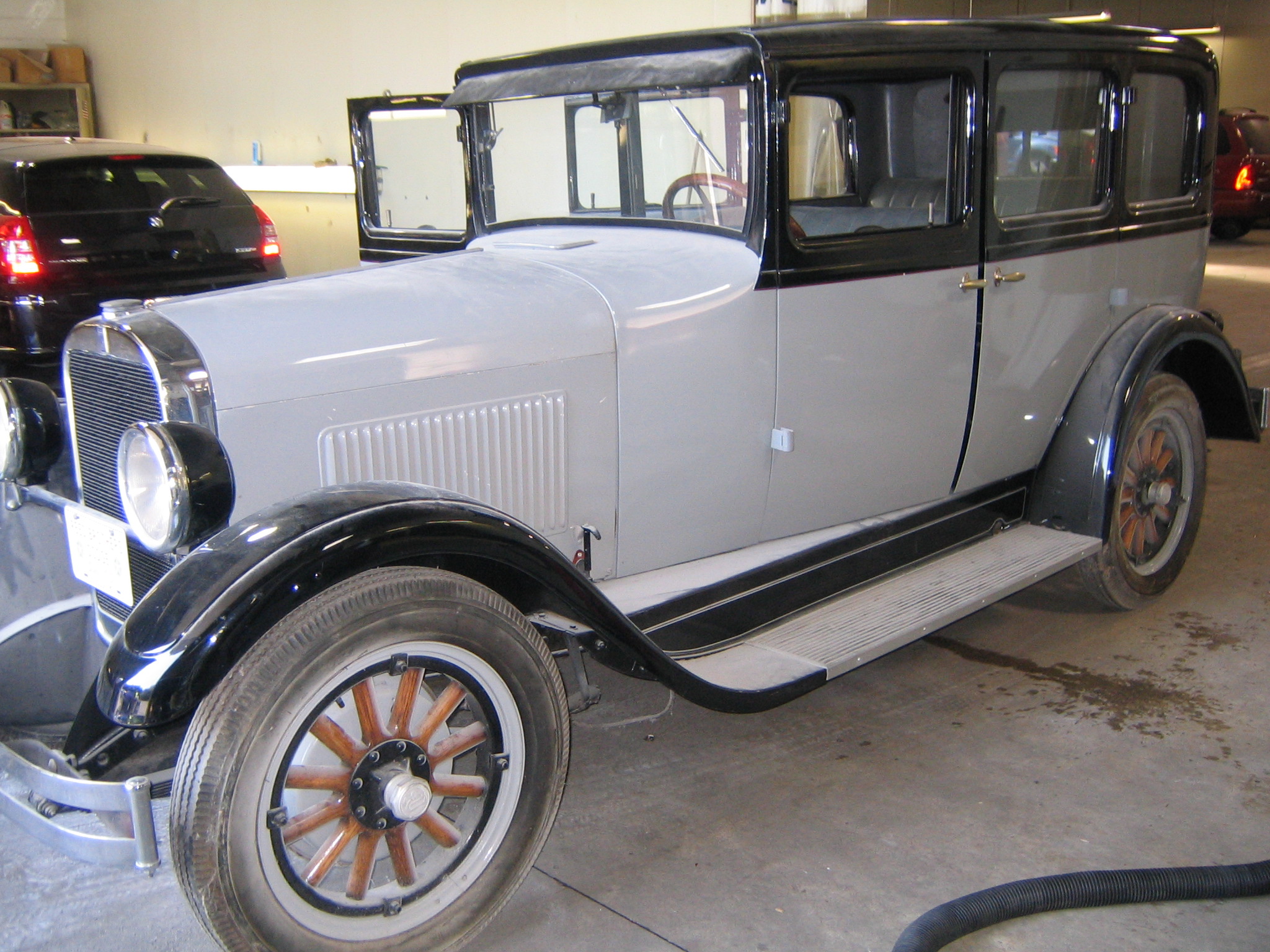
1928 Dodge Brothers Standard Six in the Service Department
Sometimes history rolls into your life when you least expect it. Over a half century ago, a phone call from a Montgomery County used car dealer changed the course of Reed Brothers’ history. The dealer told my dad, “Lee, I have something I want you to see.” What he had was a 1928 Dodge Brothers Standard Six — priced at just $100!
Lee knew the car was in rough shape, but he also knew it was something special. With its vintage charm and connection to Dodge history, the Standard Six was exactly the kind of treasure that belonged with Reed Brothers.
Reed Brothers Restoration: Preserving Automotive History
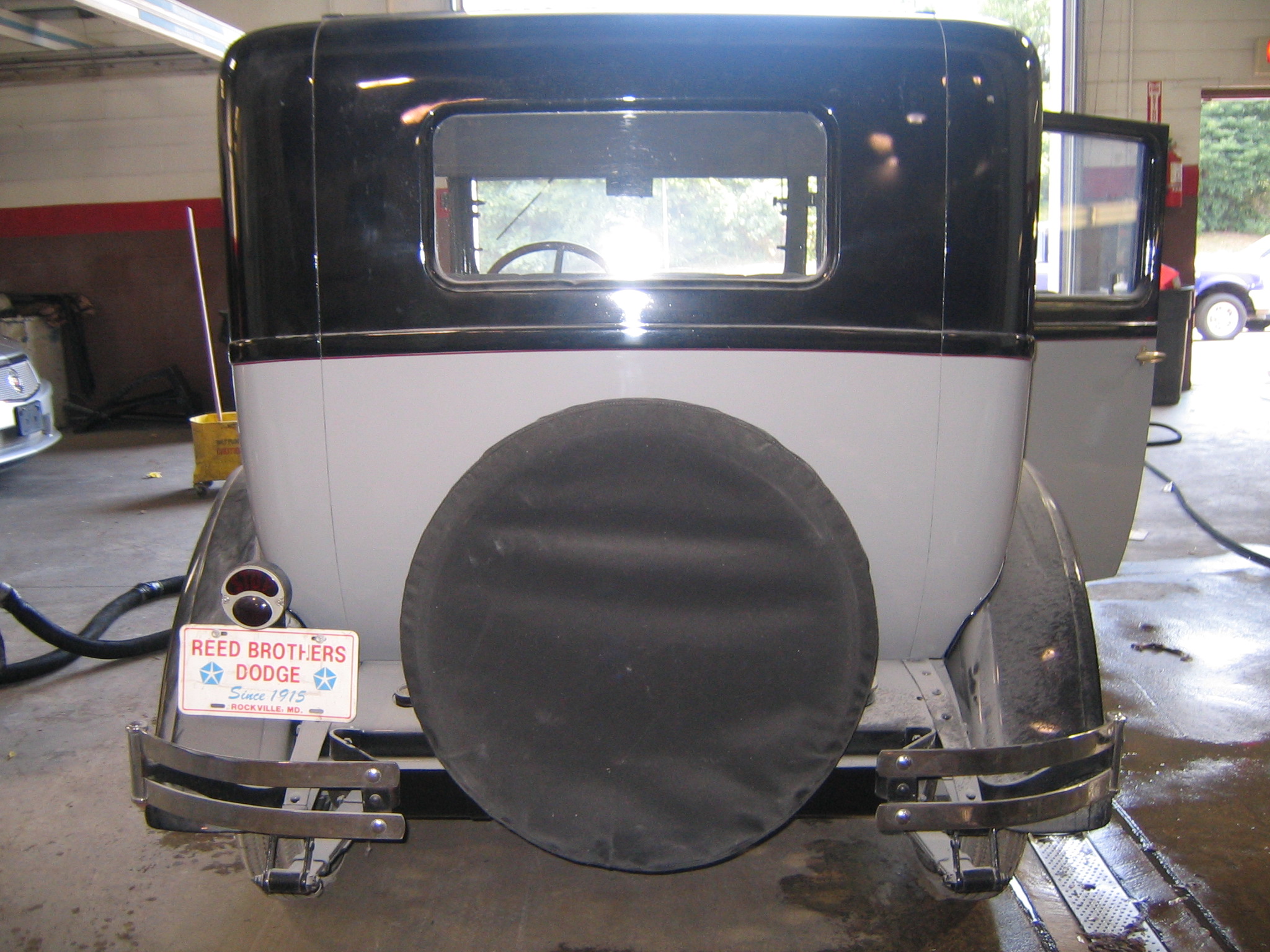
1928 Dodge Brothers Standard Six in the Service Department
In dealer ownership for more than fifty years, the Standard Six became a long-term project and point of pride. Restored and maintained by the Reed Brothers Body Shop and Service Department, the car was not just preserved but celebrated.
Originally selling for $835, the Dodge Brothers Standard Six was powered by a 6-cylinder L-head engine rated at 27.34 hp and had just 46,504 original miles. Over the decades, Reed Brothers’ Body Shop and Service Department meticulously restored and maintained it, giving the vintage Dodge a second life.
A Showroom Conversation Piece
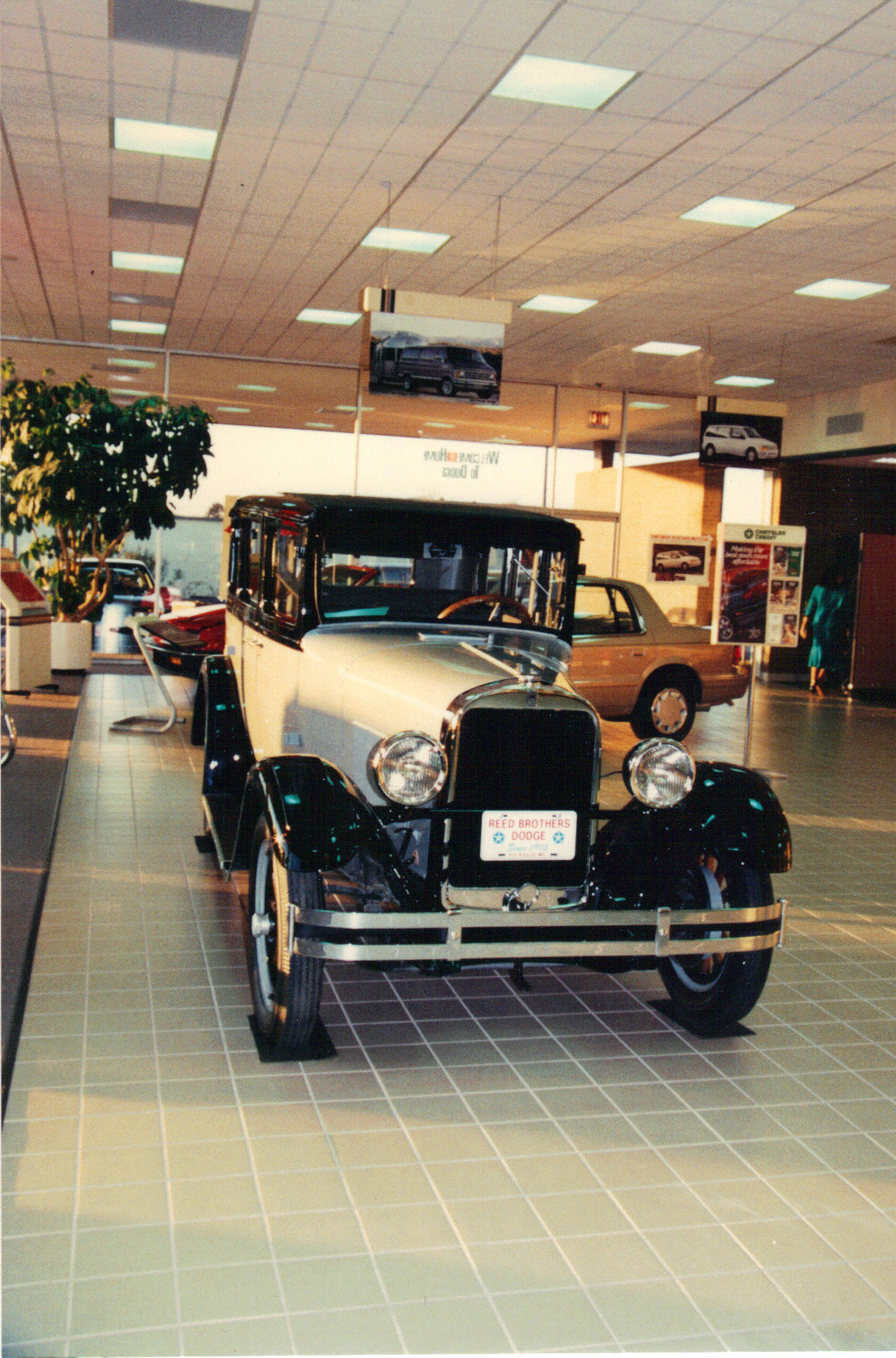
1928 Dodge Brothers Standard Six on the Showroom Floor
Once fully restored, the car was showcased prominently in the showroom, where it became more than just an antique; it was a conversation starter, a link to the past, and a tangible reminder of Dodge heritage. For years, visitors admired it, marveled at its history, and swapped their own car stories in front of it.
In 2012, with the closing of the dealership, the 1928 Dodge Brothers Standard Six ended its decades-long stay with the Reed Brothers family. But the memories of that $100 find, and the dedication it took to bring it back to life, remain an enduring part of Reed Brothers’ story.
Books

Related Resources


Copyright Notice

Reed Brothers Dodge History (1915-2012) by Jeanne Gartner is licensed under a Creative Commons Attribution-NonCommercial 3.0 Unported License.
 Reed Brothers Dodge History 1915 – 2012
Recent Comments