
July 7, 1928: The Automobile That Helped Build Chrysler and Became Part of Rockville History

𝗠𝗮𝗿𝘃𝗶𝗻 𝗦𝗵𝘂𝗹𝘁𝘇’𝘀 𝗥𝗲𝗲𝗱 𝗕𝗿𝗼𝘁𝗵𝗲𝗿𝘀 𝗗𝗼𝗱𝗴𝗲-𝗣𝗹𝘆𝗺𝗼𝘂𝘁𝗵 𝗦𝗵𝗼𝗽 𝗖𝗼𝗮𝘁. Embroidered with the dealership’s name, it reflects the years when Reed Brothers proudly represented both Dodge and Plymouth.
In 1930, Reed Brothers expanded its showroom by adding the Plymouth line, marking an important milestone in the dealership’s history. When Plymouth debuted in 1928, franchises were reserved exclusively for Chrysler dealers. Two years later, Chrysler opened the brand to Dodge and DeSoto dealerships, allowing established dealers like Reed Brothers to offer the new low-priced automobile. With the addition of Plymouth, the dealership officially became Reed Brothers Dodge-Plymouth, broadening its appeal to a growing market of budget-conscious buyers.
The timing proved ideal. As the nation entered the Great Depression, Plymouth quickly emerged as one of America’s three best-selling automobile brands, joining Ford and Chevrolet at the top of the industry. More than just a successful new model, Plymouth became the financial backbone of Chrysler Corporation. Its combination of affordability, dependability, and advanced engineering attracted thousands of customers during the country’s most difficult economic years. The steady sales of Plymouth automobiles helped sustain Chrysler through the Depression and played a pivotal role in securing the company’s future as one of Detroit’s major automakers.
For Reed Brothers Dodge-Plymouth, the addition of the Plymouth franchise brought many new customers through the showroom doors in Rockville. Families who wanted the quality and engineering of a Chrysler-built automobile at an affordable price found exactly what they were looking for in Plymouth. The brand would remain an important part of the dealership’s identity for nearly four decades.
Below: Salesman Raleigh Chinn’s business card, printed after 1930, reflects the dealership’s new identity as Reed Brothers Dodge-Plymouth following the addition of the Plymouth franchise.
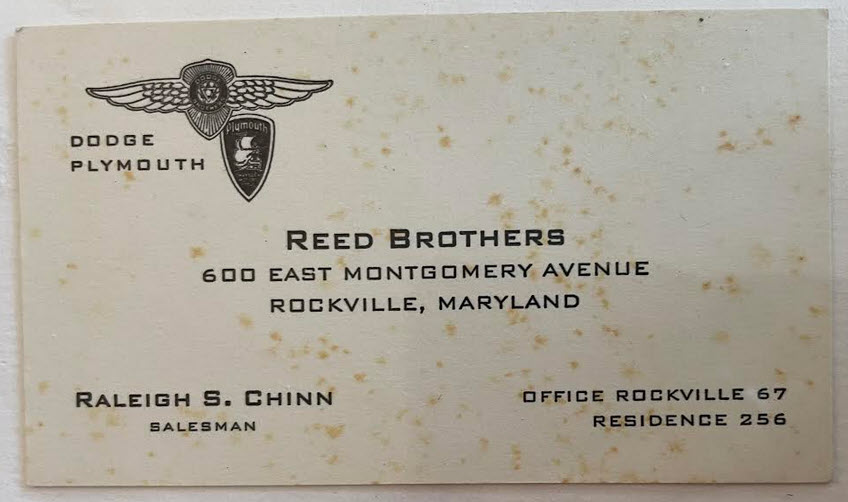
Business card courtesy of Jane C. Sween,
The First Plymouth Automobile Debuted on This Date 94 Years Ago
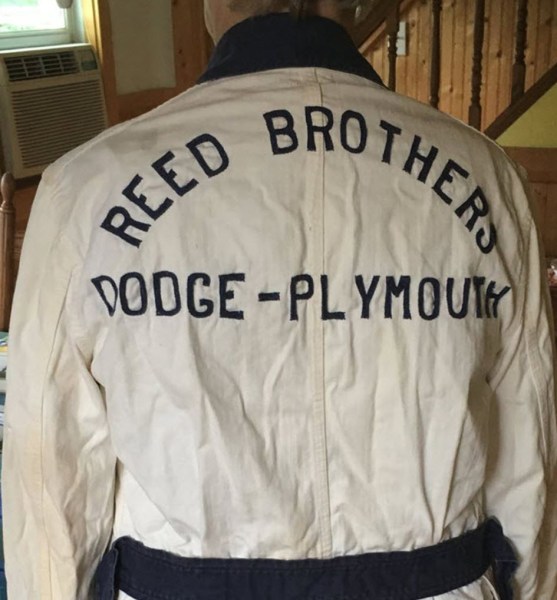
Plymouths were sold at Reed Brothers from 1930-1969. Pictured is an original 1940s Reed Brothers Dodge-Plymouth three-pocket shop coat made by Anderson Bros. of Danville, VA.
The first Plymouth automobile was introduced on July 7, 1928. Plymouth was Chrysler Corporation’s first entry in the low-priced field, which at the time was already dominated by Chevrolet and Ford. Plymouths were actually priced slightly higher than their competition, but offered all standard features such as internal expanding hydraulic brakes that the competition did not provide. While the original purpose of the Plymouth was to serve a lower-end marketing niche, during the Great Depression of the 1930s, the marque helped significantly in ensuring the survival of the Chrysler Corporation in a decade when many other car companies failed. Beginning in 1930, Plymouths were sold by all three Chrysler divisions (Chrysler, DeSoto, and Dodge).
Plymouth sales were a bright spot during this dismal automotive period, and by 1931 Plymouth rose to the number three spot among all cars. Plymouth almost surpassed Ford in 1940 and 1941 as the second most popular make of automobiles in the U.S.
In 1957, Virgil Exner’s new Forward Look design theme, produced cars with much more advanced styling than Chevrolet or Ford. 1957 total production soared to 726,009, about 200,000 more than 1956, and the largest output yet for Plymouth. However, the 1957–1958 Forward Look models suffered from poor materials, spotty build quality and inadequate corrosion protection; they were rust-prone and greatly damaged Chrysler’s reputation.
Most Plymouth models offered from the late 1970s onward, such as the Volaré, Acclaim, Laser, Neon, and Breeze, were badge-engineered versions of Chrysler, Dodge, or Mitsubishi models. By the 1990s, Plymouth had lost much of its identity, as its models continued to overlap in features and prices with Dodges. Plymouth’s product offerings and buyer appeal, and sales continued to fall.
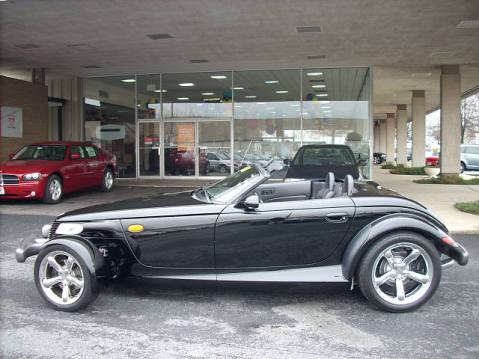
This Limited Edition 1999 Plymouth Prowler convertible was a vehicle from the dealership owners’ private collection. Photo by blog author.
By the late 1990s, only four vehicles were sold under the Plymouth name: the Voyager/Grand Voyager minivans, the Breeze mid-size sedan, the Neon compact car, and the Prowler sports car, which was to be the last model unique to Plymouth. The Prowler came about as part of Chrysler’s efforts (the last as it turned out) to differentiate Plymouth from the rest of its lineup in hopes of keeping the brand alive. It was hoped that it would be received well enough to garner some attention, some of which might spill over into some of their other models.
Plymouth rarely exceeded 200,000 cars per year after 1990. Consequently, DaimlerChrysler decided to drop the make after a limited run of 2001 models. This was announced on November 3, 1999.
The First Plymouth was Introduced by Chrysler on This Date in 1928
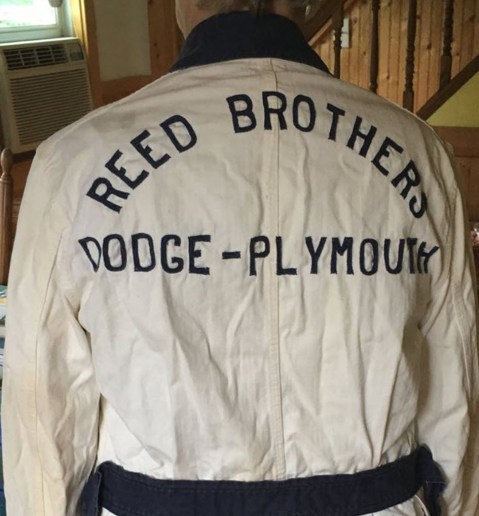
Plymouths were sold at Reed Brothers from 1930-1969.
The first Plymouth automobile was introduced on July 7, 1928. Plymouth was Chrysler Corporation’s first entry in the low-priced field, which at the time was already dominated by Chevrolet and Ford. Plymouths were actually priced slightly higher than their competition, but offered all standard features such as internal expanding hydraulic brakes that the competition did not provide. While the original purpose of the Plymouth was to serve a lower-end marketing niche, during the Great Depression of the 1930s, the marque helped significantly in ensuring the survival of the Chrysler Corporation in a decade when many other car companies failed. Beginning in 1930, Plymouths were sold by all three Chrysler divisions (Chrysler, DeSoto, and Dodge).
Plymouth sales were a bright spot during this dismal automotive period, and by 1931 Plymouth rose to the number three spot among all cars. Plymouth almost surpassed Ford in 1940 and 1941 as the second most popular make of automobiles in the U.S.
In 1957, Virgil Exner’s new Forward Look design theme, produced cars with much more advanced styling than Chevrolet or Ford. 1957 total production soared to 726,009, about 200,000 more than 1956, and the largest output yet for Plymouth. However, the 1957–1958 Forward Look models suffered from poor materials, spotty build quality and inadequate corrosion protection; they were rust-prone and greatly damaged Chrysler’s reputation.
Most Plymouth models offered from the late 1970s onward, such as the Volaré, Acclaim, Laser, Neon, and Breeze, were badge-engineered versions of Chrysler, Dodge, or Mitsubishi models. By the 1990s, Plymouth had lost much of its identity, as its models continued to overlap in features and prices with Dodges. Plymouth’s product offerings and buyer appeal, and sales continued to fall.
1999 Plymouth Prowler
By the late 1990s, only four vehicles were sold under the Plymouth name: the Voyager/Grand Voyager minivans, the Breeze mid-size sedan, the Neon compact car, and the Prowler sports car, which was to be the last model unique to Plymouth. The Prowler came about as part of Chrysler’s efforts (the last as it turned out) to differentiate Plymouth from the rest of its lineup in hopes of keeping the brand alive. It was hoped that it would be received well enough to garner some attention, some of which might spill over into some of their other models.
Plymouth rarely exceeded 200,000 cars per year after 1990. Consequently, DaimlerChrysler decided to drop the make after a limited run of 2001 models. This was announced on November 3, 1999.
Plymouth Automobile First Introduced July 7, 1928
The logo featured a rear view of the ship Mayflower which landed at Plymouth Rock. However, the Plymouth brand name came from Plymouth Binder Twine, chosen by Joe Frazer (a 20th-century American automobile company executive employed in succession by Chrysler, Willys-Overland, Graham-Paige and Kaiser-Frazer Corporation).
The first Plymouth automobile debuted on July 7, 1928, to help Chrysler Corporation compete with Chevrolet and Ford in the entry-level market. The name was inspired by Plymouth Rock and the first Pilgrim colony in the United States, and the Mayflower ship was stamped on the radiator.
In 1928, Walter P. Chrysler took over after Horace and John Dodge died and Lewis Reed became an original member of the Chrysler family.
Plymouth went on to become Chrysler’s top-selling brand from 1930 to 1978.
Some notable Plymouths:
• Barracuda: The muscle car had a decadelong run from 1964 to 1974, though the last generation, 1970-74, is considered the true Mustang and Camaro competitor and remains a popular collector car today.
• Road Runner: Dubbed Plymouth’s “muscle car icon” by FCA, the Road Runner was introduced in 1968. It was based on the Plymouth Belvedere. Plymouth paid Warner Brothers $50,000 for the rights to use the Road Runner and Coyote characters throughout the car’s run, according to Ateupwithmotor.com. Chrysler’s engineering department modified the car’s horn to sound like the cartoon bird’s “beep-beep” as well.
• Superbird: Created to entice stock car racing’s Richard Petty back to Plymouth for NASCAR, the Superbird was a modified Road Runner hardtop with an iconic large wing and nose for aerodynamics.
• Voyager: Plymouth was also at center stage when Chrysler CEO Lee Iacocca introduced a new product in November 1983: front-wheel-drive minivans in the form of the Plymouth Voyager and Dodge Caravan.
Plymouth went defunct at the end of the 1999 model year in Canada and consequently, DaimlerChrysler decided to drop the make after a limited run of 2001 models. This was announced on November 3, 1999. Plymouths were sold at Reed Brothers until 1969, when the Plymouth brand was given to the Chrysler dealers.
Plymouth production ended on June 28, 2001, when the last car, a silver Neon, rolled off the line at a plant in Belvidere, Illinois.
Anyone grow up with a Plymouth in their driveway?
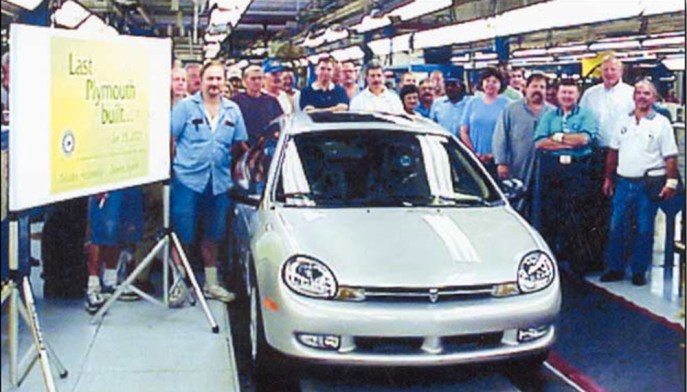
The last Plymouth Neon — and the last Plymouth — was built on June 28, 2001.
Books

Related Resources


Copyright Notice

Reed Brothers Dodge History (1915-2012) by Jeanne Gartner is licensed under a Creative Commons Attribution-NonCommercial 3.0 Unported License.


Recent Comments