
Meet Edgar Reed
Meet Edgar Reed, partner with brother Lewis Reed, in Reed Brothers Dodge.

Edgar Reed as a young man
Edgar was born in Darnestown, Maryland on October 17, 1890. He was a veteran of World War I and an active citizen of Rockville. He served as a Sergeant in the Army Medical Corps and had been posted to General Hospital No. 11 in Cape May, New Jersey. Previous to his enlistment he had been employed by R.W. Vinson, Rockville druggist for eight years. In 1919, Edgar joined his brother Lewis Reed in the business and the name changed to Reed Brothers Dodge. Edgar was in the automobile business with his brother for 35 years.
As a prominent businessman active in local commercial, civic, and religious institutions, Edgar was a respected community leader. For many years, he served on the Town Council and was Chairman of Stewards at the Rockville Methodist Church. Edgar was an original incorporator and charter member of the Rockville Volunteer Fire Department when the fire company was organized in 1921. He was a charter member and Past President of the Rockville Rotary Club and was a director of the Farmers Banking & Trust Company in Rockville until the time of his death. He was the first President and one of 30 original members of the Dealers Automotive Association of Montgomery County.
Edgar was the executive of Reed Brothers and handled all of the technicalities of the business. He was generally in charge of new car and truck sales. Edgar Reed passed away on October 24, 1951 after a prolonged illness.
Reed Brothers Dodge & Plymouth Service Repair Invoice
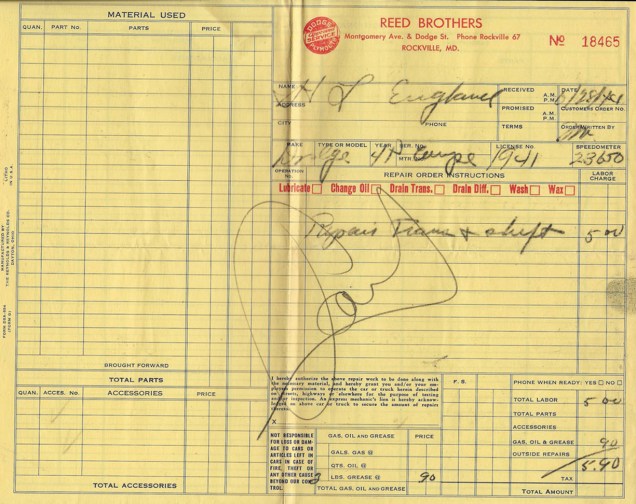
Reed Brothers Dodge & Plymouth Service Repair Invoice – June 28, 1944
If you’ve had an automobile repaired recently, you might enjoy seeing this Reed Brothers Dodge Service Invoice No.7577 dated June 28, 1944. Reed Brothers address at the time was 600 East Montgomery Avenue Rockville. The fact that the phone number was just ’67′ gives a real feeling of how different life was back then.
H.L. England’s name is on the invoice and his car was a 1941 Dodge Coupe. Harrison L. England was active in land development of older Rockville, including Lincoln Park and Croydon Park. He was born in a building known as Hungerford Tavern on N. Washington Street and operated a business under the name of Suburban Properties. His father was John G. England, the first mayor of Rockville.
In 1930, Reed Brothers added the Plymouth line. The first Plymouth was built in 1928 and Plymouths were sold at Reed Brothers until 1969, when the brand was given to the Chrysler dealers.
Check out the invoice… $5.00 labor and 90 cents parts for a total of $5.90!
1940s Full Service Gulf Station
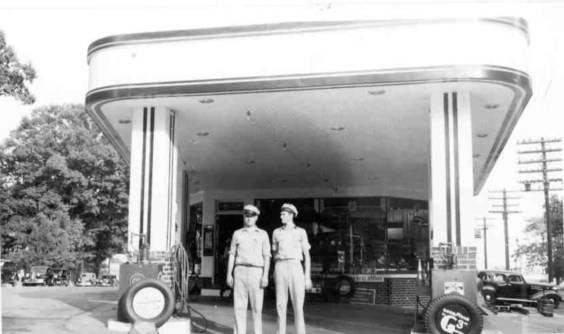
Reed Brothers Dodge Canopied Gulf Gasoline Station circa 1940
This is a previously unpublished photo of Reed Brothers Dodge full service Gulf Gasoline Station with two gas station attendants standing in front. Professional service was very important in the first half of the twentieth century, so it was common for gas station attendants to wear the company uniform.
Reed Brothers Dodge was the first Gulf gasoline dealer in the Washington, D.C. area. In 1915, they began selling gas at their original location in Old Rockville at the triangle at Veirs Mill Road and Rockville Pike. Their first gas station consisted of a single pump. Later, in addition to gas, they carried a full line of Gulf lubricants, Goodyear tires, Willard batteries, complimentary road maps, free air and water, and many other well known brands of merchandise to meet their patrons needs. Reed Brothers discontinued offering this product line when they relocated to their new facility in November 1970.
Early Car Starters: How Did Old Cars Start?

Lewis Reed hand cranking an old car. The hammer in Lewis Reed’s right hand is for straightening the hand crank. Apparently they can bend when starting big engines. The license plate is MD 10307 dated 1913.
Today, we take the starting of automobiles for granted. Simply place the key in the ignition, turn, and VROOM, the engine starts. Vintage cars from from the 1900s and 1910s were comparatively archaic and limited in their mechanical features. Even starting these old relics was difficult because the process involved a number of complicated steps that the driver had to perform in the correct order.
However, this was not always the case. Hand cranks were the most common type of engine starters in the early days of the automobile. Cars in the early parts of the century had to be started by hand. This was accomplished by turning a crank, usually located in the front of the automobile. The driver would literally “crank the engine” by turning the handle, which would allow the process of internal combustion to begin. After a given number of cranks, the engine would begin to run on its own, and the crank could be removed.
Although hand crank starters were simple and reliable, they suffered from a handful of drawbacks. The main issue with this method of starting an engine is that it is inherently dangerous to the operator. For instance, if an engine kicks back during the cranking process, the operator could get TKO’d by the hand crank. Although many of these cranks used overrun mechanism, there was also a potential for injury if the handle continued to turn after the engine started running.
The other main issue with hand crank starters is that it took a certain degree of physical effort to turn them. That meant anyone who lacked the necessary physical strength or dexterity was incapable of starting a vehicle equipped with this type of starter.
By 1920, nearly all manufacturers were producing cars equipped with starters making it easy for anyone, regardless of physical abilities, to start a car by pressing a button mounted on the dash or floor. An ignition on and starter engage switch operated by a key was introduced by Chrysler in 1949.
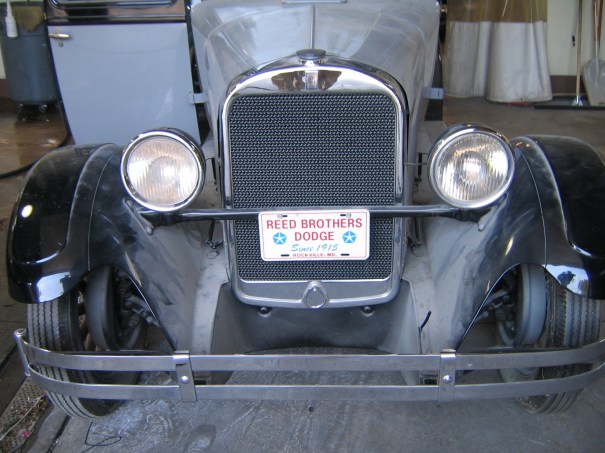
1928 Dodge Brothers Standard Six had both hand crank and starter. I’m assuming the crank was a backup in case the starter failed. The crank hole cover can be seen just below the front grill. Photo by Reed Brothers Dodge
Several new mechanical innovations were included in the 1946 Dodge Deluxe models. Among them were the introduction of the famous Fluid-Drive, a push-button starter system. The dash-mounted button on the 1946 Dodge Deluxe pictured below activated a solenoid, which in turn engaged the starter. For the first time since 1928 there was no provision made to manually hand crank the engine.

The push button starter on this 1946 Dodge Deluxe Fluid Drive was located on the far left, below the instrument gauges. Photo by Reed Brothers Dodge.
Judge’s Commentary, Writer’s Digest Self-Published e-Book Awards


I entered the 5th Annual Writer’s Digest Self-Published e-Book Contest, exclusively for self-published e-books. I didn’t win an award, but all entries received a review from a publishing professional which I am proud to share below:
Entry Title: Portrait Of An Automobile Dealer Third Edition
Author: Jeanne T. Gartner
Entry Category: Life Stories
Judge’s Commentary:
Portrait of an Automobile Dealer Third Edition is a loving tribute, told with pictures and documents, of a family automobile business that almost made it to 100 years. It is obvious author Jeanne T. Gartner spent much time and effort on this encyclopedic history of Reed Brothers Dodge in Rockville, Maryland. Spanning nearly a century, she chronicles their humble beginnings in 1915 until their forced closure in 2012. An historic timeline, family photos, clippings and more provide extensive documentation. It is well-organized and each photo is carefully labeled. The granddaughter of the original founder Lewis Reed, the author also seems to have a grasp of the basics of nonfiction writing. Family members, locals and friends may find something of interest here, although casual readers may pass it by. Fans of corporate or company histories might also find it to be of interest.
Thank you for the privilege of reading your book! And bravo on all your hard work!
The book “Portrait Of An Automobile Dealer, Third Edition” is available through Blurb.com print-on-demand bookstore. If you would like to check out the hard copy book or purchase a copy, please visit: http://www.blurb.com/b/8514165-portrait-of-an-automobile-dealer-third-edition
As a special thank you to all the readers of this blog, this book has been placed online for everyone to enjoy for free. A complimentary eBook available for Amazon Kindle Fire, Apple iPad, Android devices, and Mac or PC computers is also available through Blurb: http://www.blurb.com/b/8514165-portrait-of-an-automobile-dealer-third-edition?ebook=653481
Note: It’s worth noting that Print-On-Demand (POD) books, are usually more expensive per copy than a book printed via offset printing. That’s because offset printing (the method used for most mass-produced books found in bookstores) requires a minimum order of 500-1,000 copies. Print on demand, on the other hand, needs only a minimum order of one copy. The smaller scale and different workflow results in a higher cost per book, since books are only printed when they are ordered. This book is not marked up for profit; but sold at base price.
Books

Related Resources


Copyright Notice

Reed Brothers Dodge History (1915-2012) by Jeanne Gartner is licensed under a Creative Commons Attribution-NonCommercial 3.0 Unported License.
 Reed Brothers Dodge History 1915 – 2012
Recent Comments