
A Field, a Gun, and a Trap
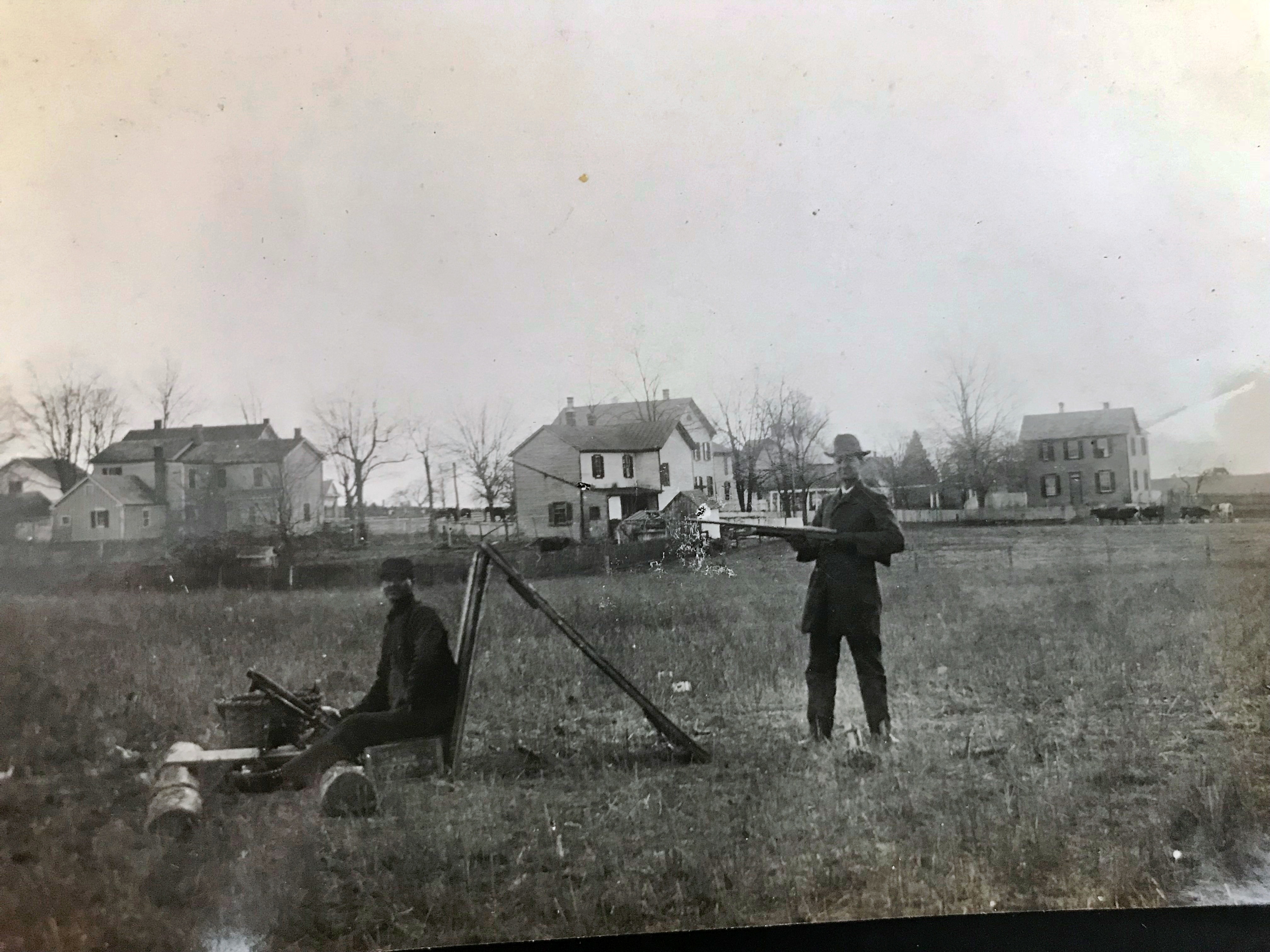
Early 1900s field trap shoot in Darnestown, Maryland, captured by Lewis Reed, showing one man poised with a shotgun while another readies the simple wooden trap amid farmhouses and open pasture.
In this photograph, two men stand in an open field bordered by modest frame houses and fenced pastures, a scene typical of small crossroads communities like Darnestown in the early 1900s. One man holds what appears to be a long gun, while the other sits beside a simple wooden rig that resembles the framework used to cock and release early manually operated target throwers or live‑bird traps
The proximity to grazing livestock suggest that this is not a formal gun club range but an improvised shooting ground on private farmland, which was common before purpose‑built trap clubs spread widely. Rural shooters often practiced in meadows or behind farmhouses, using homemade equipment and relying on a friend to work the trap while the shooter took position in front.
Darnestown in Reed’s era was a small but important crossroads in western Montgomery County with farms, mills, and the Andrew Small Academy serving the surrounding countryside. Later roadside historical markers that use Lewis Reed’s images emphasize how thoroughly he documented the community’s buildings and daily activities, making it likely that he also recorded local recreations such as shooting, fishing, or horse‑related events.
Clay target shooting gained popularity in the United States after the introduction of standardized targets and simple spring‑powered traps in the late 19th century, and Maryland farm communities were no exception. Scenes like this one, with neighbors gathering in an open field to test their marksmanship, reflect how shooting sports blended workday skills with weekend socializing in a largely agricultural landscape.
This image captures a rare glimpse of informal trap shooting at the moment when traditional rural life was beginning to intersect with modern leisure and sport. The combination of farmhouses, fence lines, cattle, and improvised equipment tells a layered story: of a county still rooted in agriculture, of residents embracing new pastimes, and of a photographer committed to preserving unscripted moments as carefully as grand events.
For historians, collectors, and local families, the photograph is more than a quaint scene; it is a visual document that anchors memories of people, place, and pastime in a specific landscape. As additional Reed negatives are identified and researched, images like this may help flesh out the early history of shooting sports in Montgomery County and deepen understanding of how communities like Darnestown spent their rare hours of leisure.
Montgomery County Maryland Almshouse aka Poor Farm

The Montgomery County Maryland Almshouse aka Poor Farm was established in 1789 and torn down in 1959. A modern jail is on its site on Seven Locks Road near Falls Road. Photo taken by Lewis Reed.
A Poor Farm in Montgomery County? Yep. Although a lot of people have never heard of “poor farms,” they were once common across the nation. Various terms have been used to describe the “house for the poor,” and often the titles were unique to the part of the country where the house was located.
This is the Almshouse (aka Poor Farm). The 50-acre tract which includes the pauper’s graveyard was once part of the Montgomery County Poor Farm, established in 1789 as a place where the poor and homeless went to live, work, and, if they died, to be buried.
At the time, the farm was located well beyond the bounds of what was then the town of Rockville. But growth eventually caught up with the property. The farm house was razed in 1959 to make way for a county jail, and another chunk of property was dedicated for I-270. At least 75 graves were identified during a 1983 survey of the property by state archeologists, but according to George R. Snowden, funeral director, there may be as many as 500 people buried in the potter’s field.
Although the county’s poor farm existed for almost 170 years, virtually nothing has been documented about it, said Jane Sween, a librarian with the Montgomery County Historical Society. The property was deeded to the county in 1789 and expanded in 1825. After the Civil War, the farm’s almshouse was rebuilt, and until it was razed a century later it was home to an average of 40 indigent people, she said. The state paid for burial but did not pay for grave markers or upkeep on the property.
The Montgomery County Poor Farm Cemetery is no longer in existence. The National Park Service conducted an archaeological dig in 1987, which resulted in the removal of 38 bodies to Parklawn Cemetery in Rockville, Maryland. Montgomery County sold the land to a private developer.
Books

Related Resources


Copyright Notice

Reed Brothers Dodge History (1915-2012) by Jeanne Gartner is licensed under a Creative Commons Attribution-NonCommercial 3.0 Unported License.
 Reed Brothers Dodge History 1915 – 2012
Recent Comments