
Autumn at Pleasant Hills: A Pumpkin Harvest in Early Darnestown
In the early 1900s, Darnestown was still firmly rooted in agriculture, with large family farms, open fields, and country roads defining much of the surrounding landscape. Pleasant Hills was part of that rural world, and the Kelley family was among the local families whose farm products were well known throughout the area.
Lewis Reed’s photograph of three men standing in Thomas Kelley’s pumpkin field preserves a rare glimpse of that earlier Darnestown. The men are clearly not farm workers at harvest. Dressed in jackets, hats, and polished shoes, they appear to have simply stopped among the pumpkins and posed for Reed’s camera, turning an ordinary autumn visit into a lasting record of local history.
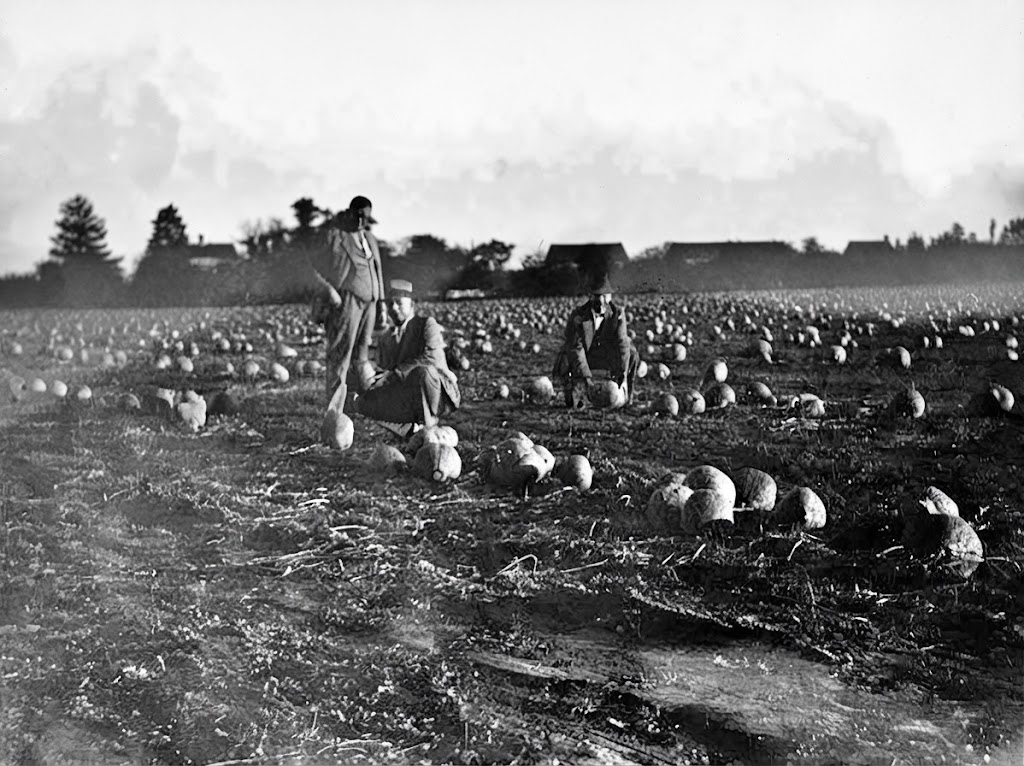
Men gathering pumpkins in Thomas Kelley’s field near Pleasant Hills in the Darnestown area, early 1900s. Lewis Reed’s photographs preserved not only community celebrations, but also the seasonal traditions of everyday life in Montgomery County. Photograph by Lewis Reed.
Pleasant Hills was a substantial working farm, and the Kelley family became especially associated with fresh produce, including the well-known “Kelley Corn” wagon that traveled through the community. Pumpkins were part of the farm’s autumn landscape at a time when seasonal produce came directly from nearby fields and local farms remained closely tied to everyday life.
Lewis Reed knew this countryside well. Raised in Darnestown, he photographed the people, farms, roads, homes, and small moments that surrounded him. At the time, such scenes would have seemed entirely ordinary, but today they preserve details that written records rarely capture: how people dressed, where they gathered, and what the rural landscape looked like before suburban growth transformed much of western Montgomery County.
That is what gives this photograph its lasting importance. It is more than a picture of three men in a pumpkin field. It is a surviving fragment of early Darnestown, preserving Pleasant Hills as part of a farming community that has largely disappeared from the modern landscape.
From Rockville to Gaithersburg: The Montgomery County Fair Through the Lens of Lewis Reed
Special Feature for Montgomery County Agricultural Fair Week
August 14–22, 2026
A look back at the fair’s early years through the lens of Lewis Reed.
Every August, hundreds of thousands of visitors flock to the Montgomery County Agricultural Fair to enjoy livestock exhibitions, agricultural displays, carnival rides, competitions, concerts, and family traditions that have endured for generations. While today’s fairgrounds in Gaithersburg are familiar to many, the fair itself began long before the current site existed.
Organized in 1846 by the Montgomery County Agricultural Society, the annual fair was established to promote agriculture, encourage innovation, and strengthen the county’s farming community. For decades, it brought together farmers, merchants, craftsmen, and families from across Montgomery County to exchange ideas, exhibit their finest livestock and crops, and celebrate the region’s agricultural heritage.
By the time Lewis Reed began photographing Montgomery County around the turn of the twentieth century, the fair had become one of the county’s largest and most anticipated annual events. Carrying his camera throughout the fairgrounds, Reed documented not only the exhibits and attractions but also the people who made the fair an enduring community tradition.
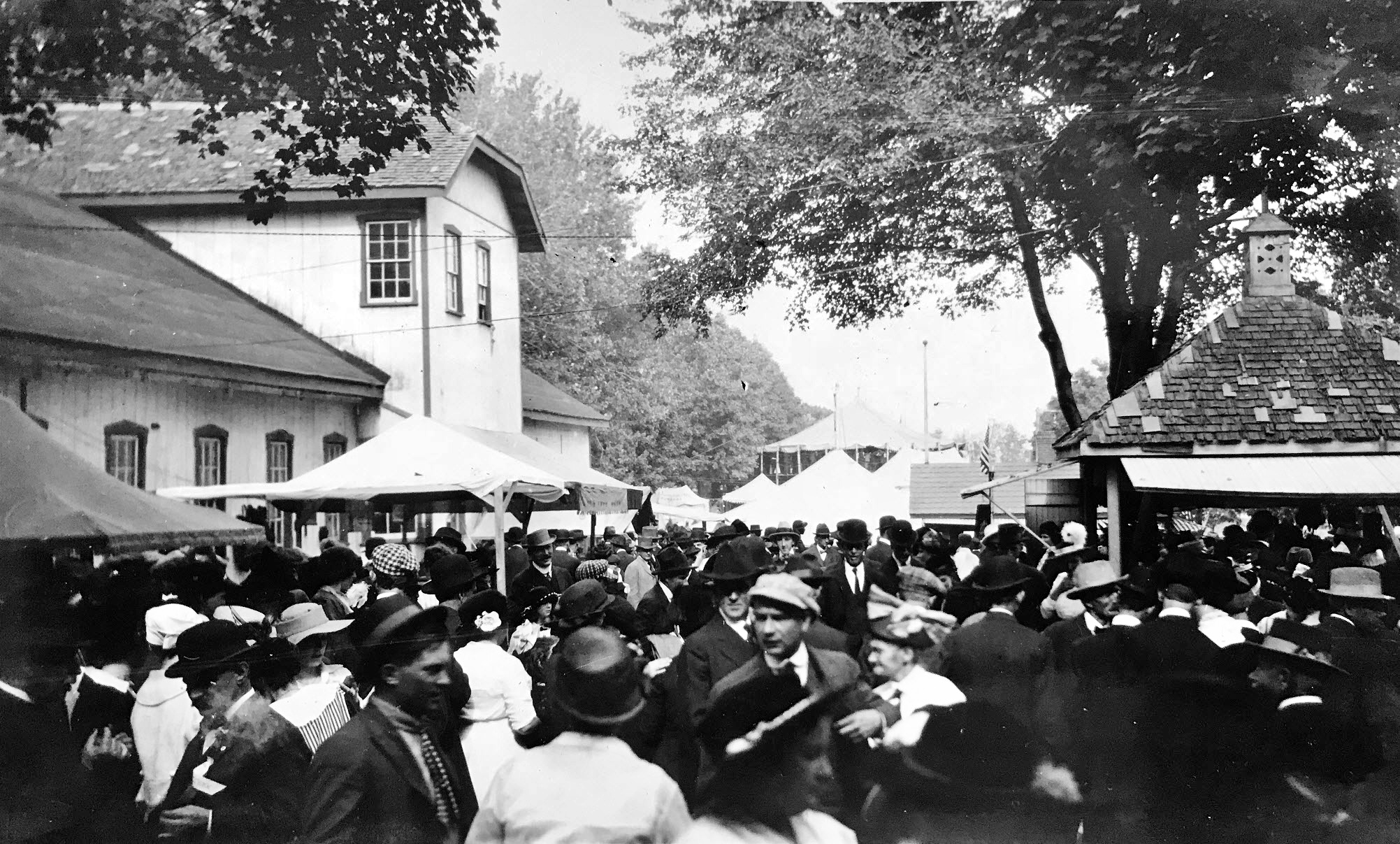
Fairgoers stroll along the midway in their Sunday best, ca. 1910. Broad-brimmed hats, long flowing dresses, and tailored suits reflected the fashion of the era, when dressing for the county fair was as much a social occasion as the event itself.
Reed’s photographs reveal a fair that was both educational and entertaining. Agriculture remained its foundation, but visitors also came to enjoy the excitement of the midway, where amusement rides, games, and food vendors transformed the fairgrounds into a festive gathering place for young and old alike.
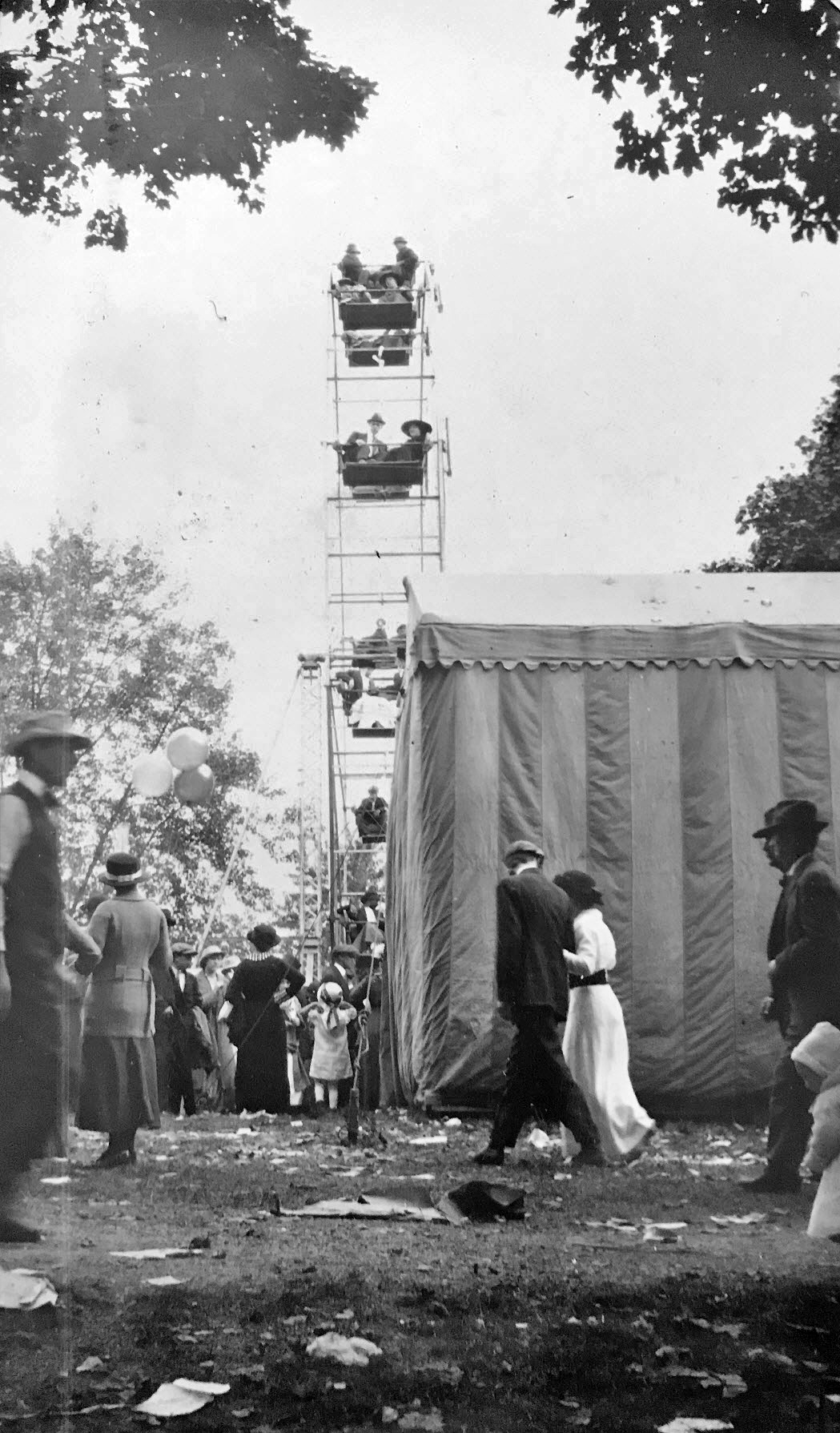
Ferris Wheel at the Montgomery County Fair, Rockville, ca. 1910. One of the fair’s most popular attractions towered above the fairgrounds, symbolizing how the annual exhibition combined agricultural traditions with modern entertainment.
Behind the excitement of the midway was the fair’s original purpose. Exhibition halls displayed the county’s finest produce, flowers, baked goods, preserves, and handcrafted items, while nearby barns housed prize-winning livestock representing the best of Montgomery County’s farms. Manufacturers exhibited the latest farm machinery and equipment, giving visitors an opportunity to see how new technology was steadily transforming rural life.
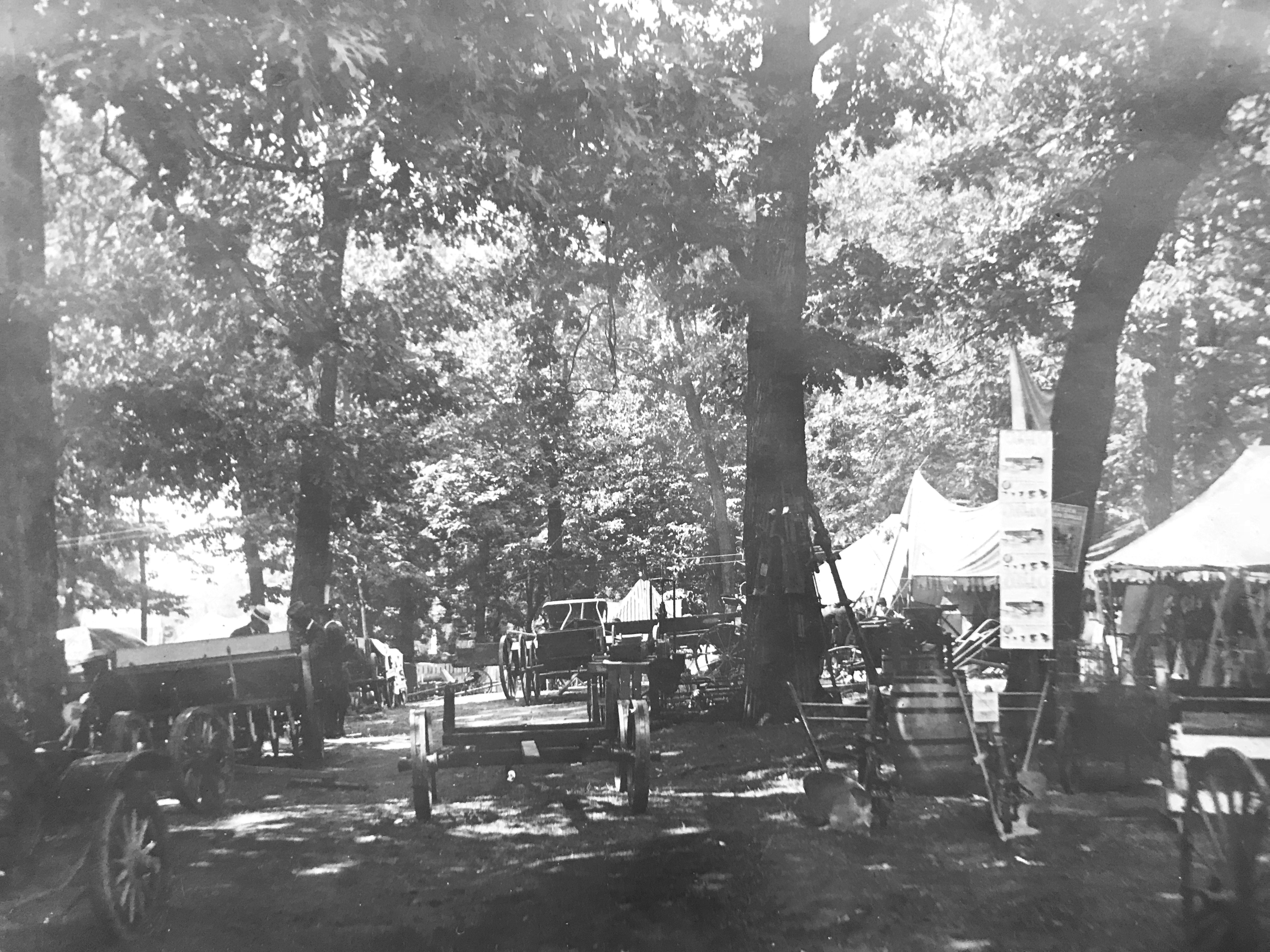
Agriculture remained the heart of the fair. Manufacturers displayed the latest farm machinery, giving local farmers an opportunity to compare new equipment and modern farming methods.
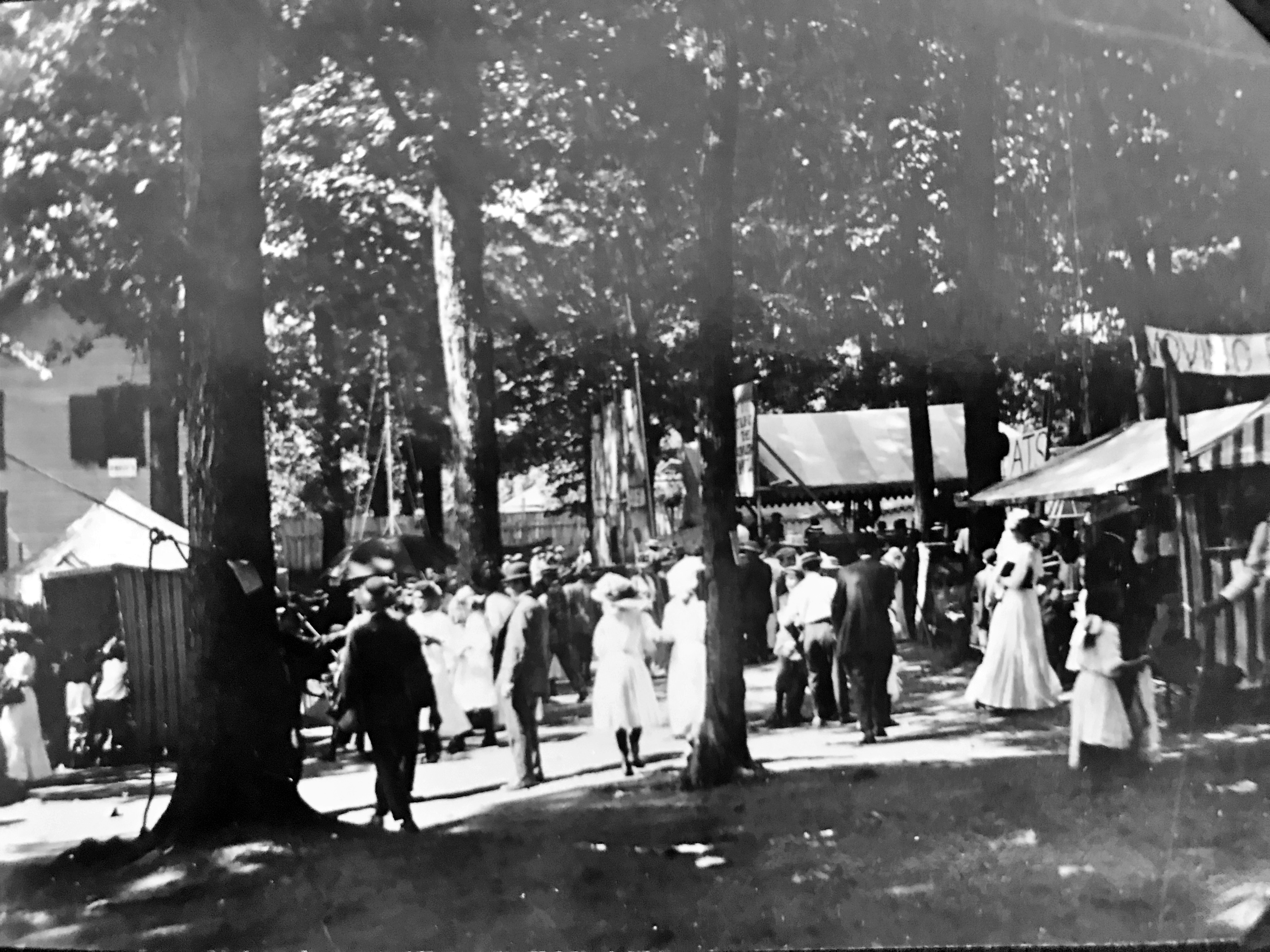
Visitors explored displays celebrating Montgomery County’s agricultural achievements, local craftsmanship, and community pride.
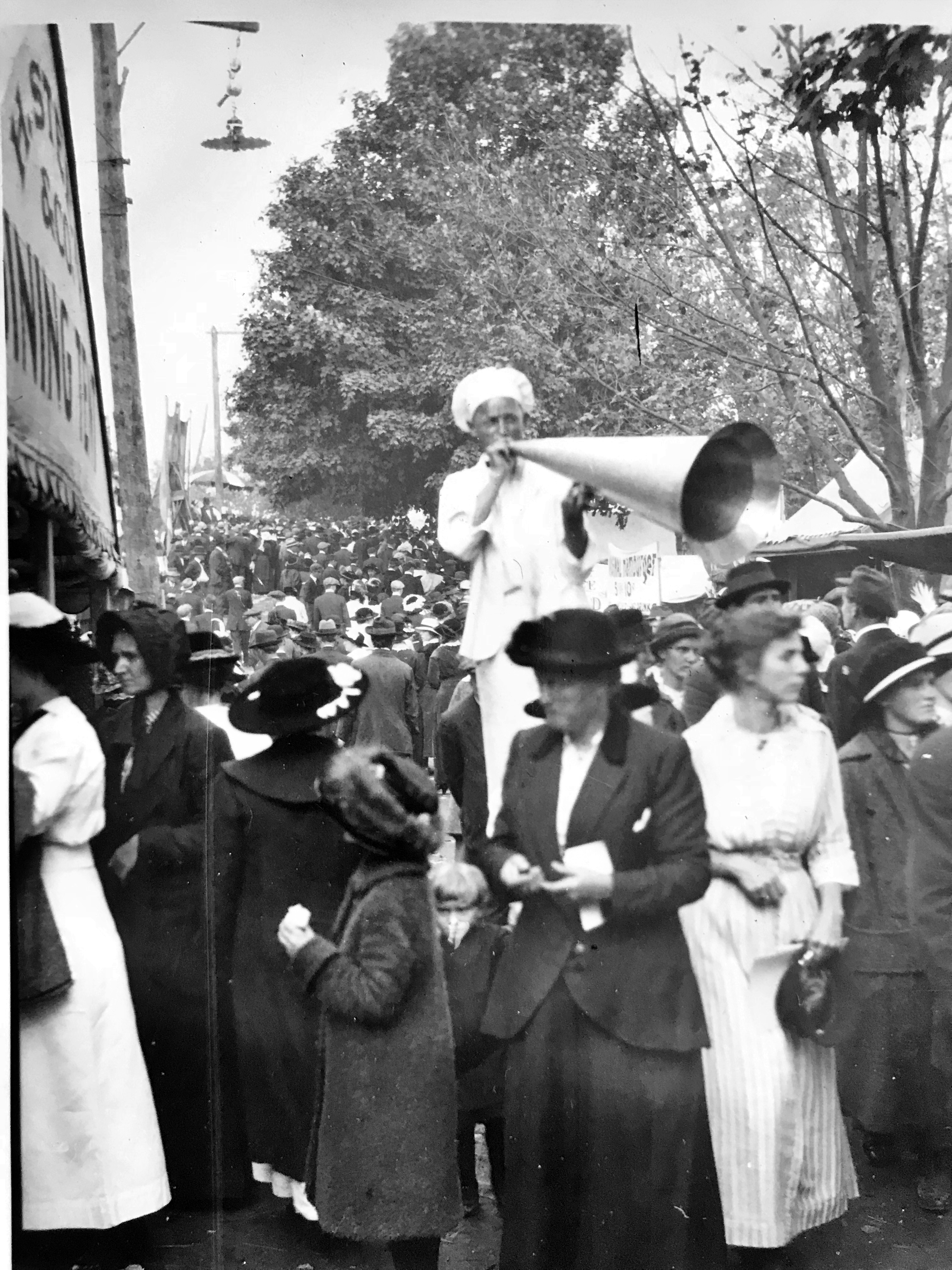
An exhibitor captures the attention of fairgoers.
One of Lewis Reed’s most compelling photographs captures hundreds of automobiles parked throughout the fairgrounds. As a lifelong automobile enthusiast and future founder of Reed Brothers Dodge, Reed recognized that the motorcar was transforming Montgomery County. His photograph preserves that moment when the automobile had become an integral part of daily life and community gatherings.
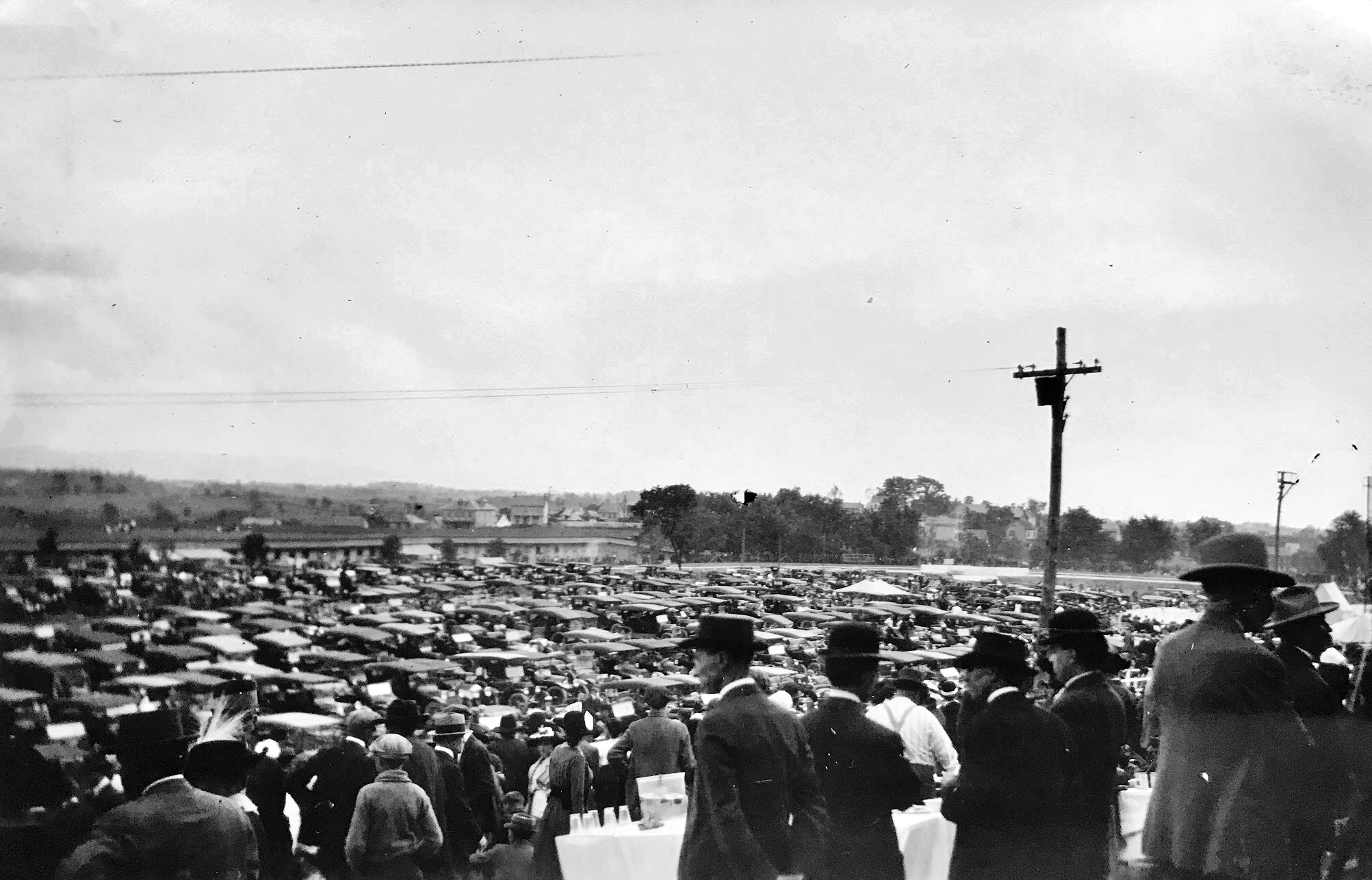
Hundreds of cars in the parking lot.
The grandstand and one-third-mile dirt race track were among the fair’s most popular attractions. Horse racing remained a favorite event, while bicycle races, motorcycle exhibitions, and eventually automobile competitions reflected America’s growing fascination with speed and mechanical innovation. Reed’s photographs preserve these moments at a time when transportation itself was rapidly changing.
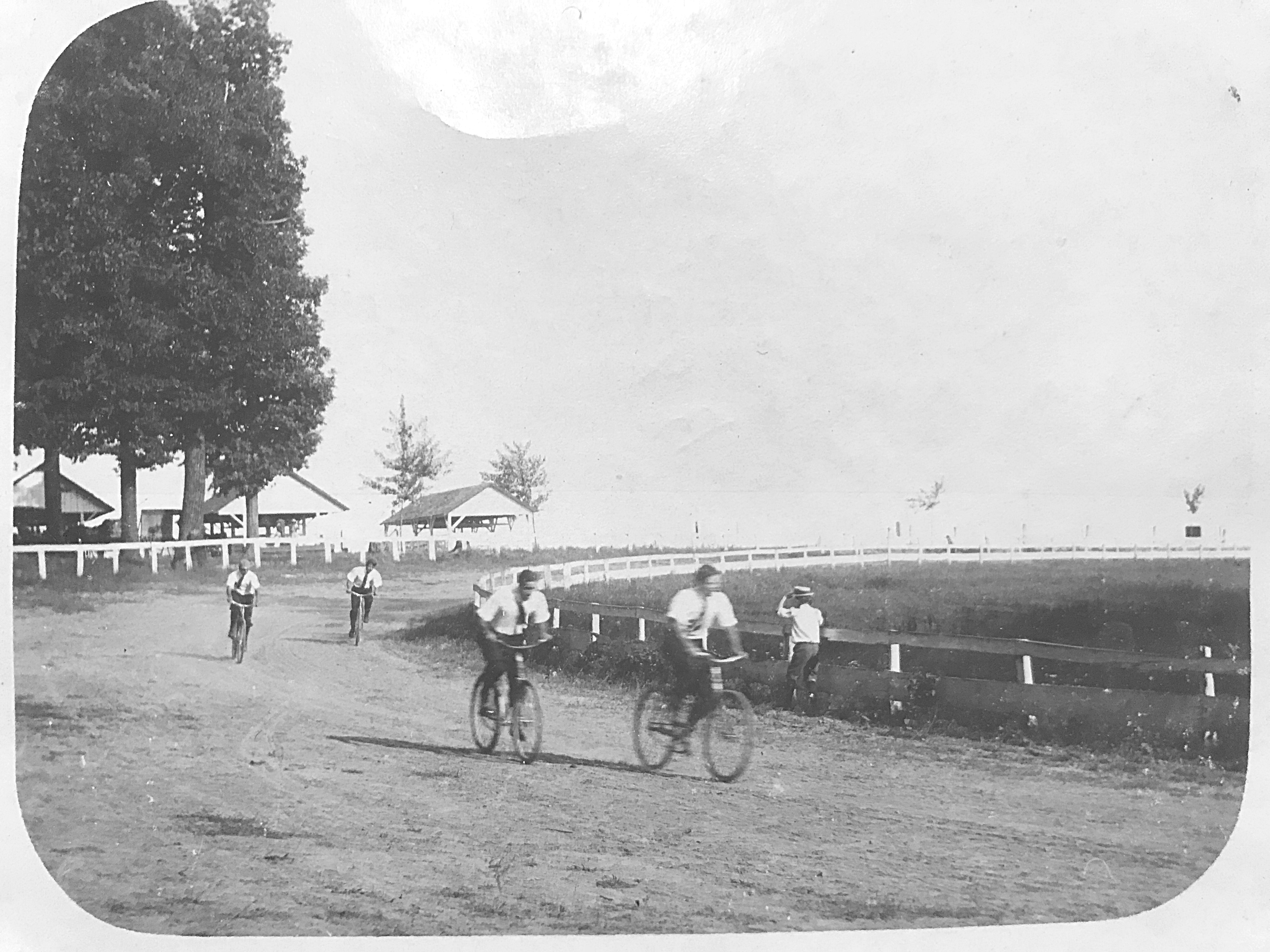
Bicycle races became very popular throughout the country and were a novel event at the Rockville Fairgrounds as early as 1915. The track was a half-mile dirt racing oval with wide, sweeping curves and a grandstand for spectators, which made for clear views. Notice the riders are in shirts and ties.
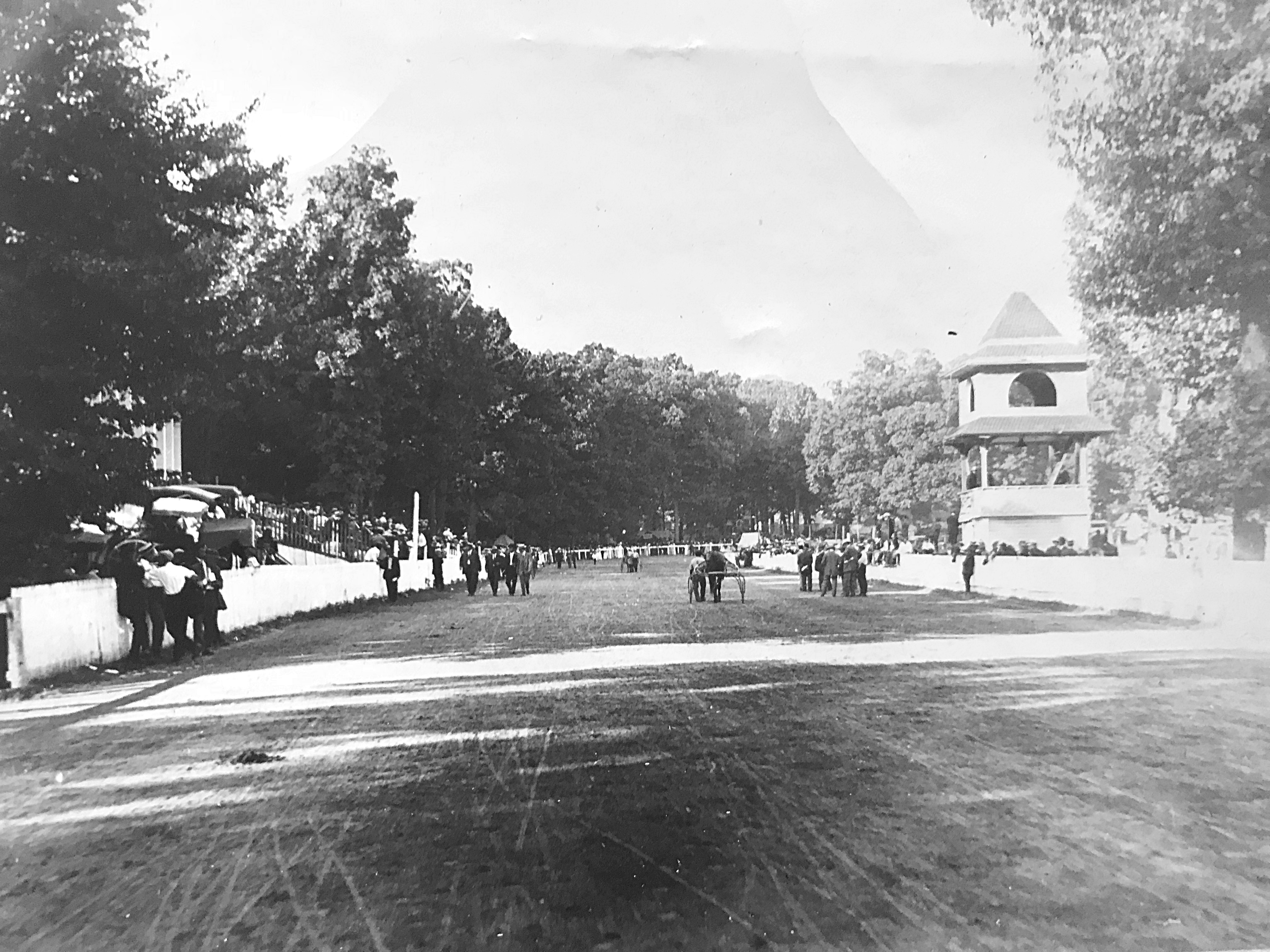
Harness racing was one of the main attractions at the race track before the introduction of the automobile and the subsequent popularity of racing cars.
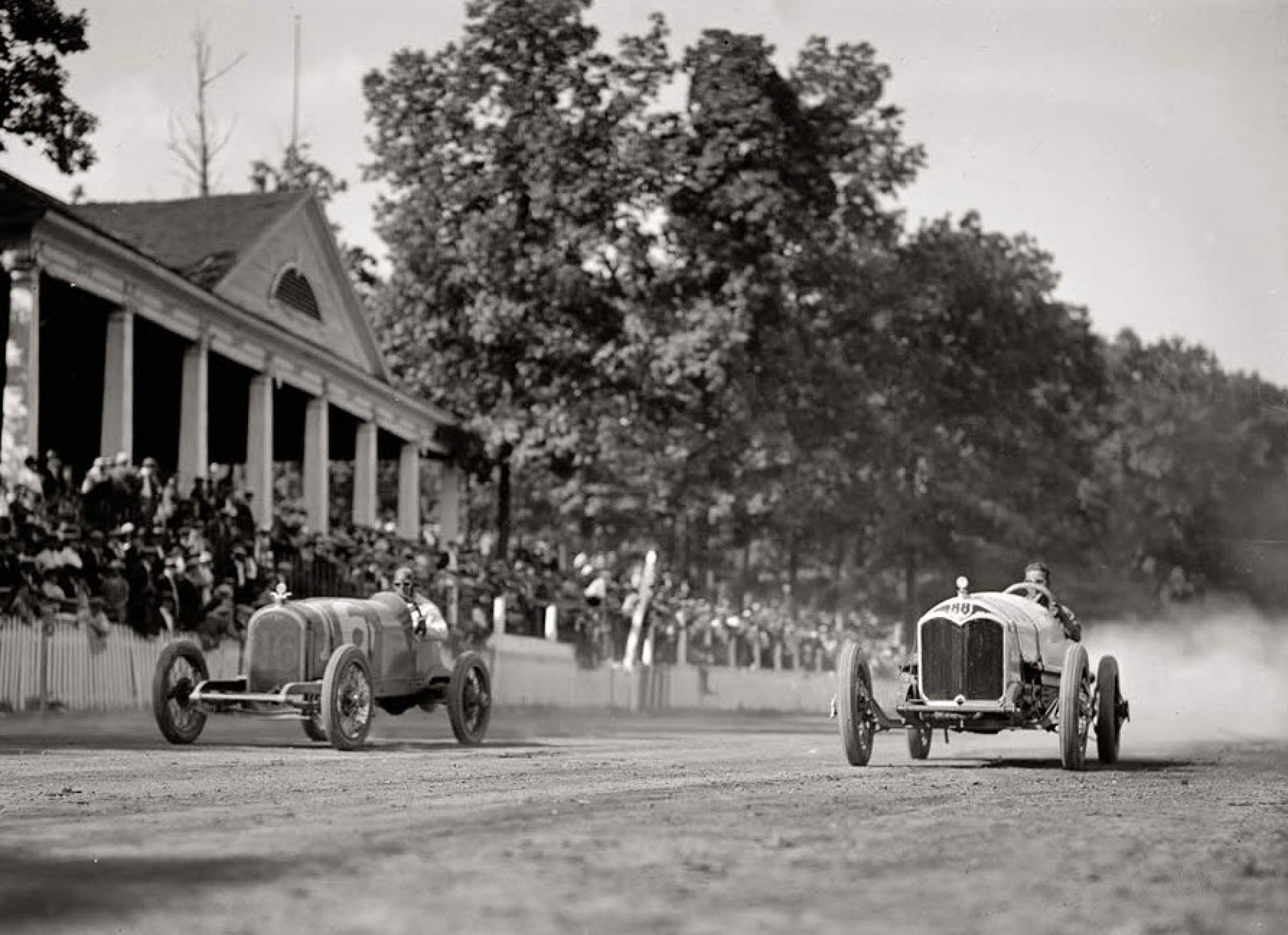
Spectators pack the grandstand for the automobile races at the Rockville Fair, August 25, 1923. Racing events drew visitors from across the region and showcased the excitement of the new motor age.
The Rockville fairgrounds continued to host the Montgomery County Fair until 1932, when financial hardships brought on by the Great Depression forced the Agricultural Society to sell the property. The site would later become the home of Richard Montgomery High School. In 1949, hundreds of volunteers joined together to establish the Montgomery County Agricultural Center in Gaithersburg, where the fair continues today.
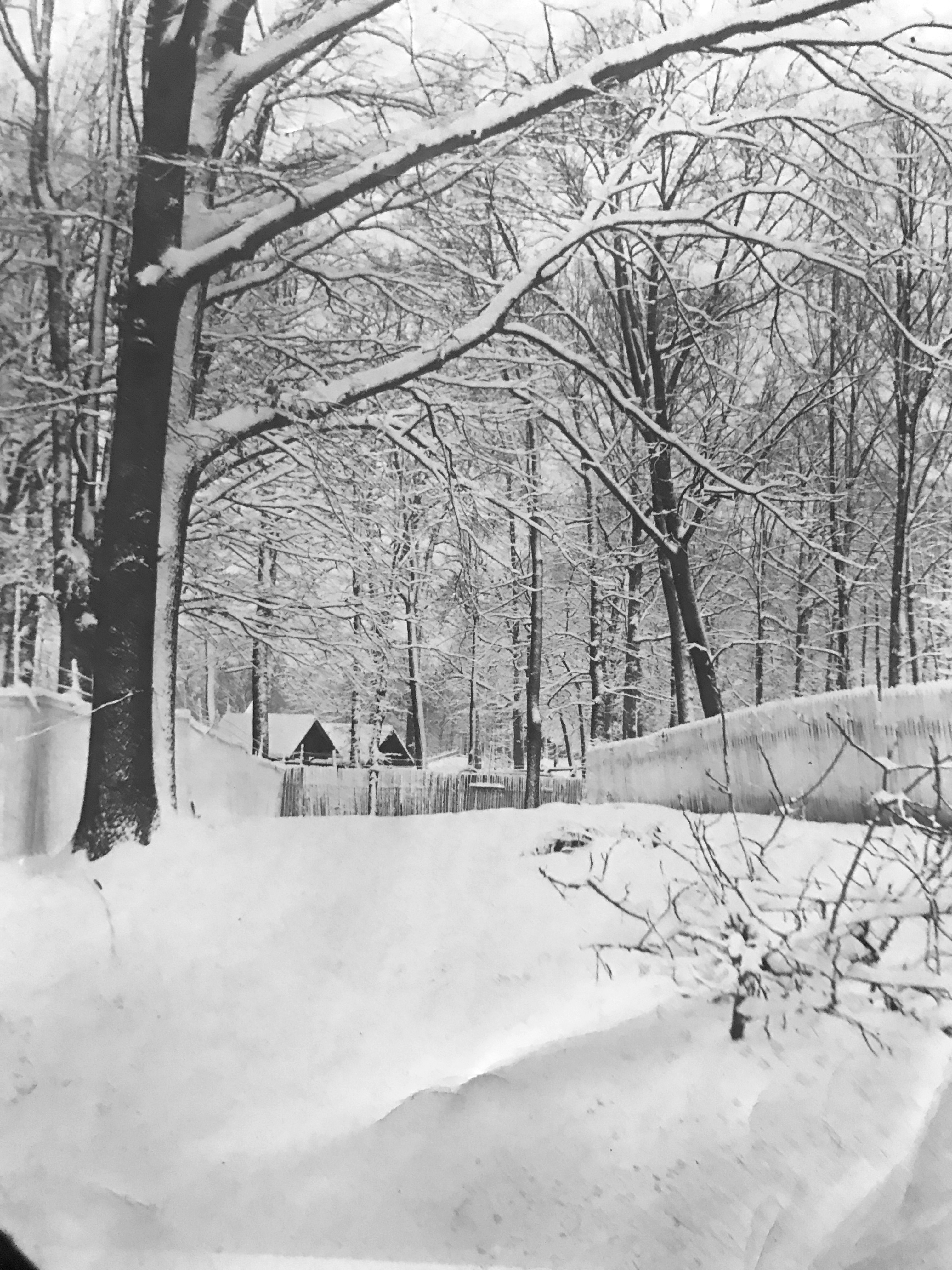
Winter at the Rockville Fairgrounds, 1910. Lewis Reed’s photograph captures a rare, tranquil view of the fairgrounds between seasons, preserving a landscape that would eventually disappear from Montgomery County.
Much has changed since Lewis Reed walked the fairgrounds with his camera. The original race track has disappeared, the Rockville fairgrounds exist only in photographs, and Montgomery County has grown from a rural farming community into one of Maryland’s most populous counties. Yet the fair’s mission has remained remarkably consistent: celebrating agriculture, education, community, and innovation.
As visitors gather for this year’s Montgomery County Agricultural Fair, Lewis Reed’s photographs offer a rare opportunity to look back at the fair’s early years and experience a tradition that has united generations of Montgomery County residents for nearly 180 years.
Two New Books Featuring Lewis Reed’s Historic Montgomery County Photographs
More than 125 years ago, a young boy named Lewis Reed picked up a camera and began photographing the world around him. What started as a youthful fascination with photography grew into one of the most important visual records of Montgomery County’s history.
From the late 1890s through the mid-twentieth century, Lewis Reed documented a county in transition. His photographs preserve everyday life during an era when dirt roads gradually gave way to paved highways, horse-drawn wagons shared the road with the first automobiles, and small rural communities evolved into the suburban landscape we know today. Today, the Lewis Reed Photograph Collection contains more than 2,500 photographs and continues to serve as an invaluable resource for historians, educators, museums, and local preservation projects.
For a little more than a decade, I have been privileged to preserve, research, and share this remarkable collection through books, online exhibits, presentations, historical markers, and hundreds of articles published here on Reed Brothers Dodge History. It has been my goal to ensure that Lewis Reed’s photographs remain accessible to everyone interested in Montgomery County’s rich heritage.
I am pleased to announce the completion of two new softcover companion books inspired by the Montgomery History online exhibits that celebrate Lewis Reed’s photographic legacy and introduce these remarkable images to an even wider audience.
Montgomery County: Through the Lens of Lewis Reed
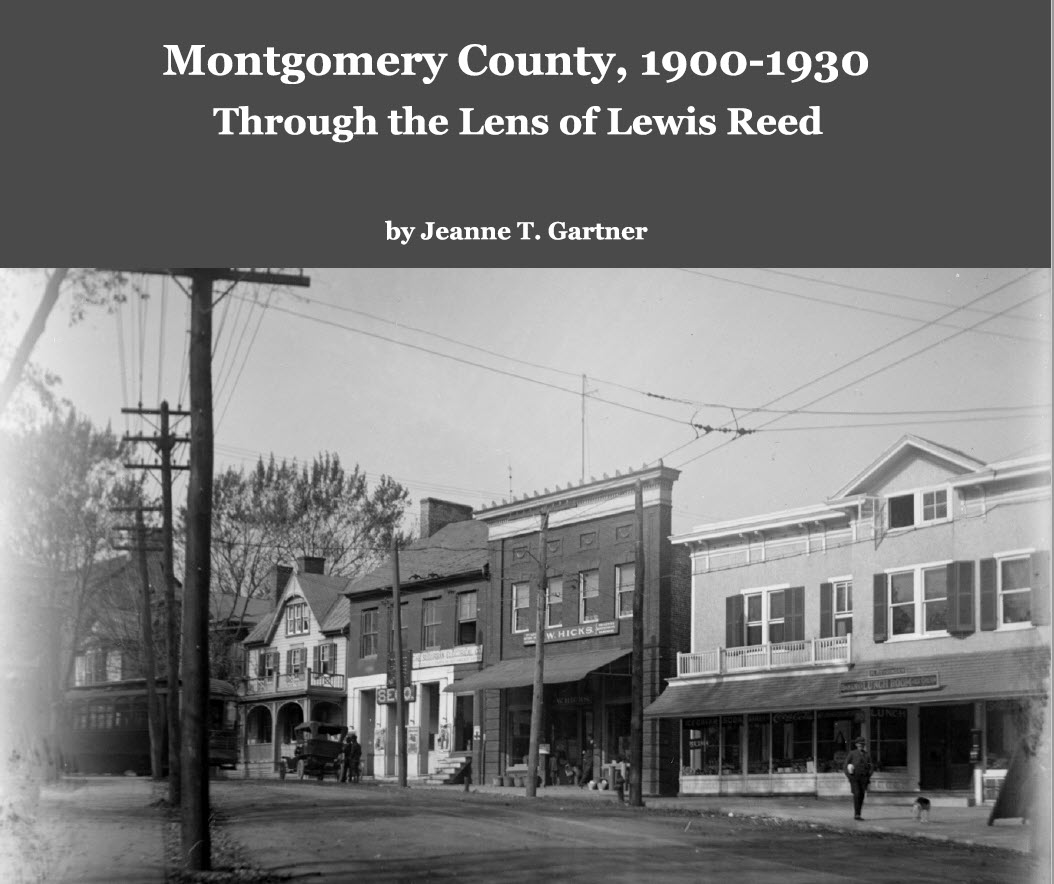
Created as a companion volume to Montgomery History’s online exhibit of the same name, this compact book presents a carefully selected collection of Lewis Reed’s finest photographs. Inspired by the online exhibit, it preserves a remarkable visual record of a Montgomery County that has largely disappeared.
Taken during the first decades of the twentieth century, these photographs capture a county undergoing profound change while demonstrating Lewis Reed’s remarkable gift for documenting history as it unfolded. Today, they stand among the most significant visual records of Montgomery County’s early history.
Montgomery County: Then and Now – Photography of Lewis Reed and Barry Gartner

Also created as a companion volume to Montgomery History’s online exhibit of the same name, this full-color book pairs Lewis Reed’s historic photographs with modern images recreated from the same locations by his grandson, Barry Gartner. Together, the photographic pairs reveal more than a century of change while preserving a visual connection between Montgomery County’s past and present.
The result is a unique comparison of familiar landscapes, demonstrating how photography can bridge generations and deepen our understanding of the communities that continue to evolve.
Now Available
I’m excited to share that Montgomery County: Then and Now – Photography of Lewis Reed and Barry Gartner is now available to preview or purchase through Blurb’s print-on-demand bookstore.
Readers can browse the entire book online before ordering, making it easy to explore this unique photographic journey through Montgomery County’s past and present.
Preview or order your copy here:
Montgomery County: Then and Now – Photography of Lewis Reed and Barry Gartner
The companion volume, Montgomery County: Through the Lens of Lewis Reed, will also be available soon.
Continuing the Legacy
Every publication built around the Lewis Reed Photograph Collection helps preserve a remarkable visual record of Montgomery County’s history. More than historic images, these photographs connect us with the people, places, and landscapes that shaped our communities and remind us how much can be learned from a single photograph.
Thank you to everyone who has encouraged and supported this work over the years. Your interest in Lewis Reed’s photography has helped ensure that this extraordinary collection continues to educate, inspire, and preserve Montgomery County’s history for future generations.
To explore these and my other publications, please visit the Featured Publications page here on Reed Brothers Dodge History.
The Devastation of May 2, 1929: Montgomery County’s Deadliest Tornado in Historic Photographs
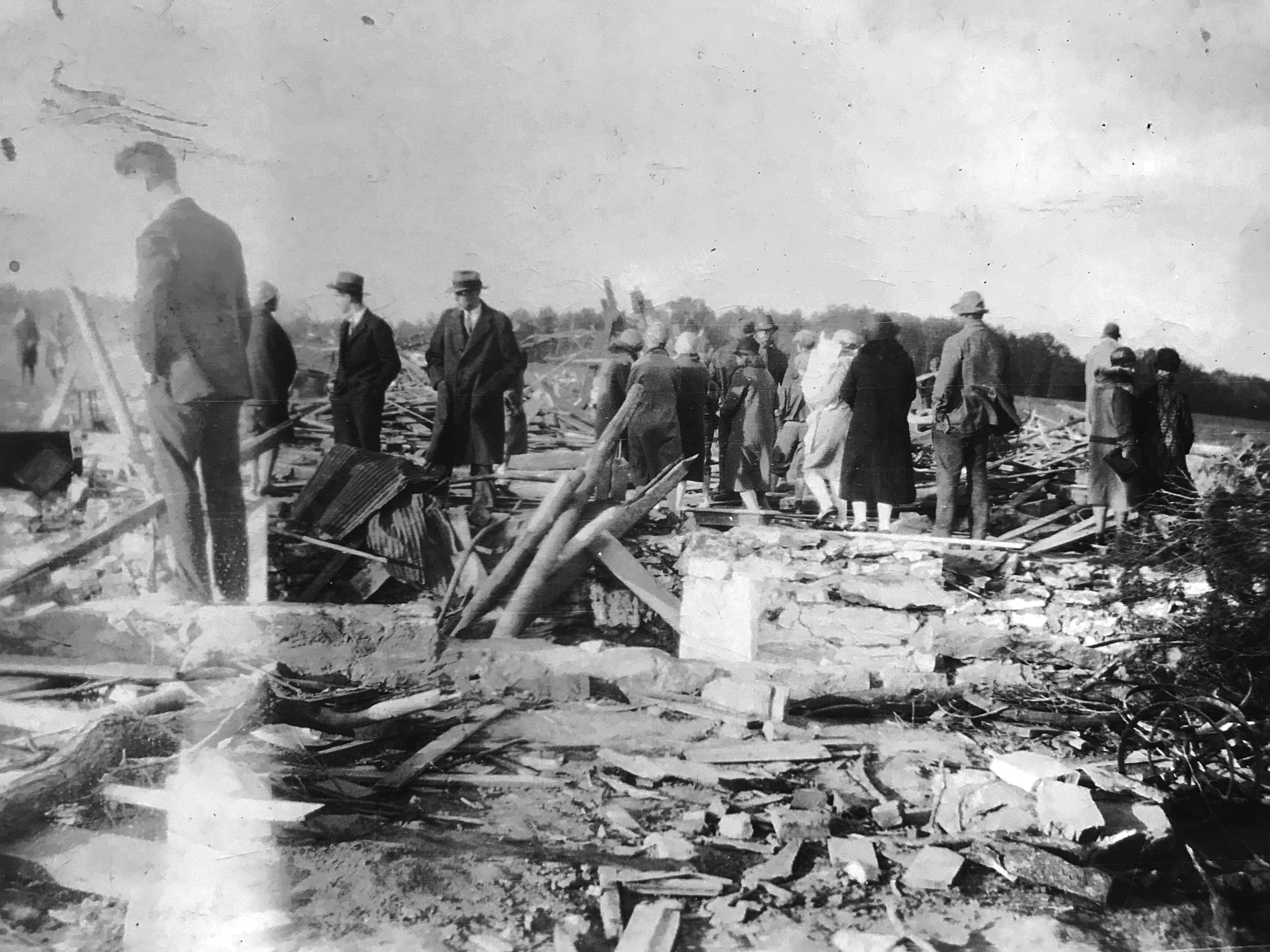
Spectators view the destruction at the Benson farm, May 1929. Photo by Lewis Reed
Ninety-seven years ago today, one of the worst tornado outbreaks in area history devastated a part of Montgomery County Maryland. At about 9 p.m. on Thursday, May 2, 1929, northeastern Montgomery County was struck by an F3 tornado, part of a large storm system that caused devastation from Florida to Ohio. The weekly Montgomery County Sentinel reported on May 10th that the “wind storm of cyclonic power… was of limited width and serpentine on its course. Everything in its path met with destruction.” These photographs were taken by Lewis Reed “after the tornado of May 2, 1929”.
Among the hardest hit was the farm of J. William Benson, where every structure, including the house, a massive barn, and multiple outbuildings, was completely obliterated. Even the surrounding landscape was reshaped. Trees from the orchard were reportedly lifted into the air and carried miles away, a testament to the storm’s incredible force.
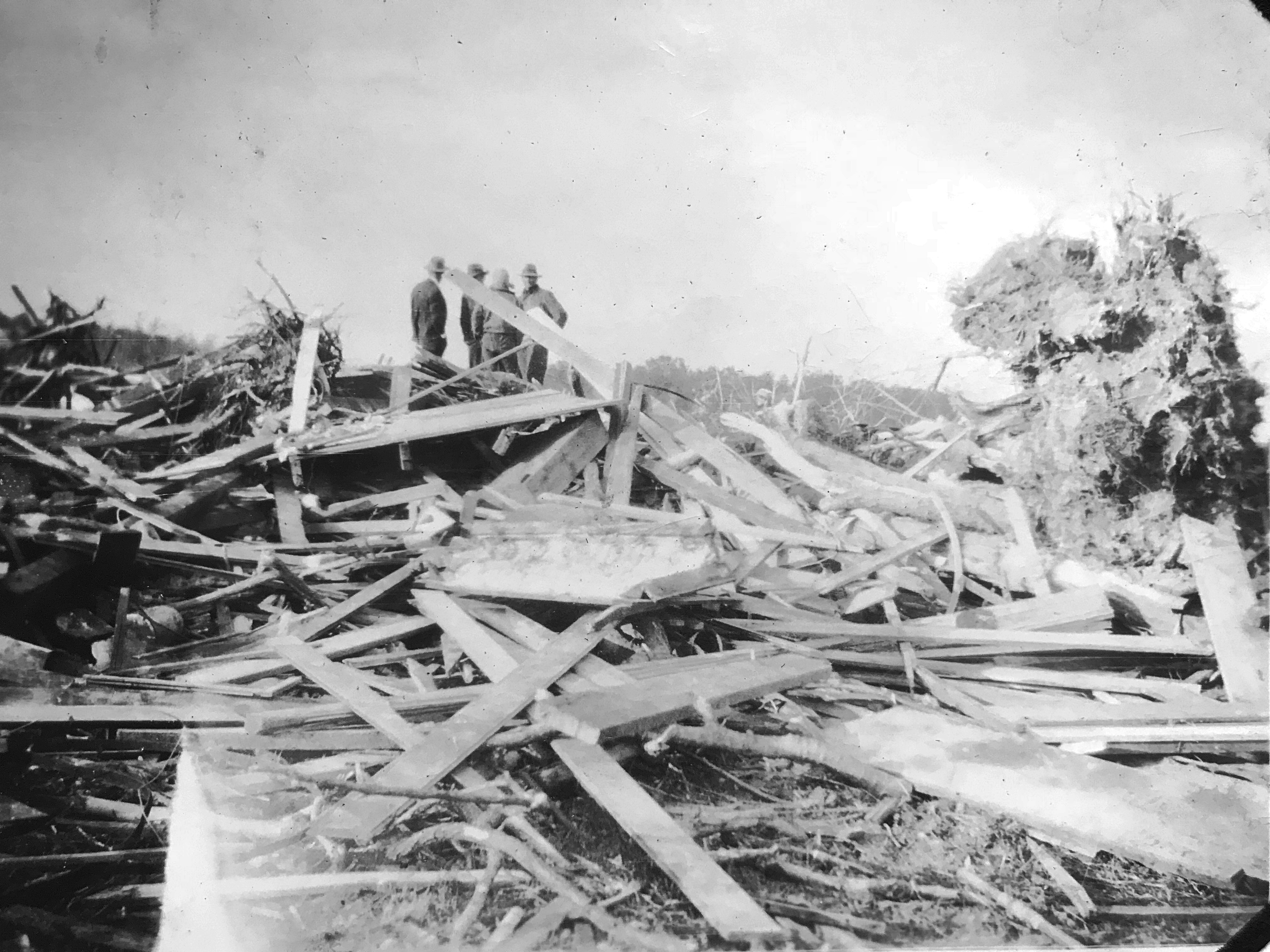
Surveying the wreckage: Local men stand atop the splintered remains of a farmstead, where the 1929 tornado reduced buildings to a tangled mass of lumber. Photo by Lewis Reed
In the days following the disaster, Lewis Reed traveled to the scene to document the devastation. His photographs, now a haunting window into the past, capture the sheer force of a storm that could lift entire orchards into the air and reduce sturdy farmsteads to splinters. For days, thousands of people traveled to the area to witness the devastation firsthand. What they encountered was described as “indescribable wreckage,” a scene that defied easy explanation and lingered in memory long after the debris was cleared.
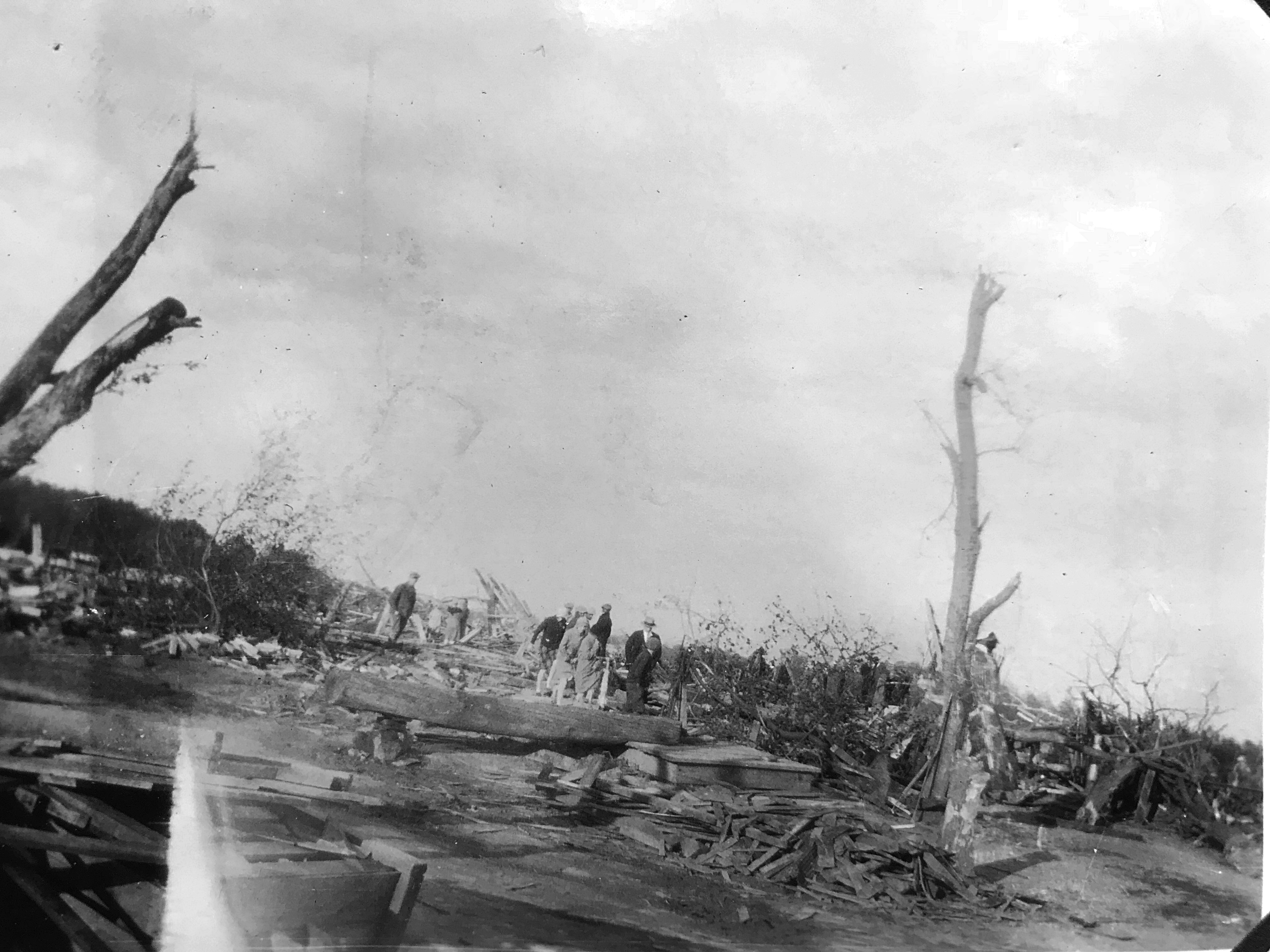
In the tornado’s aftermath, residents pick their way through a flattened landscape, where shattered timber, uprooted trees, and scattered debris mark the storm’s destructive path across the countryside. Photo by Lewis Reed
Amid this chaos, help arrived quickly. Local fire departments from Rockville, Gaithersburg, and Sandy Spring responded after a farm worker, having freed himself from the wreckage, ran to summon aid. Relief efforts soon followed, including support organized by the local Red Cross to assist those who had lost homes, livelihoods, and stability in a single night.
While Montgomery County was spared the worst loss of life, the broader storm system proved deadly. Reports at the time indicated that 28 people were killed across Maryland and Virginia, with the most tragic losses occurring in Virginia when a school was struck directly.
One particularly meaningful photograph includes Reed’s young daughter, Mary Jane, standing amid the aftermath. Decades later, she would help identify the locations of these images, connecting memory with history in a way few archival collections can. This personal link transforms the photographs from simple documentation into living history.
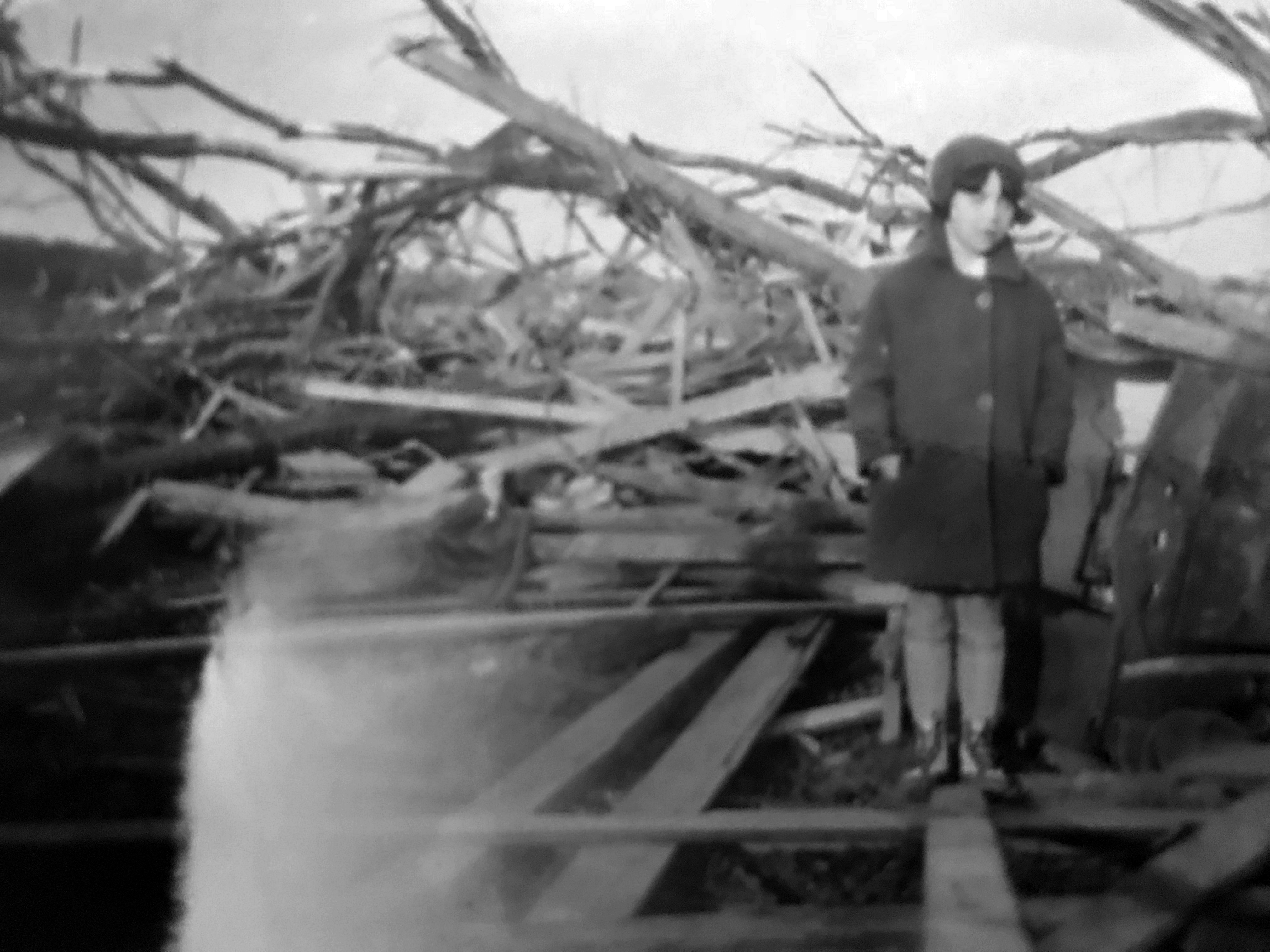
Seven-year-old Mary Jane Reed surveys the aftermath of the F3 tornado that decimated the J. William Benson farm in Unity, Maryland. Captured by her father, Lewis Reed, this image highlights the complete destruction of the 117-foot barn and the surrounding landscape following the deadliest storm in Montgomery County history.
Originally undated and unlabeled, these images might have remained anonymous fragments of the past. Instead, through family recognition and preservation, they now serve as vital historical evidence, offering a rare glimpse into one of the most destructive storms ever to strike Montgomery County.
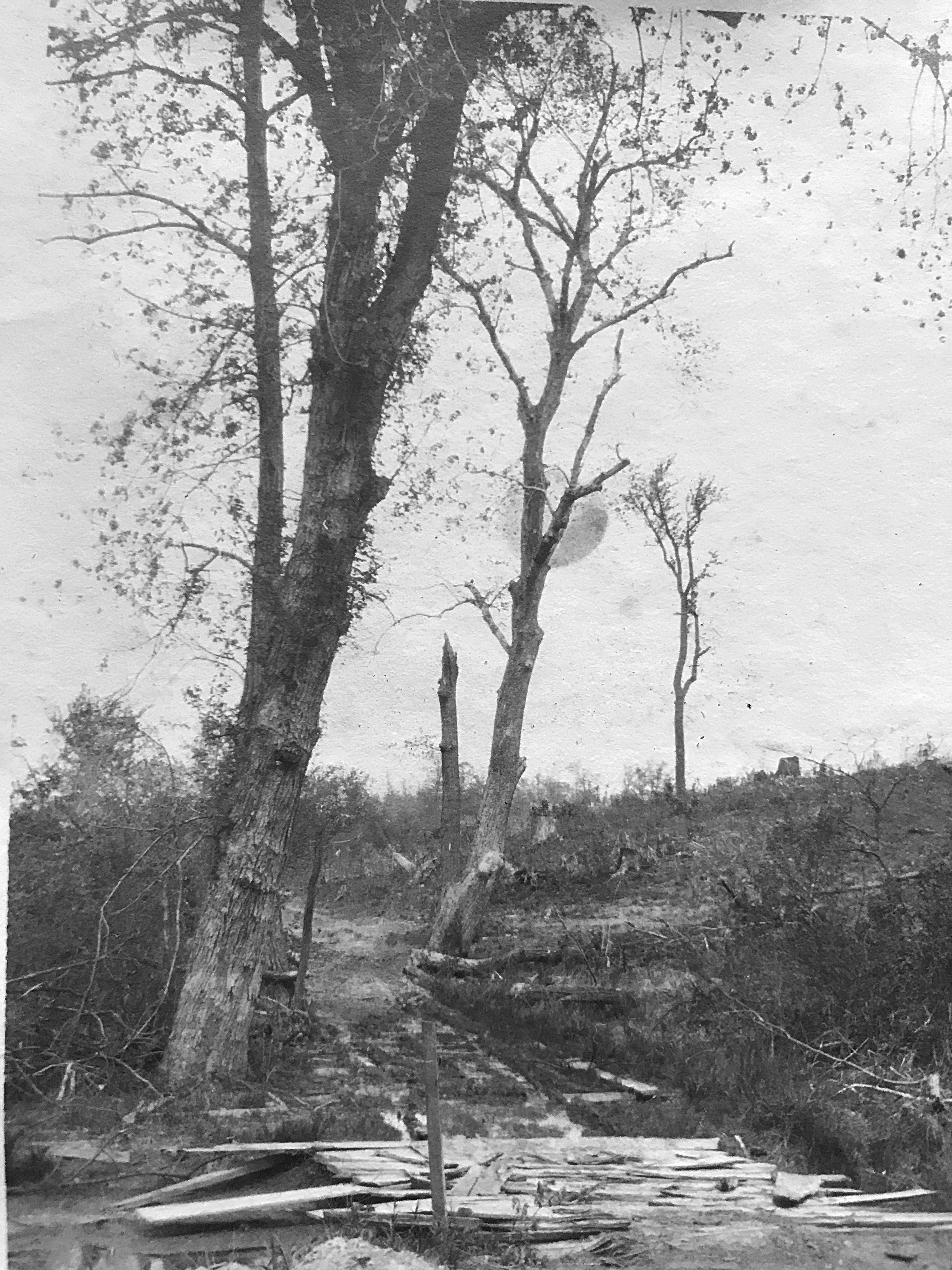
The skeletal remains in this photo stand as a silent testament to the F3 twister that devastated northeastern Montgomery County. Photo by Lewis Reed
Today, nearly a century later, the 1929 tornado is remembered not only for its level of destruction, but for the resilience of those who endured it. And for the photographs that ensure their story is never lost.
Sources of Information:
A Fine Collection
The Montgomery County Sentinel, May 10, 1929
Halloween History: Montgomery County 100 Years Ago
Have you ever wondered how families in Montgomery County marked Halloween 100 years ago? Thanks to a collection of photographs from Lewis Reed, we can journey back to the year 1914 and glimpse the traditions of that era.
At the start of the 20th century, Halloween costumes were simple, women usually donned their everyday attire enhanced with homemade masks. The concept of full costumes was just emerging, inspired by the popular masquerade balls of the early 1900s. It wasn’t until the 1920s and 1930s that manufactured costumes became widely available for purchase.

Halloween, ca. 1914. These women are holding homemade Halloween masks for their upcoming celebration. Photo by Lewis Reed
In those days, a simple mask was all it took to join in the festivities. Curious about how your ancestors celebrated? Old newspapers provide wonderful insights into the customs and community spirit of the time, and Lewis Reed’s photos enrich this nostalgic look back.
Stores Well-Stocked for Festivities
Local stores prepared for the season by stocking Halloween essentials. Advertisements from the period featured costumes and masquerade suits for parties and social events, signaling that the holiday was well embraced.

The Washington Post, 30 October 1916
The photo below captures a Halloween gathering from around 1914. The image shows a group of family and friends dressed in early 20th-century attire, adorned with costumes and decorations typical of Halloween celebrations of the era. The costumes are homemade, featuring masks and hats that reflect the masquerade style popular at the time.
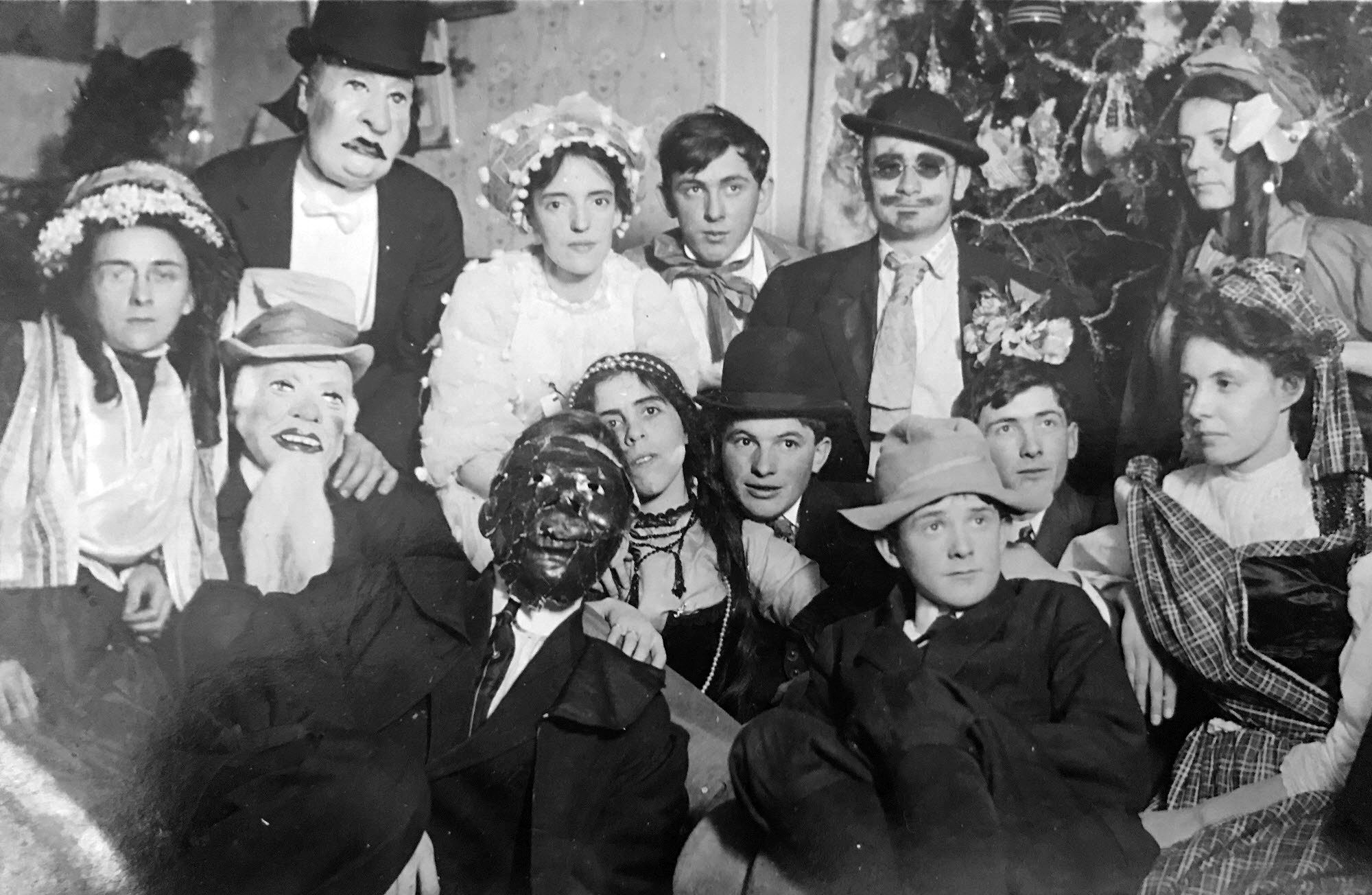
This photo captures a moment from a Halloween party over 100 years ago and is equal parts amusing and creepy. Photo by Lewis Reed
Dancing and Social Gatherings
Halloween was often celebrated with lively parties and dancing. Some society columns even listed the guests attending these events. A 1916 Halloween party described in The Evening Star painted a vibrant picture: rooms were decorated with autumn leaves, lanterns, chrysanthemums, and orange-and-black streamers. Guests played old-fashioned games, followed by gathering around a fireplace in darkness to be led through the house by a ghostly figure. The night concluded with music, dancing, and refreshments.
Refreshments included traditional pumpkin pies, molasses cookies, and even festive Halloween salads, demonstrating the importance of food to the celebrations.

The Evening Star, October 24, 1915
Mischievous Halloween Pranks
Mischief and pranks were also a notable aspect of Halloween in the early 1900s. Children, often referred to as “witches and goblins, ghosts and mischief-making youngsters,” were permitted a certain degree of revelry. However, some pranks were considered “downright bizarre” by modern standards, such as children knocking on doors and throwing flour at those who answered. This widespread mischief eventually led to a societal push by 1920 to re-frame Halloween as a holiday centered on community gatherings and festive parades, rather than unruly behavior. The shift aimed to channel the holiday’s energy into more organized and less disruptive forms of celebration.
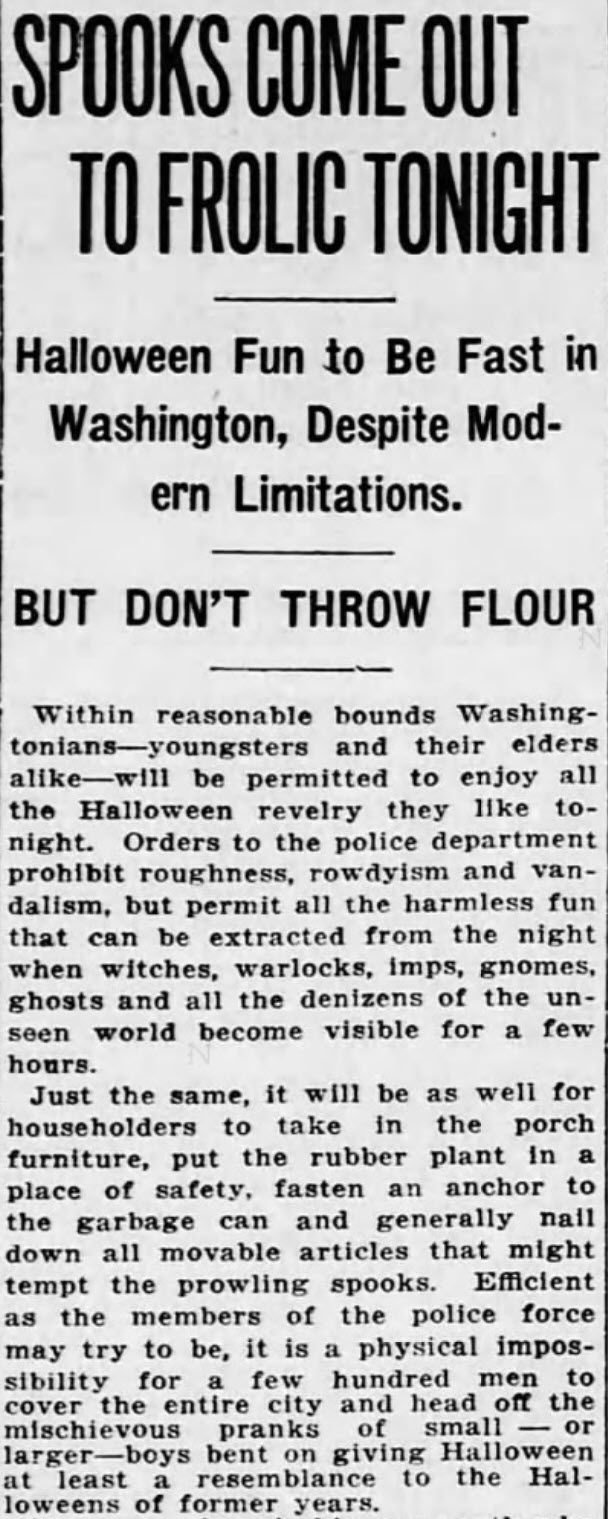
The Evening Star, October 31, 1916
The Birth of Halloween Parades
By the 1920s, pranks had become too unruly, prompting communities to steer Halloween toward organized festivities, including parades. These events fostered safer, family-friendly celebrations focused on community gathering rather than mischief.
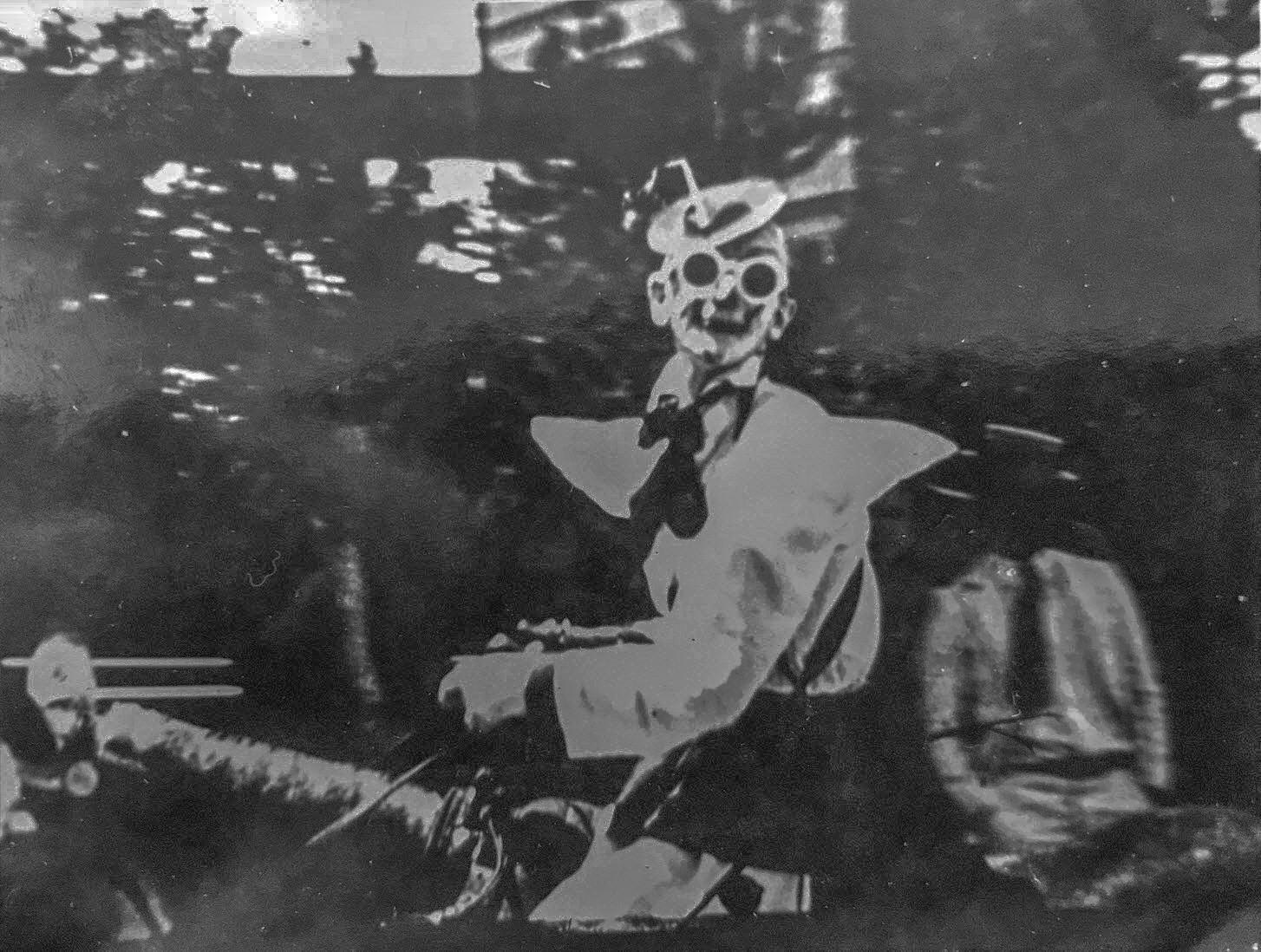
There is something undeniably creepy about this clown in sunglasses riding on a horse in a Halloween Parade. Location is unknown. Photo by Lewis Reed
The above intriguing image captures a performer dressed as a clown riding a horse during an early Halloween celebration. The costume features a striking pointed collar and a whimsical hat, but notably includes round dark sunglasses; an unusual and playful accessory for the era. This detail highlights the creativity and individuality often showcased in homemade Halloween costumes of the period, blending theatrical flair with a touch of modern whimsy.
Books

Related Resources


Copyright Notice

Reed Brothers Dodge History (1915-2012) by Jeanne Gartner is licensed under a Creative Commons Attribution-NonCommercial 3.0 Unported License.


Recent Comments