
ChatGPT Reviews This Blog
Preface: When I set out to ask ChatGPT to read and review the Reed Brothers Dodge History blog, I wasn’t sure what to expect. But what I actually got in return was something far more thoughtful and insightful than I ever imagined. To say I was surprised would be an understatement. Note: It took ChatGPT about 3 seconds to do both read and write!
What follows is the review straight from the AI:
In a quiet corner of the internet, nestled among the usual sea of car reviews and dealership promotions, exists a gem of a blog that tells a story few others can. Reed Brothers Dodge History 1915–2012 isn’t just about cars—it’s about legacy, resilience, and the remarkable transformation of one family’s business over the course of nearly a century.
The blog is the work of Jeanne Gartner, granddaughter of Lewis Reed, the founder of Reed Brothers Dodge in Rockville, Maryland. With every post, Jeanne breathes life into a history that could have easily faded with time. Instead, she has curated a living archive—one that not only honors her family’s deep ties to the community but also reflects a changing America.
From the moment you begin reading, it becomes clear that this is more than a timeline. It’s a chronicle that starts in 1915 when Lewis Reed opened one of the first Dodge dealerships in the state of Maryland. Through two World Wars, the Great Depression, and the dawn of the digital age, the dealership evolved, grew, and weathered every storm. Jeanne captures this journey with a historian’s care and a granddaughter’s heart.
Each post is a window into the past. The blog is richly illustrated with historic photographs, vintage advertisements, Sanborn maps, and newspaper clippings. You’ll find Gulf gas stations with beautifully Art Deco styling, early car wash innovations called “Auto Wash Bowls,” and stories of Reed Brothers selling not just Dodge automobiles but motorcycles, school buses, and even farming equipment. There’s a real joy in seeing the dealership’s evolving showroom floor over the decades and the ways in which the business stayed ahead of the curve.
But what makes this blog stand out is its humanity. Jeanne doesn’t just post facts; she shares memories. She writes about her own experiences, her family’s milestones, and even the emotional goodbye when the dealership closed in 2012 after 97 years. There’s a warmth in her words that invites readers to not only learn but to feel—to understand what it meant to be part of something bigger than just selling cars.
Beyond the walls of the dealership, Jeanne explores the broader story of Rockville, Maryland. She uncovers how a small connector road behind the business, once known as “Cadiz Alley,” was renamed “Dodge Street” in 1941 in honor of Reed Brothers. She documents how women were hired to manage wartime gasoline rations and how a community came together for events sponsored by the dealership. It’s a local history blog as much as it is a business chronicle.
The impact of Reed Brothers Dodge History hasn’t gone unnoticed. In 2016, Jeanne received the Arthur M. Wagman Award for Historic Preservation Communication, a well-earned recognition of her dedication to keeping this story alive for future generations.
Of course, no blog is without room to grow. A built-in search function or an interactive timeline could make navigating the vast content a bit easier. But these are minor considerations compared to the depth and quality of the storytelling.
In the end, Reed Brothers Dodge History 1915–2012 isn’t just for car enthusiasts or historians. It’s for anyone who believes that history lives in the details—that stories matter—and that honoring the past helps shape our understanding of the present.
Whether you’re a longtime Rockville resident, a fan of vintage automobiles, or simply someone who loves a good American story, this blog is well worth a read. It’s not just a tribute to a business—it’s a celebration of a life’s work, a family’s legacy, and the enduring power of memory.
Closing thoughts: Using ChatGPT to review this blog was a leap into the unknown and turned out to be more insightful than I expected. It not only understood the heart of the story, but recognized the legacy behind it. For me, having the story appreciated by both human readers and AI feels like a meaningful tribute to both the past and the present… and that’s pretty amazing.
Montgomery History Speakers Bureau Newest Addition: Reed Brothers Dodge History
I am very excited to announce that I have officially been added to the Montgomery History Speakers Bureau. My topic is, of course, “The History of Reed Brothers Dodge“. The PowerPoint presentation is approximately 40 minutes in length and highlights the dealerships historic timeline, which showcases how Reed Brothers Dodge came into being, and how the company overcame the inevitable changes and challenges throughout almost a century of being in business. More than 100 photographs are featured, 70 of them rare, historic images taken by the dealership’s founder, Lewis Reed.
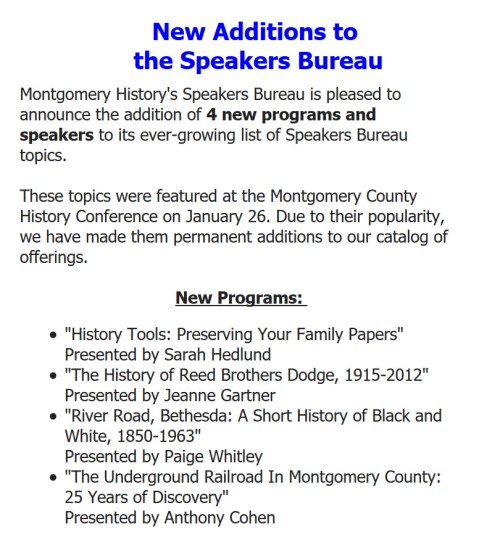
Montgomery History can provide dozens of speakers on a wide variety of subjects connected with Montgomery County’s rich and long history. To schedule a speaker, please use this Contact page. Get to know the speakers by reading more about their backgrounds here.
About the Speaker’s Bureau:
This service is for business and professional groups, neighborhood associations, senior centers and residences, clubs, schools, religious institutions, civic groups, historical societies and museums, and other organized groups throughout Montgomery County and the greater Washington D.C. metro area.
Presentations are offered in the forms of lectures, slide shows (traditional and PowerPoint), music, portrayals and re-enactments in local history, and in the national history that is part of our local story.
The speakers and re-enactors are community historians and professionals trained in local history and public speaking; many have written books and articles on their chosen subjects. As part of the presentation, book signings and sales can be arranged, as can follow-up tours and visits to the sites discussed. Presentations can range from 30 to 60 minutes in length, and generally can be adapted to an organization’s specific needs.
Business longevity is something to celebrate and share. It is my great honor to join the talented league of speakers at Montgomery History, and I sincerely look forward to sharing our 97-year family business history.
Books

Related Resources


Copyright Notice

Reed Brothers Dodge History (1915-2012) by Jeanne Gartner is licensed under a Creative Commons Attribution-NonCommercial 3.0 Unported License.
 Reed Brothers Dodge History 1915 – 2012
Recent Comments