
Autumn at Pleasant Hills: A Pumpkin Harvest in Early Darnestown
In the early 1900s, Darnestown was still firmly rooted in agriculture, with large family farms, open fields, and country roads defining much of the surrounding landscape. Pleasant Hills was part of that rural world, and the Kelley family was among the local families whose farm products were well known throughout the area.
Lewis Reed’s photograph of three men standing in Thomas Kelley’s pumpkin field preserves a rare glimpse of that earlier Darnestown. The men are clearly not farm workers at harvest. Dressed in jackets, hats, and polished shoes, they appear to have simply stopped among the pumpkins and posed for Reed’s camera, turning an ordinary autumn visit into a lasting record of local history.
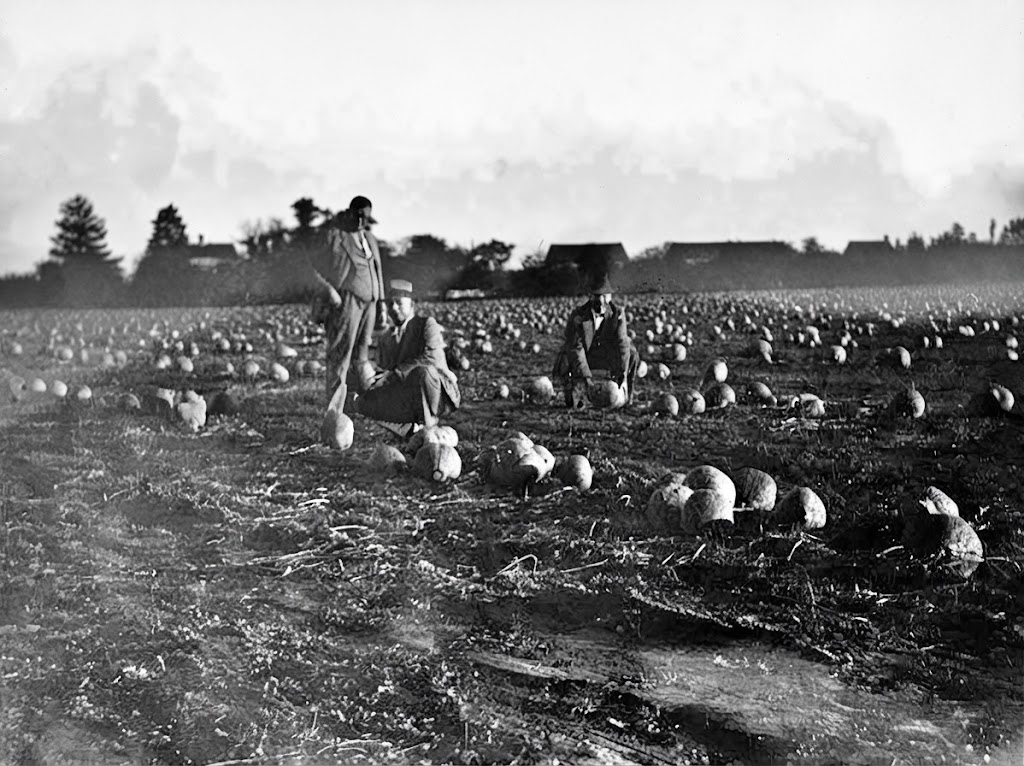
Men gathering pumpkins in Thomas Kelley’s field near Pleasant Hills in the Darnestown area, early 1900s. Lewis Reed’s photographs preserved not only community celebrations, but also the seasonal traditions of everyday life in Montgomery County. Photograph by Lewis Reed.
Pleasant Hills was a substantial working farm, and the Kelley family became especially associated with fresh produce, including the well-known “Kelley Corn” wagon that traveled through the community. Pumpkins were part of the farm’s autumn landscape at a time when seasonal produce came directly from nearby fields and local farms remained closely tied to everyday life.
Lewis Reed knew this countryside well. Raised in Darnestown, he photographed the people, farms, roads, homes, and small moments that surrounded him. At the time, such scenes would have seemed entirely ordinary, but today they preserve details that written records rarely capture: how people dressed, where they gathered, and what the rural landscape looked like before suburban growth transformed much of western Montgomery County.
That is what gives this photograph its lasting importance. It is more than a picture of three men in a pumpkin field. It is a surviving fragment of early Darnestown, preserving Pleasant Hills as part of a farming community that has largely disappeared from the modern landscape.
Books

Related Resources


Copyright Notice

Reed Brothers Dodge History (1915-2012) by Jeanne Gartner is licensed under a Creative Commons Attribution-NonCommercial 3.0 Unported License.


Recent Comments