
Calling All Memories!
 Share your memories and take a trip down memory lane with one of the nations oldest Dodge dealers.
I thought it would be fun to create a special blog post of employee, friends, and family memories of Reed Brothers. So far, I have already collected some great stories from a handful of people sharing their personal favorite highlights of Reed Brothers. If you have any favorite memories, stories, or even photos you would like to share, please send them to me via the “Contact Me” section at the top of this page or click on this link: https://reedbrothersdodgehistory.wordpress.com/about-2/contact-me/
I will compile and showcase them here in a special blog post. This really will tell a very personal story of our company from the perspective of those who contributed to its 97 years of success.
Let’s hear them!
Manufacturing Dodge Motor Cars, ca 1917
Get ready for a treat! Here is a film that the Dodge Brothers company made to promote their brand in 1917. Copied at 16 frames per second from a 35mm tinted print preserved by the Academy Film Archive from source material provided by the New Zealand Film Archive. Running Time: 28 minutes (silent, no music, incomplete).
In the 1900s, brothers John and Horace Dodge of Detroit became the major suppliers of drive trains to the Ford Motor Company. They achieved such a stellar reputation for quality that when they decided to manufacture their own automobiles, incorporating as the Dodge Brothers Motor Car Company in 1914, 13,000 dealers registered to sell the new vehicles before a single auto had been produced. In 1915, Reed Brothers was franchised as a Dodge dealership and service facility; less than one year after the first Dodge automobile rolled off the assembly line.
In 1916, the company created a film department to promote the Dodge brand. This film appears to be one of its first products. It shows the company’s assembly line in action, demonstrating to viewers the workmanship and care invested in each vehicle. The beginning is missing, lending credence to the hypothesis that the film may be the three-reel profile of the company’s production process distributed in 1917 to Dodge dealerships. The film finishes with close up looks at the Dodge Brothers’ models of the day: the Sedan, Coupe, Roadster and Touring Car. It also demonstrates Dodge’s capabilities in the snow and on steep hills (particularly fun to watch!).
If you have a half-hour to spare, kick back and enjoy this rare treat! You will get a true insider’s look at how the very first Dodge automobiles were made!
Dodge Made a Car Just for Women
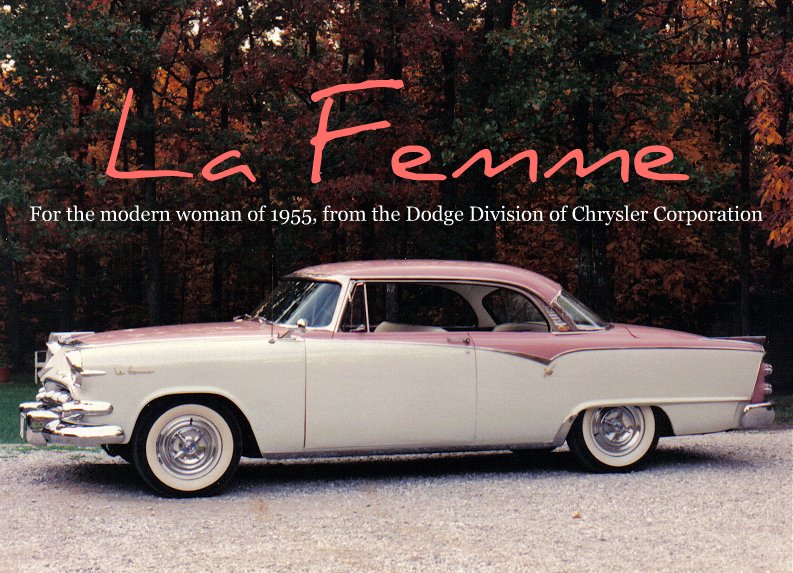 The Dodge La Femme stemmed from Chrysler’s marketing department’s observation that more and more women were taking an interest in automobiles during the 1950s, and that women’s opinions on which color car to buy was becoming part of the decision making process for couples buying an automobile. The La Femme was an attempt to gain a foothold in the women’s automobile market.
Dodge introduced the new La Femme option package in 1955: For $143, you could have the Custom Royal Lancer feminized, with rose paint, gold script, and a nauseating shade of Pepto-pink interior complete with rosebuds.
The accessories which came with the car as standard equipment were where things started getting weird. The car came with a calfskin purse in the same shade of pink as the car’s interior. There was a special compartment behind the passenger seat for this purse, where it could sit with the buckle facing outward. This buckle was large enough for owners to have their name engraved on them, and this is what they were encouraged to do. Inside the purse there was a makeup compact filled with pale pink powder, a lipstick holder, a gold-toned cigarette lighter and case, an imitation tortoiseshell comb, a cigarette lighter, a vanity mirror and silk change purse.
These accessories were all finished in gold-color metal and (you guessed it) pink. For those who wanted them, Dodge also offered an umbrella, boots, a cape (seriously?) and a hat, all matching the seat upholstery.
It went nowhere. La Femme became La Flop. Women stayed away in droves and men weren’t about to be seen driving around in the darling Rosebud. The Dodge La Femme was sold for two years in the U.S. — 1955 and 1956
(Line from a long-lost episode of “Leave it To Beaver”)
“Gee Wally…. all the guys are callin’ me a sissy…. a pink and white car and it says La Femme on the side …. I just can’t be driven to school in mom’s new car anymore …. Yeah, Beave …. I know what ya mean …. that’s why I ride with Eddie …. and besides, mom’s not all that thrilled with the car either!”
Info Source: Dodge La Femme Wikipedia
Reed Brothers Becomes an Original Member of Chrysler
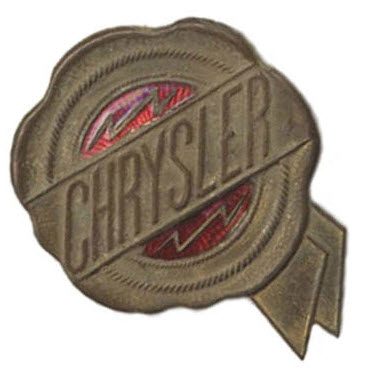
1930s Chrysler radiator “ribbon” emblem
May 28, 1928 marks an important milestone in the history of Chrysler. It was on this day in 1928 that Dodge Brothers, Horace and John Dodge, became a part of Chrysler. It was on this same date that Lewis Reed, founder of Reed Brothers Dodge in Rockville, Maryland also became an original member of the Chrysler family.
During 1920, the Dodge Brothers company lost its founding fathers. John Dodge died in January, and his younger brother Horace succumbed the following December. A New York investment banking firm paid the brothers’ widows, in a single cash payment, $146 million for the Dodge Brothers firm. Within three years, the bankers initiated negotiations, and on May 28, 1928, Walter P. Chrysler purchased Dodge Brothers, Inc. for $170 million, making it, at the time, the largest business transaction in history. When the transaction was complete, the Chrysler Corporation had grown five-fold overnight to become the third of Detroit’s “Big Three” automakers.
The first Plymouth was built in 1928 and Plymouths were sold at Reed Brothers until 1969, when the Plymouth brand was given to the Chrysler dealers.
Book Release: “Portrait Of An Automobile Dealer” Third Edition


In September 2012, I created a self-published book version of this blog, entitled “Portrait of An Automobile Dealer”. In short, it’s an updated and chronologically ordered version of this blog. A second edition was published in place of the first edition, which was released in 2013. Now, after five years, the third, and final edition, is available through Blurb.com print-on-demand bookstore. Overall, since the second edition, “Portrait Of An Automobile Dealer” Third Edition has expanded to 224 pages and is enhanced by over 600 photographs, some of them more than 100 years old, taken by Lewis Reed, founder of Reed Brothers Dodge. The third edition again has loads of small updates, including a new chapter: “Celebrating a Legacy”.
In this book, readers will find an historic timeline that showcases the company’s 95-year history, how Reed Brothers Dodge came into being, and how the company overcame the inevitable changes and challenges throughout almost a century of being in business. “This book is of interest not only to those of us who remember Reed Brothers Dodge, but to others who wish to get to know Rockville as it was before they arrived”, said Jane C. Sween, former librarian at the Montgomery County Historical Society.
The author puts the former Dodge dealership in perspective by demonstrating that the dealerships influence continues to this day on the site of its former location, now the Bainbridge Shady Grove Metro Apartments. “Honoring the rich historical legacy of this site was extremely important to us,” said Tom Keady, President & Chief Executive Officer of The Bainbridge Companies. “With the sculpture and the floor plan names, our residents and visitors feel a real connection to the site’s past, and we pay tribute to Reed Brothers Dodge’s role in creating a vibrant Rockville.”
Blog creator and book author, Jeanne Gartner, received the 2016 Arthur M. Wagman Award for Historic Preservation Communication from Peerless Rockville for documenting the history of Reed Brothers Dodge in both blog and book format. This distinguished honor recognizes outstanding achievement by writers, educators, and historians whose work has heightened public awareness of Rockville’s architectural and cultural heritage, growth and development. The book is an “exemplary effort to inform, establishing a virtual commemoration of a landmark, which lacks surviving tangible form”, noted Peerless Rockville.
The book “Portrait Of An Automobile Dealer, Third Edition” is available through Blurb.com print-on-demand bookstore. If you would like to check out the hard copy book or purchase a copy, please visit: http://www.blurb.com/b/8514165-portrait-of-an-automobile-dealer-third-edition
As a special thank you to all the readers of this blog, this book has been placed online for everyone to enjoy for free. A complimentary eBook available for Amazon Kindle Fire, Apple iPad, Android devices, and Mac or PC computers is also available through Blurb: http://www.blurb.com/b/8514165-portrait-of-an-automobile-dealer-third-edition?ebook=653481
Note: It’s worth noting that Print-On-Demand (POD) books, are usually more expensive per copy than a book printed via offset printing. That’s because offset printing (the method used for most mass-produced books found in bookstores) requires a minimum order of 500-1,000 copies. Print on demand, on the other hand, needs only a minimum order of one copy. The smaller scale and different workflow results in a higher cost per book, since the books are only printed when they are ordered. This book is not marked up for profit; but sold at base price.
Books

Related Resources


Copyright Notice

Reed Brothers Dodge History (1915-2012) by Jeanne Gartner is licensed under a Creative Commons Attribution-NonCommercial 3.0 Unported License.
 Reed Brothers Dodge History 1915 – 2012
Recent Comments