
48 Years Ago Today: 55th Anniversary and Grand Opening

Today marks 48 years since the Grand Opening of Reed Brothers Dodge new showroom and service facility. When the state widened the roads in 1970, Lee Gartner purchased 4.37 acres of land from Eugene Casey and relocated Reed Brothers Dodge to a new state-of-the-art showroom and Dodge/Chrysler/Jeep service complex on Route 355 at 15955 Frederick Road in Rockville Maryland.
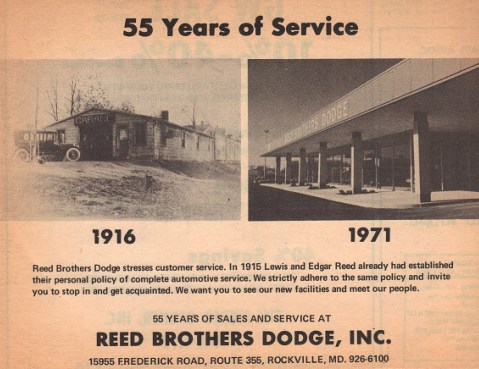
Turning out to honor the company were several hundred dignitaries, officials, businessmen and friends. The new building, a complete automotive sales and service facility marked Reed Brothers 55th year of selling Dodge’s. The state-of-the-art dealership contained the newest customer-focused features throughout which combined technology and comfort.


The new dealership provided a modern new vehicle showroom, 30 service bays, a comprehensive detail and car wash area, Parts Department, Body Shop, the newest technologies to service customer’s vehicles and provided customers with a convenient location to purchase and service their vehicle needs.

Design and construction of the new dealership was managed by the Glen Construction Company.
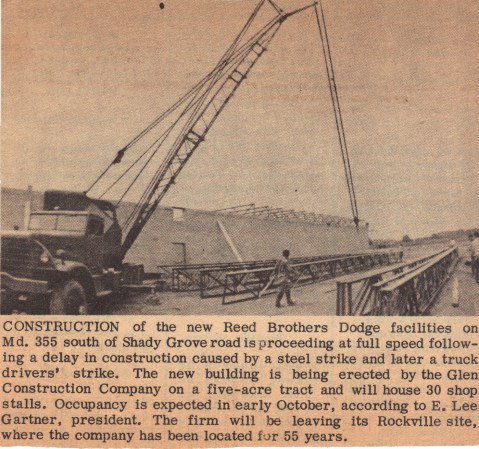
The Great Frederick Fair Parking Lot Shot, 1914

This fascinating scene of hundreds of cars parked in the Frederick Fair parking lot was taken by Lewis Reed in 1914. What is fascinating to me is, with all of these early cars painted in black, how on earth would you find your car in the parking lot?
This week (September 14-22) marks the 156th edition of the Great Frederick Fair, the largest and greatest county fair in the State of Maryland. There have been many changes since the first fair was held in 1822 when it was known as the Cattle Show and Fair: that was a two-day event, now it’s nine days. The location has changed and so has the name. Today, the Frederick County Fair is officially named the Great Frederick Fair. It’s been held in May, October and November, but now (and for many years) takes place in September — rain or shine.
Fair entertainment has certainly evolved over the years. In 1888, May Lillie, an “expert girl shot with a rifle” from the back of a running mustang, performed. In the early 1900s, acrobatic bears and monkeys, high-wire acts and vaudeville performers took the stage. In 1950, the highlight of the “Irish Horan and the lucky Hell Drivers” show was a “stock convertible catapulted from a giant cannon.” In 1965, it was Jack Kochman’s Hell Drivers performing stunts with cars.
The Thursday of the 1911 fair was noted as a record day with 15,000 people in attendance, 100 autos and 1,000 carriages, according to “The Great Frederick Fair” book. Today, fair attendance can range from 210,000 to 250,000 people during the nine-day fair.
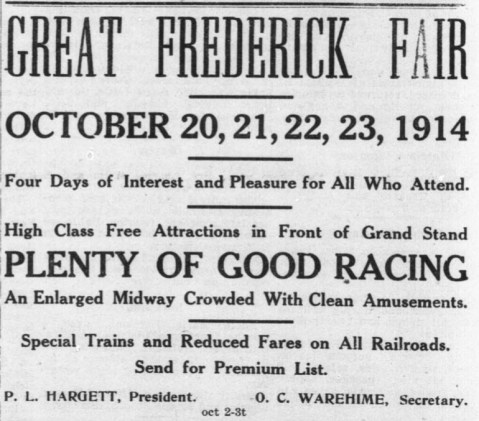
Newspaper ad advertising The Great Frederick Fair. THE DEMOCRATIC ADVOCATE OCTOBER, 1914
Source: Frederick News-Post
Chrysler Buys Dodge

1928 Chrysler logo
May 28, 1928 marks an important milestone in the history of Chrysler. It was on this day in 1928 that Dodge Brothers, Horace and John Dodge, became a part of Chrysler. It was on this same date that Lewis Reed, founder of Reed Brothers Dodge in Rockville, Maryland also became an original member of the Chrysler family.
During 1920, the Dodge Brothers company lost its founding fathers. John Dodge died in January, and his younger brother Horace succumbed the following December. A New York investment banking firm paid the brothers’ widows, in a single cash payment, $146 million for the Dodge Brothers firm. Within three years, the bankers initiated negotiations, and on May 28, 1928, Walter P. Chrysler purchased Dodge Brothers, Inc. for $170 million, making it, at the time, the largest business transaction in history. When the transaction was complete, the Chrysler Corporation had grown five-fold overnight to become the third of Detroit’s “Big Three” automakers.
The first Plymouth was built in 1928 and Plymouths were sold at Reed Brothers until 1969, when the Plymouth brand was given to the Chrysler dealers.
Stories From The Past By Friends & Employees
 A while ago, I put out a call for stories and memories from employees and friends of Reed Brothers. It has taken a while for me to compile them all, but I am delighted to share them with you now in this special post. Here is what they said.
John Hall – Mechanic
The mechanics at Reed brothers Dodge worked on the Flat Rate System of pay. That meant if there was no work, there was no pay. This was very difficult on a family man. There were times in the winter that we were lacking customers. Brownie, who was an excellent mechanic would bang a Torsion Bar on a metal trash can to get Phil Vetter’s, or one of the service advisers attention (a torsion bar is a steel bar that was used on Chrysler products in place of front springs.) The bar could be twisted to raise or lower the height of the vehicle. There was also no sick leave, or holiday pay offered through the dealership. I decided to write up a proposal to the president of the dealership, Lee Gartner via Phil Vetter. All of the mechanics signed the petition. After a period of negotiation back, and forth, Lee Gartner came back with an offer of 6 sick days a year at $20.00 a day, and the six major holidays at $40.00 a day. This does not seem like a lot of money now, but in the early seventies it was much appreciated. Reed Brothers was now one of very few dealerships at that time to offer sick, and holiday pay to flat rate mechanics.
When the state widened the roads in 1970, Reed Brothers relocated from its original facility at the intersection of Veirs Mill Road and Rockville Pike to new Dodge/Chrysler/Jeep service complex on Route 355 at 15955 Frederick Road. Many longtime customers followed them to the new location. One of them that I remember well is John Logan Seitz from his 1957 Dodge that he owned, and the spinner hubcaps were always getting stolen from the front of his house in Kensington, Md, before he moved to Potomac in 1971. He was still coming to Reed Brothers when I came back to work in 1999, and for many years after I left. He said all the Gartner’s were very nice, and the employees treated him well.
In the winter time when the doors were all shut in the shop, and the engines on more then one car was running, the fumes were so bad that we had to open the side employee entrance door and walk outside for some air. One morning Lee Gartner walked by, and said; What are you boys doing? Why aren’t you in the shop working? We said we needed some fresh air because of the fumes. After we complained about the fumes for awhile, OSHA came out, and measured the carbon monoxide level in the shop, and it was high. Shortly after that Lee Gartner installed a whole new exhaust vent system in the shop.
One time John Trammel drove a customers car through the front garage door because the brakes failed, and when he beeped the horn for someone to open the door, no one did. It was winter time. The Gartner kids were as young as me at the time, and I worked on all of their Demos. Lee used to water his plants, and read his newspaper usually standing up in the corner of the showroom, and then walk through the shop picking up trash. I think he controlled the heat in the shop for us. The shop was smaller then 30 bays in 1972. The building ended right behind the heavy truck lift. There was a radiator repair shop in the back of the Body Shop, and Nathan Howard used to repair many radiators there. He also kept a small garden in the field behind the shop. The body shop was much smaller then. Lee took us to Mealy’s restaurant in New Market for a Christmas dinner once in a Snowstorm. We were all dressed up. He said, “I didn’t know you boys could look so good.” There was a man named Robert who was the car painter. In those days painters had to breathe a lot of fumes. His beard was usually painted along with the car he was painting.
The shop was broken into in the 70’s and Ben McGowan’s tools were stolen, along with some other mechanics tools. Lee Gartner had us all inventory our tools, and in a few days replaced all the stolen tools.
Roger Camp – Mechanic
He said the shop was again broken into years later, and the thieves stole a box truck off the lot with a lift gate, and loaded all the tool boxes up in the shop into the truck. They also took a large sledge hammer out of the body shop, and tried to break open the office safe. They were never caught. Roger said Lee Gartner installed an alarm system shortly after, due to the insurance companies regulations.
Janice Beall Taylor
Both of my parents worked at Reed Brothers in the early 1930’s. My mother (Mary Anna Slater) was the book keeper, and my father (Leonard Beall) worked in the paint shop. At the beginning of WWII my dad was working in the Paint Shop at Reed’s, matching paint on cars that had been damaged. When the draft took place, Selective Service disqualified him because they said he was “colorblind”.
Daddy always told this story: In 1942, they only had one new car left to sell. It was up to him to back it into the showroom. He was in the driver’s seat, with the door open looking backwards to see where he was going, and he got too close to a support pole (and was probably going too fast!), and ripped the door right off the car! The last one! Maybe it wasn’t a coincidence that Daddy left Reed’s and took a War job at National Airport until he opened his own business in 1944. I also remember my mom telling stories about riding to work with Mr. Raleigh Chinn after they moved into their new house on Anderson Ave. in 1938.
When the Goodyear Blimp came to visit Reed Brother’s in 1938 to promote tires I went up for a ride!! My mother worked as a bookkeeper at Reed’s when the Blimp came, and she was 8 1/2 months pregnant with me! She called her doctor (Dr. Hartley) and asked if it would be okay for her to go on the Blimp, and he said, “…only if I can go, too”. So she and Dr. Hartley and I rode along. Of course, I wasn’t born until 2 weeks later, but my mother and Dr. Hartley went up! My kids always thought it was neat that I’d been up in a blimp!!!
Robert Higdon (Assistant Service Manager)
I came to Reed Brothers Dodge a little over a year after spending three years in the Army serving in Vietnam 67-68. Reed Brothers Dodge was a part of my early life, but we all move on and change with the times. I was very sorry to see you lose your franchise. It wasn’t fair that it happened and now the building is gone too. Longevity should have played a part in you keeping the business. You all have played a big part in my life during those years and from time to time I think and remember some of the best times in my life were being your friend and co-worker.
Other Stories on Social Media
Tim B. Used to go into the service bay after school at St. Marys and get a Dr. Pepper and some Lance peanuts. Poured the peanuts into the Dr. Pepper and guzzled it down while watching mechanics work on cars. And it was a cool place for boys to hang out and watch cars get fixed. Very cool to a 4th grader.
Mark T. On the left side of Reed Bros. Dodge there was a concrete ramp going up to the second level. I used to play on it while my mom (Marie Thompson) crossed school kids from St. Mary’s to Richard Montgomery. She crossed Veirs Mill and the Pike for 30 years. The only time she missed is when she was pregnant with me in 1956.
John M. The first car I bought was a Dodge Dart Sport from Reed Brother’s. My dad went along with me to pick it out. I remember him asking me if I was sure I could afford it. I had just gotten my first teaching job. Never had another new car for the next 40 years. I loved that car. When I worked at United Auto Parts, I mixed the paint that the body shop painter used to paint Riggs Schultz’s sweet Plymouth — Go Mopar.
Michael B. I remember when the new car models would be snuck into Rockville at night and covered up every fall until the “release date” … I think back then it was October 1 …
John W. B. My parents bought their strangest car at Reed Brothers. A 1962 dart with a watermelon shaped steering wheel and push-button shifting.
Sally M. My first new car, a 1980 Dodge Colt came from Reed Brothers. My ’69 Chevy Laguna blew up at Lake Forest Mall the day my car arrived and Reed Brothers still honored the trade in.
Izetta W. T. Jeanne T. Gartner, my dad is George Waters. I remember him talking about you! Reed Brothers was like a big family. He enjoyed working there and the relationship with everyone. He was well respected there, as he would tell me of one of the Brothers personally asking him to help on a difficult job because he knew my dad had the skills to do it. Great memories.
Minnie W. S. Wow, thanks for this story. I remember we were Reed Brothers’ emergency number, which is why we could never tie up the phone. He loved working at Reed Brothers, was like a second family for him.
Thanks to everyone who responded with memories of the good years. I would love to see more if anyone else has any.
Early Commercial Trucks on the Job in Rockville
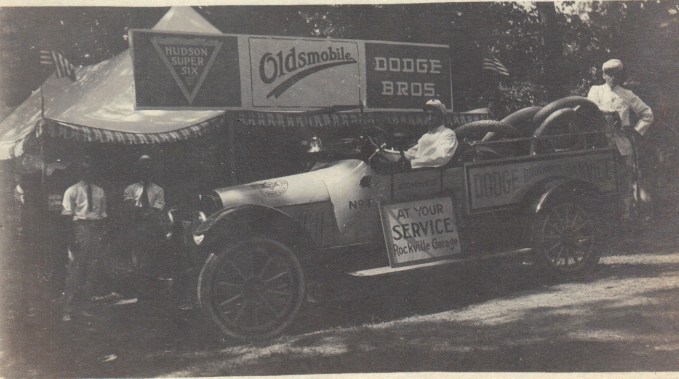
1918 – Lewis Reed in drivers seat of Rockville Garage Dodge Brothers Service Truck. Note the Dodge Brothers six-point emblem on the hood and “Dodge Brothers Service” displayed on the side panel.
After the introduction of mass-produced automobiles, people started to modify their vehicles for enhanced utility. These people stripped off the rear bodywork and mounted open-topped boxes that resembled the first step towards the modern pickup truck. The photos on this post gives a wide variety of vehicles outfitted with the equipment necessary for various trades… Dealership Service Truck, Delivery Truck, and Firetruck.
Horace and John Dodge reluctantly agreed to develop a commercial vehicle in 1917 after their sales associates lobbied for a work truck that could be sold to small businesses that made deliveries of fruit, beer, and other goods. The result was a vehicle based on the first Dodge passenger car. The vehicle eventually became the screen-side Dodge business truck, with a thousand-pound payload, selling for $885.
The photo below of the original Offutt’s General Store shows a 1919 Dodge Screenside delivery truck purchased from Reed Brothers Dodge parked in front. Notice the screens on the side with roll up canvas covers. Commercial users of these units preferred Dodges because they had an all steel body.

Offutt’s General Store, with a 1919 Dodge Screenside delivery truck purchased from Reed Brothers Dodge parked in front. The store later became Hank Dietle’s Tavern on Rockville Pike which was recently destroyed by fire. Photo courtesy of Mary Offutt Stubbs, Edward Offutt’s daughter
In 1919, the Graham Brothers produced the “Truck-Builder” which was a basic platform from which a customer could spec a truck according to their needs. The Truck Builder was essentially a truck conversion that began with a passenger car. The Truck Builder worked this way: The new-car dealer would sell a new car to a customer, then suggest to the buyer that his old car could be converted into a truck.

Original Dodge Truck Build Order
The Dodge Truck Building Order listed the components and equipment that go into an individual truck; engine, transmission, axles, ratios, tires, special equipment, and others. A copy of the order is affixed to the cab or body, engine, and frame during the first steps in the assembly process and accompanies it until the truck is completely assembled.
In 1921, Dodge Brothers began to market Graham Brothers medium-duty trucks through its dealerships; in turn, every Graham vehicle utilized a Dodge engine. This partnership provided Dodge dealers with a full line of trucks to sell in addition to the highly regarded Dodge passenger cars, and the resulting sales increases prompted Dodge to buy the Graham Brothers Company.

In the 1920s Reed Brothers sold Dodge Brothers Motor Cars and Graham Brothers Trucks
1922 was the birth of the Kensington (Maryland) Volunteer Fire Department. The following quote was extracted from the KVFD History page.
With little money, the new company went about purchasing apparatus. A Dodge truck was purchased from Reed Brothers in Rockville. A fire body was then put on the truck by Jacobs Brothers in Gaithersburg. To raise money, the volunteers held carnivals. The Fire Department incorporated in 1925, and two years later moved into a permanent home in the basement of the National Guard Armory.
Lewis Reed later became a charter member and President (Feb.1933 – Feb 1937) of the Gaithersburg – Washington Grove Volunteer Fire Department.

This photo was on the Kensington VFD web page. The trucks in front appear to be c. 1920s.
The Dodge trucks would carry the Graham Brothers nameplate until 1928 with a few of the designs lasting as long as the 1930s.
Books

Related Resources


Copyright Notice

Reed Brothers Dodge History (1915-2012) by Jeanne Gartner is licensed under a Creative Commons Attribution-NonCommercial 3.0 Unported License.
 Reed Brothers Dodge History 1915 – 2012
Recent Comments