
Not Just a Dodge Dealer
Lewis Reed’s Rockville Garage sold more than just Dodges. During the early years, Reed Brothers represented several franchise nameplates along with Dodge, including Oldsmobile, Hudson and Essex. The Hudson and Oldsmobile were sold at Reed Brothers from roughly 1917 through 1921.
In 1930. Reed Brothers added the Plymouth line. The first Plymouth was built in 1928 and Plymouths were sold at Reed Brothers until 1969, when the brand was given to the Chrysler dealers.
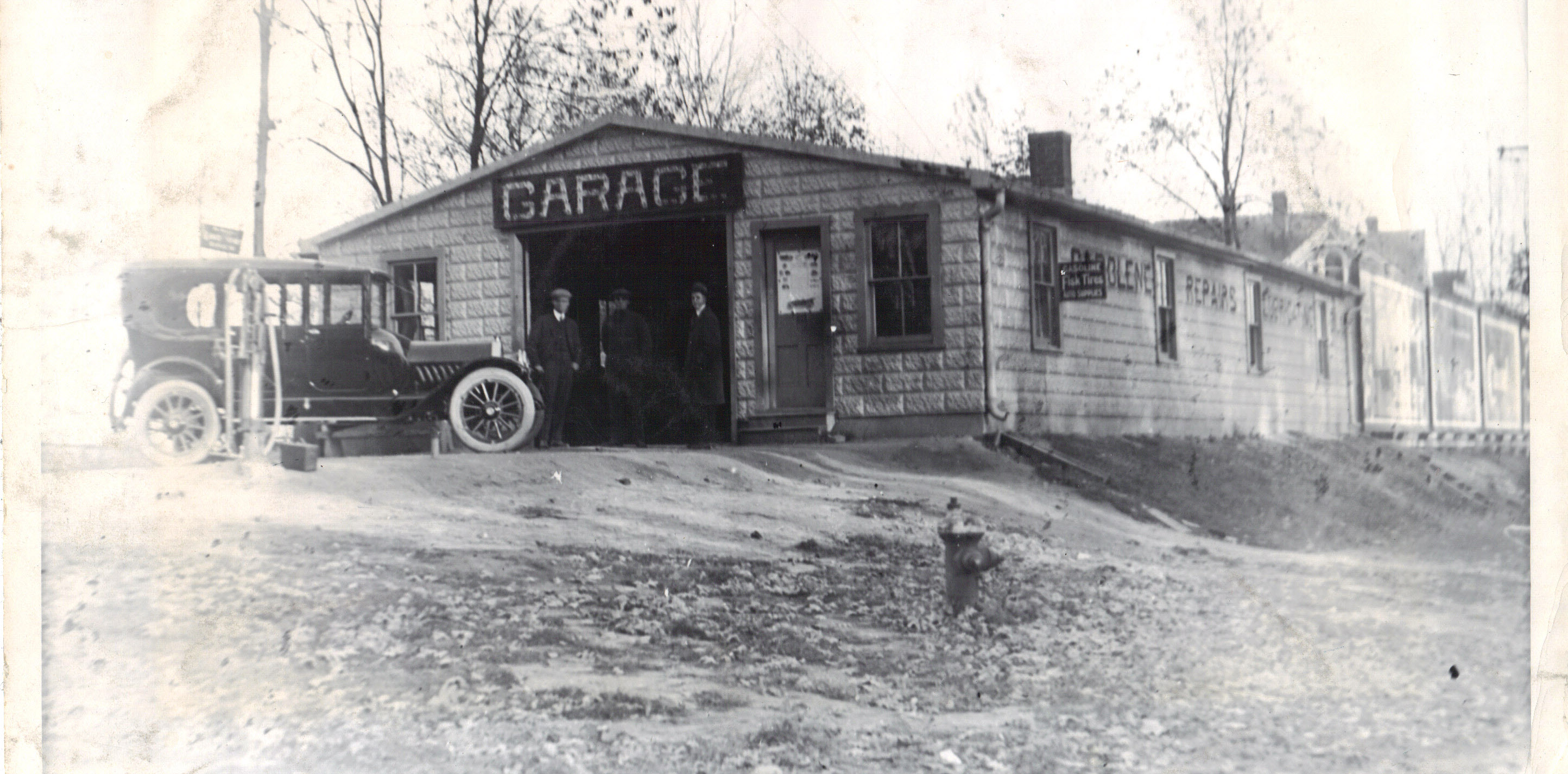
This photograph of the original 1916 Rockville Garage shows a 1916 model 44 Oldsmobile with V8 and sedan body parked in front. The original owners of Rockville Garage are standing in front. From left: Roy Warfield – Lewis Reed – Griffith Warfield.
Below is new car showtime as fair-goers get their first glimpse at the latest models that Rockville Garage had to offer. Identified by the triangle logo on the grill and the number of passengers seated in it, the car below appears to be a 1918 Hudson Super Six Seven Passenger Touring.
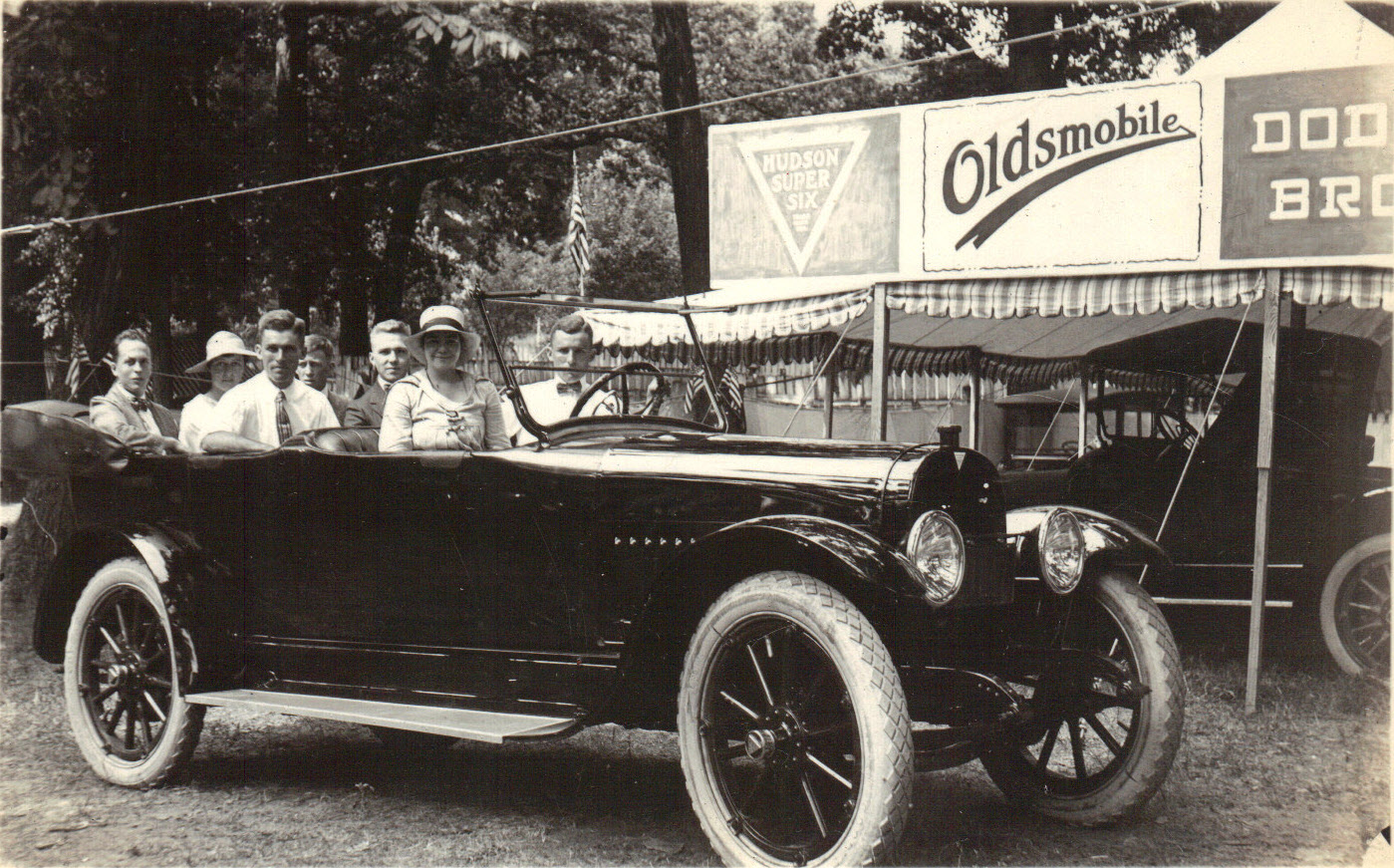
Anybody for a demonstration drive? 1918 Hudson Super Six Seven Passenger Touring
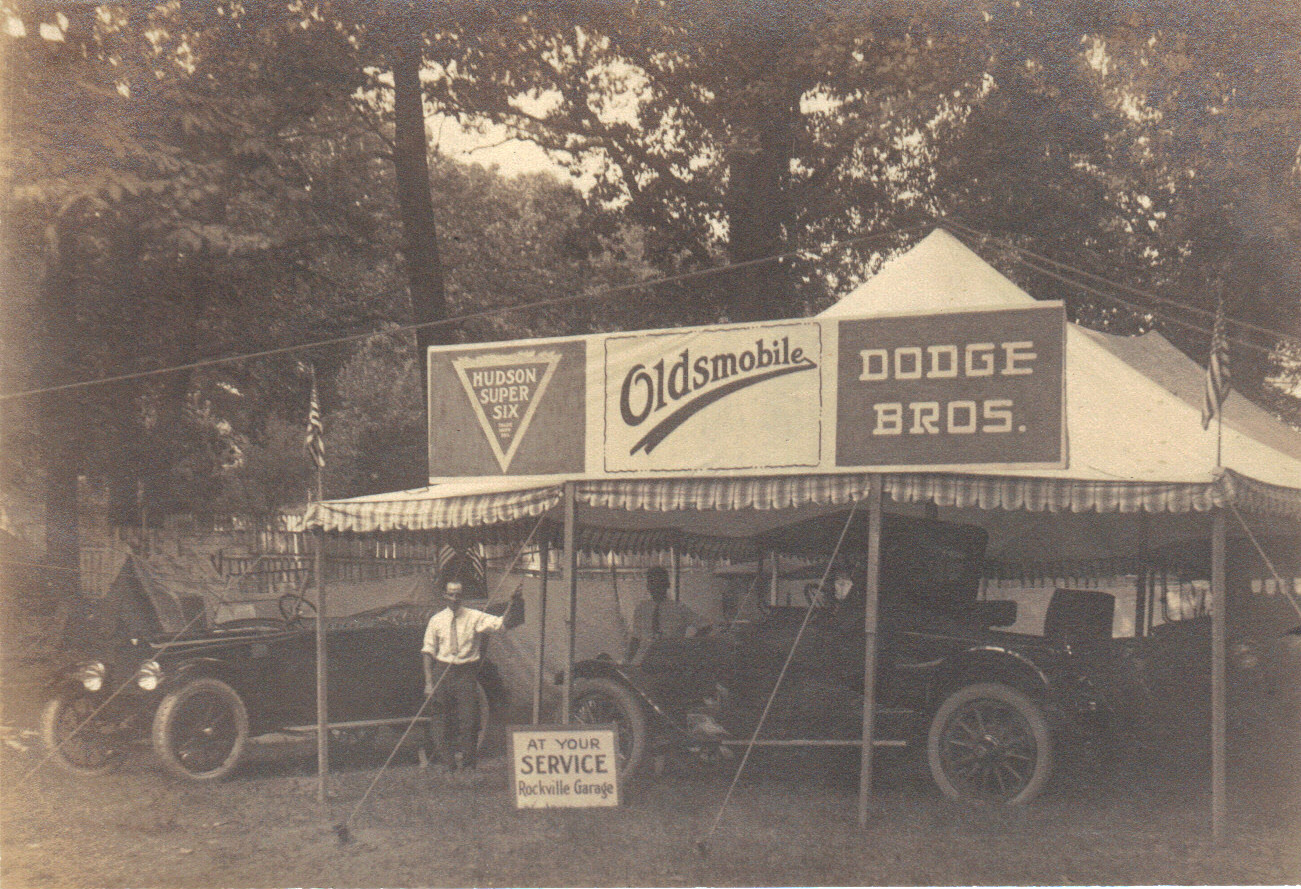
Hudson Super Six, Oldsmobile, and Dodge Brothers Motor Cars on display
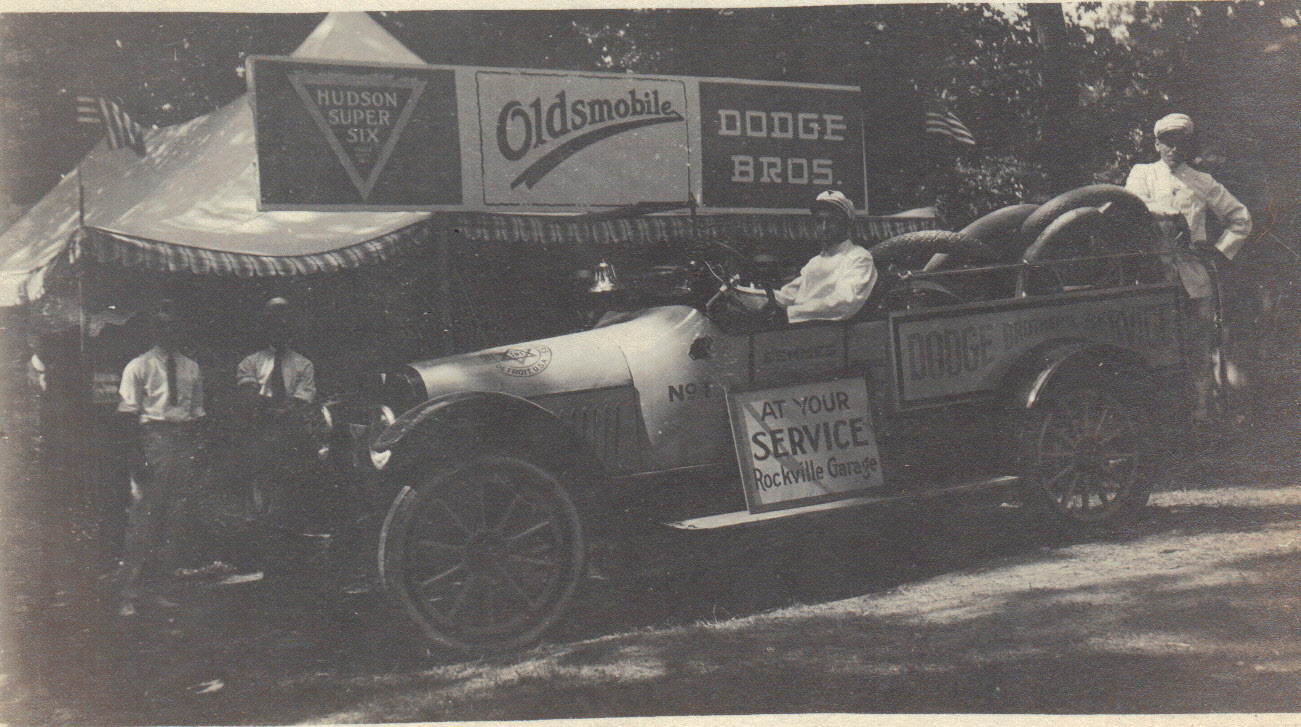
Rockville Garage, 1918 – Hudson Super Six, Oldsmobile, and Dodge Brothers Motor Cars on display at Rockville Fairgrounds. Lewis Reed is seated in the drivers seat of the Rockville Garage Service Truck.
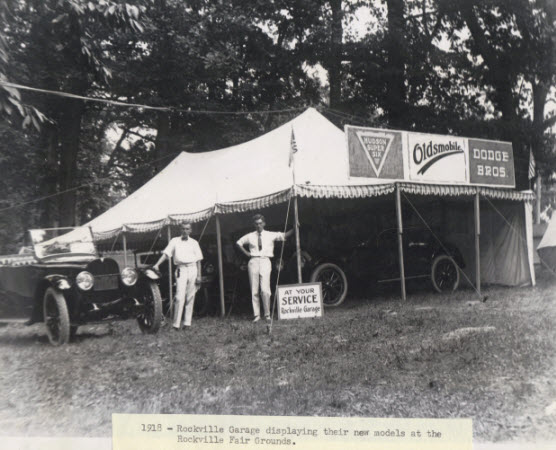
1918 Rocvkille Fair Grounds
The first advertisement below, distributed by the Oldsmobile Sales Company in the Sunday, June 29, 1919 edition of The Washington Post is probably one of the first ads in which the Rockville Garage appeared. Dealers are listed in fine print at the bottom: note Rockville Garage, Rockville, Md, highlighted in yellow. (click on image to enlarge)

Washington Post 1919
July 4, 1922: First MCPD Posing in Front of Reed Brothers Dodge
This blog entry is posted today to commemorate the anniversary of the Montgomery County Police Department. It was 93 years ago on July 4, 1922 that the MCPD was first established. In those days, Montgomery County was farm country, sparsely populated, automobiles sharing dirt roads with horse-drawn wagons. But it was changing into a proper suburb, and there needed to be a police department.
Posing in front of Reed Brothers Dodge on July 4, 1922 Chief Charles Cooley, center, and his men of the first mounted unit of the Montgomery County Police Force, were on their first day of duty. (click image to enlarge)
The MCPD consisted of five officers and a Chief. Each of the officers was issued a Harley-Davidson motorcycle, a .38 Smith & Wesson handgun, a black jack, law book and was allotted $300.00 a year for the upkeep of their motorcycle.

Pictured left to right: Earl Burdine, Lawrence Clagett, Guy Jones, Chief Charles Cooley, Leroy Rodgers, and Oscar Gaither. Photo by Lewis Reed
Source: Montgomery County, Two Centuries of Change by Jane Sween
Reed Brothers Dodge Featured in Norris-Banonis Calendar
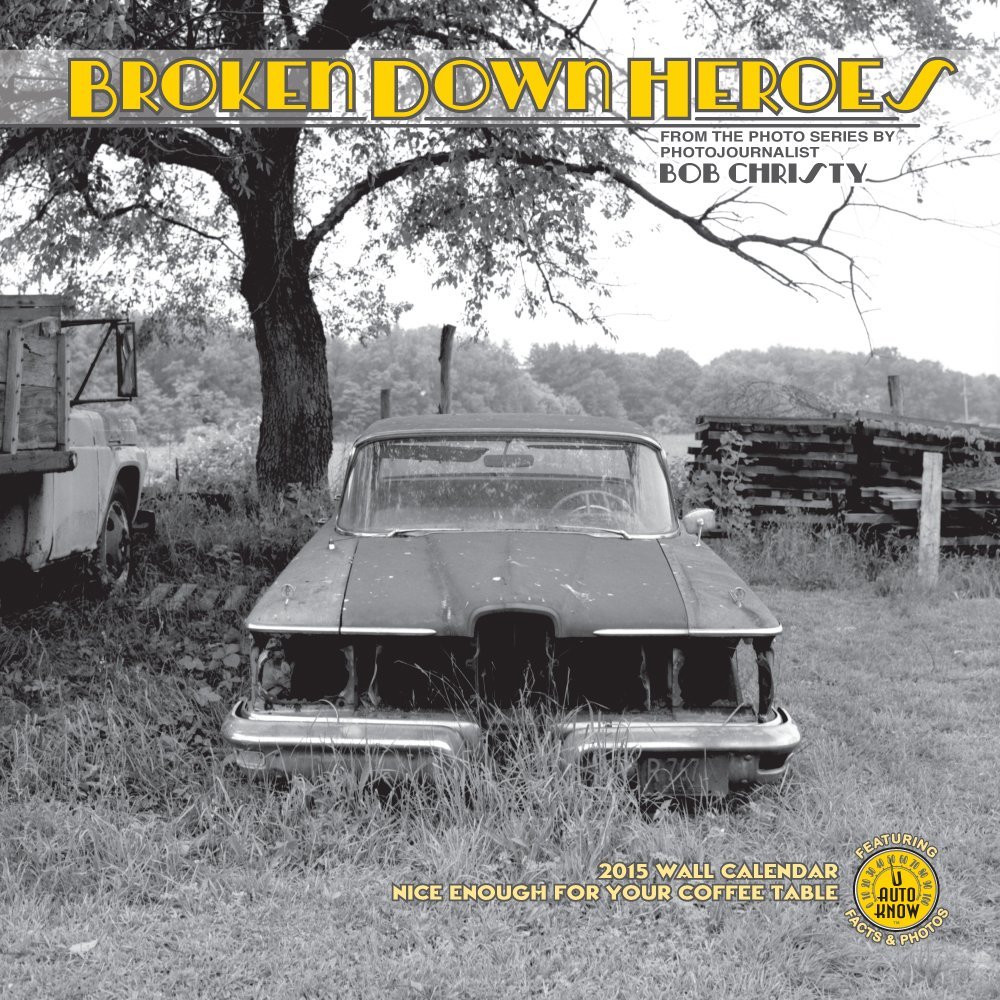 I was delighted to provide Kevin Banonis of Norris-Banonis Group with several photographs that will go into the month of May 2015 wall calendar which features a 1952 Dodge Coronet.
The calendar is entitled, “Broken Down Heroes”, which showcases twelve months of old abandoned, but not forgotten vehicles found in fields across the U.S. The calendar is in high resolution black and white and highlights the artistic nature of the photographs by noted photographer Bob Christy. Also included throughout are significant and unusual dates in automotive history. The inside back cover features a 2-page “The EDSEL is on its way!” photo essay.
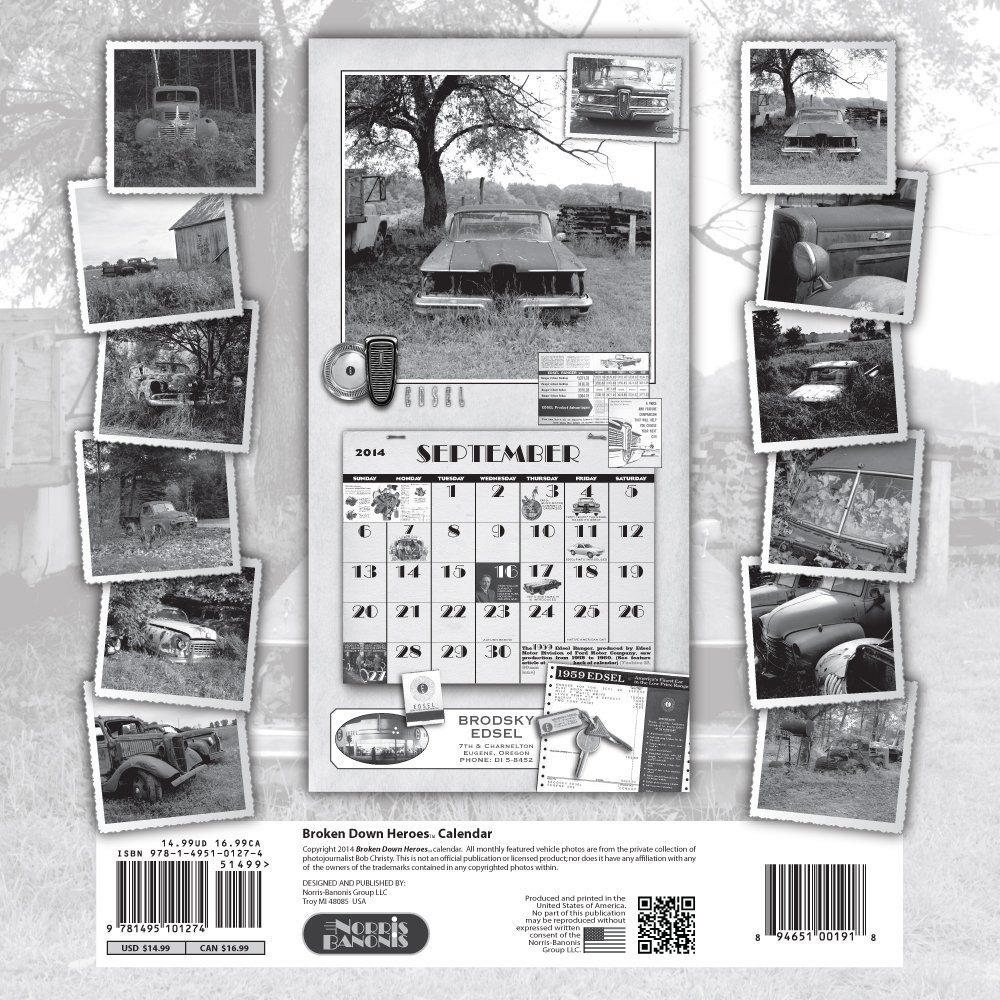
The top part of the calendar features a photograph of Lewis Reed and a snippet of history. At the bottom of the calendar there is a photograph of the 1936 Reed Brothers Dodge canopied Gulf Gas Station and the original 1915 Rockville Garage. (click on image twice to enlarge)
This amazing calendar like no other – it’s more like a coffee table book than a calendar and a must have for old car enthusiasts. The 2015 printed calendar is available now for purchase on norris-banonis.com.

Minivan – How It All Began
 Minivans… you must have heard about them. Back in 1983 — when Ronald Reagan was president — the economy was far from robust and Chrysler was on death’s doorstep (talk about déjà vu). Chrysler needed a home run, and Lee Iacocca, who was running the company at the time, gambled that the first wave of baby boomers who were starting families would likely want something roomier and far more practical than the traditional family hauler, the station wagon.
Mentioning “family car” in 1983 would have conjured up a station wagon. I remember getting carsick while sitting in the rear-facing third row torture chamber, cut off from the rest of the family and their forward-looking vantage point. The tail-gunner position, however, was a great way to test out new hand gestures and making silly faces on following motorists. Do you have any idea how impossible it is to win the alphabet license plate or billboard game when you’re the last one to see everything? I spent many a family car trips never once seeing where we were going, only where we’d been. “Oh, look, there WAS the Bay Bridge. There WAS a bear. There WAS the most incredible thing ever except … whoops, now it’s gone. Too bad.” Indeed, how soon we forget that the minivan, when it debuted 30 years ago, was such a welcome replacement for the station wagon.
Iacocca practically bet the company on the fact that a new automotive segment dubbed “the minivan” — a front wheel drive small van built on the K-car platform — would catch on with the boomers. It was a $660-million gamble, only made possible by money acquired earlier from Washington’s $1.5-billion bailout of Chrysler.
It soon turned out that Iacocca’s gambit wasn’t merely a home run — the Dodge Caravan/Plymouth Voyager turned out to be a bases-loaded grand slam.
On November 2, 1983, the first minivan rolled down the assembly line in Windsor. These 1984 model-year Dodge Caravan and Plymouth Voyager models quickly appeared in dealerships alongside the Dodge Aries and Plymouth Reliant K-cars.Along the way, Chrysler has developed countless minivan firsts and toppled countless competitors that imitated them — and it remains just about the last one standing — as Chrysler just passed its 30th anniversary in the minivan market.
Now that I think about it, maybe facing backward so much during my formative years is why I tend to look backward too much in life and get nostalgic for silly things like rear-facing station wagon seats and minivans.
Sources: Autoevolution & Allpar
Dodge Brothers March
Sing a song of old Detroit, for she’s the flashing, dashing pioneer of motor glory …

Dedicated by Victor Herbert to the Late Mr. Horace E. Dodge in Respectful Appreciation of His Generous Efforts Towards the Advancement of American Music; Published Especially for Dodge Brothers.
I love this march and the history behind it — it is such a typical success story of the early part of the 20th century. The Detroit Symphony Orchestra (DSO) owes much of its prestige to half of the auto-building Dodge Brothers, John and Horace. It was Horace, the more mechanically-inclined of the two — and a decent enough amateur musician, by all accounts — that helped pay for a permanent conductor hired in 1918 to give the symphony world-class status. More importantly, he contributed $150,000 toward the cost of a new concert hall and led the successful fund-raising campaign for the building. Detroit’s Orchestra Hall, which opened in October 1919.
The Symphony was what finally smoothed the way into Detroit high society for Horace. Prior to that, the brothers were repeatedly blackballed — they were hard-drinking brawlers who didn’t much care what other people thought of them. (Their first major success was in manufacturing parts for Henry Ford’s assembly line. John Dodge was asked why the brothers abandoned that lucrative work to make their own cars. “Think of all those Ford owners who will someday want an automobile,” he snarked.) By the time the brothers suddenly died in 1920 — both from complications of the influenza then raging world-wide, although Horace’s condition was precipitously undermined by John’s death—such was their renown that none other than Victor Herbert paid tribute with “The Dodge Brothers March.”
The Dodge Brothers company distributed both the sheet music and, according to one source, 100,000 recordings of the piece.
Below are the lyrics and sound recording (without voice) of the march:
DODGE BROTHERS MARCH LYRICS
From the hills of San Jose San Jose
To the lights of gay Broadway gay Broadway
Sing a song of old Detroit
For she’s the flashing dashing pioneer of motor glory
Born of thunder steel and flame
All the world now hails her name hails her name
Here’s to Dodge and old Detroit
We pledge the glory of their fame
From the hills of San Jose San Jose
To the lights of gay Broadway gay Broadway
Sing a song of old Detroit
For she’s the flashing dashing pioneer of motor glory
Born of thunder steel and flame
All the world now hails her name hails her name
Here’s to Dodge and old Detroit
We pledge the glory of their fame
What better way to tap into the soul of an era than through music?
References:
The Dodge Brothers: The Men, The Motor Cars, And The Legacy
Johns Hopkins University, Levy Sheet Music Collection, Box 075, Item 028
The city of Detroit, Michigan, 1701-1922
Books

Related Resources


Copyright Notice

Reed Brothers Dodge History (1915-2012) by Jeanne Gartner is licensed under a Creative Commons Attribution-NonCommercial 3.0 Unported License.
 Reed Brothers Dodge History 1915 – 2012
Recent Comments