
Early Car Starters: How Did Old Cars Start?

Lewis Reed hand cranking an old car. The hammer in Lewis Reed’s right hand is for straightening the hand crank. Apparently they can bend when starting big engines. The license plate is MD 10307 dated 1913.
Today, we take the starting of automobiles for granted. Simply place the key in the ignition, turn, and VROOM, the engine starts. Vintage cars from from the 1900s and 1910s were comparatively archaic and limited in their mechanical features. Even starting these old relics was difficult because the process involved a number of complicated steps that the driver had to perform in the correct order.
However, this was not always the case. Hand cranks were the most common type of engine starters in the early days of the automobile. Cars in the early parts of the century had to be started by hand. This was accomplished by turning a crank, usually located in the front of the automobile. The driver would literally “crank the engine” by turning the handle, which would allow the process of internal combustion to begin. After a given number of cranks, the engine would begin to run on its own, and the crank could be removed.
Although hand crank starters were simple and reliable, they suffered from a handful of drawbacks. The main issue with this method of starting an engine is that it is inherently dangerous to the operator. For instance, if an engine kicks back during the cranking process, the operator could get TKO’d by the hand crank. Although many of these cranks used overrun mechanism, there was also a potential for injury if the handle continued to turn after the engine started running.
The other main issue with hand crank starters is that it took a certain degree of physical effort to turn them. That meant anyone who lacked the necessary physical strength or dexterity was incapable of starting a vehicle equipped with this type of starter.
By 1920, nearly all manufacturers were producing cars equipped with starters making it easy for anyone, regardless of physical abilities, to start a car by pressing a button mounted on the dash or floor. An ignition on and starter engage switch operated by a key was introduced by Chrysler in 1949.
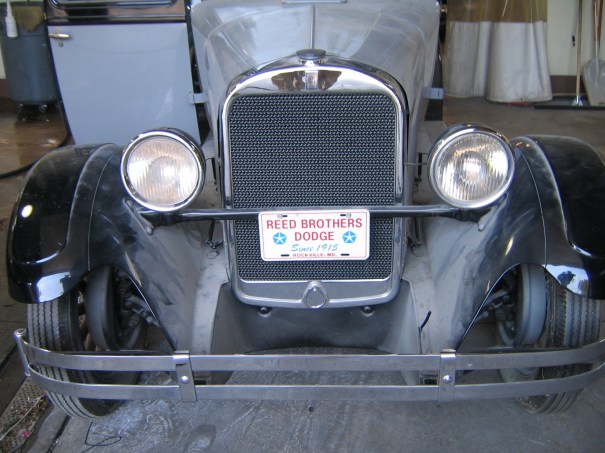
1928 Dodge Brothers Standard Six had both hand crank and starter. I’m assuming the crank was a backup in case the starter failed. The crank hole cover can be seen just below the front grill. Photo by Reed Brothers Dodge
Several new mechanical innovations were included in the 1946 Dodge Deluxe models. Among them were the introduction of the famous Fluid-Drive, a push-button starter system. The dash-mounted button on the 1946 Dodge Deluxe pictured below activated a solenoid, which in turn engaged the starter. For the first time since 1928 there was no provision made to manually hand crank the engine.

The push button starter on this 1946 Dodge Deluxe Fluid Drive was located on the far left, below the instrument gauges. Photo by Reed Brothers Dodge.
47 Years Ago Today: New Facility Grand Opening
 Today marks forty seven years since the Grand Opening of Reed Brothers Dodge new showroom and service facility. When the state widened the roads in 1970, Lee Gartner purchased 4.37 acres of land from Eugene Casey and relocated Reed Brothers Dodge to a new state-of-the-art showroom and Dodge/Chrysler/Jeep service complex on Route 355 at 15955 Frederick Road in Rockville Maryland.
Turning out to honor the company were several hundred dignitaries, officials, businessmen and friends. The new building, a complete automotive sales and service facility marked Reed Brothers 55th year of selling Dodge’s. The state-of-the-art dealership contained the newest customer-focused features throughout which combined technology and comfort.
The new dealership provided a modern new vehicle showroom, 30 service bays, a comprehensive detail and car wash area, Parts Department, Body Shop, the newest technologies to service customer’s vehicles and provided customers with a convenient location to purchase and service their vehicle needs.
Design and construction of the new dealership was managed by the Glen Construction Company.

 Photos taken at the Grand Opening. (click photos to scroll through gallery)


The First Dodge Car
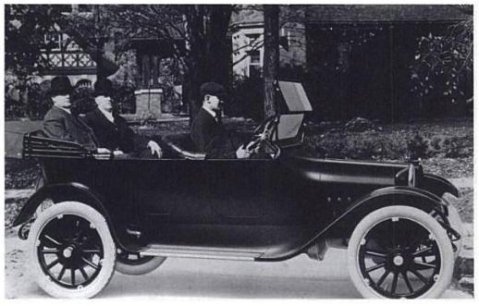
Horace Dodge (left rear) and John Dodge (right rear) in “Old Betsy” in front of John Dodge’s Boston Boulevard home, 14 November 1914.
One hundred and three years ago on this date – November 14, 1914 — the very first Dodge car, “Old Betsy”, rolled off the assembly line. On that day, the Dodge Brothers (Horace and John) were photographed riding in the rear seat of the first car to bear their last name. It cost $785, had a 110-inch wheelbase, and was powered by an L-head 4-cylinder engine that proved so reliable it was continued until 1920 with very little modification. Total production for 1914 was a mere 249 touring cars. The following year, Dodge offered a two-passenger roadster which also sold for $785 and the plant went into full production.
According to “The Dodge Brothers: The Men, the Motor Cars, and the Legacy” by Charles K. Hyde, here’s the full story:
The widely accepted history of the initial production of early Dodge Brothers automobiles in November 1914 is at odds with much of the evidence about the earliest Dodge Brothers cars. Automotive historians have thought that the first production car, later named “Old Betsy,” came off the assembly line at the Hamtramck factory on 14 November 1914. Guy Ameel, superintendent of final assembly for Dodge Brothers since the start of automobile production, served as John and Horace’s chauffeur that day. With the brothers in the back seat, Ameel stopped the first Dodge Brothers car in front of John Dodge’s mansion on Boston Boulevard in Detroit and a photographer recorded this important moment.
“Old Betsy” was more likely an experimental prototype car assembled several months before 14 November 1914 and not a production car at all…
The Dodge Brothers began an aggressive advertising campaign to promote their new automobiles and to attract potential dealers to sell their cars. Lewis Reed was an enterprising young man who put his future in the fledgling automobile industry. In 1915 he received his franchise to sell Dodge Brothers Motor Cars from John and Horace Dodge; less than one year after “Old Betsy” rolled off the assembly line. Lewis Reed and his brother Edgar, were the first to sell Dodge cars in Montgomery County, Maryland. That made Reed Brothers the oldest Dodge dealership under the same family ownership in Maryland, and one of the oldest in the entire nation.
Dodge Made a Car Just for Women
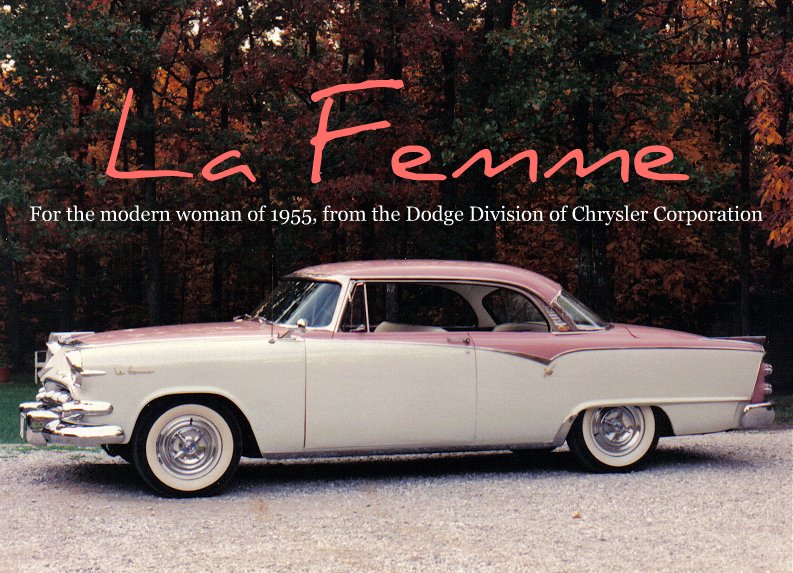 The Dodge La Femme stemmed from Chrysler’s marketing department’s observation that more and more women were taking an interest in automobiles during the 1950s, and that women’s opinions on which color car to buy was becoming part of the decision making process for couples buying an automobile. The La Femme was an attempt to gain a foothold in the women’s automobile market.
Dodge introduced the new La Femme option package in 1955: For $143, you could have the Custom Royal Lancer feminized, with rose paint, gold script, and a nauseating shade of Pepto-pink interior complete with rosebuds.
The accessories which came with the car as standard equipment were where things started getting weird. The car came with a calfskin purse in the same shade of pink as the car’s interior. There was a special compartment behind the passenger seat for this purse, where it could sit with the buckle facing outward. This buckle was large enough for owners to have their name engraved on them, and this is what they were encouraged to do. Inside the purse there was a makeup compact filled with pale pink powder, a lipstick holder, a gold-toned cigarette lighter and case, an imitation tortoiseshell comb, a cigarette lighter, a vanity mirror and silk change purse.
These accessories were all finished in gold-color metal and (you guessed it) pink. For those who wanted them, Dodge also offered an umbrella, boots, a cape (seriously?) and a hat, all matching the seat upholstery.
It went nowhere. La Femme became La Flop. Women stayed away in droves and men weren’t about to be seen driving around in the darling Rosebud. The Dodge La Femme was sold for two years in the U.S. — 1955 and 1956
(Line from a long-lost episode of “Leave it To Beaver”)
“Gee Wally…. all the guys are callin’ me a sissy…. a pink and white car and it says La Femme on the side …. I just can’t be driven to school in mom’s new car anymore …. Yeah, Beave …. I know what ya mean …. that’s why I ride with Eddie …. and besides, mom’s not all that thrilled with the car either!”
Info Source: Dodge La Femme Wikipedia
Reed Brothers Becomes an Original Member of Chrysler
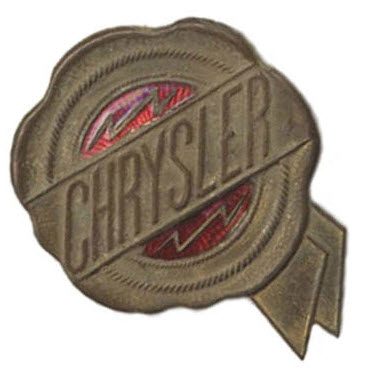
1930s Chrysler radiator “ribbon” emblem
May 28, 1928 marks an important milestone in the history of Chrysler. It was on this day in 1928 that Dodge Brothers, Horace and John Dodge, became a part of Chrysler. It was on this same date that Lewis Reed, founder of Reed Brothers Dodge in Rockville, Maryland also became an original member of the Chrysler family.
During 1920, the Dodge Brothers company lost its founding fathers. John Dodge died in January, and his younger brother Horace succumbed the following December. A New York investment banking firm paid the brothers’ widows, in a single cash payment, $146 million for the Dodge Brothers firm. Within three years, the bankers initiated negotiations, and on May 28, 1928, Walter P. Chrysler purchased Dodge Brothers, Inc. for $170 million, making it, at the time, the largest business transaction in history. When the transaction was complete, the Chrysler Corporation had grown five-fold overnight to become the third of Detroit’s “Big Three” automakers.
The first Plymouth was built in 1928 and Plymouths were sold at Reed Brothers until 1969, when the Plymouth brand was given to the Chrysler dealers.
Books

Related Resources


Copyright Notice

Reed Brothers Dodge History (1915-2012) by Jeanne Gartner is licensed under a Creative Commons Attribution-NonCommercial 3.0 Unported License.
 Reed Brothers Dodge History 1915 – 2012
Recent Comments