
Early Car Starters: How Did Old Cars Start?

Lewis Reed hand cranking an old car. The hammer in Lewis Reed’s right hand is for straightening the hand crank. Apparently they can bend when starting big engines. The license plate is MD 10307 dated 1913.
Today, we take the starting of automobiles for granted. Simply place the key in the ignition, turn, and VROOM, the engine starts. Vintage cars from from the 1900s and 1910s were comparatively archaic and limited in their mechanical features. Even starting these old relics was difficult because the process involved a number of complicated steps that the driver had to perform in the correct order.
However, this was not always the case. Hand cranks were the most common type of engine starters in the early days of the automobile. Cars in the early parts of the century had to be started by hand. This was accomplished by turning a crank, usually located in the front of the automobile. The driver would literally “crank the engine” by turning the handle, which would allow the process of internal combustion to begin. After a given number of cranks, the engine would begin to run on its own, and the crank could be removed.
Although hand crank starters were simple and reliable, they suffered from a handful of drawbacks. The main issue with this method of starting an engine is that it is inherently dangerous to the operator. For instance, if an engine kicks back during the cranking process, the operator could get TKO’d by the hand crank. Although many of these cranks used overrun mechanism, there was also a potential for injury if the handle continued to turn after the engine started running.
The other main issue with hand crank starters is that it took a certain degree of physical effort to turn them. That meant anyone who lacked the necessary physical strength or dexterity was incapable of starting a vehicle equipped with this type of starter.
By 1920, nearly all manufacturers were producing cars equipped with starters making it easy for anyone, regardless of physical abilities, to start a car by pressing a button mounted on the dash or floor. An ignition on and starter engage switch operated by a key was introduced by Chrysler in 1949.
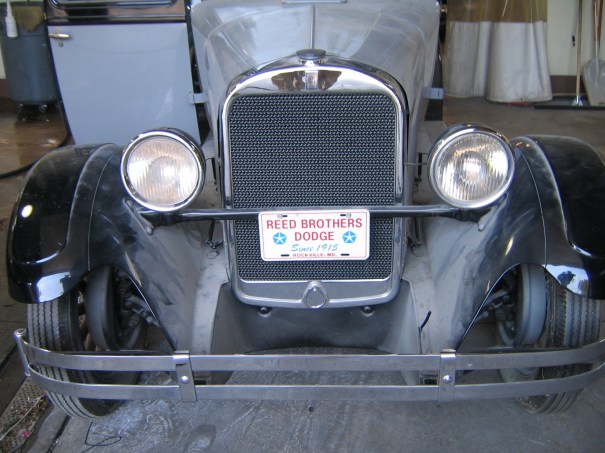
1928 Dodge Brothers Standard Six had both hand crank and starter. I’m assuming the crank was a backup in case the starter failed. The crank hole cover can be seen just below the front grill. Photo by Reed Brothers Dodge
Several new mechanical innovations were included in the 1946 Dodge Deluxe models. Among them were the introduction of the famous Fluid-Drive, a push-button starter system. The dash-mounted button on the 1946 Dodge Deluxe pictured below activated a solenoid, which in turn engaged the starter. For the first time since 1928 there was no provision made to manually hand crank the engine.

The push button starter on this 1946 Dodge Deluxe Fluid Drive was located on the far left, below the instrument gauges. Photo by Reed Brothers Dodge.
The First Dodge Car
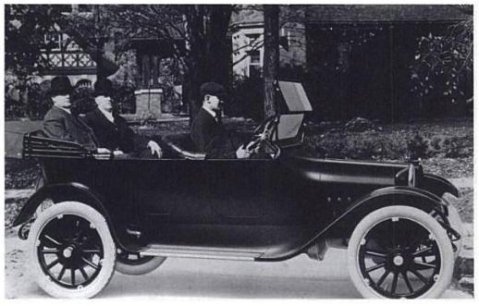
Horace Dodge (left rear) and John Dodge (right rear) in “Old Betsy” in front of John Dodge’s Boston Boulevard home, 14 November 1914.
One hundred and three years ago on this date – November 14, 1914 — the very first Dodge car, “Old Betsy”, rolled off the assembly line. On that day, the Dodge Brothers (Horace and John) were photographed riding in the rear seat of the first car to bear their last name. It cost $785, had a 110-inch wheelbase, and was powered by an L-head 4-cylinder engine that proved so reliable it was continued until 1920 with very little modification. Total production for 1914 was a mere 249 touring cars. The following year, Dodge offered a two-passenger roadster which also sold for $785 and the plant went into full production.
According to “The Dodge Brothers: The Men, the Motor Cars, and the Legacy” by Charles K. Hyde, here’s the full story:
The widely accepted history of the initial production of early Dodge Brothers automobiles in November 1914 is at odds with much of the evidence about the earliest Dodge Brothers cars. Automotive historians have thought that the first production car, later named “Old Betsy,” came off the assembly line at the Hamtramck factory on 14 November 1914. Guy Ameel, superintendent of final assembly for Dodge Brothers since the start of automobile production, served as John and Horace’s chauffeur that day. With the brothers in the back seat, Ameel stopped the first Dodge Brothers car in front of John Dodge’s mansion on Boston Boulevard in Detroit and a photographer recorded this important moment.
“Old Betsy” was more likely an experimental prototype car assembled several months before 14 November 1914 and not a production car at all…
The Dodge Brothers began an aggressive advertising campaign to promote their new automobiles and to attract potential dealers to sell their cars. Lewis Reed was an enterprising young man who put his future in the fledgling automobile industry. In 1915 he received his franchise to sell Dodge Brothers Motor Cars from John and Horace Dodge; less than one year after “Old Betsy” rolled off the assembly line. Lewis Reed and his brother Edgar, were the first to sell Dodge cars in Montgomery County, Maryland. That made Reed Brothers the oldest Dodge dealership under the same family ownership in Maryland, and one of the oldest in the entire nation.
Chauffeur Lewis Reed Drives Pierce-Arrow Limousines

Two ladies with parasols are sitting in the landaulet section of an early Pierce-Arrow limousine, while chauffeur Lewis Reed tends to the motor. The rear portion of the limousine is partitioned from the driver with a glass shield, and covered by a convertible top, which you can see is currently in the lowered position behind the ladies. Ca. 1910
Lewis Reed understood automobiles. He knew how they worked and how to fix them. He loved cars and anything associated with them. Prior to World War I, Lewis Reed’s love of automobiles led him to becoming a chauffeur. Chauffeurs were not only trained to be proficient with their driving skills, but they also had to keep the luxury automobiles in tip top shape which is where his mechanic training – a vital skill in the early days of motoring – would have come into play.
Lewis Reed received his training at the Pierce-Arrow factory at Buffalo, New York, the Dodge Hamtramck and Hudson Motor Car factories in Detroit, Michigan, and the Washington Auto College. Pierce-Arrow was once one of the most recognized and respected names in the automobile industry. For 38 years, the Pierce-Arrow Motor Car Company in Buffalo, New York, produced some of the finest automobiles made.
The photo above would have to date to the time when Lewis Reed drove as a Chauffeur and before he started the Rockville Garage in 1914. Based on the time frame he drove as a Chauffeur and its appearance, the car in the above photo appears to be an early Pierce-Arrow limousine. If you can help to date it and/or identify the model, please leave a comment. The license plate in the photo below is dated 1914, and I would guess the car to be a 1910 – 1911 Pierce-Arrow Model 48.

Chauffeur Lewis Reed (left) in the 1914 photo above poses with an unidentified family and their Pierce-Arrow Model 48.
The earliest car owners had no real repair business to turn to. To be a successful motorist in the early 1900s, you needed to have some sort of mechanical skills. Or you had to find someone who did. Wealthy people employed private chauffeur-mechanics to not only drive, but also maintain and repair their large, expensive automobiles — rather than learn to do it themselves. Chauffeurs would be in charge of everything to do with the owner’s motor vehicle including repairs and maintenance and cleaning this meant that early personal chauffeurs had to be skilled mechanics.
With every car sold was a tool box that had the necessary to tools with instructions on how to dismantle and clean each part of the engine. It was recommended to do so after a certain amount of mileage depending on the make of the car, usually around seven hundred miles. When a tire wore out or was damaged, it was recommended that an expert do it, because it was glued to the rim and it took some doing to get it off. The new tire had to be cut to size for they were not always made to fit.
A mechanical aptitude was also necessary to be a car dealer in the early 1900’s. When cars were shipped to the dealer from the manufacturer, they arrived partially assembled in railroad boxcars. It was the dealer’s responsibility to unpack and assemble the cars at the rail yard and drive them back to the dealership. Mechanics were often needed to repair the new cars if they broke down along the way. During the early years, Reed Brothers represented several franchise nameplates along with Dodge, including Oldsmobile, Hudson and Essex. The Hudson and Oldsmobile were sold at Reed Brothers from roughly 1917 through 1923.
11/14/1914: First Dodge Off Assembly Line
John & Horace Dodge in one of their 1914 Tourers
One hundred and two years ago on this date –November 14, 1914 — the very first Dodge car, “Old Betsy”, rolled off the assembly line. On that day, the Dodge Brothers (Horace and John) were photographed riding in the rear seat of the first car to bear their last name. It cost $785, had a 110-inch wheelbase, and was powered by an L-head 4-cylinder engine that proved so reliable it was continued until 1920 with very little modification. Total production for 1914 was a mere 249 touring cars. The following year. Dodge offered a two-passenger roadster which also sold for $785 and the plant went into full production.
According to “The Dodge Brothers: The Men, the Motor Cars, and the Legacy” by Charles K. Hyde, here’s the full story:
The widely accepted history of the initial production of early Dodge Brothers automobiles in November 1914 is at odds with much of the evidence about the earliest Dodge Brothers cars. Automotive historians have thought that the first production car, later named “Old Betsy,” came off the assembly line at the Hamtramck factory on 14 November 1914. Guy Ameel, superintendent of final assembly for Dodge Brothers since the start of automobile production, served as John and Horace’s chauffeur that day. With the brothers in the back seat, Ameel stopped the first Dodge Brothers car in front of John Dodge’s mansion on Boston Boulevard in Detroit and a photographer recorded this important moment.
“Old Betsy” was more likely an experimental prototype car assembled several months before 14 November 1914 and not a production car at all…
The Dodge Brothers began an aggressive advertising campaign to promote their new automobiles and to attract potential dealers to sell their cars. Lewis Reed was an enterprising young man who put his future in the fledgling automobile industry. In 1915 he received his franchise to sell Dodge Brothers Motor Cars from John and Horace Dodge; less than one year after “Old Betsy” rolled off the assembly line. Lewis Reed and his brother Edgar, were the first to sell Dodge cars in Montgomery County, Maryland. That made Reed Brothers the oldest Dodge dealership under the same family ownership in Maryland, and one of the oldest in the entire nation.
October 1915: The Beginning of a Legacy
Woodrow Wilson was President of the United States; the Green Bay Packers did not yet exist; the United States was two years away from joining World War I; the cost of a stamp was two cents, and Reed Brothers Dodge in Rockville, Maryland was founded.
This is when it all began. It was 101 years ago in October 1915 that Rockville automobile pioneer Lewis Reed, founder of Reed Brothers Dodge, signed a franchise agreement with Horace and John Dodge in Detroit; less than one year after the first Dodge automobile rolled off the assembly line. Since then, the business grew and transformed from a small-scale garage and dealership into one of the largest and most recognized commercial enterprises on Rockville Pike.
This photograph of the original 1915 Rockville Garage shows a 1916 model 44 Oldsmobile with V8 and sedan body parked in front. The original owners of Rockville Garage are standing in front. From left: Roy Warfield – Lewis Reed – Griffith Warfield. (click on photo to enlarge)
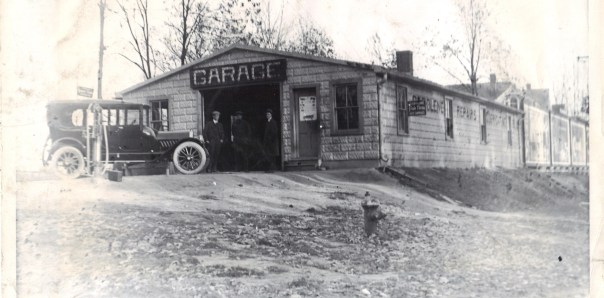
In 1914, Lewis Reed became a partner in Rockville Garage, a business he purchased in 1918. His brother Edgar joined the business in 1919 upon his return from World War I, and the name became Reed Brothers Dodge. Initially, Reed Brothers sold Oldsmobile and Hudson along with Dodge. The first Plymouth was built in 1928 and Plymouths were sold at Reed Brothers from 1930 until 1969, when the Plymouth car was given to the Chrysler dealers. In 1928, when Walter P. Chrysler took over after Horace and John Dodge died, Lewis Reed became an original member of the Chrysler family. By 1929, when the stock market crashed and Great Depression began, nobody could afford to buy cars. Like most other businesses, the Great Depression hit hard and Reed Brothers had to rely on its Service Department to make ends meet.
Reed Brothers faced another setback during World War II. All U.S. car manufacturers stopped production in order to concentrate on military equipment. Reed Brothers had no new cars to sell for three plus years. Many car dealers went bankrupt at this time. Lewis Reed converted his car showroom into a display room and sold GE washing machines and other large appliances. The brothers operated their own full service Gulf gasoline and service station. In fact, the company was the first Gulf gas dealer in the Washington, D.C. area, selling gas at its original location in Old Rockville at the triangle at Veirs Mill Road and Rockville Pike.
The dealership survived two World Wars, the Great Depression, the first Chrysler Bailout, the sale of Chrysler to Daimler and the later sale to the private equity firm Cerberus. Reed Brothers has, in fact, survived everything but Chrysler itself. Regrettably, loyalty was not enough to keep the dealership open when Chrysler cut dealership ranks during their 2009 bankruptcy process. After almost 95 years selling Dodges, Reed Brothers was notified by Chrysler that their franchise agreement would not be renewed. Reed Brothers Dodge occupied two locations, the original at the Veirs Mill Road and Rockville Pike intersection and the second on 355 near Shady Grove Metro.
Today, Bainbridge Shady Grove Metro Apartments pays homage to this history by celebrating the golden era of the automobile with commemorative art on the former site of the iconic Reed Brothers dealership.

Bainbridge Shady Grove Metro Apartments now stands on the former site of the Reed Brothers Dodge dealership at 15955 Frederick Road. But a sculpture now installed on the property pays tribute to the oldest Dodge dealership in Maryland history. More than 20 feet high, and over 6 feet wide, the public art is inspired by 1939 Dodge headlamps, and the fender of a 1957 Dodge pickup truck.
Books

Related Resources


Copyright Notice

Reed Brothers Dodge History (1915-2012) by Jeanne Gartner is licensed under a Creative Commons Attribution-NonCommercial 3.0 Unported License.
 Reed Brothers Dodge History 1915 – 2012
Recent Comments