
Back in Time: Roadside Springs
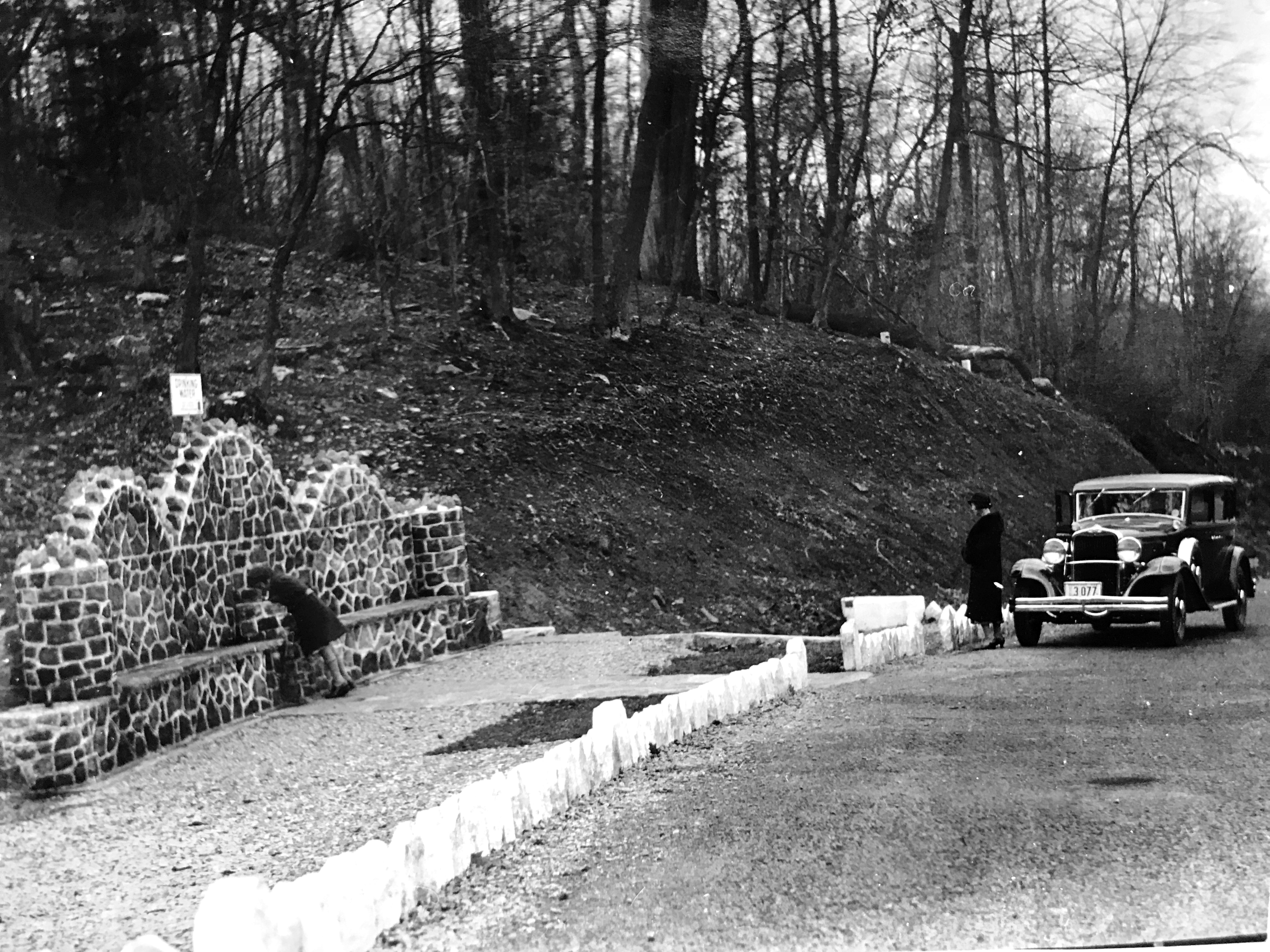
Early 1930s roadside spring. The sign above the wall reads, “drinking water”. Fountains like these were placed along roads to give motorists an opportunity to stop for a drink. The child at the fountain is Lewis Reed’s daughter, Mary Jane, and the woman standing next to the circa 1930s Dodge Sedan is his wife, Ethelene. Photo by Lewis Reed.
Imagine a time when automobiles lacked air conditioning, highway travel was young and life moved at a much slower pace. Back in the day, it was more about the journey than the destination. As better roads allowed motorists to travel increased distances it became apparent that they would need places to stop along the way. The model of place that led to the establishment of waysides and roadside parks was initiated by the traveling public. Stopping sites emerged in rural areas where commercial establishments were not available. Often they appeared in areas of scenic interest or merely in places where there was room for a car to pull off the roadway. These earliest waysides materialized out of necessity, when motorists needed to wanted to stop they pulled off and parked along the roadside.
The photo was taken by Lewis Reed on one of his many cross country road trips. This unknown roadside rest area with water fountain gives us a real sense of a bygone era. We don’t travel like this anymore. Now we’re just trying to get from point A to point B as quickly as possible.
During the 1930s, the State Road Commission was engaged in a program to improve the road infrastructure, which included beautification efforts as well as road paving and bridge construction. Numerous roadside fountains were constructed across the state. No statewide inventory exists.
Books

Related Resources


Copyright Notice

Reed Brothers Dodge History (1915-2012) by Jeanne Gartner is licensed under a Creative Commons Attribution-NonCommercial 3.0 Unported License.
 Reed Brothers Dodge History 1915 – 2012
Recent Comments