
Lewis Reed Photos: Rockville’s First Water Tower

1906 historic view of Rockville Maryland’s first pipestem water tower. (1897-1946)
Photograph by Lewis Reed, founder of Reed Brothers Dodge
This 1906 photograph taken by Lewis Reed depicts Rockville Maryland’s very first water tower. I wanted to share this photograph, because it offers a visual history for its role in the development of public utilities in the City of Rockville. My grandfather picked up the hobby of photography even before automobiles were around. He was a well-known photographer in the county and many of his early photographs are now part of the Montgomery County Historical Society photo archives.

View of Rockville Water Tower and Baltimore Road B&O Railroad Crossing circa 1909. Photo by Lewis Reed
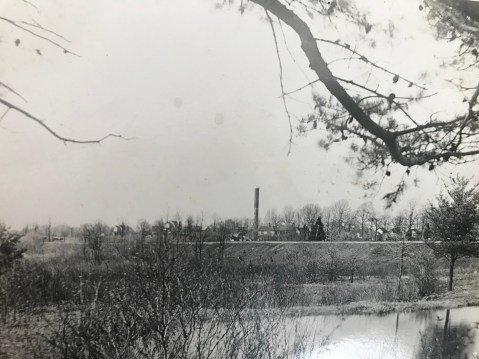
Another view of Rockville Water Tower. Photo by Lewis Reed
The pipestem tower was an element of the 1897 pumping station known as the “Rockville Electric Lights and Water Works,” located in Rockville Park and the future Croydon Park. In the 1890s, Rockville grew both as a resort and as a town. With substantial residential appeal, the need for services grew. In about 1899, Rockville got its first water tower at a cost of about $20,000. Its construction signaled the dawn of local municipal water service. Prior to the tower’s construction water in the city was primarily drawn from private wells. Concern for water quality in the 1880s led to the decision to develop a municipal system. The stand pipe was a typical shape for a water tower at the turn of the century. From this high point, water could be piped throughout the town. The chimney stack originally extended to a height of 50’, as documented in the Sanborn maps 1908, 1915.

Rockville Pump House, circa 1912. Photo by Lewis Reed
Built in 1879, the Pump House at Croydon Park is a historic building in Rockville and the site of the first municipal water supply. Once known as the “Rockville Electric Lights & Water Works.” the building was the City’s first public water system and supplier of electricity for street lights and private homes.
Sources:
National Register of Historic Places, Rockville Pumping Station
Peerless Rockville
Lewis Reed Photos: Rockville High School, 1911
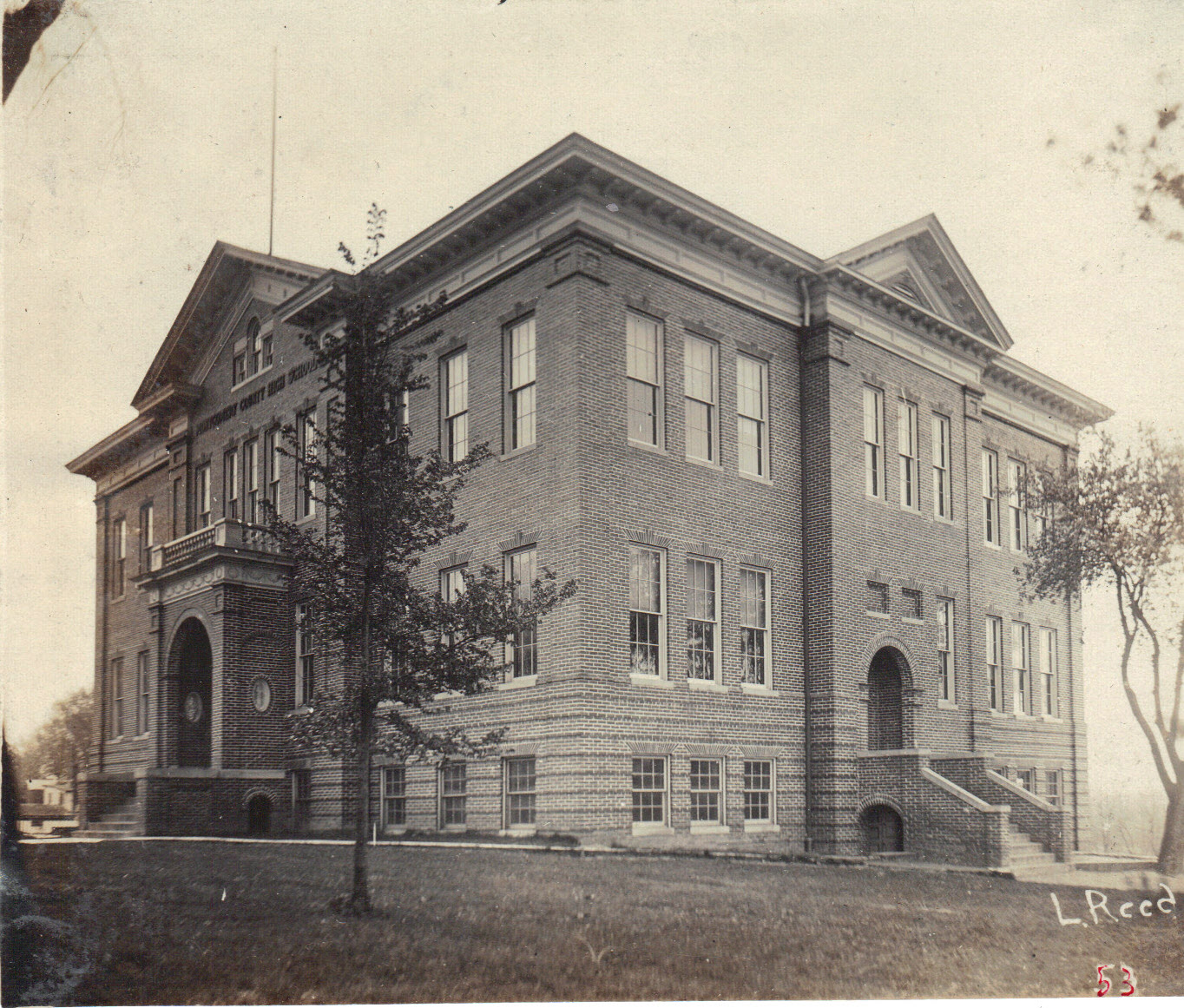
1911 Originally known as Montgomery County High School, later as Rockville High School. Located at corner of Monroe Street and E. Montgomery Avenue. Photo by Lewis Reed
Rockville High School was established in 1892, when the state Board of Education first allocated funds to local school to educate high school students. In the first State report of school statistics nine years later, the Rockville school was listed as enrolling 47 pupils. The first 12 graduates received their diplomas from “Rockville High School” in 1897.

Rockville High School, 1911. Photo by Lewis Reed
A new high school was constructed and opened for use in September 1905 on East Montgomery Avenue and Monroe Street. An addition was built in 1917, expanding the school to 19 classrooms. The school was renamed Richard Montgomery High School 1935.
Source: Richard Montgomery HS – MSA
Lewis Reed Photo: Rockville Courthouse 1914

Red Brick Courthouse 1914. Photo by Lewis Reed
This special post is a part of a new blog feature called, “Rockville’s Past Through the Lens of Lewis Reed”. It doesn’t have anything to do with Reed Brothers Dodge, but it does have a lot to do with it’s founder, Lewis Reed. With photography for a hobby, one that began even before automobiles were around, Lewis Reed had amassed an extensive collection of photographs from historical locations in Maryland, Washington, DC and Virginia.
This photograph was taken by Lewis Reed circa 1914. The Red Brick Courthouse was constructed in 1891 at a cost of $50,000.
Inscription. Montgomery County’s third courthouse. Built in 1891 the “Old Red Brick Courthouse” has become the symbol and architectural monument of old Rockville. Designated a historic building on July 19, 1965 by the Montgomery County Historical Society, Inc.
Featured Photo: Market Street, Frederick, MD circa 1915
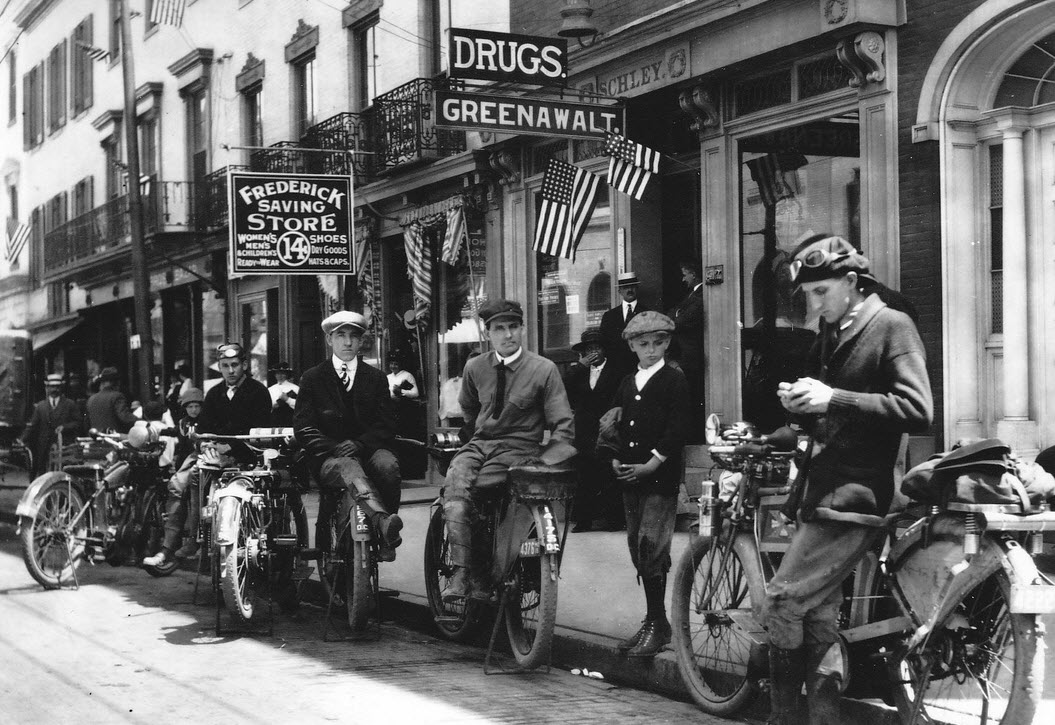
Lewis Reed taking photograph (from left: Lewis Reed’s motorcycle, Edgar Reed, unknown person, Bernard Hanshaw, unknown child, unknown man) in front of Greenawalt Drug Store on Market Street in Frederick, MD circa 1915
Things look pretty quiet in front of Greenawalt Drug Store on Market Street in Frederick, Maryland on this day some 100 years ago. Lewis Reed was not only passionate about automobiles, he also enjoyed riding motorcycles and photography.
In the early days, motorcycles were a staple of transportation, and both Lewis and Edgar Reed rode Harley-Davidson motorcycles. Motorcyclists in the 1900s were more likely to wear a tie and sporty little cap than the leather of today.
Lewis Reed’s Hand-tinted Photos
Before the advent of color photography, photographers painstakingly applied color to black and white photos in order to show a truer visual depiction of a photo image. The hand-tinted photos of Lewis Reed and his daughter, Mary Jane (Reed) Gartner are examples of this medium. The small collection of hand-tinted photographs were taken by Lewis Reed in the early 1900s. The photographs were hand-colored my my mother, Mary Jane (Reed) Gartner.
 Below are hand-tinted photos before and after. Pastel was a good choice for coloration.
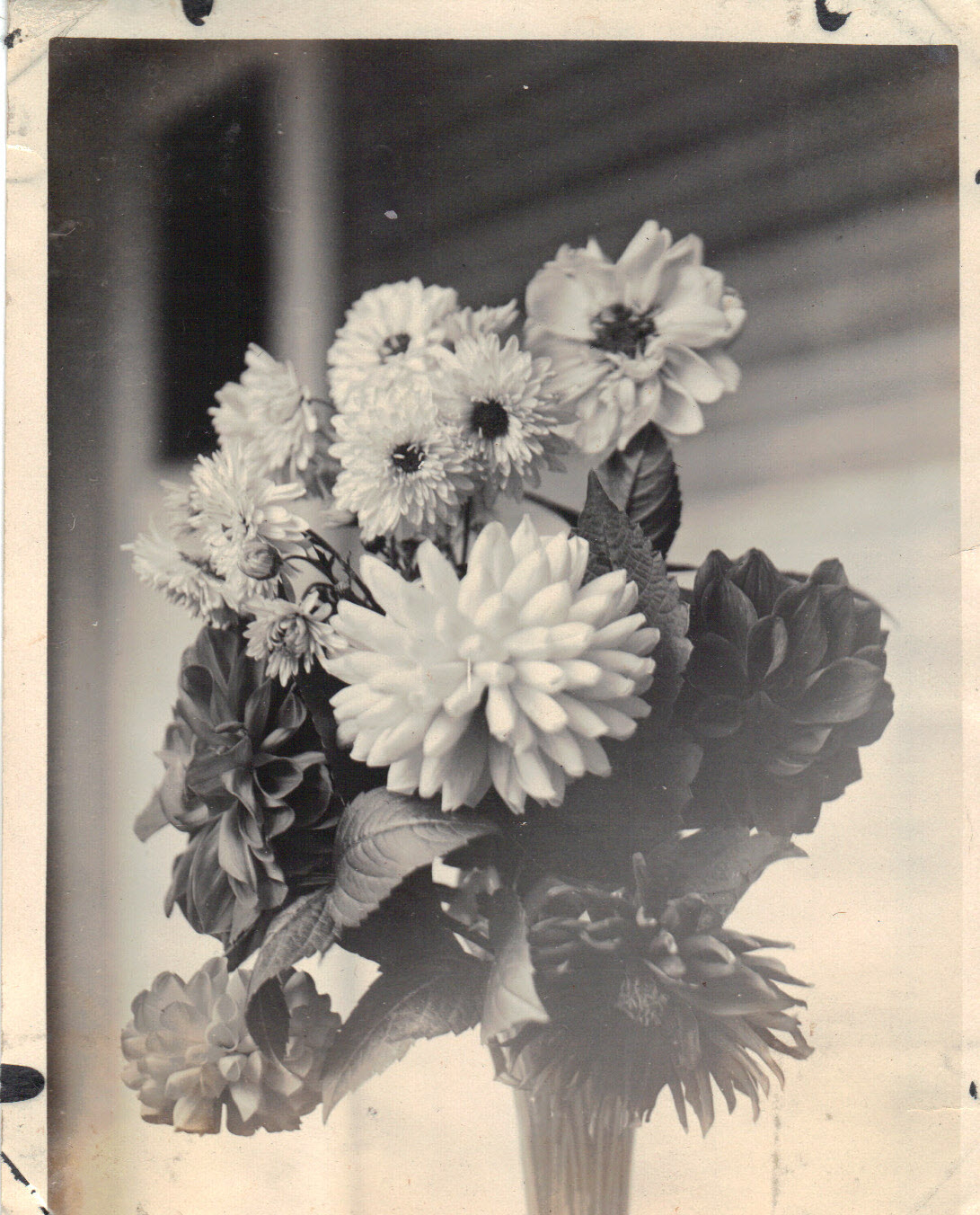
Original photograph by Lewis Reed.

Original photograph by Lewis Reed. The photograph was meticulously tinted by my mother, making it look like a color photo.
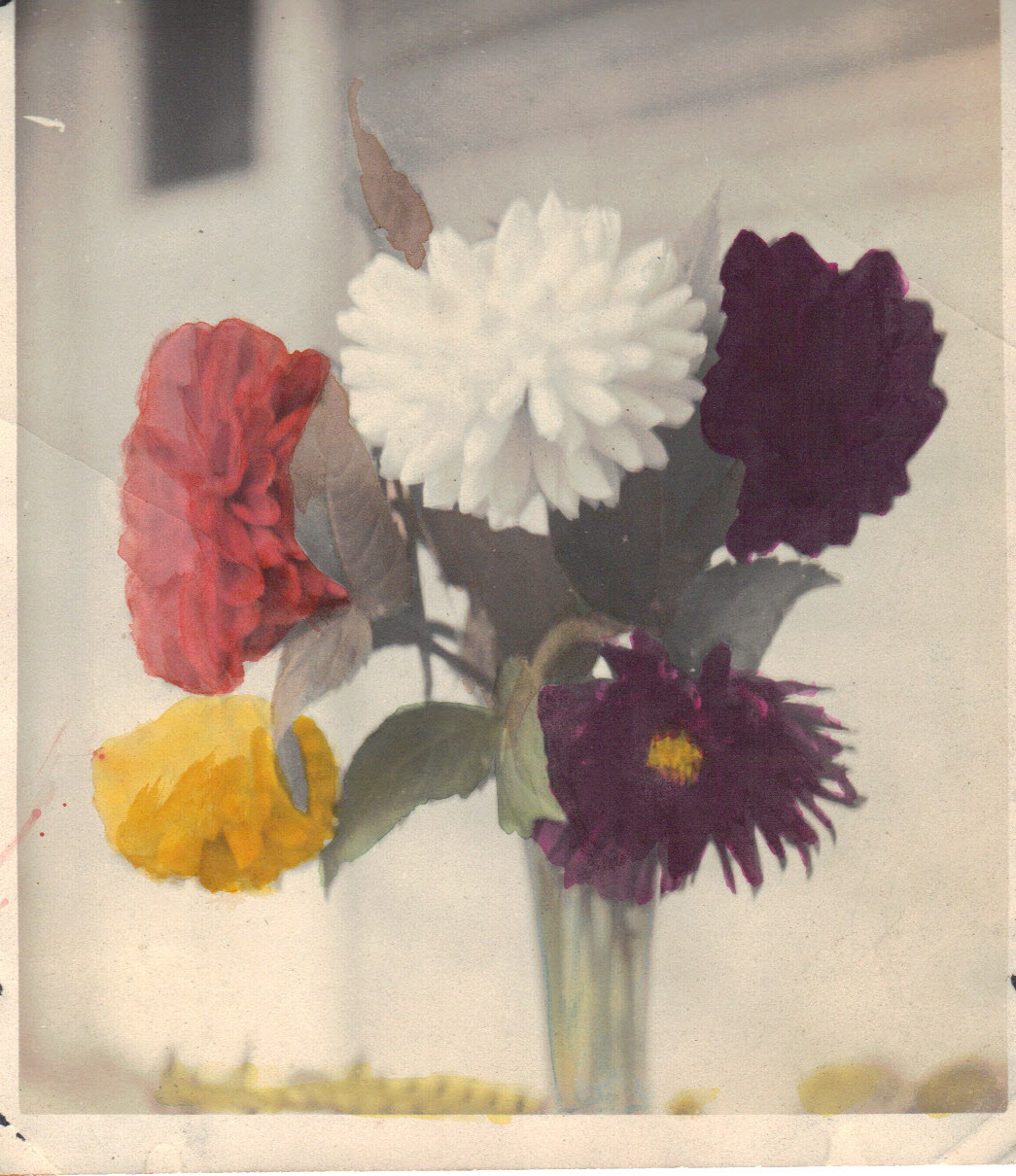
The art of hand tinted photos was introduced along side the daguerreotype in 1839. In the 19th century it was most common for the professional photographer to tint the photograph or tintype just after printing. Later photo artists introduced new techniques using oil, watercolor and other types of paint to achieve the desired result. With the Great Depression, the sale of professional hand tinted photographs declined, but the home artist continued to have access to hand tinting kits. There is a very informative wiki article here which provided me with the brief details I have shared with you.
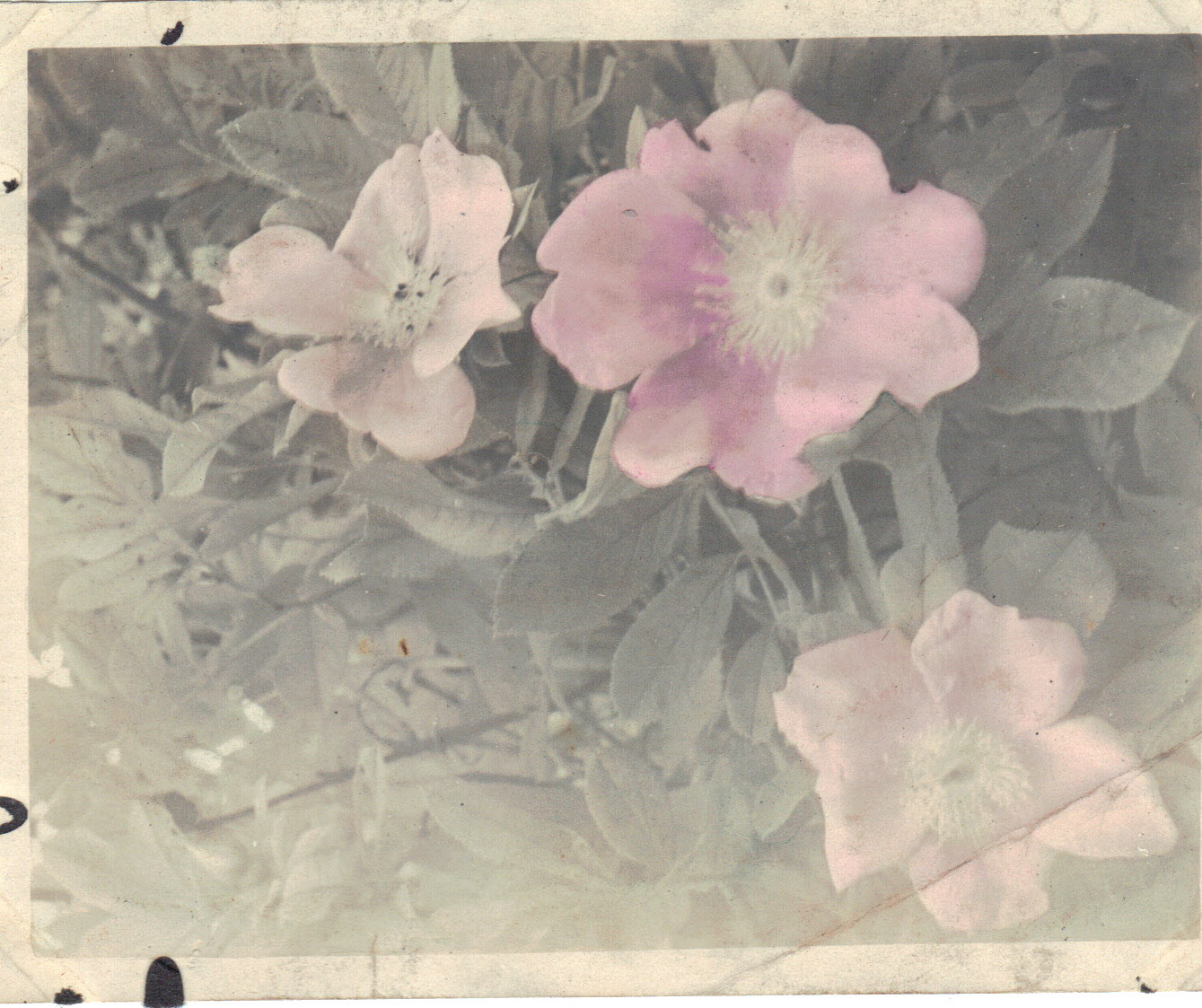 These days, most people rely on Photoshop to digitally make such enhancements. Progress, you know …
Books

Related Resources


Copyright Notice

Reed Brothers Dodge History (1915-2012) by Jeanne Gartner is licensed under a Creative Commons Attribution-NonCommercial 3.0 Unported License.
 Reed Brothers Dodge History 1915 – 2012
Recent Comments