
July 4, 1922: First MCPD Posing in Front of Reed Brothers Dodge
This blog entry is posted today to commemorate the anniversary of the Montgomery County Police Department. It was 94 years ago on July 4, 1922 that the MCPD was first established. In those days, Montgomery County was farm country, sparsely populated, automobiles sharing dirt roads with horse-drawn wagons. But it was changing into a proper suburb, and there needed to be a police department.
Posing in front of Reed Brothers Dodge on July 4, 1922 Chief Charles Cooley, center, and his men of the first mounted unit of the Montgomery County Police Force, were on their first day of duty. (click image to enlarge)
The MCPD consisted of five officers and a Chief. Each of the officers was issued a Harley-Davidson motorcycle, a .38 Smith & Wesson handgun, a black jack, law book and was allotted $300.00 a year for the upkeep of their motorcycle.
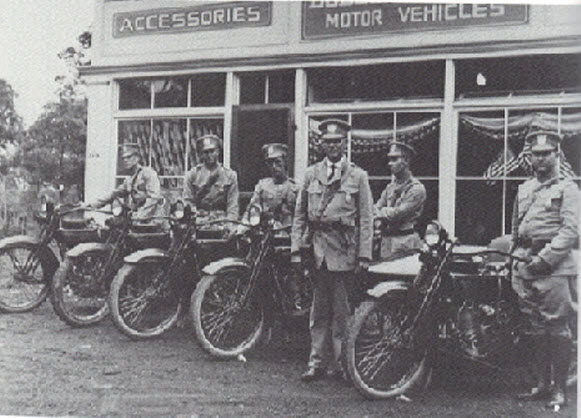
Pictured left to right: Earl Burdine, Lawrence Clagett, Guy Jones, Chief Charles Cooley, Leroy Rodgers, and Oscar Gaither. Photo by Lewis Reed
Lewis Reed Photos: Steam-Powered Engines
Looking back at photography from the past is a fascinating experience for me. Since I started this blog, I have had the opportunity to look through my grandfather’s extensive collection of photographs from locations all across the country. The majority of his photos are more than 100 years old and, unfortunately, are lacking labels and/or dates, which requires quite a bit of research and a little photo detective work on my part. Adding up the clues can help solve the mystery, date, and help identify the images. Google sometimes surprises me with its capabilities.
The below previously unpublished photos (dated 1909) from Lewis Reed’s album are what appears to be some of the early machines that helped build America. Steam traction engines, or steam rollers and road locomotives as they were sometimes called, were the predecessor to today’s modern farm tractor. They could plow, they could haul, and you could put a big belt on the fly wheel and drive a saw mill; whatever you wanted to do. They were also used as a transportable power source. The engines would normally run on coal, wood, or even straw, or whatever would build a fire. The photos shown here were dated 1909.

1909: SAWMILL POWERED BY STEAM TRACTION ENGINE – photograph by Lewis Reed
As a Michigan farm boy, Henry Ford recorded his first sight of a traction engine: “I remember that engine as though I had seen it only yesterday, for it was the first vehicle other than horse drawn that I had ever seen. It was intended to drive threshing machines and power sawmills and was simply a portable engine and a boiler mounted on wheels.” It was the steam traction engine that inspired Ford to design and manufacture automobiles.
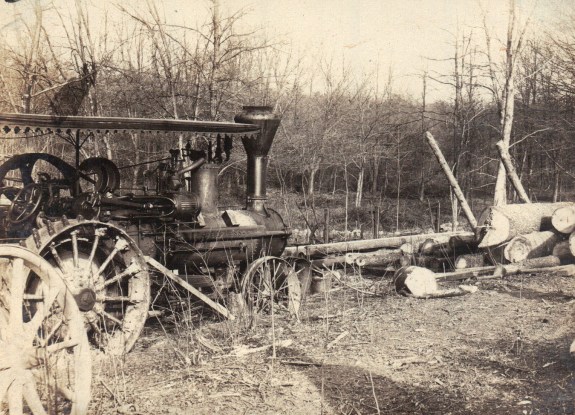
1909: SAWMILL POWERED BY STEAM TRACTION ENGINE – photograph by Lewis Reed
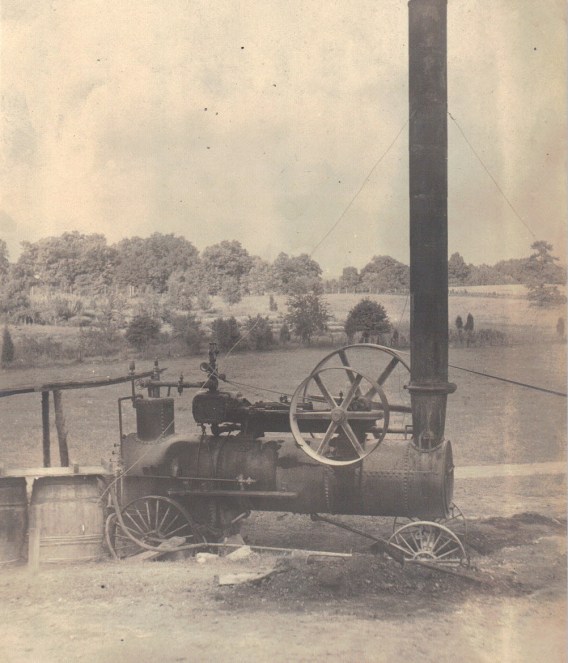
PORTABLE ENGINE WITH CHIMNEY SHOWING THE LACK OF SELF-DRIVEN WHEELS – photograph by Lewis Reed
A portable engine is a type of self-contained steam engine and boiler combination that may be moved from site to site. Although bearing a strong family resemblance, in both appearance and (stationary) operation, the portable engine is not classed as a traction engine as it is not self-propelled.

STEAM ROAD ROLLER – photograph by Lewis Reed
Steam Road Roller: This take-off of the steam traction engine was designed specifically for road building and flattening ground mimicking today’s modern rollers used for compacting road surfaces. A single, heavy roller replaced the front wheels and axle and a smoother rear wheels replaced larger wheels without strakes. (strake – name for the diagonal strips cast into or riveted onto the wheel rims to provide traction on unmade ground).
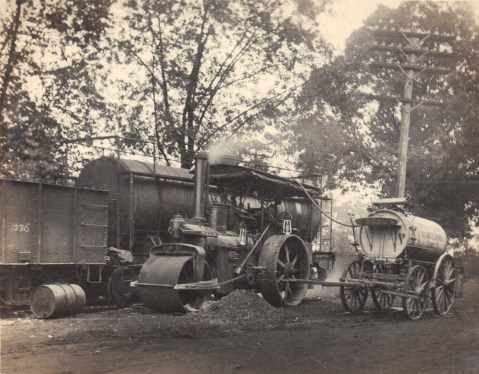
STEAM ROAD ROLLER – photograph by Lewis Reed
Photos cannot convey the raw power of a steam tractor: the way its pistons, valves, gears, and wheels are locked in constant motion. You really have to see this machinery in action.
Watch video of a 1916 Case steam engine tractor power a sawmill.
Road Tripping in a 1935 Dodge Touring Sedan

Lewis Reed’s 1935 Dodge Touring Sedan. Photo by Lewis Reed
This photograph was taken by Lewis Reed on one of his many cross country road trips. The car is a 1935 Dodge Touring Sedan with Maryland Dealer license plates. Note the rear-hinged “Suicide Door” in the photo below. Cars of this era did not have seat belts, so there was nothing to hold a passenger in the car. The term “suicide doors” was therefore placed on vehicles with the rear-hinged door configuration, the theory being that the forward motion of the car could cause the door to fly open, possibly causing the unlucky person sitting next to the door to be pulled out of the car, or the door itself could be ripped from its hinges.

I have no idea what prompted my grandfather to take a photo at this location, but perhaps it was the amazing view in the background. Photo by Lewis Reed
April 6, 1936 Gainesville GA Tornado: Through the Lens of Lewis Reed
One of the deadliest tornadoes in American history hit Gainesville, Georgia on April 6, 1936. And Lewis Reed was there to capture the aftermath. On the 80th anniversary of this epic tornado, I have posted seven original snippets of history that Lewis Reed captured through the lens of his camera that day.
In 1936, two F4 tornadoes tore through the heart of town destroying much of the business district and the county courthouse, trapping hundreds in debris, before moving on to surrounding neighborhoods. The funnel fueled fires all over the area, including the Cooper Pants manufacturing company, where 60 employees were killed. The storm left more than 200 dead, 1,600 injured, 2,000 homeless and millions of dollars in damage. President Franklin Roosevelt toured the city three days later, and returned in 1938 to rededicate the courthouse and city hall after a massive citywide rebuilding effort.
Take a look at some of the sobering aftermath photos of the deadliest tornado to ever hit Georgia … through the lens of Lewis Reed. (click on images for slide show)


Source: Wikipedia – 1936 Tupelo–Gainesville tornado outbreak
Lewis Reed Photo: 1911 Speedwell Touring

Two ladies posing in a 1911 Speedwell Touring car. Photo by Lewis Reed
One of the things I enjoy doing is looking through all of the old photographs in my grandfather’s albums and trying to figure out who and what they are. Unfortunately, the majority of the photos are more than 100 years old and do not come neatly labeled on the back with names, dates, people or places. Anyway, I came across this cool looking car and thought it would be fun to try and identify it, so I went on a quest. The only real clue I had to go on was the “S” on the front of the car.
After some digging, my research has identified the car as a circa 1910 or 1911 Speedwell Touring car — pictured just below is a fully restored 1911 Speedwell Series 11 50HP. Looks the same to me. What do you think?

Fully restored 1911 Speedwell Series 11 50HP. In 2011, this car was offered for sale at auction. It was estimated to sell for $195,000-$225,000 but bidding fell short of the estimate and left the auction unsold.
The Speedwell Motor Car Company was an early United States automobile manufacturing company that produced cars from 1907 to 1914. In 1910, the Speedwell cars and the Wright aircraft were produced in the same factory building. Powering the cars was a Speedwell four-cylinder motor that offered 50 horsepower, making it more than capable of sustaining high speeds. The exterior designs of the Speedwell automobiles were inspired from multiple parts of the automotive industry. Speedwell declared bankruptcy in 1915.
Source: Wikipedia – Speedwell Motor Car Company
Books

Related Resources


Copyright Notice

Reed Brothers Dodge History (1915-2012) by Jeanne Gartner is licensed under a Creative Commons Attribution-NonCommercial 3.0 Unported License.
 Reed Brothers Dodge History 1915 – 2012
Recent Comments