
Then & Now: Georgetown University and Potomac Aqueduct Bridge 100 Years Apart
Washington DC has a lot of history. The Smithsonian museums, the monuments, etc., but it is interesting to see just how much the city has changed over the years. I thought it would be fun to revisit an historic location using one of Lewis Reed’s original photographs for “then” and a stock image from today for “now” to see what differences are visible. In the following photographs, you can see how Washington, DC looks both the same and completely different from a century ago.
Georgetown University and Aqueduct Bridge (THEN): The Key Bridge was not the original connector between Georgetown and Virginia. Prior to that construction in the 1920s, there were two iterations of the Aqueduct Bridge. The second iteration of the bridge looked visibly different, but even that one suffered from deterioration and was only used between 1889 and 1918. The Aqueduct Bridge continued as a bridge for traffic until the Key Bridge opened in 1923.
Seen in the black & white photograph taken by Lewis Reed in 1913, is the Aqueduct Bridge over the Potomac River in Washington, DC. The spires of buildings at Georgetown University can be seen in the background.
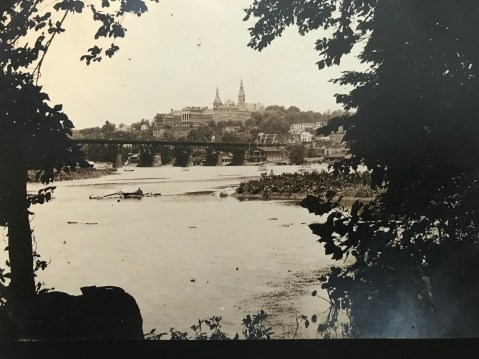
Potomac Aqueduct Bridge Washington DC 1913. Photo by Lewis Reed
Georgetown University and Key Bridge (NOW): The same view over a century later hasn’t changed much.

Georgetown University and Key Bridge Washington DC today
Historic Montrose School, Rockville (1909)
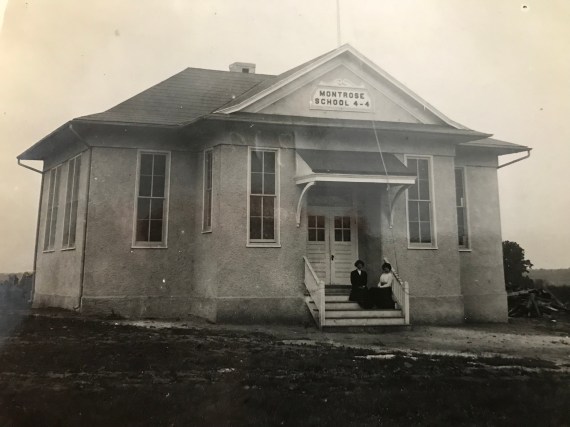
Montrose School, Photo by Lewis Reed, ca. 1909
Completed in 1909, Montrose School was designed as a two room schoolhouse and offered classes for first to seventh grade. Other modern amenities included kerosene hurricane lamps affixed to the walls and pot-bellied coal burning stoves in each classroom; an outside hand pump provided well water, and outdoor boys’ and girls’ rest rooms. Increased modernization, including electricity and indoor plumbing were added throughout the early to middle decades of the 20th century. One hundred students enrolled.
Below, is a photo of teacher and students taken by Lewis Reed circa 1909.
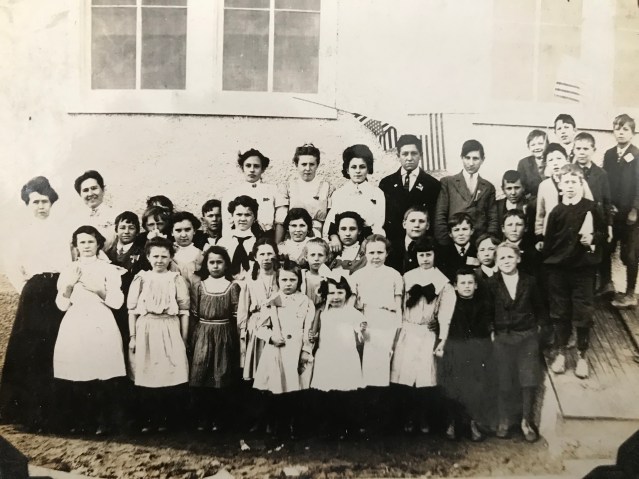
Montrose School Students, Photo by Lewis Reed, ca. 1909
Frederick, Maryland, 1912: Jug Bridge Over the Monocacy River

Motorcyclist waving as he crosses Jug Bridge. Photo by Lewis Reed, ca. 1912
The Jug Bridge was built over the Monacacy River in 1808 at a location a few miles east of Frederick, Maryland. The bridge consisted of two 65-foot spans. The bridge’s name derived from a stone bottle that was situated at the northeastern end of the bridge. There was a legend that an Irish mason accidentally sealed a jug of whiskey inside the stone bottle. Today, the stone bottle sits in a roadside park west of the river.
The bridge collapsed suddenly on March 3, 1942, creating a nightmarish detour for through traffic. A replacement bridge was opened just south of the jug bridge. Click the photos to get a better look at the huge demijohn that guards the entrance.
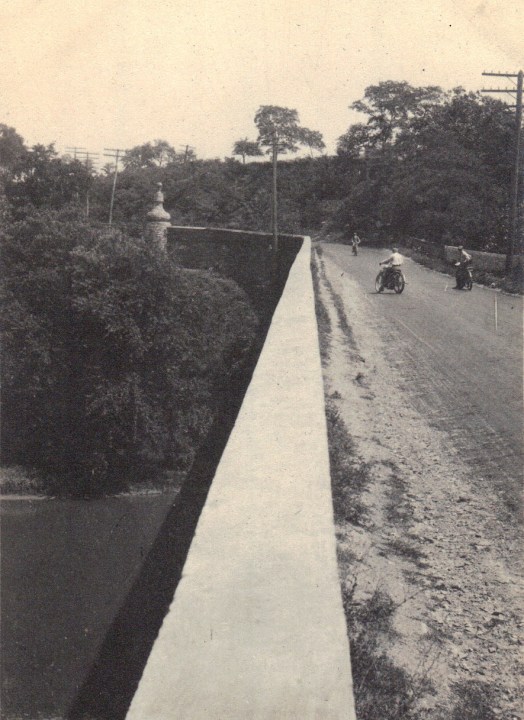
Motorcyclists crossing Jug Bridge. Photo by Lewis Reed, ca. 1912
With the new alignment across the Monacacy River, the stone bottle was dismantled and moved to an interpretive park high on the western bank of river valley. By the way, the bottle was empty – there was no jug of whiskey.
Thomas Hardware Store, Gaithersburg ca. 1928

Thomas Hardware Store, originally built and operated by Thomas I. Fulks. Photo by Lewis Reed, ca. late 1920s
This photo was taken by Lewis Reed when the first system of water mains and sewers were installed by the WSSC in Gaithersburg, circa 1926-1928. The store in the background is the Thomas Hardware Store, originally built and operated by Thomas Iraneous Fulks. The water pipes to be laid are resting by the side of the road. The child on the right in the photograph is Lewis Reed’s daughter, Mary Jane (Reed) Gartner.
T. I. Fulks was a businessman and farmer. He worked as a bookkeeper for the Gaithersburg Milling and Manufacturing Company and then opened a hardware store at 219 East Diamond Avenue.
Source: Gaithersburg: History of a City
Here’s How Rockville’s Trolley Era Looked Over 115 Years Ago
This special post is a collection of early trolley car photos that were taken by Lewis Reed in the early 20th century. Trolleys existed in American cities before the Civil War, but a line did not connect Washington, DC to Rockville, Maryland, until 1900.
The agreement between the town of Rockville and the W&R Railway Co. ran for 35 years. From 1900 to 1935, street cars plied the track from the Washington terminus at Wisconsin and M Streets, N.W., up Wisconsin and then Old Georgetown Road, over a steel trestle just before the cars approached Georgetown Prep, through dense woods at Montrose and onto the Rockville Pike, through Rockville on Montgomery Avenue, to Laird Street, and back again. The cars could be driven from either end. In 1929, W&R ran 24 trips a day between 6:30 a.m. and 12:30 a.m. to connect Rockville and Washington. Major stops along the line included Georgetown, Alta Vista, Bethesda, Montrose, Halpine, the Fairgrounds, Courthouse Square, and Chestnut Lodge. Six switching stations and side tracks enabled street cars to pass as they went in different directions.
Below are a collection of photographs taken by Lewis Reed that shows what the old trolley cars looked like, highlighting what riding the trolley car was like in the early 1900s. From wood-paneled exteriors with ceiling fans to advertisements, here’s a nostalgic look back at Rockville’s Trolley car era through the lens of Lewis Reed. (click on photos to enlarge)

Western Avenue car barn for the streetcars that served the Georgetown-Tenelytown-Bethesda-Rockville line. Photo by Lewis Reed
A car barn is the streetcar equivalent of a garage for buses. It’s a covered facility in which streetcars were stored overnight, cleaned and given light repairs before the next day’s run. The car barn for the trolleys at the time was the second Western Avenue car barn for the streetcars that served the Georgetown-Tenelytown-Bethesda-Rockville line. It was located at on west side of Wisconsin at between Harrison and Jennifer. It was demolished and later replaced by a purpose-built bus garage which is still in use by WMATA. The National Capital Trolley Museum was instrumental in helping to identify the car barn in the photo above.
Leroy King described the street car below as one of Washington Railway’s majestic “Rockville” cars, at 4 switch in 1908. Note multiple unit jumper box under center front window.

Passengers board car #596 heading to Rockville in 1908. These distinctively styled cars, popularly know as ‘Rockville’ cars, were also used on Washington Railway’s Maryland line. Note the ‘people catcher’ or ‘lifeguard’ in the front. Photo by Lewis Reed, 1908
Traveling in snow was sometimes hazardous to trolley cars, as evidenced by the trolley pictured below which derailed the train tracks and plowed into a telephone pole at Montrose Road and Rockville Pike. Lewis Reed was there to capture the accident from two different perspectives using a five-by-four box camera which produced images on a glass plate.
In populated areas, street cars kept speeds to 12 mph (6 mph at intersections), but in open country they could get up to 40 mph.

Derailed trolley at Montrose Road and Rockville Pike. Photo by Lewis Reed
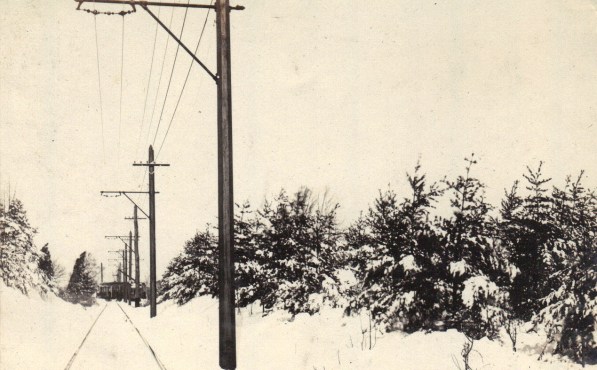
Derailed trolley through dense woods at Montrose Road and Rockville Pike. Photo by Lewis Reed
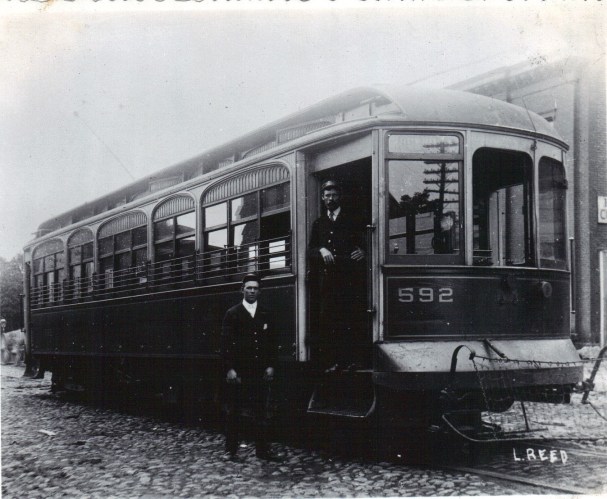
Rockville Trolley Car 592. Photo by Lewis Reed
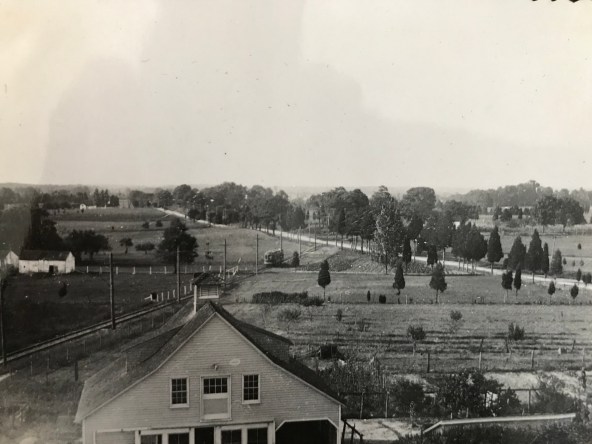
A trolley heads south from Rockville toward Tenallytown through open farmland. This view appears to be looking north and shows the area south of where Montrose Road intersects with Rockville Pike. The Pike is in the background. Photo by Lewis Reed, 1910

Trolley tracks on Rockville Pike south of Sherrer Farm. Note that one of the young men is holding a bicycle. Photo by Lewis Reed, ca. 1911
The Archival Producer for television’s most-watched history series, AMERICAN EXPERIENCE on PBS, found the photograph of the 1920’s trolley interior on this blog and asked permission to use it in the documentary, “The Great War,” a six-hour, three-night event, that premiered April 10-12, 2017 in conjunction with the 100th anniversary of America’s entry into WWI.
All of these prints were originally made from a glass plate negative, an early photographic technique which was in common use between the 1880s and the late 1920s. The early 1900s were considered by many to be the golden era of early photography, because of its new availability to the public and somewhat simplified production methods. Many of Lewis Reed’s early photographs are now part of the Montgomery County Historical Society photo archives.
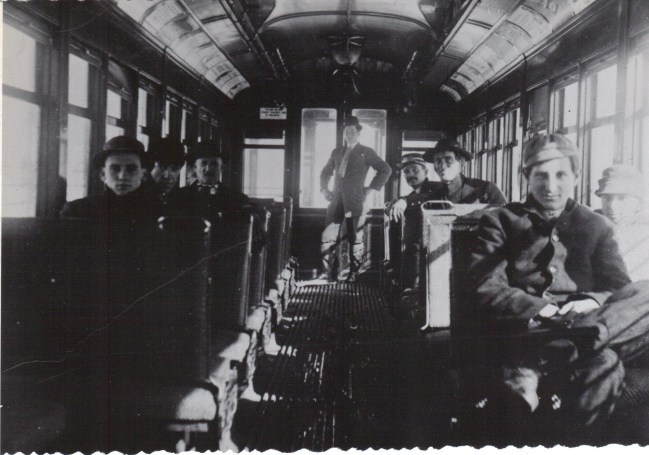
Interior of 1920’s Rockville trolley car. Photo taken by Lewis Reed
Panels for advertising line the edge of the ceiling on both sides of the trolley. Instead of AC, the interiors were cooled with wooden ceiling fans.
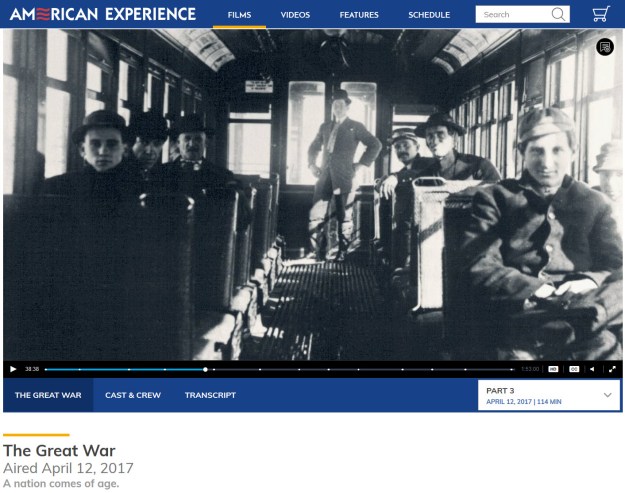
Rare peak of the inside of a 1920’s trolley car and passengers featured in PBS documentary “The Great War”. Photo taken by Lewis Reed
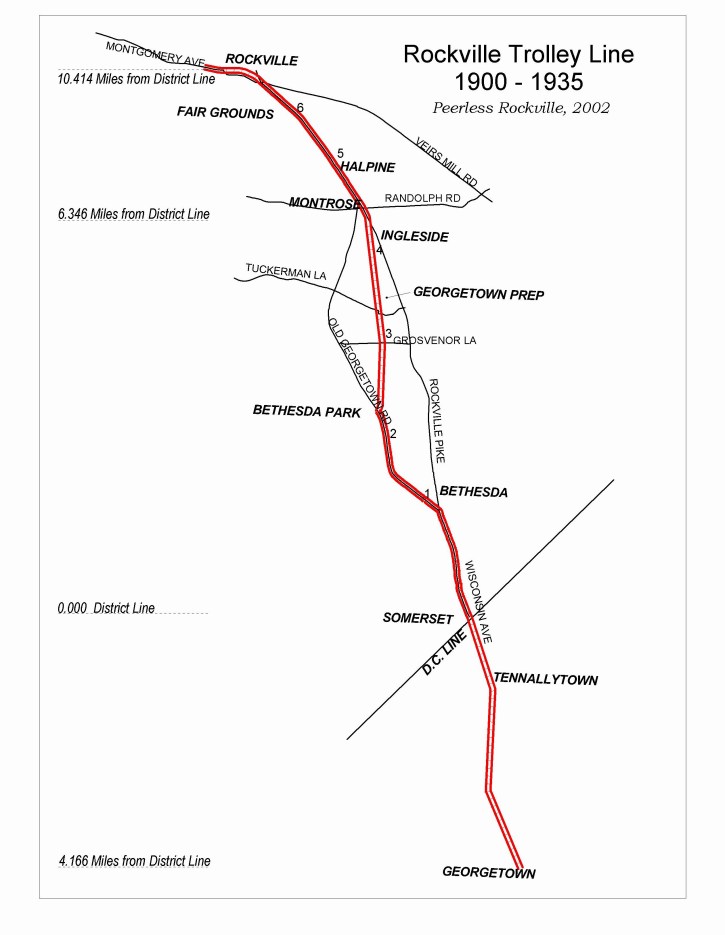
Rockville Trolley Line 1900-1935 – Peerless Rockville 2002
Sources: Rockville Pike History – City of Rockville
History of the Street Car Lines of Montgomery County
Books

Related Resources


Copyright Notice

Reed Brothers Dodge History (1915-2012) by Jeanne Gartner is licensed under a Creative Commons Attribution-NonCommercial 3.0 Unported License.
 Reed Brothers Dodge History 1915 – 2012
Recent Comments