
More Than Just Motors: The Enduring Link Between Reed Brothers Dodge and the MCPD
When you look back at the history of Montgomery County, Maryland, certain names are synonymous with the growth of the region. Reed Brothers Dodge is certainly one of them, but while we are often remembered as the first Dodge dealership in the area, our history is also deeply intertwined with the very foundation of the Montgomery County Police Department (MCPD). This connection wasn’t just about the cars and motorcycles; it was about the people who kept them on the road.

This is the first known photograph of the entire Montgomery County Police Force Motor Unit. Pictured left to right: Earl Burdine, Lawrence Clagett, Guy Jones, Chief Charles Cooley, Leroy Rodgers, and Oscar Gaither. Photo taken by Lewis Reed on July 4, 1922.
The relationship between Lewis Reed and the MCPD began on the department’s very first day of duty: July 4, 1922. On that historic morning, Chief Charles Cooley and his five original officers gathered at Reed Brothers Dodge to have their first official group photo taken. At the time, the department was a “mounted” unit on Harley-Davidson motorcycles. Because modern, branded dealerships didn’t exist yet, Reed Brothers served as a vital hub for sales and service. Lewis Reed and his brother Edgar were motorcycle enthusiasts who had founded Rockville’s Park Avenue Motorcycle Club a decade earlier in 1912, and their expertise made the dealership the natural home for the county’s early fleet. In those early days, each officer was allotted $300 a year for motorcycle upkeep, and our shop was where much of that vital work happened.
As the decades passed and the MCPD grew into a modern force, the need for expert maintenance grew with it. The department eventually established its own internal garage, but they didn’t have to look far to find the best talent to staff it. The “Reed Brothers standard” was so well-regarded that the police garage specifically recruited veteran mechanics from the dealership. By the late 1970s, two of our most skilled technicians, Ben McGowan and John Hall, transitioned from the service bays at Reed Brothers Dodge to work for the Montgomery County Police garage. Ben, an electrical and AC specialist, and John, a Maryland State Inspector and ASE-certified mechanic, brought a wealth of “under-the-hood” knowledge to the county.


This pipeline of talent from the dealership to the public sector highlights a beautiful piece of Rockville history. It shows that Reed Brothers Dodge was more than just a business; it was a training ground for the craftsmen who kept the county moving. When we see photos of those early 1922 officers on their Harleys or hear stories of the police fleet in the decades that followed, we aren’t just looking at machines. We are looking at the legacy of men like Lewis Reed, Ben McGowan, and John Hall– the hands that built, serviced, and supported the safety of our community for over a century.
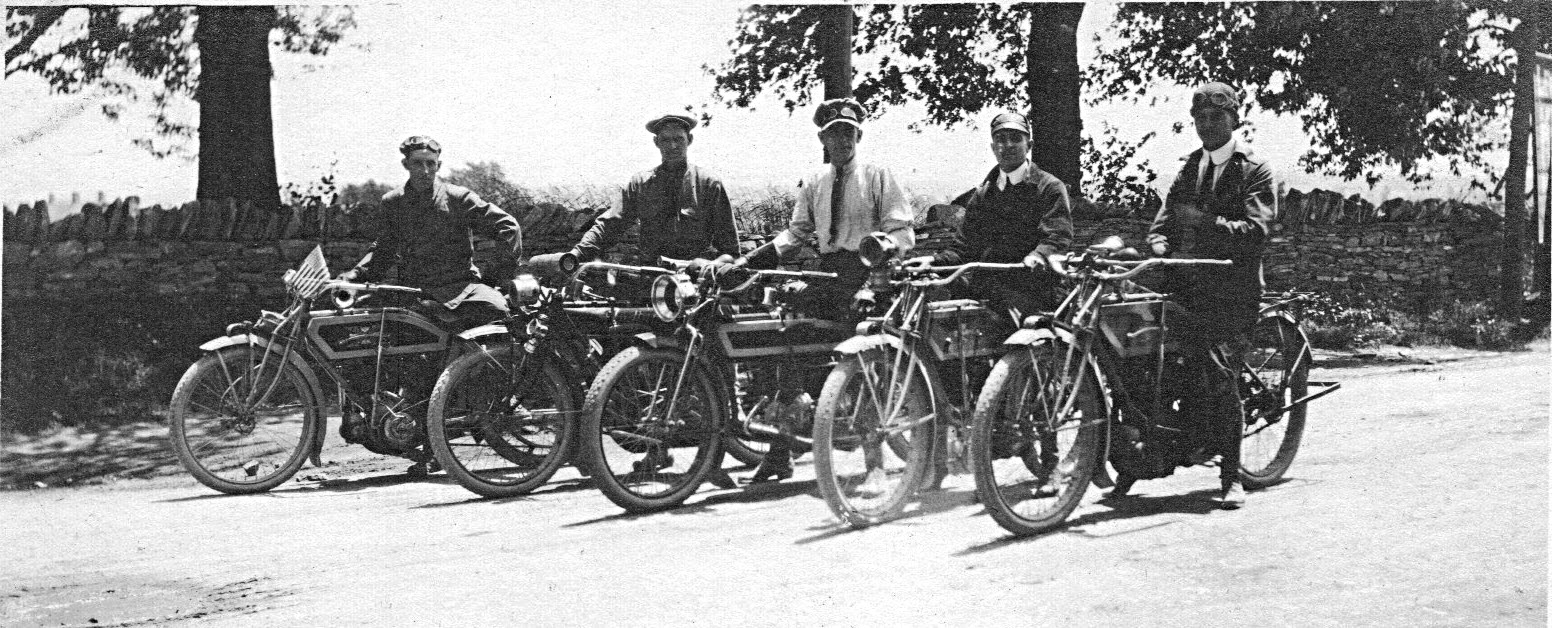
First motorcycle club in Rockville, Maryland. One Harley Davidson, one Indian, and Three Excelsior motorcycles on Park Avenue, 1912. Lewis Reed, far left.
As the curator of these archives and the granddaughter of Lewis Reed, I feel a great sense of pride in preserving these connections. Seeing the faces of men like Ben McGowan and John Hall reminds me that our family business was built on the shoulders of dedicated craftsmen who served their neighbors and their county. It is a legacy of service that I am honored to document and share with you today.
The Reed Sisters and the Spirit of Early Motorcycling
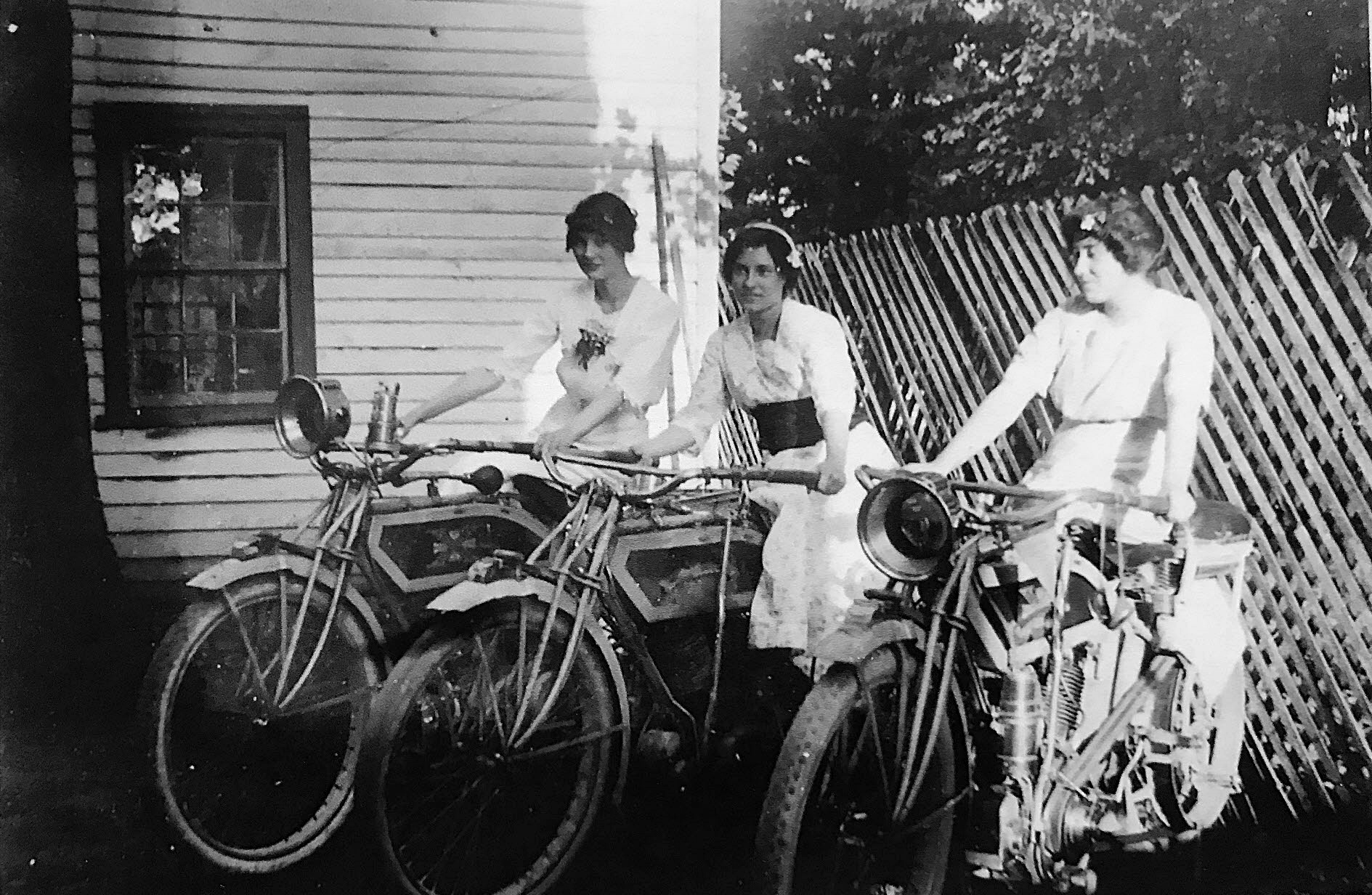
Eleanora Reed with Lewis Reed’s sisters, Geneva and Eva, posing on Excelsior motorcycles. Photo by Lewis Reed, ca. 1912.
At the dawn of the 20th century, motorcycles symbolized the spirit of innovation sweeping the modern age. Adapted from bicycles and powered by the new internal combustion engine, these machines represented freedom, ingenuity, and progress. Before cars dominated the roads, motorcycles often outnumbered automobiles, and it wasn’t uncommon to see riders as young as fourteen traveling the open road.
Photographer Lewis Reed captured this transformative era through his lens, preserving scenes of both relatives and acquaintances astride their machines between the 1900s and early 1920s. His collection offers a rare glimpse into an age when motorcycling was as much a bold adventure as it was a social pastime. Among his most memorable subjects were sisters Eleanora, Geneva, and Eva Reed, who embodied the daring enthusiasm of the time, embracing both the excitement and modernity that early motorcycling so vividly represented.
In the photograph below, a woman and a young child are seated on an Excelsior motorcycle, one of America’s premier machines of the early twentieth century. The child’s cap and goggles, likely intended as playful props rather than functional equipment, evoke the novelty and adventure associated with motorcycling during this era. The woman’s practical riding skirt, tailored jacket, and matching cap and goggles, however, suggest that she was an experienced rider with a genuine familiarity with the motorcycle.
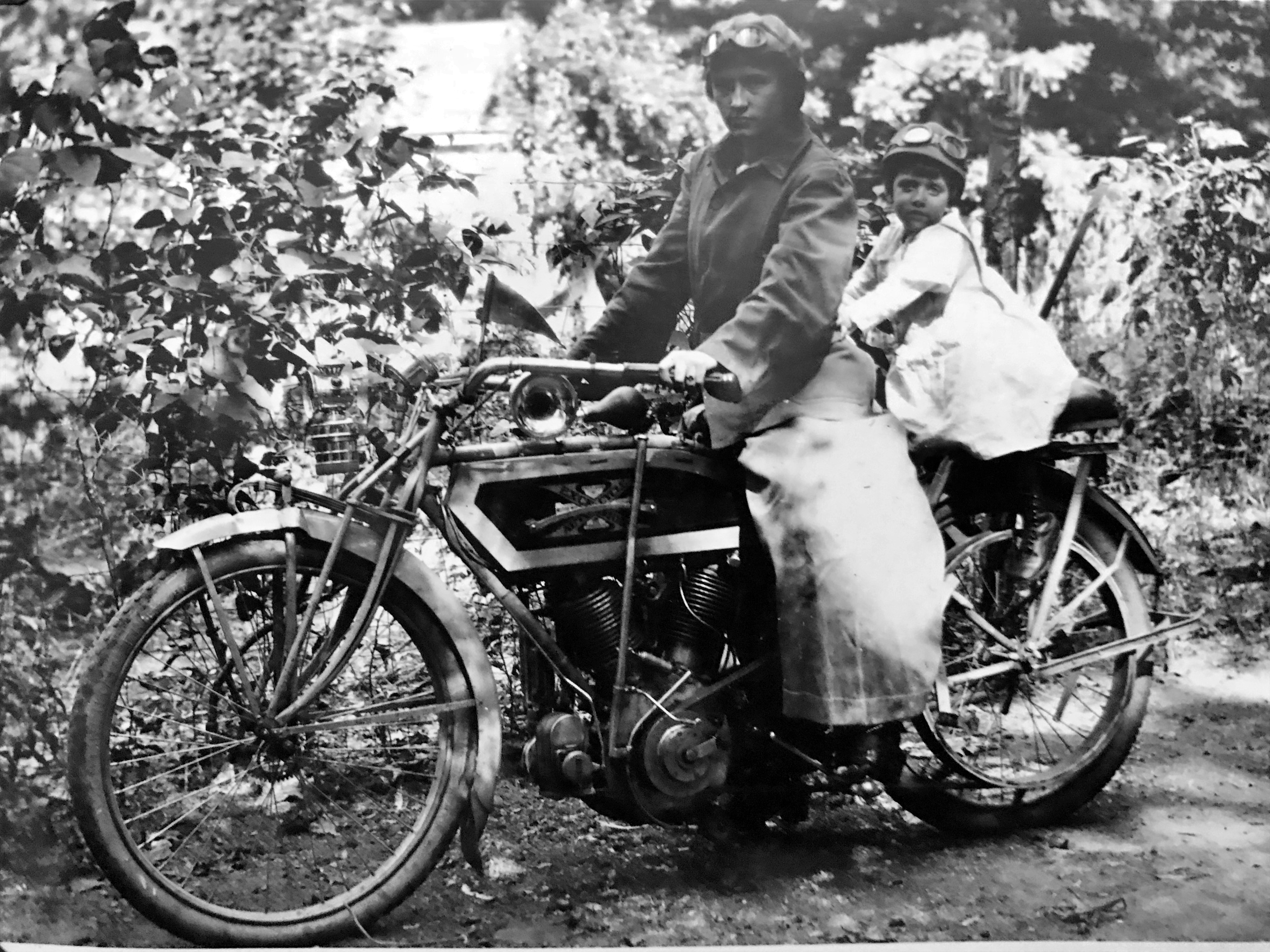
Woman and toddler on an Excelsior motorcycle. Photo by Lewis Reed.
The Excelsior itself showcased early 20th-century innovation, featuring a headlamp for night riding, a handlebar-mounted Klaxon horn with its famous “Ahoo-ga!” sound, and a padded passenger seat for a brave companion. In the early 1900s, many women rode motorcycles before they were even widely allowed to drive cars… while wearing military-style riding gear that shocked more than a few bystanders along the way.
Adding to this story of early American motorcycling is another remarkable photograph below; one featuring a woman and toddler posed on a Harley-Davidson motorcycle. Images like this one remind us how quickly motorcycles captured the public imagination in the years before World War I. They were not only practical for travel over rough roads but also symbols of progress and personal freedom. For women, especially, posing on, or even simply near, a motorcycle was a subtle act of empowerment at a time when societal expectations were still very traditional.
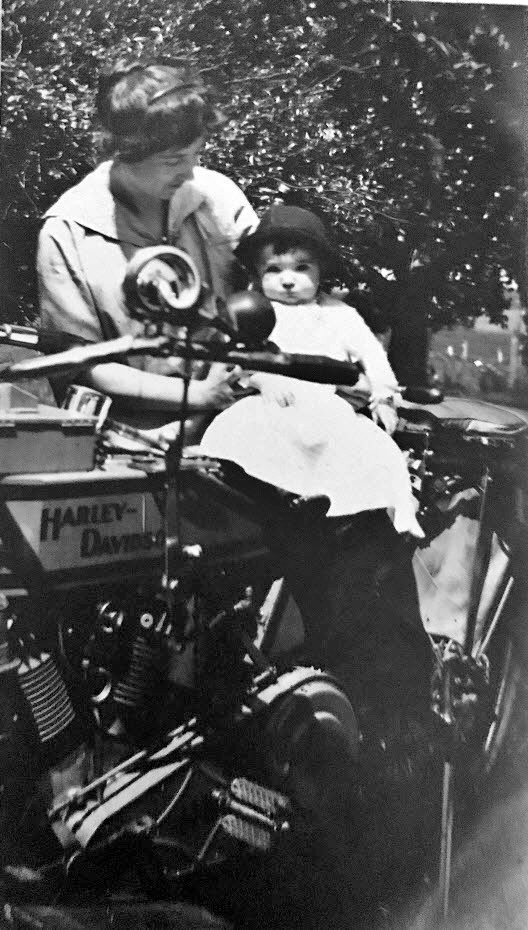
Woman and toddler on Harley Davidson motorcycle, ca. 1912. That slightly timid look says it all; not quite ready to ride, but definitely ready for her close-up! Photo by Lewis Reed.
Preserved through Lewis Reed’s remarkable photography collection, these images remain both a family heirloom and a glimpse into a transformative era. Through his lens, we see not only the evolution of transportation but also the growing independence and confidence of women at the dawn of modern motorcycling.
Reed Sister’s on Excelsior Motorcycles (1912)
Back in the early part of the last century when the motorcycle was still new and a novelty, it was often used for Kodak moments. Lewis Reed has a number of photographs showing relatives and other unknown people on their motorcycles in the period of the early 1900s through the early 1920s. In a time when you could ride a motorcycle at age fourteen and on the roads there were more motorcycles than cars, sisters Eleanora, Geneva, and Eva Reed also appeared to also enjoy the thrills of motorcycling.
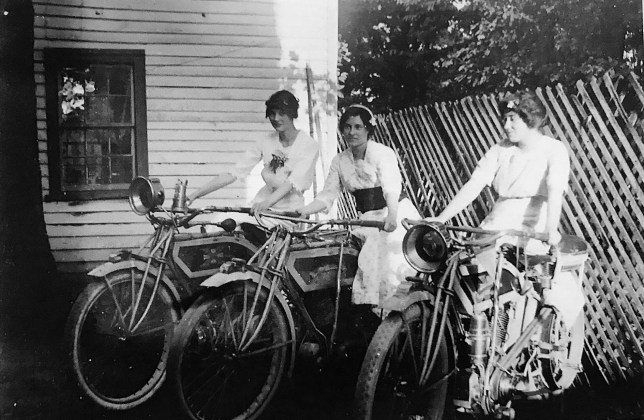
Eleanora Reed, and Lewis Reed’s sisters Geneva and Eva proudly pose on Excelsior motorcycles, 1912. In doing so, they declared their embrace of the new technology. For many, a motorcycle portrait was also a kind of declaration of independence. (Note they are all sitting “side-saddle” as true ladies of the time would have been expected to do).
While women have been enthusiastic bikers ever since motorcycles were invented, they have had to push back against deeply ingrained attitudes. Women in the first half of the 20th century were expected to dress fashionably and conservatively, and above all, remain ladylike. Sitting astride a motorcycle was considered uncouth: the same as riding a horse with a leg on each side. During this time, female pioneers like Amelia Earhart and Annie Edson Taylor pushed the envelope of expectations for women and set the stage for the Roaring Twenties flapper era.
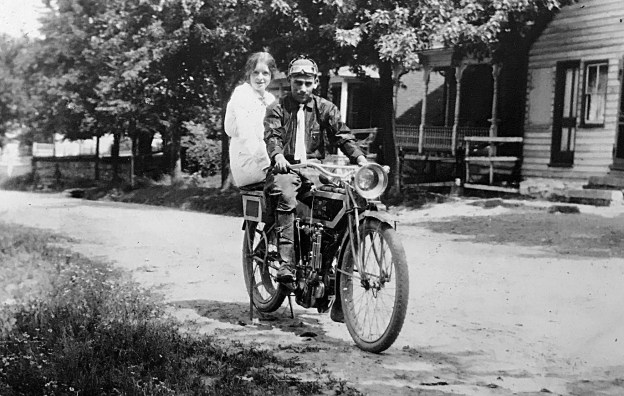
Edgar Reed and an unidentified lady sitting side-saddle on an Excelsior motorcycle.
Instead of having a motorcycle as a source of transportation, gentlemen of the days oftentimes used it to spice up their sunny weekends and impress ladies. Outfit relevance dictated a gentleman to be presentable and neat, so when going for a spin, Edgar Reed is wearing a leather jacket, full-length boots, necktie and sporty cap with goggles.

Woman and toddler pose on an Excelsior motorcycle. (The toddler’s sporty little cap and goggles are only for show: she won’t be going for a ride!) The motorcycle seems to be well equipped with extras including: a headlamp, a handlebar-mounted Klaxon horn, and a well-padded passenger seat on the back.
The above photo is, without question, one of the best posed photos on a motorcycle that I have come across in my grandfather’s albums. The toddler’s sporty little cap and goggles make the image. Just imagine how excited she must have been to sit on that big machine.
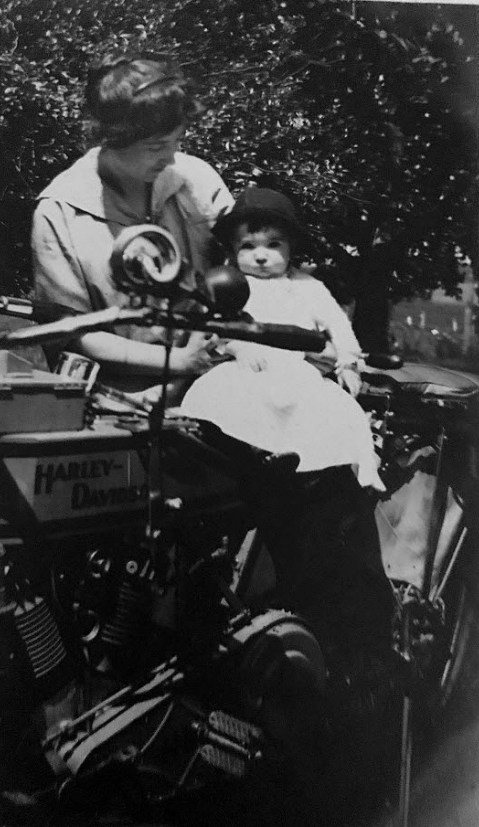
Woman and toddler on Harley Davidson Motorcycle
The 100th Anniversary of the Founding of the Montgomery County Police Department

Here posing in front of Reed Brothers Dodge on July 4, 1922 is the first known photograph of the entire MCPD. Pictured left to right: Earl Burdine, Lawrence Clagett, Guy Jones, Chief Charles Cooley, Leroy Rodgers, and Oscar Gaither. Photo taken by Lewis Reed on July 4, 1922.
July 4th marks the 100th anniversary of the beginning of the Montgomery County Police Department. Cattle rustling, bootlegging and stealing poultry were among the most common crimes when Montgomery County hired its first police chief and five officers in July 1922. So widespread was the theft of chickens and turkeys that some residents employed a homespun form of crime prevention by cutting off a specific claw on their birds to identify them. “Officers knew who all the chicken thieves were,” said one historical account of the era put together by the police department, “and upon getting a report of missing Rhode Island Reds, or some other breed, would head straight for the thieves’ hideaway to try to catch them ‘red handed’ before the birds got to the frying pan.”
Posing in front of Reed Brothers Dodge on July 4, 1922 Chief Charles Cooley, center, and his men of the first mounted unit of the Montgomery County Police Force, were on their first day of duty. For several years, since there was no police station, the officers would meet for “roll call” on the steps of the Red Brick Courthouse in Rockville at 2:00 p.m. every day to let each other know they were alive and well. Chief Cooley was given the privilege of a Model T Ford. The chief was paid $1,800 a year (the chief now gets $112,564) while the officers got $1,500. Each of the officers was issued a Harley-Davidson motorcycle, a .38 Smith & Wesson handgun, a black jack, law book and was allotted $300.00 a year for the upkeep of their motorcycle. Jones patrolled Silver Spring, Rodgers the Bethesda-Chevy Chase area and Burdine, Clagett and Gaither the Upper County areas.
The county’s population in the early 1920s was just 35,000 (it’s now more than 800,000). Much of the county was farmland, which accounted for the thefts of livestock. It also was the Prohibition era, when bootlegging and moonshine still factored routinely on an officer’s shift.
The officers worked 14 hours at night, 10 hours in the day, with two days off every two weeks. But they were on call at all times. Since there was no mobile radio contact (the first one-way radio system was installed in cars in the early 1930s), the officers tended to hang around the courthouse or a local firehouse that had a phone.
One of the officers came up with the idea of placing a flashing red beacon light on a pole atop the Rockville courthouse. When flashing, it would alert police that they had a call or were wanted at the office. In 1927, similar lights were used at district stations in Silver Spring and Bethesda.
As part of the 100th anniversary celebration, there will be a Commemorative Ceremony at the Red Brick Court House on July 7, 2022 from 10am-12pm that will mirror the swearing in that took place 100 years ago. The Chief will reveal the contents of the time capsule that was buried 25 years ago, as well as reveal the contents of what will be placed in the new time capsule. This event is free of charge to attend. For more info and other scheduled events, click here: https://www.mcpd100.org/live-events
Congratulations MCPD and thank you for your many years of service!
Montgomery County Police Department 99th Anniversary
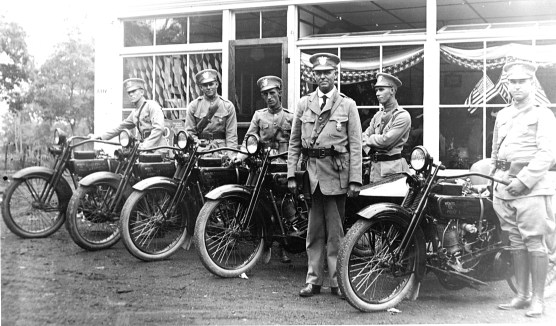
This is the first known photograph of the entire MCPD. Pictured left to right: Earl Burdine, Lawrence Clagett, Guy Jones, Chief Charles Cooley, Leroy Rodgers, and Oscar Gaither. Photo taken by Lewis Reed on July 4, 1922.
July 4th marks the 245th anniversary of the birth of our nation and the 99th anniversary of the beginning of the Montgomery County Police Department. Cattle rustling, bootlegging and stealing poultry were among the most common crimes when Montgomery County hired its first police chief and five officers in July 1922. So widespread was the theft of chickens and turkeys that some residents employed a homespun form of crime prevention by cutting off a specific claw on their birds to identify them. “Officers knew who all the chicken thieves were,” said one historical account of the era put together by the police department, “and upon getting a report of missing Rhode Island Reds, or some other breed, would head straight for the thieves’ hideaway to try to catch them ‘red handed’ before the birds got to the frying pan.”
Posing in front of Reed Brothers Dodge on July 4, 1922 Chief Charles Cooley, center, and his men of the first mounted unit of the Montgomery County Police Force, were on their first day of duty. For several years, since there was no police station, the officers would meet for “roll call” on the steps of the Red Brick Courthouse in Rockville at 2:00 p.m. every day to let each other know they were alive and well. Chief Cooley was given the privilege of a Model T Ford. The chief was paid $1,800 a year (the chief now gets $112,564) while the officers got $1,500. Each of the officers was issued a Harley-Davidson motorcycle, a .38 Smith & Wesson handgun, a black jack, law book and was allotted $300.00 a year for the upkeep of their motorcycle. Jones patrolled Silver Spring, Rodgers the Bethesda-Chevy Chase area and Burdine, Clagett and Gaither the Upper County areas.
The county’s population in the early 1920s was just 35,000 (it’s now more than 800,000). Much of the county was farmland, which accounted for the thefts of livestock. It also was the Prohibition era, when bootlegging and moonshine still factored routinely on an officer’s shift.
The officers worked 14 hours at night, 10 hours in the day, with two days off every two weeks. But they were on call at all times. Since there was no mobile radio contact (the first one-way radio system was installed in cars in the early 1930s), the officers tended to hang around the courthouse or a local firehouse that had a phone.
One of the officers came up with the idea of placing a flashing red beacon light on a pole atop the Rockville courthouse. When flashing, it would alert police that they had a call or were wanted at the office. In 1927, similar lights were used at district stations in Silver Spring and Bethesda.
Congratulations MCPD and thank you for your many years of service!
Books

Related Resources


Copyright Notice

Reed Brothers Dodge History (1915-2012) by Jeanne Gartner is licensed under a Creative Commons Attribution-NonCommercial 3.0 Unported License.
 Reed Brothers Dodge History 1915 – 2012
Recent Comments