
Batter Up! Reed Brothers Company Softball Team
From a distance, it looks and sounds like a regular baseball game: the crack of the bat, the cheering from the bench, the sliding into home plate. But a closer look at the field shows something is very different. They’re playing on a rough grass field, no one is using a batting helmet, fielding glove, or catcher’s mask.

Reed Brothers Softball Team playing on a field set up inside the Rockville Fair racetrack oval, circa early 1920s. Photo by Lewis Reed
From the 1920s through the 1940s, Reed Brothers had their own company softball team that played on the fields at the Rockville Fairgrounds where Richard Montgomery High School now stands. In 1939, the Rockville Fire Department and Reed Brothers Dodge, two top-ranking teams, inaugurated the Montgomery Softball Association championship series at the newly renovated Welsh Field in Rockville. Situated in the heart of Rockville’s business district, the field was renovated and illuminated in 1939.
Participating teams at the time included Pepco, Takoma Phil-Gas Company, Marine Barracks, Rockmont Motor Company, St Mary’s Boys’ Club, Lawyers and Businessmen, among others.

The Evening Star, 9 May 1939

Reed Brothers Dodge Softball Team playing on Welsh Field in Rockville, circa early 1920s. Photo by Lewis Reed
Note the player with the five finger glove in the photo above. Out of all of these photos, this is the only glove that can be seen on a player. The use of gloves wasn’t original to the first years of the game; needing a padded glove was viewed as pretty wimpy. (According to an article in the Smithsonian Magazine, one of the first players to wear a glove tried – and failed – to find one that would be invisible to fans.) By the 1880s gloves were accepted equipment, however, and soon inventors and manufacturers were coming up with new and improved gloves (more padding, deeper webbing…)

Reed Brothers Dodge Softball Team, circa early 1920s. This photo was taken at Welsh Field, which is the site of the County Office Building. The house in the background was in right field. Photo by Lewis Reed
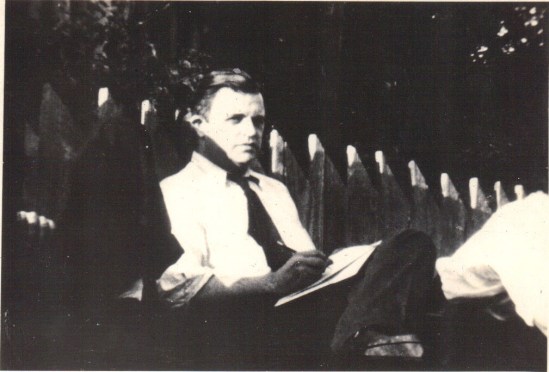
Leo (Pat) Murray, the company’s first Parts Department Manager, is keeping score on the sidelines. Pat worked at Reed Brothers for more than 21 years. Photo by Lewis Reed
From the about the 1920s through the 1940s, Reed Brothers Dodge also sponsored a bowling team that competed locally in the Rockville Duck Pin League. Participating teams at the time included Post Office, Chevrolet, Fire Department, Question Marks, Mechanics, Reed Brothers, Holy Rollers, and Potomac.

The Evening Star Feb 9, 1932
First Kensington VFD Fire Truck Purchased from Reed Brothers Dodge
The first piece of fire apparatus purchased by the Kensington (Maryland) Volunteer Fire Department was a 1925 Dodge-Graham fire engine purchased from Reed Brothers Dodge at a cost of $5,000. It was not a complete truck when purchased, however.
From the Kensington Volunteer Fire Department’s “History” webpage:
1922 was the birth of the Kensington Volunteer Fire Department. With little money, a Dodge truck was purchased from Reed Brothers Dodge in Rockville. A custom fire body was then built and fitted on the truck by Jacobs Brothers in Gaithersburg who ran the Wheelwright Shop on East Diamond Avenue. To raise money, the volunteers held carnivals. The Fire Department incorporated in 1925, and two years later moved into a permanent home in the basement of the National Guard Armory.
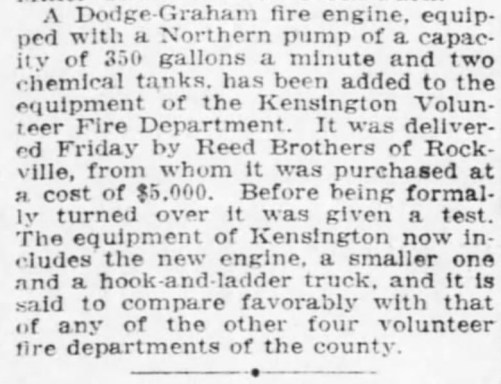
The Evening Star, 16 Aug 1925
A bit of Dodge-Graham Brothers history: Dodge trucks actually began with three brothers named Graham. In reality, it is the story of two companies – the Dodge Brothers Company and the Graham Brothers Company. In 1916, seeing the need for a good, dependable truck to serve people, the Graham brothers entered the truck body business. By 1919, they had produced the “Truck-builder,” which is a basic platform from which a customer could spec a truck according to his or her needs. The Truck Builder was essentially a truck conversion that began with a passenger car.
In 1921, Dodge Brothers began to market Graham Brothers medium-duty trucks through its dealerships; in turn, every Graham vehicle utilized a Dodge engine. This partnership provided Dodge dealers with a full line of trucks to sell in addition to the highly regarded Dodge passenger cars, and the resulting sales increases prompted Dodge to buy the Graham Brothers Company.
The Dodge trucks would carry the Graham Brothers nameplate until 1928 with a few of the designs lasting as long as the 1930s.
Pictured below is not the Kensington engine, but a fully restored 1925 Dodge-Graham Brothers Era Chemical Pumper that was probably very similar to the original one that was used.
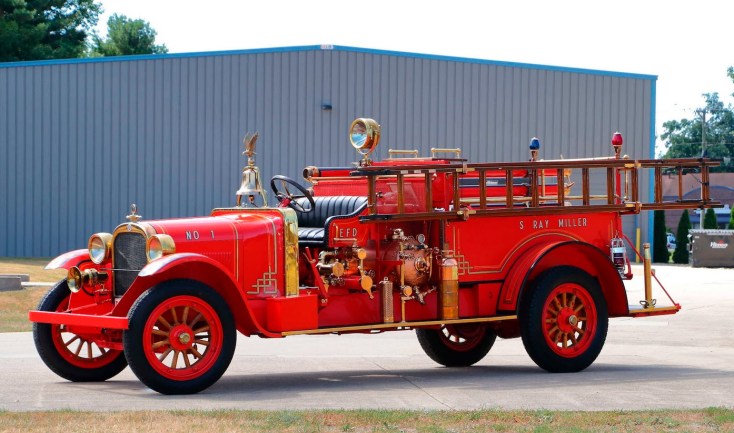
Fully Restored 1925 Dodge-Graham Brothers Era Chemical Pumper
No New Cars During WWII, But That Didn’t Stop Lewis Reed
During World War II, Reed Brothers Dodge had virtually no new cars to sell for three and a half years. Tires and parts were rationed. Strict price ceilings governed used-car sales. Used cars were really hard to find, because people couldn’t afford to give them up. So, most dealerships had to rely on their service and parts departments to fix the cars people couldn’t replace. Empty showrooms were a problem. When manufacturers halted car production and many dealers went bankrupt, Lewis Reed converted his car showroom into a display room and sold GE washing machines, Westinghouse Radios, and other large appliances to fill the gap.
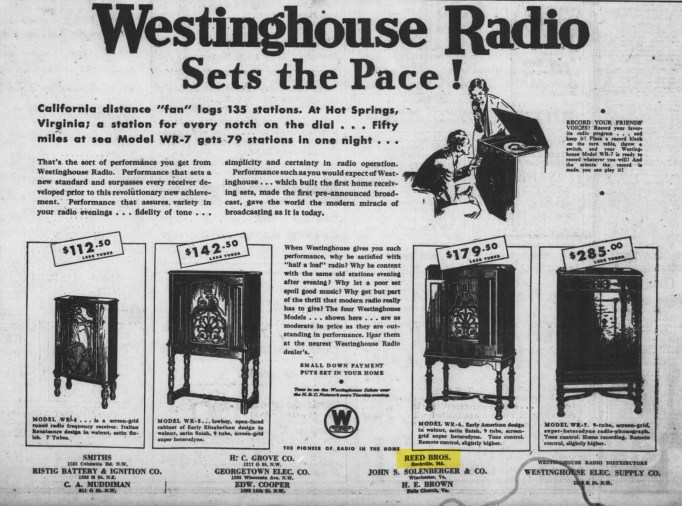
Newspaper ad for Westinghouse Radios with Reed Bros, Rockville, MD listed in fine print at the bottom
Reed Brothers Dodge lost eight employees to the draft. One former employee, Philip Frank, a member of the Air Corps in World War II was in killed in combat in the South Pacific. Raleigh S. Chinn of Rockville, Salesman, who started with Reed Brothers in 1920, resigned in 1942 due to lack of automobiles to sell. Edward R. Brosius of Barnesville, Salesman, started with the company in 1938. He, too, resigned in 1942 when cars were unavailable. Guy Merry of Rockville started in 1937 as a mechanic. He entered the armed forces in World War II and served for three years. When he was released, he returned to his old job. John Burdette of Gaithersburg, Gas Station attendant, started in 1940 and worked for about one year and then entered the armed services. He served four years in World War II and returned to his old job when he was released. Richard C. Burdette, Rockville, mechanic, started in 1941 and also worked at Reed Brothers until he entered the service. He served two years and then returned to work.
Car salesmen back in the 1940s would drive as far as 35 miles to deliver cars to their spread-out farmer customers. Lewis Reed allotted specific sales territory to his salesmen in four different directions from the dealership. The salesmen spent all day in the outlying areas, because the farmers in Poolesville, Rockville, Barnesville and Spencerville had no time to go to a showroom. Lee Gartner (Lewis Reed’s son-in-law) spent his summers on his grandfather’s farm and it was Mr. Lewis Reed who brought his grandfather’s car to him. Three of the four salesmen at the time were Francis O. Day, Raleigh S. Chinn and Benjamin Thompson.
At that time, Reed Brothers was selling about eight new cars a month and most sales resulted from knocking on people’s doors. After the end of World War II, the car boom came and the automobile assembly lines were back in action. The first car after the war was the1946 Dodge, which sold for about $800.
Books

Related Resources


Copyright Notice

Reed Brothers Dodge History (1915-2012) by Jeanne Gartner is licensed under a Creative Commons Attribution-NonCommercial 3.0 Unported License.
 Reed Brothers Dodge History 1915 – 2012
Recent Comments