
Iconic Advertising Slogans by Dodge
Like any major business that’s been around throughout the evolution of television advertising, Dodge has been on the point of many trends and gimmicks over the decades. At the same time, they’ve also set an advertising tone that challenges other manufacturers to try and keep up. Whether you’re a young buck or an ol’ timer, you’re bound to remember at least a few of these Dodge advertising slogans over the past five decades.
Through the years the ads have definitely improved from a timeless, artistic aspect; however the older ads definitely transport you back to a simpler time, both in the car world and in American history.
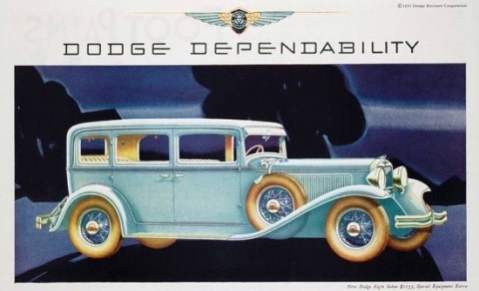
1. Dependability, The Dependables. (1920s–1967)
Capitalizing on their reputation, the Dodge Brothers used their name, “Dodge Brothers” followed by “Reliable, Dependable, Sound” to market their products. Devoted Dodge customers raved about the rugged construction, quality, and power of their vehicles. Buyers consistently commented that this was a car that could be depended upon. In a Dodge marketing stroke of genius, Theodore MacManus coined the word “dependability.” Dodge was using the term in advertising from around 1914, and by the 1930’s, the word was appearing in dictionaries, and soon found its way into common, everyday usage.
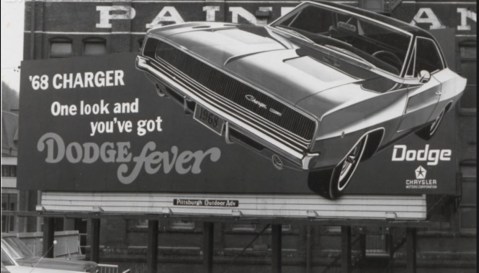
2. Dodge Fever. (1968–1969)
It was the fall of 1967, and for the 1968 model year, Dodge introduced the all-new second-generation Charger that was an instant hit with car buyers and would eventually become an iconic symbol of the muscle car era. In 1968, Dodge started the successful Dodge Fever campaign. A prospective buyer could check off the desired performance options when ordering a new Dodge, work out the terms for a manageable down payment and monthly installments, and drive out with one of the bumblebee striped Dodges. If a twin tail striped Charger R/T was purchased, the new owner now owned one of the “five from the hive” Dodges, which included the Swinger 340, Dart 340 GTS, Coronet R/T, Super Bee, and the Charger R/T. Picking up one of these Dodges authorized the owner to “Run with the Dodge Scat Pack,” which was always a cure for the fever.
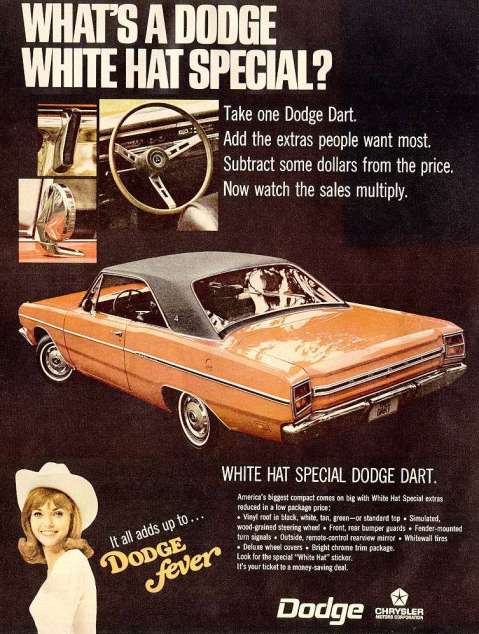
3. Dodge White Hat Specials (late 1960s)
Banking on the height of the popular spaghetti westerns of the late 1960′s, Dodge launched the 1969 “White Hat Special” editions of their lineup. Named after the old Roy Rodgers maxim that, “The good guys wore the white hats,” the White Hat Specials were more about the look and comfort than say, the more performance heavy R/T packages. Vinyl tops, seats, light packages, wheel covers, and remote-controlled side-view mirrors were par for the course. The White Hat Special package was also made available on Darts, Polaras, and Coronets in addition to the sporty Chargers.
4. You Could be Dodge Material. (1970–1971)
Advertising has changed a lot over the years, but it doesn’t even feel like too long ago that this commercial for the 1970 Dodge Charger 500 was airing on the networks. Nowadays, though, a spot like this ends up being more hilarious than most of the ads that are intentionally funny. In this spot, you can see for yourself just how attractive the 1970 Dodge Charger really was. So much so that it could change your whole image, therefore causing you to leave your lady stranded on the beach.
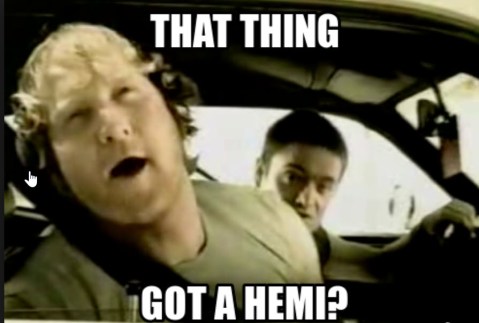
5. That Thing Gotta Hemi?
The actor Jon Reep launched his career by uttering, “That thing got a Hemi?” in a Dodge Ram television ad. In the video, we see two scuzzy dudes in a scuzzy Plymouth Duster. They stop at a light and find themselves next to a gleaming Dodge Ram pickup—which in turn tows behind it a gorgeous, vintage Dodge Charger. The scuzzy passenger leans out of his window and asks, “Hey, that thing got a Hemi?” The Ram owner answers, “Yeah.” The scuzzy driver says, “Sweeeeeeeeeeeet,” and revs his engine. Cue green light. The pickup waxes the scuzzmobile. At the next light, the Ram driver turns to the Plymouth. “Did you mean the Charger?” he asks. ” ‘Cause, you know that’s got a Hemi, too.”
6. An American Revolution. (1982–1989)
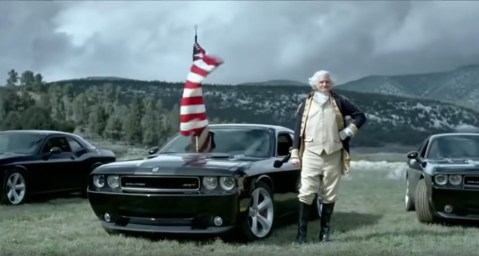
If George Washington drove back in the 1700s, he would be driving a Dodge Challenger. At least that’s what a new commercial wants you to think. A running commercial for the Challenger, which debuted during the World Cup, shows Washington scaring off the Redcoats in the muscle car, effectively winning the American Revolution.
7. The Pride is Back (1980)
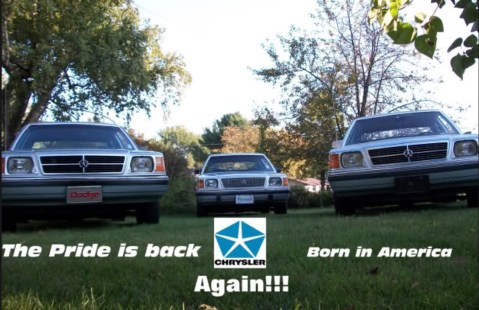
Lee Iacocca saves Chrysler. Reeling from the combined effects of a recession and a global energy crisis, in 1979 Chrysler was forced to seek government loan guarantees. Meanwhile, Chrysler chairman Lee Iacocca took the company’s case straight to the people in a series of television commercials. Looking straight into the camera, the legendary auto executive pitched the company’s new K-cars with total conviction, asserting, “America, if you can find a better car, buy it.”
Buyers took up Iacocca’s challenge, flocking to the showrooms to buy their own K-cars. Nearly one million Aries were sold (and another million Reliants), allowing Chrysler to pay off its loans a full seven years early. Soon Iacocca was back on the airwaves with another ad campaign. This one was called “The Pride Is Back.”
8. The New Dodge. (1992–2000)
In 1992, Dodge moved their performance orientation forward substantially with the Viper and all Dodge cars and trucks were shown in bright red ads. This was the first step in what was marketed as “The New Dodge”, which was an aggressive advertising campaign with a litany of new models, with television ads that pointed out the innovations in the vehicles and challenged their competitors.

9. Dodge. Different. (2000–2001)
“The New Dodge” signature was replaced by “Dodge Different”. Dodge found the way to success was to offer products that were bolder and more exciting than its competitors. In other words, by being different. It was the largest and most comprehensive print and television campaign in the company’s 85-year history.

10. Grab Life By The Horns. (2001–2007, mainly for Dodge truck market)
The slogan “Grab life by the horns” started appearing in Dodge commercials in 2001.
11. Grab life. (2007 – mid-June 2010, in Ram pickup truck ads)
The whole idea of ‘Grab Life’ as opposed to ‘Grab Life by the Horns’ kind of disenfranchises it from the Dodge Ram. The slogan shift was planned by Dodge to coincide with its car sales growth. The automaker is rolling out cars to circumvent the declining sales of pickups due to the volatile gasoline prices. If they cut off ‘by the horns,’ you’re less likely to think Ram and more likely to think maybe a Caliber or Avenger.
12. Never neutral. (2010–present)
The 2012 Dodge Charger advertisement called Never Neutral takes a swing at one of the major issues of the car industry: their tendency to take out driver involvement on the actual act of driving. The Never Neutral commercial says that the new model will always be an alternative to hands free driving, cars that park themselves, and to the unmanned car driven by a search engine company. In essence, the main point of Dodge’s new TV spot is to say that the 2012 Charger is a car made for driving, and for being driven in.

13. Guts. Glory. Ram. (2010–present, Ram Truck division)
“Guts. Glory. Ram,” with an old western theme—a perfect setting for what Ram suggests its brand portrays. Of course, the only forms of transportation back then consisted of horses, trains and wagons, but the spots foster the idea that if an automobile existed during these times of courageousness and survival, it would be the Ram pickup.
14. Wisdom (2014, commemorating Dodge’s 100-year anniversary )
In “Wisdom,” commemorating the century mark of the Dodge brand, a one-minute spot honored centenarians who laughed heartily and grinned big in front of the camera while handing out timely nuggets of wisdom on life and fast cars. “Live for now … Because life is good, you make it good.” Each person from the era when Dodge Brothers was still independent was identified by name and their birth year. The theme was simple but earnest: “You learn a lot in a hundred years … Here’s to the next hundred. Born Dodge.” So, here’s to putting the pedal to the metal … and never, ever forgetting where we came from. “Wisdom” was named 2015’s Automotive Ad of the Year during the 10th Nielsen Global Automotive Advertising Awards.
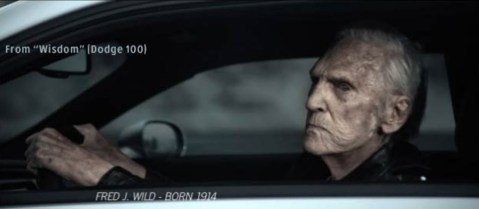
15. Born Dodge. (2014–present)
The Dodge car brand turned 100 years old in 2014. For this they released special 100th anniversary edition cars, re-designed the Charger and Challenger and released this epic commercial. Featuring timeless advice from people who’ve been around as long (or nearly as long) as the Dodge brand itself.
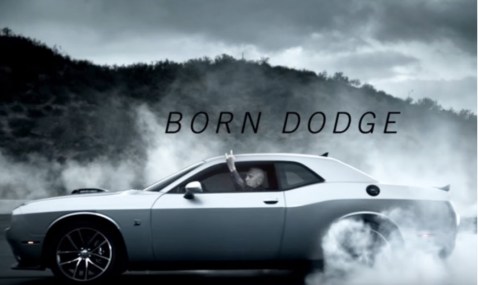
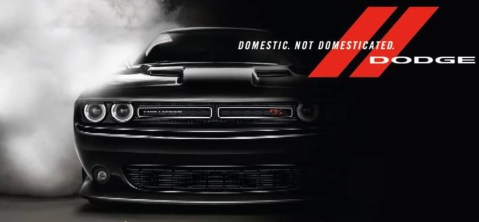
16. Domestic. Not Domesticated. (2016–present)
The tagline, “Domestic. Not Domesticated.” aims to capture the passion and attitude of Dodge. ‘Domestic. Not Domesticated.’ means that Dodge vehicles can handle grocery runs and recital pickups just as well as they can handle laps around the race track. You don’t have to sacrifice pleasure for practicality. You can have both.
November 14, 1914: First Dodge Automobile Built

Horace Dodge (left, rear) and John Dodge (right, rear) take delivery of the first Dodge automobile on Nov. 14, 1914.
One hundred and four years ago on this date –November 14, 1914 — the very first Dodge car, “Old Betsy”, rolled off the assembly line. On that day, the Dodge Brothers (Horace and John) were photographed riding in the rear seat of the first car to bear their last name. It cost $785, had a 110-inch wheelbase, and was powered by an L-head 4-cylinder engine that proved so reliable it was continued until 1920 with very little modification. Total production for 1914 was a mere 249 touring cars. The following year. Dodge offered a two-passenger roadster which also sold for $785 and the plant went into full production.
According to “The Dodge Brothers: The Men, the Motor Cars, and the Legacy” by Charles K. Hyde, here’s the full story:
The widely accepted history of the initial production of early Dodge Brothers automobiles in November 1914 is at odds with much of the evidence about the earliest Dodge Brothers cars. Automotive historians have thought that the first production car, later named “Old Betsy,” came off the assembly line at the Hamtramck factory on 14 November 1914. Guy Ameel, superintendent of final assembly for Dodge Brothers since the start of automobile production, served as John and Horace’s chauffeur that day. With the brothers in the back seat, Ameel stopped the first Dodge Brothers car in front of John Dodge’s mansion on Boston Boulevard in Detroit and a photographer recorded this important moment.
“Old Betsy” was more likely an experimental prototype car assembled several months before 14 November 1914 and not a production car at all…

The Dodge Brothers
The Dodge Brothers began an aggressive advertising campaign to promote their new automobiles and to attract potential dealers to sell their cars. Few people jumped onto the Dodge Brothers bandwagon earlier than Lewis Reed, and not many have lasted longer.
Lewis Reed received his franchise to sell Dodge Brothers Motor Cars from John and Horace Dodge; less than one year after “Old Betsy” rolled off the assembly line. He was just 27 years old. Since then, the business grew and transformed into the oldest Dodge dealership in Maryland history and one of the oldest in the entire nation.
35 Years Ago Today, Chrysler Invented the Minivan, And Changed History
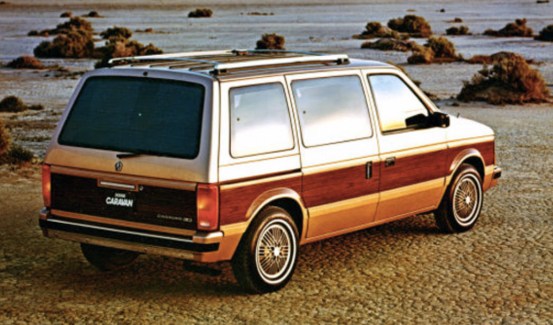
1984 Dodge Caravan
On November 2nd, 1983, the world’s first minivan rolled off of Chrysler’s assembly line. It was the vehicle that saved Chrysler from financial doom. When Ronald Reagan was president — the economy was far from robust and Chrysler was on death’s doorstep. Chrysler needed a home run, and Lee Iacocca, who was running the company at the time, gambled that the first wave of baby boomers who were starting families would likely want something roomier and far more practical than the traditional family hauler, the station wagon. Iacocca practically bet the company on the fact that a new automotive segment dubbed “the minivan” would catch on with the boomers. It was a $660-million gamble, only made possible by money acquired earlier from Washington’s $1.5-billion bailout of Chrysler.
Sales improved dramatically with the debut of the well-received K-car platform and the introduction of the Dodge Caravan and Plymouth Voyager. Chrysler paid off government loans seven years early. Reed Brothers successfully navigated through numerous Chrysler setbacks during the 1970’s and 80’s, including the first Chrysler Bailout and resurgence under Lee Iacocca.
The 1984 Dodge Caravan was designed specifically with families in mind. The early design looked like station wagons at the time, featuring a wood panel along the sides. The Caravan was essentially a big, roomy box on wheels, utilizing maximum form efficiency — small on the outside, huge on the inside.
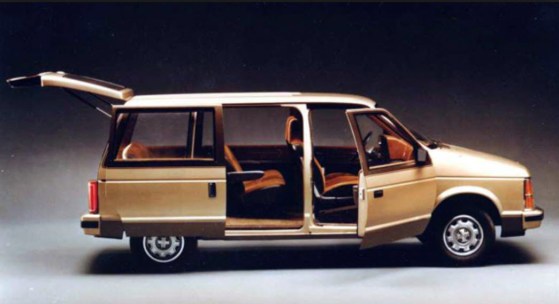
1984 Dodge Caravan
The other distinguishing features of the new minivan were its car-like features – notably including power windows, comfortable interiors, a nice dashboard, and front-wheel drive. These also explain the appeal of the vehicle. Not only did it fit in a garage like a car, but it actually drove like a car, while also providing plenty of room for the kids and luggage and giving mom a nice, high view of the road. The sliding door made it easy to for people to quickly enter or exit the vehicle and, with its lack of hinges, the sliding door was seen as a safer option for children.
After The 1984 Dodge Caravan was released, it became an immediate success. The minivan helped bring the company back from the brink of bankruptcy, and it reinvigorated the automotive market. Many buyers had to wait weeks to have their orders filled because there was so much demand. Dodge created an entirely new market with the minivan, and other models soon followed suit.
Lee Iacocca, the mastermind of the minivan era, presented this 12,000-mile Voyager at the assembly line in Windsor, Canada on November 2, 1983. A truly game-changing vehicle…
The First Dodge Car
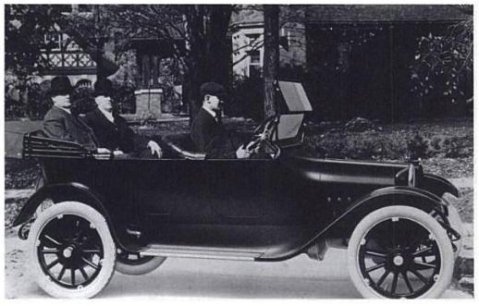
Horace Dodge (left rear) and John Dodge (right rear) in “Old Betsy” in front of John Dodge’s Boston Boulevard home, 14 November 1914.
One hundred and three years ago on this date – November 14, 1914 — the very first Dodge car, “Old Betsy”, rolled off the assembly line. On that day, the Dodge Brothers (Horace and John) were photographed riding in the rear seat of the first car to bear their last name. It cost $785, had a 110-inch wheelbase, and was powered by an L-head 4-cylinder engine that proved so reliable it was continued until 1920 with very little modification. Total production for 1914 was a mere 249 touring cars. The following year, Dodge offered a two-passenger roadster which also sold for $785 and the plant went into full production.
According to “The Dodge Brothers: The Men, the Motor Cars, and the Legacy” by Charles K. Hyde, here’s the full story:
The widely accepted history of the initial production of early Dodge Brothers automobiles in November 1914 is at odds with much of the evidence about the earliest Dodge Brothers cars. Automotive historians have thought that the first production car, later named “Old Betsy,” came off the assembly line at the Hamtramck factory on 14 November 1914. Guy Ameel, superintendent of final assembly for Dodge Brothers since the start of automobile production, served as John and Horace’s chauffeur that day. With the brothers in the back seat, Ameel stopped the first Dodge Brothers car in front of John Dodge’s mansion on Boston Boulevard in Detroit and a photographer recorded this important moment.
“Old Betsy” was more likely an experimental prototype car assembled several months before 14 November 1914 and not a production car at all…
The Dodge Brothers began an aggressive advertising campaign to promote their new automobiles and to attract potential dealers to sell their cars. Lewis Reed was an enterprising young man who put his future in the fledgling automobile industry. In 1915 he received his franchise to sell Dodge Brothers Motor Cars from John and Horace Dodge; less than one year after “Old Betsy” rolled off the assembly line. Lewis Reed and his brother Edgar, were the first to sell Dodge cars in Montgomery County, Maryland. That made Reed Brothers the oldest Dodge dealership under the same family ownership in Maryland, and one of the oldest in the entire nation.
Manufacturing Dodge Motor Cars, ca 1917
Get ready for a treat! Here is a film that the Dodge Brothers company made to promote their brand in 1917. Copied at 16 frames per second from a 35mm tinted print preserved by the Academy Film Archive from source material provided by the New Zealand Film Archive. Running Time: 28 minutes (silent, no music, incomplete).
In the 1900s, brothers John and Horace Dodge of Detroit became the major suppliers of drive trains to the Ford Motor Company. They achieved such a stellar reputation for quality that when they decided to manufacture their own automobiles, incorporating as the Dodge Brothers Motor Car Company in 1914, 13,000 dealers registered to sell the new vehicles before a single auto had been produced. In 1915, Reed Brothers was franchised as a Dodge dealership and service facility; less than one year after the first Dodge automobile rolled off the assembly line.
In 1916, the company created a film department to promote the Dodge brand. This film appears to be one of its first products. It shows the company’s assembly line in action, demonstrating to viewers the workmanship and care invested in each vehicle. The beginning is missing, lending credence to the hypothesis that the film may be the three-reel profile of the company’s production process distributed in 1917 to Dodge dealerships. The film finishes with close up looks at the Dodge Brothers’ models of the day: the Sedan, Coupe, Roadster and Touring Car. It also demonstrates Dodge’s capabilities in the snow and on steep hills (particularly fun to watch!).
If you have a half-hour to spare, kick back and enjoy this rare treat! You will get a true insider’s look at how the very first Dodge automobiles were made!
Books

Related Resources


Copyright Notice

Reed Brothers Dodge History (1915-2012) by Jeanne Gartner is licensed under a Creative Commons Attribution-NonCommercial 3.0 Unported License.
 Reed Brothers Dodge History 1915 – 2012
Recent Comments