
Early Days of Automobile Repair
The first car was created and it was good. A few days later, it broke down. That was bad. This led, of course, to the creation of the auto mechanic.
With a surge in automobile purchases in the early 1900’s, and an equal amount of car accidents and breakdowns, Rockville Garage/Reed Brothers Dodge began offering auto repair services as early as 1914. By the early 1900s, there were a great deal of cars on the roads, which meant that manufacturers and dealerships needed to provide drivers with the means of repairing their vehicles in the event of a collision or breakdown. To meet this demand, manufacturers started making standardized parts that could easily replace damaged components of a vehicle. Dealerships were now able to employ mechanics that were able to easily repair vehicles using the prefabricated parts provided by the manufacturers.
The First Auto Mechanics of Rockville Garage
First auto mechanics of the Rockville Garage: Lewis Reed, (first name unknown) Long and Phillip Reed.
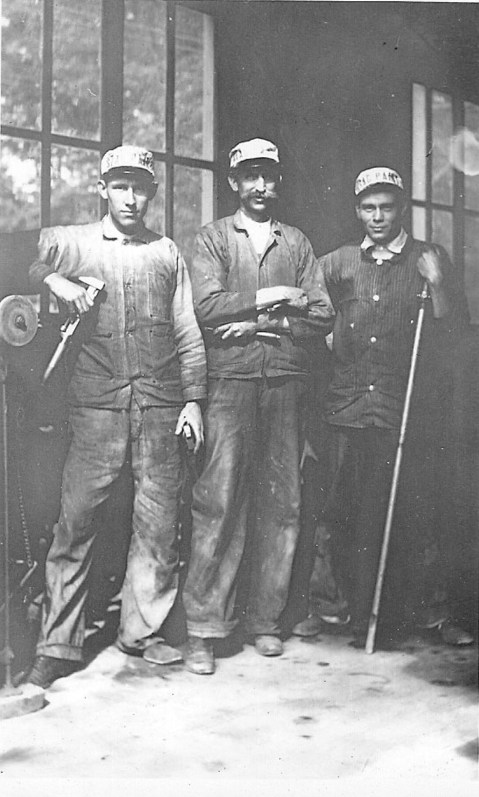
A mechanical aptitude was necessary to be a dealer in the early 1900’s. When cars were shipped to the dealer from the manufacturer, they arrived partially assembled in railroad boxcars. It was the dealer’s responsibility to unpack and assemble the cars at the rail yard and drive them back to the dealership. Mechanics were often needed to repair the new cars if they broke down along the way. Lewis Reed was an expert auto mechanic. He received his automotive training at the Pierce-Arrow factory in Buffalo, New York, the Dodge Hamtramck and Hudson Motor Car factories in Detroit, Michigan and The Automobile College of Washington.
The Automobile College of Washington
The Automobile College of Washington was organized in 1909 for the purpose of training young men to become chauffeurs and repair cars. The school was the pioneer institution of its kind in Washington, DC. The school had a repair department, machine shop, and a chassis construction classroom for the very latest automobiles. Some of the cars used in the school: the Washington A-1 Touring Car, Pope Tribune, Ricketts Model G 6-cylinder, Peerless 35hp; and the Mitchell 25hp.
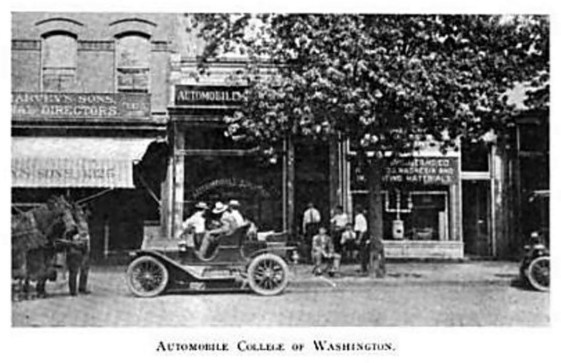
The Automobile College of Washington from the August 11, 1909 issue of The Horseless Age magazine (Google Books)
During the early days when automobiles had left the factory, routine maintenance and repair was largely left up to the owner as the auto repair industry was still in its formative stages. For the early generations of cars and car drivers, how long an automobile remained in good operating condition was left up to the owner and their routine service visits.
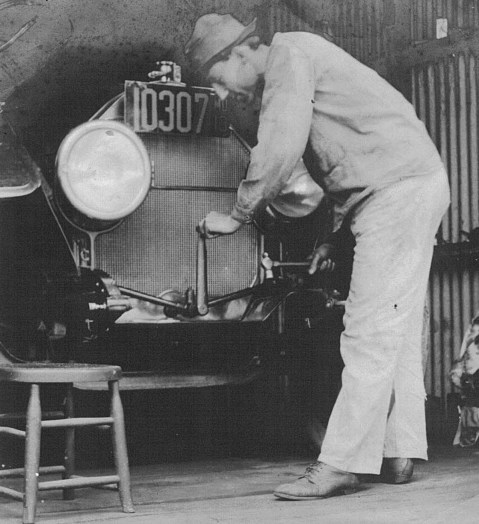
Lewis Reed hand cranking an old car. The hammer in Lewis Reed’s right hand is for straightening the hand crank. Apparently they can bend when starting big engines. The license plate is MD 10307 dated 1913.
Many early auto dealers started out of existing garages. Business owners of the early dealership soon discovered they could create a market not just for sales but for repair as well. Between 1900 and 1930 the American automobile business was built by tinkerers and visionaries and the repair and maintenance industry was no different. In 1932, automobile manufacturing reached its lowest point since 1918 and the advent of the used car rose to great prominence in the automotive community.
Lewis Reed, Chauffeur-Mechanic
The year is 1910 and you’ve just purchased a brand new automobile. To show it off for the first time, you’ve hired a knowledgeable chauffeur. You sit on a padded seat while the chauffeur tends to the engine. Though it takes a while to start up, your new ride can reach around 37 mph. The ride is a bumpy one, and you could probably walk faster than the car travels. Ooops!!! One of the wheels has popped off as you go around a bend. Chauffeurs were not only trained to be proficient with their driving skills, but they also had to keep the luxury automobiles in tip-top shape, which is where Lewis Reed’s mechanic training – a vital skill in the early days of motoring – would have come into play.
Prior to World War I, Lewis Reed’s love of automobiles led him to becoming a chauffeur. At the dawn of the early 20th century, society was transitioning from horse-drawn carriages to automobiles. Having grown up in a blacksmith family, he was well positioned to move to the new technology.
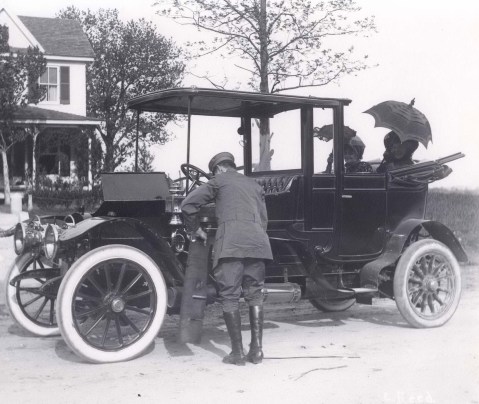
Chauffeur Lewis Reed is tending to the motor. Photo taken circa 1910.
Chauffeur-mechanics of the early 1900s were the first group to earn a living working on automobiles. Wealthy people employed private chauffeur-mechanics to not only drive, but also maintain and repair their large, expensive automobiles — rather than learn to do it themselves. The vehicles of the time came with mobile toolboxes often resembling a small hardware store tucked away in the trunk. The early 1900s Pierce-Arrow toolkit included extra intake and exhaust valves, not exactly your typical roadside service. During the height of travel season, Spring through Fall, oil changes were required almost weekly. As you can easily surmise, there had to be someone to keep track of all of the maintenance and upkeep of the vehicle as well as the daily driving. The 1910 census indicated that 23-year-old Lewis Reed was working as a machinist. Lewis worked as a chauffeur from roughly 1910-1914, before he became involved in the business of selling and repairing automobiles.
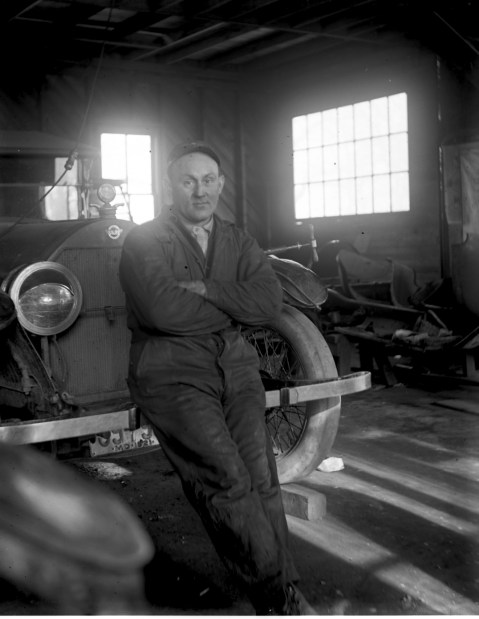
Grafton Reed, Mechanic & Garage Manager, Rockville Garage, ca. 1921
Grafton Reed was a brother of Lewis Reed and a part of the dealership’s first shop force. Grafton started working as a mechanic at the dealership in ca. 1918. According to his U.S. World War I Draft Registration Card, 1917-1918, his occupation at the time was listed as Garage Manager, Rockville Garage. Phillip Reed, another brother of Lewis Reed, was also a part of the dealership’s first work force. Phillip came to work for the dealership in 1916 and worked as a mechanic until 1944.
During the Great Depression, many consumers held onto their vehicles for longer periods of time and the lubrication of the vehicle became a matter of great importance to extend its running life. Author and Automotive Historian Robert Genat wrote, “The Depression of the early 1930s proved devastating for the marginally financed automakers. Dealerships for the top-selling cars survived the drought by virtue of their parts and service departments for maintenance and repair of consumer automobiles.” Like most other businesses, the Great Depression hit hard and Reed Brothers had to rely on its Service Department to make ends meet. But, the dealership survived through those hard times.

Books

Related Resources


Copyright Notice

Reed Brothers Dodge History (1915-2012) by Jeanne Gartner is licensed under a Creative Commons Attribution-NonCommercial 3.0 Unported License.
 Reed Brothers Dodge History 1915 – 2012
Recent Comments