
Early Montgomery County Road Paving Equipment
These vehicles below, strangely recognizable as forerunners to our modern equivalents, date from 1909. At this time, a lot of the equipment was still horse-drawn, such as the horse-drawn tanker wagon. Steamrollers (more correctly called road rollers) were literally powered by steam, like locomotives, and were similar to motorized farm vehicles of the time period. Road rollers were the last type of steam engine to be used on the roads. Before the hot tar has a chance to cool, sand, small pebbles, or small pieces of crushed rock are spread on top of it and compacted with a road roller, which also helps to bind it all together into a long-wearing, waterproof pavement.

PAVING TRUCK, 1909 – photograph by Lewis Reed
The early 1900s paving truck seen in the photo above is equipped with a high-powered spray mounted on the back of the truck. The truck consists of a storage tank, a burner below it to keep the asphalt hot and liquid, and a pump to pressurize it and send it to the spray bar and through the nozzles in the back. You can see the massive chain that puts power to the rear wheels.
Before the hot tar has a chance to cool, sand, small pebbles, or small pieces of crushed rock are spread on top of it and compacted with a steamroller that’s powered by steam, which also helps to bind it all together into a long-wearing, waterproof pavement.

STEAM ROAD ROLLER, 1909 – photograph by Lewis Reed
This take-off of the steam traction engine was designed specifically for road building and flattening ground mimicking today’s modern rollers used for compacting road surfaces. A single, heavy roller replaced the front wheels and axle and a smoother rear wheels replaced larger wheels without strakes. (strake – name for the diagonal strips cast into or riveted onto the wheel rims to provide traction on unmade ground).

STEAM ROAD ROLLER, 1909. Note the horse-drawn flusher adjacent to the steamroller – photograph by Lewis Reed
In 1900, ninety percent of the roads in Maryland were dirt roads; in Montgomery County the figure was ninety-five percent. In 1909 the State Roads Commission paved the 5.47 miles of Old Georgetown Road with a six-inch macadam covering, and the state did further paving in 1921, 1923, 1926, 1927 and 1929. You can see how much things have changed for the people who work on our roads.
Photos cannot convey the raw power of a steam road roller: the way its pistons, valves, gears, and wheels are locked in constant motion. You really have to see this machinery in action.
Here is a video of a vintage steam roller in action as it chugs along past a camera.
A Look Back at Montgomery County High School from 110 Years Ago
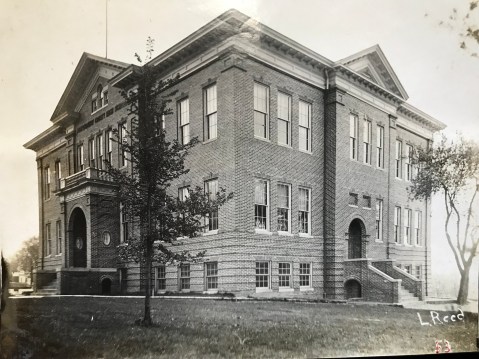
Originally known as Montgomery County High School, later as Rockville High School and Richard Montgomery High School. Located at the corner of Monroe Street and East Montgomery Avenue. Photo by Lewis Reed, 1906.
The tradition of graduation ceremonies, complete with pomp and circumstance, caps and gowns, and awarding diplomas, marks a rite of passage at schools in Montgomery County and at other high schools across the country. Not this year. The coronavirus pandemic has left in its wake widespread cancellations of annual events and ceremonies. This year’s 2020 graduates will be honored in the minds and hearts of loved ones for their achievements, and individual efforts will be made to celebrate the moment, but this year’s graduating seniors won’t be able to participate in the traditional graduation celebrations. In honor of this year’s high school graduates, here is a look back at a collection of photos of graduates from Montgomery County High School that were taken by Lewis Reed in 1910.
A bit of history: Located in the City of Rockville, Richard Montgomery High School is the oldest public high school in Montgomery County. An allocation in 1892 by the then Board of School Commissioners of a $300 addition to the existing elementary school in Rockville brought to fruition the then named “Rockville High School” that served students from grades one to eleven. The first class of twelve seniors graduated in 1897. In 1904, the Board of Education purchased land at the corner of Montgomery Avenue and Monroe Street for the construction of a new school building, to be renamed “Montgomery County High School” at Rockville. Students came to the school by train, trolley, and later by school bus from all corners of the county. In 1935, when the new “Rockville Colored High School” building opened in Lincoln Park, the Board of Education officially renamed the old Rockville High School, “Richard Montgomery High School.”
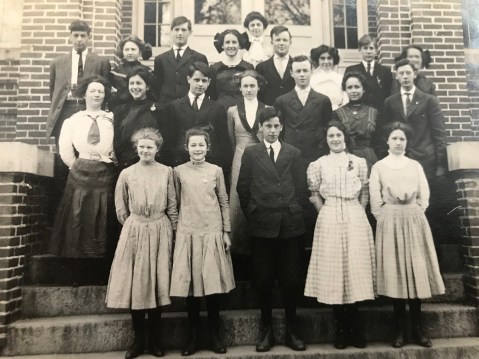
Montgomery County High School class, 1910. Photo by Lewis Reed
Back row: Edward Story, Lena Ricketts, Tom Young, Louise Larcombe, Miss Ford, Fred Hays, Lucius Lamar, name unknown, name unknown.
Middle Row: name unknown, name unknown, Jesse Wathen, Jesse Higgins, name unknown, name unknown, Mary Hyatt, name unknown, name unknown.
Front Row: Maude England, Rebecca Lamar, (first name unknown) Garrett, Helen Pumphrey, (first name unknown) Lehman.
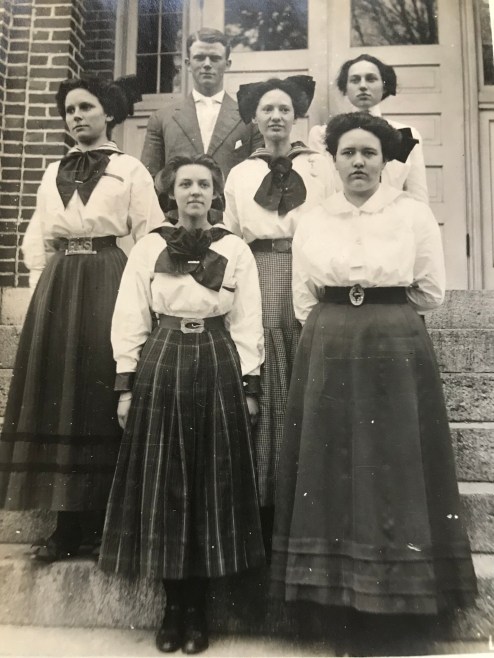
Montgomery County High School, Academic Department, 1910. Photo by Lewis Reed
Back: Harry S. Beall, Katherine Hughes
Middle: names unknown
Front: Edith Prettyman, Virginia Darby
From The Baltimore Sun, Thursday, May 26, 1910 newspaper:
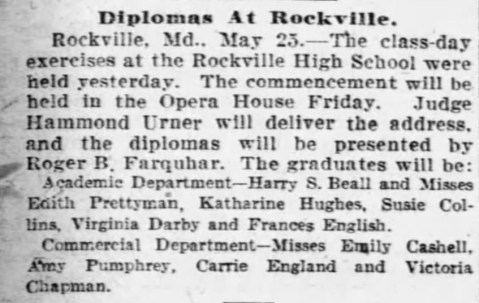
The Baltimore Sun, Thursday, 26 May 1910.
Old Rockville High School’s First Baseball Team
Inter-school athletics in Montgomery County began with a meeting, duly noted in the Sentinel of February 18, 1910, of the principals of the high schools at Rockville, Gaithersburg, Kensington, and Sandy Spring to formulate plans for a baseball league. Within a month, the athletic association of Rockville High School was formed with Roger J. Whiteford, principal, as manager of the baseball team, Edward Story, teacher, as assistant manager, and Jesse Higgins student, as captain.

Rockville High School First Baseball Team, 1910. Photo by Lewis Reed
Front: Billy Beck, Tom Young, Edward Storey, Harry Beall, Roy Warfield.
Back: Otis Hicks, Lucius Lamar, name unknown, name unknown, Jesse Higgins, name unknown, name unknown, Frederick Hays, Roger Whiteford
Holding pennant: Griffith Warfield
Announce Line-Up of High School Team. Special to The Washington Post, Sunday, March 13, 1910:
The line-up of the baseball team that will represent the Montgomery County High School this season has been decided upon, and the team will start the season as follows: Catcher. Harry Beall; Pitcher, Edward Story; First Base; Thomas Young; Second Base, Griffith Warfield; Third Base, Marshall Darby; Shortstop, Jesse Higgins; Left Field, Roland Garrett; Center Field, Frederick Hays; Right Field, Lucius Lamar; and Substitutes: Otis Hicks, Marshall Manion and William Beck.

Montgomery County High School 1910. Photo by Lewis Reed

Montgomery County High School 1910. Photo by Lewis Reed
On May 27, 1910, commencement was held in the Rockville Opera House. The major address of the graduation ceremony was given by Judge Hammond Urner. Then came the presentation of diplomas by Roger B. Farquhar and the seniors marched into the history of Montgomery County High School, as will their 2020 successors, all proud graduates.
Credit to: E. Guy Jewell, “Richard Montgomery High School.” The Montgomery County Story Vol. 24 (1981)
Other sources of information: Newspapers.com and Montgomery History
8 Years, 353 Posts & Thank You

This month marks the 8-year anniversary of this blog. It’s been an honor to share the history of Reed Brothers Dodge – whether you’ve read our blog, followed us on Twitter, or “liked” us on Facebook. I would like to thank all of you who have visited, followed, shared, or commented on this blog, and many others, for their kind words and the visibility they have provided.
Here’s a look back at the last year.
What People are Saying Around Facebook:
“Amazing blog and postings. I spent sometime reviewing your site and found it both fascinating and interesting.”
“I am thankful for the documentation this site provides with images of a beloved hometown that can no longer be seen.”
“Love seeing the old photos.”
“This is soooo cool! Someone needs to do one of those historical books of Historical Rockville photos!”
“These photos are absolutely awesome!!!”
“Thank you so much for sharing! This is classic Montgomery County info.”
“That was so cool reading all your memory posts. Best thing I’ve read on FB in a while.”
“I love seeing these old photos and reading the history. Thank you.”
“Thank you for this history. There is so much we take for granted.”
Past Lectures:
2019 Montgomery County History Conference: Each year in January, the Montgomery County Historical Society holds a day-long conference on various aspects of local history. Upwards of 200 people attend this annual event, which has been held since 2007. Last year, I was very honored for the invitation to speak about the history of Reed Brothers Dodge at the Montgomery County History Conference on Saturday, January 26, 2019.
The PowerPoint presentation followed the dealerships 97-year historic timeline and included more than 100 photographs, 70 of them rare, historic images taken by the dealership’s founder, Lewis Reed. The conference was held at the Bioscience Education Center on Montgomery College’s Germantown Campus.
Montgomery History Speakers Bureau: Officially added to the Montgomery History Speakers Bureau. My topic is, of course, “The History of Reed Brothers Dodge“. It is my great honor to join the talented league of speakers at Montgomery History, and I sincerely look forward to sharing our 97-year family business history throughout Montgomery County and the greater Washington D.C. metro area.
 Kensington Park Retirement Community Talk: Gave a presentation as part of Montgomery History’s Speakers Bureau at Kensington Park Retirement Community. Approximately 25 residents from the Woodlands Assisted Living facility attended. Such a joy me sharing, their listening, and appreciating the time spent together. Thanks to Activities Director Kate Moeller who invited me to speak.

Kensington Park Woodlands Assisted Living
Montgomery History Tuesday Talks: Montgomery History’s lunchtime lecture series, Tuesday Talks, takes place at noon on the first Tuesday of every month at the historic Beall-Dawson House in Rockville, Maryland. Enjoy presentations covering various aspects of history including local history of Montgomery County and the history of those who once lived here.

Online Exhibit: Montgomery County, 1900-1930: Through the Lens of Lewis Reed Lewis Reed’s photographs are now a part of a series of online exhibitions featured on the Montgomery History website. Montgomery County, 1900-1930: Through the Lens of Lewis Reed displays extraordinary photographs in several themed categories (Transportation, Photo-magic, Recreation, & Daily Life) taken at the beginning of the 20th century by county native and founder of Reed Brothers Dodge, Lewis Reed. It is an absolutely unique window into how the people of Montgomery County lived over a century ago. Working in collaboration with Montgomery History Librarian and Archivist, Sarah Hedlund, I am proud to play a part in the preservation of local history, making these photographs available to all.
 I appreciate all of you for your continued support and making Reed Brothers Dodge History one of the places you visit during the course of your day.

A Tribute to My Mom on This Mother’s Day

Mary Jane (Reed) Gartner
In honor of Mother’s Day, I would like to dedicate this blog to the memory of my mother, Mary Jane (Reed) Gartner who passed away eight months ago on September 10, 2019. Her father was Lewis Reed, founder of Reed Brothers Dodge. It’s hard for me not to reflect on what an amazing person she was. As with most people, I have a few people in my life who really inspire me, and my mom is one of them.
One of the most important things that I ever adopted to help me in achieving my goals were those I learned from my mother. My mother taught me that I can do anything I set my mind to, and that anything worth doing, is worth doing well. With her as my inspiration, I have been able to fearlessly reinvent myself as my life and times have changed. I cannot express my gratitude for her in words, whose unconditional love has been my greatest strength. My mother has always motivated me to be successful, encouraged me in all of my pursuits, and instilled in me the belief that I can achieve whatever it is that I desire. Her motto is one that I still live by to this day, “There is no such thing as can’t.” Instead of giving myself reasons why I can’t, I always give myself reasons why I can.
I am an author of two self-published books: “Portrait of an Automobile Dealer, Third Edition” and “Lewis Reed Photograph Collection (1898-1960)”. My mother was my primary source for information in both books. There was little documentation that accompanied the photographs, leading me to research through mostly her accounts of where the photos might have been taken, or who was in them. She assisted me with family information, photographs, and photo identification. Throughout this, my mother’s stories have influenced my interest in local history in general, and my interest in the history of our family business in particular.
One of my greatest joys was looking through all of my grandfather’s photographs along with my mother. On many afternoon visits with her, we went through hundreds of photographs and wrote down names, dates, and locations to the best of her recollection. This weekly activity, working together with her sharing memories and photos about previous generations, has been one of the greatest joys of my adult life.
Watching my mom’s eyes light up when I gave her the first proof book of her father’s entire photograph collection — 350 pages and 2500+ photographs — was a beautiful thing to see. True magic happened when she opened that book and started looking through the pictures. The book was a monumental task, and almost 10 years in the making, but it had a monumental reward at the end. Bringing out all those cherished memories for my mom was truly a celebration of her life.
 If your mother is still living, don’t forget to say “thank you” to her often, especially on Mother’s Day. And if she’s gone, thank God often for the memories you have, and the life and legacy she gave to you. I lost my mom eight months ago. And I still miss her every day. But I find it helps to take the perspective that I didn’t really lose her. I know exactly where she is and where she’ll always be. She is alive in my memories and the link to all of the history I share on this blog. Mom, this is for you… Happy Mother’s Day!
Reed Photo Collection: Transportation Before Cars
The story of transportation in Montgomery County is the saga of people constantly on the move. The difficulties people faced when they transported themselves or their goods from one place to another during the late 19th and early 20th century are almost impossible for us to comprehend today. Before the invention of trains and automobiles, animal power was the main form of travel. People were continually searching for new and better ways to transport people and goods as dependably and as fast as possible, and they started with the horse.
Many of the problems associated with the automobile today were common to the horse and carriage in the in the early 20th century: traffic jams, parking problems, noise, accidents, pollution. Of these, the most distressing was the last. While the horse emitted no exhaust, it did emit, often dropping excrement into the middle of the road. A typical horse produced more than 30 pounds of dung each day. Furthermore, horse-drawn transportation required constant attention and care, so much that wealthy Americans seldom managed horses themselves and often hired coachmen and grooms as intermediaries. The blacksmith was an important man, running a business like a modern car repair garage.
The following images from Lewis Reed’s collection illustrate various modes of transportation before highways and cars.
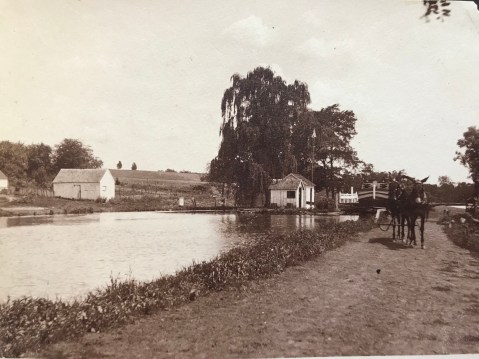
Mule provided power for canal boats traversing the 180 miles between Cumberland and Georgetown, 1914. Photo by Lewis Reed.
During the 19th century, the Chesapeake and Ohio Canal provided transportation for goods between Cumberland and the Chesapeake Bay. Mules were the preferred “engines” of the C&O Canal boat because they were cheaper to purchase than horses and were less prone to illness and injury. Mules adapted very well to life on a canal boat and could pull a 140-ton boat eight hours a day, seven days a week. Mules had both longer life spans and longer work lives than horses and could pull canal boats for twenty years if they were taken care of properly. To get a loaded boat going, the mules would have to walk until the line was taut, then put their weight into it, and step once the boat had moved, and repeat this process. Within 25 feet, the boat would be moving.
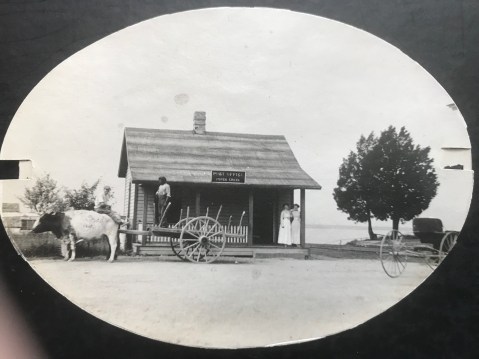
Popes Creek Post Office. Photo by Lewis Reed, ca. 1910
It’s hard to imagine a world without cars, buses, and trucks. But put yourself back in the early 20th century. Before the invention of trains and automobiles, animal power was the main form of travel. Horses, donkeys, and oxen pulled wagons, coaches, and buggies. Early settlers often used oxen to pull their big wagons. Oxen were slower than horses, but they could pull four times as much weight.
In this circa 1910 photograph two men pose with an ox-drawn wagon in front of the little Popes Creek Post Office on the Potomac River. Two elegantly dressed women with hats stand outside on the porch. Note the two-person horse buggy on the right. The Potomac River is visible in the background. The Popes Creek Post Office probably served as a social gathering place for the community.

A pair of yoked oxen pull a wagon in Point of Rocks, Maryland. Edgar Reed, second from left is seated on the railing. Photo by Lewis Reed, 1911.
Everyone’s heard the phrase, “as strong as an ox”. Oxen often were used as draft animals in the early 20th century. They supplied much of the power associated with agriculture and were used to haul heavy loads, plow fields, and for carrying goods. A two-animal team usually can manage several tons. Interesting fact: Oxen cost half as much as horses, required half the feed and could be eaten in an emergency.
Point of Rocks is a far as one can go on Route 28 to escape urbanization and see the way things once were along the rest of the route in Montgomery County.

Two ladies dressed in their Sunday best pose in a Runabout Carriage. Photo by Lewis Reed
The carriage became a precise and very visible marker of mid-century class status. People in society were judged by their mode of travel. Just as today we know the difference in class between a Kia and a Mercedes Benz, people could tell the rank of others by a glance at their horse and carriage. The carriage in this photo was known as a runabout, which was a light, open, horse-drawn vehicle with four large wheels. Similar to a buggy, the runabout was used for informal travel or “running about” on errands.
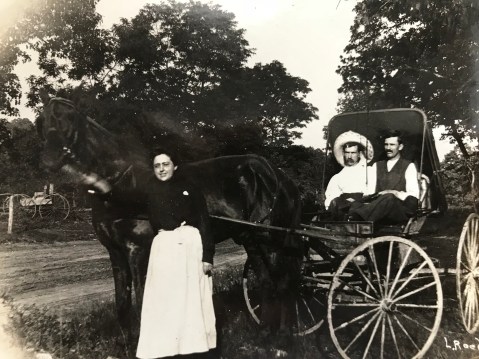
Early 20th century horse and buggy. Photo by Lewis Reed
By the early 20th century, the most popular vehicle in America was the buggy, a light, four-wheel carriage with or without a collapsible top that seated one or two people.
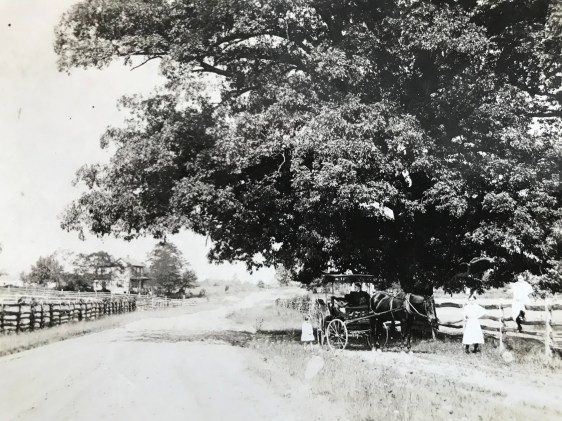
Hunting Hill Road near Rockville, ca. 1911. Photo by Lewis Reed
Buggies traversed rutted dirt roads across the Montgomery County countryside — sometimes their occupants needed a rest in the shade from the jolting motion of the carriage and the pounding heat of the sun.
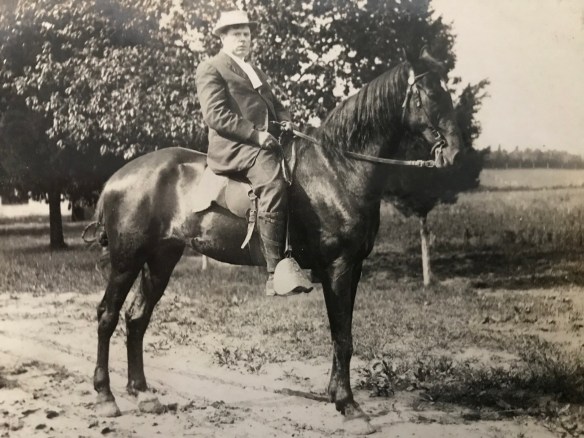
The most direct way to travel by horse was astride. Liveries provided horses for rent, which you could “drop off” at your destination, the way rental car companies work today. Photo by Lewis Reed
Less than a hundred years ago, before machines were invented, the horse was mans great partner.

Why is she wearing a headdress and carrying a rifle? Photo by Lewis Reed

Where in Maryland would that gigantic cactus be growing? Photo by Lewis Reed

Horse-drawn buggies, wagons, and automobiles all share the street and park in all directions in this circa 1914 street view. Trolley tracks are visible at the bottom left. Photo by Lewis Reed
From the late 1890s to the 1920s, carriages and automobiles overlapped on city streets, as shown in the above photo.

Young girl in a 2-wheeled pony cart. Photo by Lewis Reed
Youngsters, especially those born into wealthy families, needed to have experience riding and handling horses from a (sometimes very) early age.
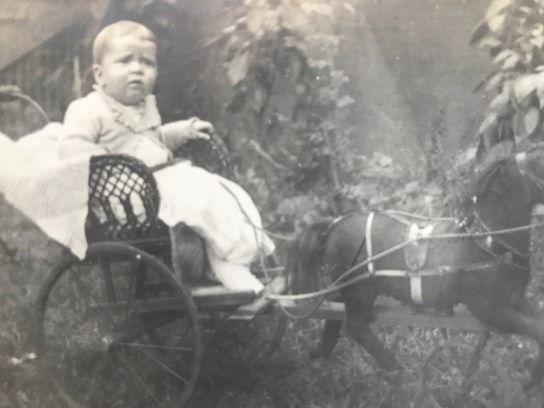
Horse drawn baby carriage. Photo by Lewis Reed
The demise of horse-drawn vehicles began in the late-nineteenth century with the gradual transition to other forms of transportation, particularly motorized streetcars and automobiles. The man most responsible for putting the world on wheels, Henry Ford, had disliked horses since one had dragged him around his farm as a 9-year-old. He exacted revenge with the introduction of his Model T in 1908.
Books

Related Resources


Copyright Notice

Reed Brothers Dodge History (1915-2012) by Jeanne Gartner is licensed under a Creative Commons Attribution-NonCommercial 3.0 Unported License.
 Reed Brothers Dodge History 1915 – 2012
Recent Comments