
The Car That Started It All: Old Betsy and the Dawn of Reed Brothers Dodge
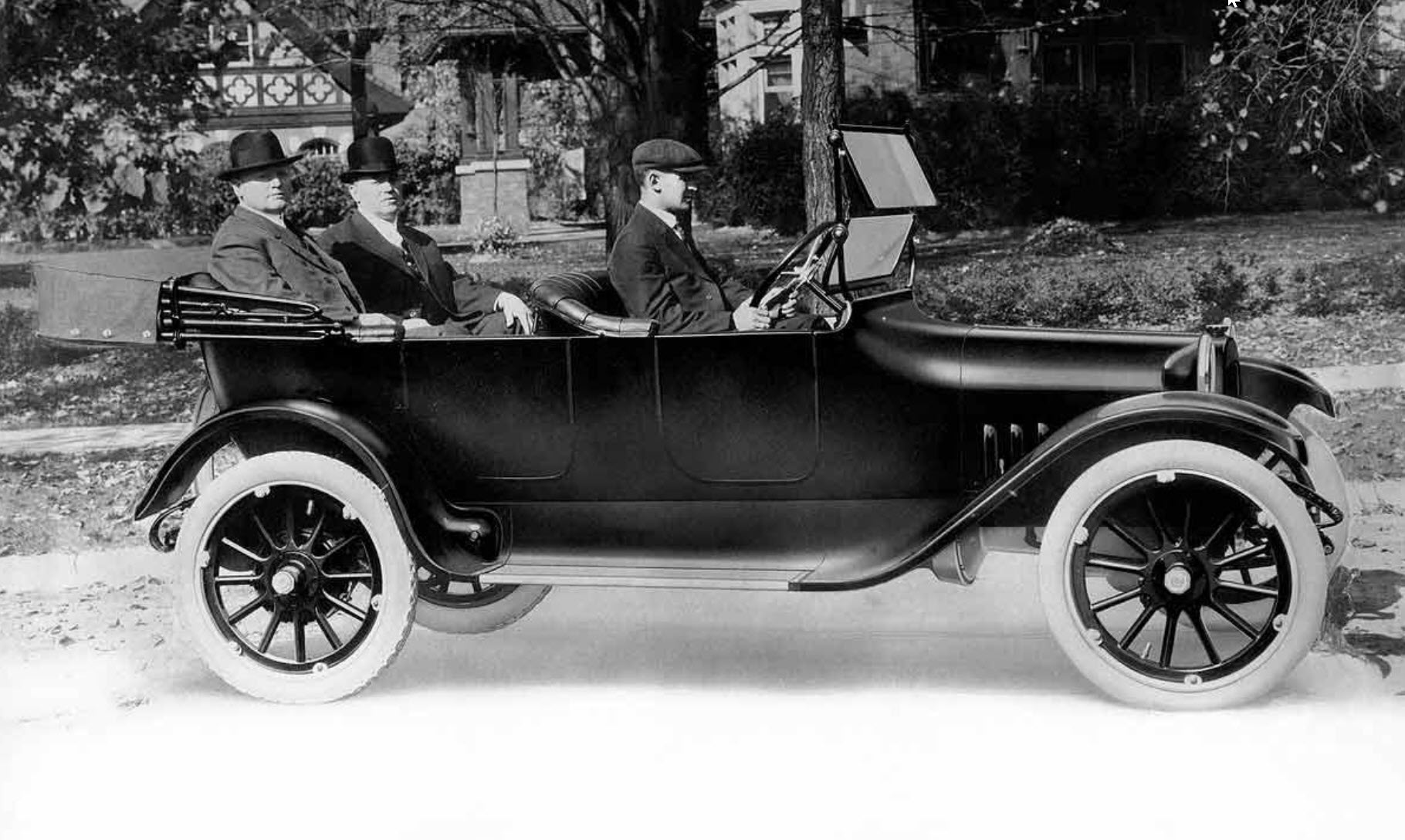
Horace Dodge, left rear, and John Dodge, right rear, seated in the early Dodge automobile known as “Old Betsy,” November 14, 1914. The photograph marks the beginning of the Dodge Brothers automobile story.
On November 14, 1914, John and Horace Dodge marked the introduction of the first automobile bearing their name. Less than a year later, Lewis Reed began selling Dodge Brothers motor cars in Rockville, Maryland, establishing a connection that would shape his family’s business for generations.
The Dodge brothers were already experienced manufacturers. They had supplied components and assemblies to other automobile companies, including Ford, before deciding to build a complete car of their own. By the end of 1914, their factory had produced just 249 automobiles, the beginning of what would become a major American automobile brand.
The first Dodge touring car sold for $785 and featured a four-cylinder engine and a 110-inch wheelbase. A familiar photograph shows the brothers seated in the rear of an early car known as “Old Betsy.” Although November 14 is traditionally recognized as the first-car milestone, historian Charles K. Hyde has suggested that the photographed vehicle may have been an experimental model assembled earlier.
As Dodge was establishing itself in Detroit, a new automobile business was taking shape in Rockville. Rockville Garage opened in July 1915 at the intersection of Rockville Pike and Veirs Mill Road. That October, Lewis Reed secured a franchise to sell Dodge Brothers motor cars. At age 27, he joined the manufacturer’s early dealer network before the first anniversary of its automobile’s introduction.
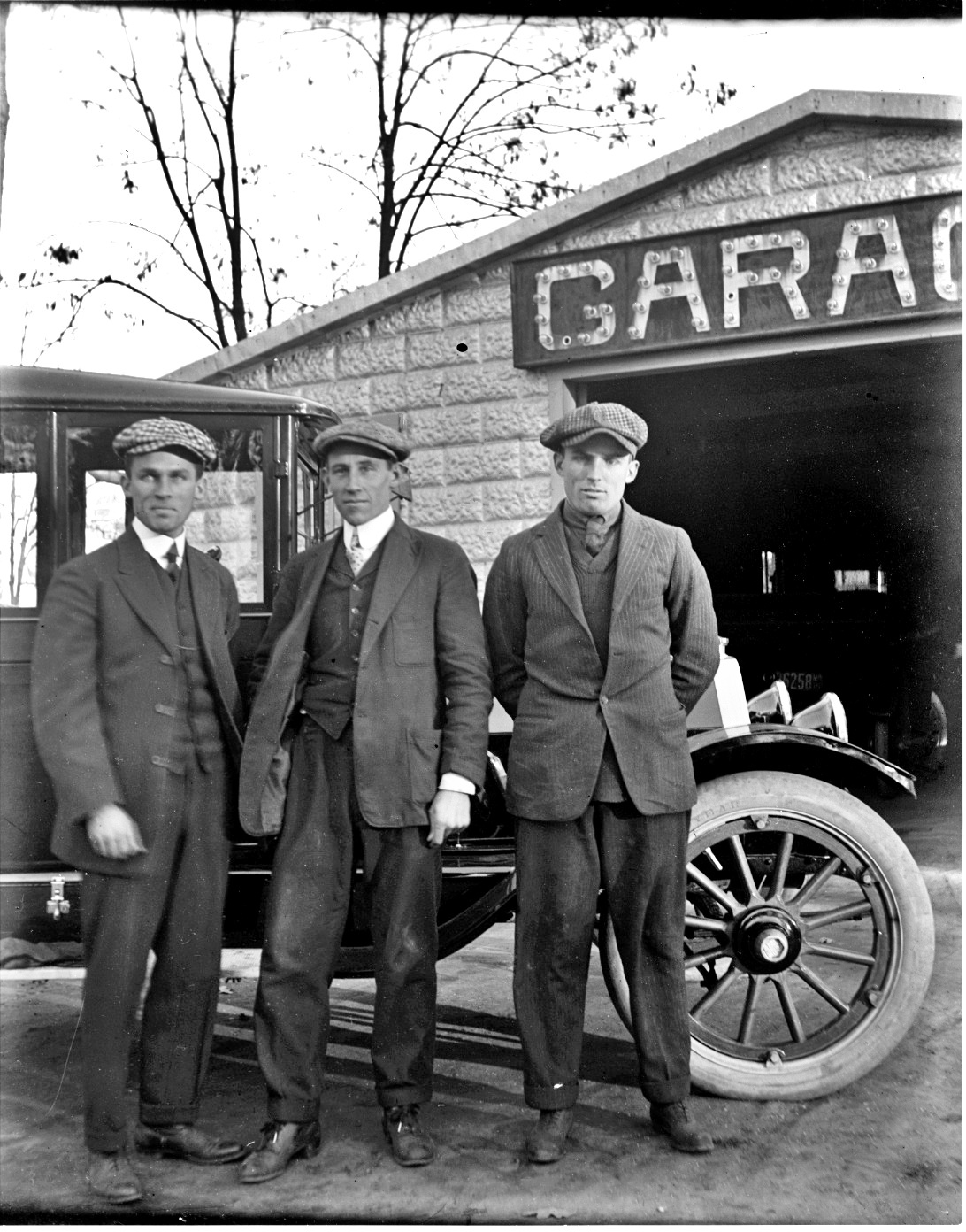
The original owners of Rockville Garage, 1915. From left: Roy Warfield – Lewis Reed – Griffith Warfield. That October, Lewis Reed secured a franchise to sell Dodge Brothers motor cars, establishing the business’s association with the new automobile manufacturer.
The timing placed Lewis near the beginning of Dodge’s history and within an important period of change in Montgomery County. Automobiles shared local roads with horse-drawn vehicles, and ownership brought a growing need for fuel, repairs, parts, and skilled mechanics. Rockville Garage provided the practical support that helped motor transportation become part of everyday life.
Like many early automobile businesses, the garage represented several makes. Dodge, however, became its enduring association. When Lewis’s brother Edgar joined the business in 1919, Rockville Garage became Reed Brothers Dodge, a name that would remain familiar to generations of local motorists.
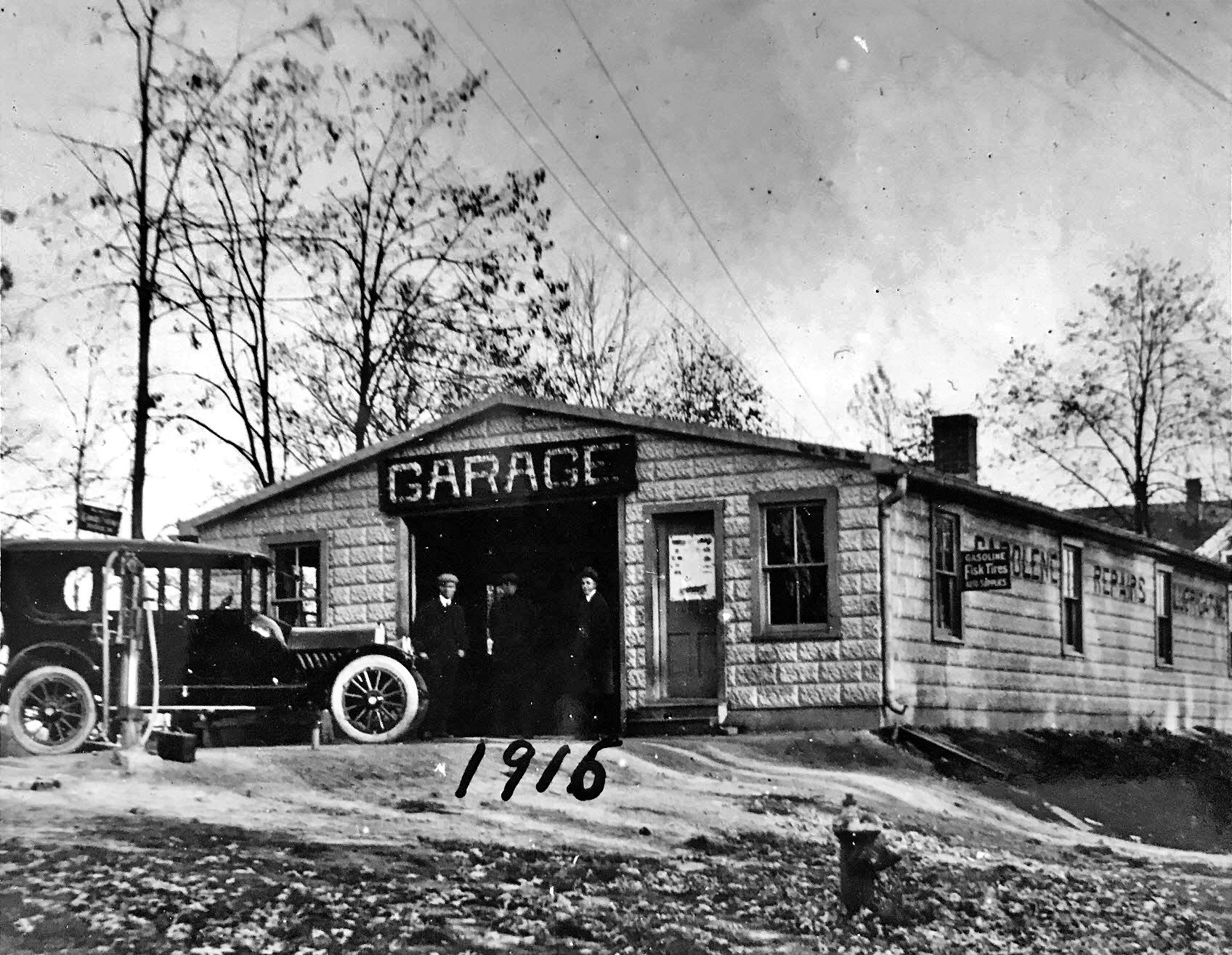
Rockville Garage at the intersection of Rockville Pike and Veirs Mill Road, 1916. Here, Lewis Reed sold and serviced automobiles during the earliest years of Dodge Brothers production. The business became Reed Brothers Dodge in 1919. Photograph by Lewis Reed.
What began as an early Dodge agency developed into one of the nation’s oldest Dodge dealerships under continuous family ownership. Through three generations, the family enterprise served the community from 1915 until 2012, continuing as Reed Brothers Automotive after its Dodge franchise ended in 2009.
The first Dodge automobile holds a place in American manufacturing history. For the Reed family, it also marks the beginning of a story with deep local roots. Lewis Reed’s decision to sell the new car in 1915 connected a young automobile manufacturer with a growing Maryland community, beginning nearly a century of family business in Rockville.
History of Dodge Logos
Many fascinating and mysterious logos have been used by Dodge throughout the past 100 years. Dodge used different logos depending on the model and vehicle purpose. Trucks, passenger cars and performance vehicles typically held different logos on grills. Below are the most notable emblems used by Dodge since its inception.
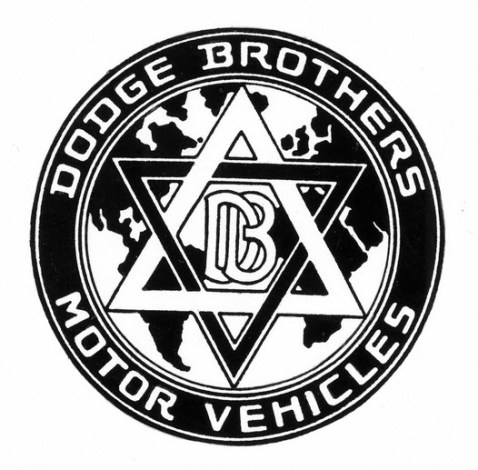
Dodge Brothers logo used from 1914 to 1927
Six-Pointed Star (1914-1938): When the Dodge brothers, Horace and John, built their first automobile in 1914, their final touch was a small enamel badge on the radiator with their company logo: a circle with two interlocking triangles forming a six-pointed star in the middle; an interlocked “DB” was at the center of the star, and the words “Dodge Brothers Motor Vehicles” encircled the outside edge. Although similar to the Star of David, the Dodge brothers were not Jewish. Although the “Brothers” was dropped from the name for trucks in 1929 and cars in 1930, the DB star remained in the cars until the 1939 models were introduced.
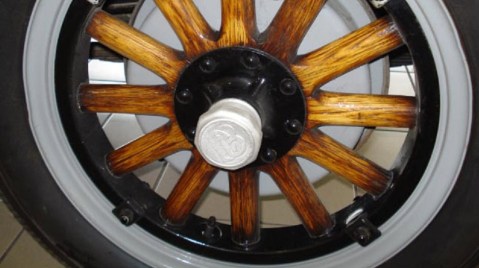
From 1928 Dodge Brothers Standard Six (intertwined “D” and “B”). Photo by Reed Brothers Dodge
 Ram: For 1932, Dodge cars adopted a leaping ram as the car’s hood ornament. Starting with the 1940 models the leaping ram became more streamlined and by 1951 only the head, complete with curving horns, remained. The 1954 model cars were the last to use the ram’s head before the rebirth in the 1980s. Dodge trucks adopted the ram as the hood ornament for the 1940 model year with the 1950 models as the last.
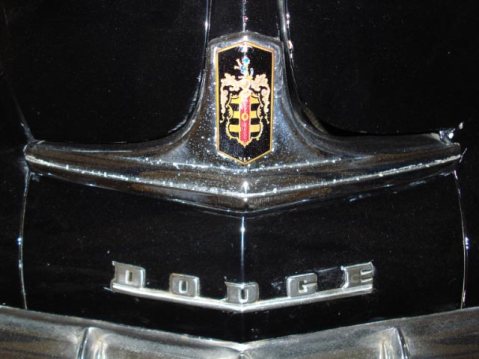
The hood of this 1946 Dodge Deluxe Fluid Drive Sedan is stamped with the Dodge coat of arms and “DODGE”. Photo by Reed Brothers Dodge
Crest: For 1941, Dodge introduced a crest, supposedly the Dodge family crest. The design had four horizontal bars broken in the middle by one vertical bar with an “O” in the center. A knight’s head appeared at the top of the emblem. Although the head would be dropped for 1955, the emblem would survive through 1957 and reappear on the 1976 Aspen. The crest would be used through to 1981 on its second time around, being replaced by the Pentastar for 1982. The knight’s head without the crest would be used for 1959.
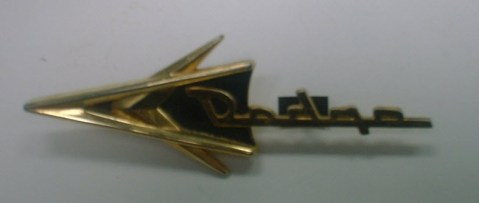
Forward Look
Forward Look (1955-1962): After the Dodge family crest was used between 1941-1957, Virgil Exner designed Dodge’s “Forward Look” logo: two overlapping boomerang shapes that suggested progress and forward motion. The design was heavily influenced by developing rocket propulsion technology and was named after the redesign campaign being used on the Chrysler Corporation’s vehicles.
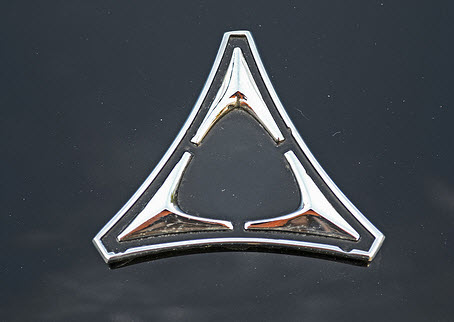
Fratzog
Fratzog (1962–1981): From 1962 to 1981, the Dodge emblem had a colorful internal label: It was called a fratzog. If you’re wondering what that word means (it sounds German, doesn’t it?), it’s totally meaningless. Three arrow shapes pointed inward to form a three-sided star. Not knowing what else to call the imaginative design, a Dodge designer made up the whimsical name.

Red Dodge Pentastar
Pentastar (1982-1992): For a decade, Dodge adopted Chrysler’s Pentastar logo on its vehicles, which had been used for corporate identification since 1962. To differentiate itself, Dodge’s Pentastar was red, while Chrysler-Plymouth’s was blue.
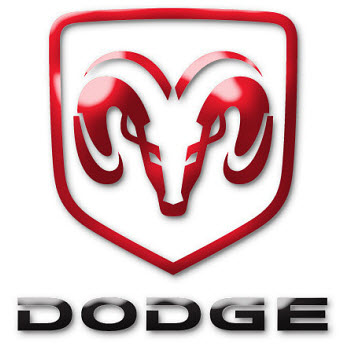
The Ram logo, used 1993–2010
Ram’s head (1993–2010): Dodge reintroduced the ram’s head hood ornament on the new 1973 Dodge Bighorn heavy duty tractor units. Gradually the ram’s head began appearing on the pickup trucks as Dodge began to refer to their trucks as Ram. The present iteration of the Ram’s-head logo appeared in 1993, standardizing on that logo in 1996 for all vehicles except the Viper, which uses the Viper’s Head.
 New Dodge logo (2010): When Ram Trucks was relaunched as its own brand in 2009 and used Dodge’s logo, Dodge was forced to replace its own. The present Dodge logo features several shades of silver and red colors. The Dodge inscription is all silver, but has a light hue at the top and dark, or rather grey, at the bottom. It stands for grandeur, dignity and sophistication. The two inclined stripes at the right side of the logo are painted red to symbolize passion and excitement, associated with the company’s vehicles. The new logo was unveiled in late May 2010.
Sources: Cartype, Wikipedia, Allpar, Dodge Brothers Club
Dodge Brothers Emblem
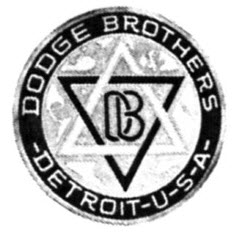
Dodge Brothers logo used from 1914 to 1927
The original Dodge was a circle, with two interlocking triangles forming a six-pointed star in the middle; an interlocked “DB” was at the center of the star, and the words “Dodge Brothers Motor Vehicles” encircled the outside edge. Although the “Brothers” was dropped from the name for trucks in 1929 and cars in 1930, the DB star remained in the cars until the 1939 models were introduced.
What’s the meaning behind the Dodge Brothers emblem?
Unfortunately, John and Horace Dodge died before they publicly told anyone how they arrived at this symbol. If any family members knew the reasons behind this, nothing was ever revealed or discovered. Apparently no one thought to ask them!
Among the possibilities:
1. These are two interlocking Greek letter “deltas” or “D s” for the two Dodge brothers
2. A medieval symbol of mysticism and the joining of mind and body, also possibly the joining of two brothers, who were known to be personally very close, in this business venture.
3. An abstraction of the square and compass of the Freemasons.
4. Nothing more or less than a badge with six pointed star similar to those used for law-enforcement officer’s badges, some outlined with triangles. Sheriff, Marshall, and police badges frequently were and are six pointed stars. The old-west Dodge City badge had six points. Horace Dodge was said to enjoy accompanying local law-enforcement officers on their runs.
5. There are other instances of a company ‘logo” selected for no particular deep meaning other than that it suited the fancy of those who selected it. The Chevrolet “bow-tie” is a classic example, as it was copied from the wall paper of a hotel room.
6. At the time the emblem was selected (most likely 1912-1914) it’s likely that the Dodge brothers were unaware of its use in Judaism. In fact, at this time, that symbol was not used universally in this context.
Rumors that are wrong include:
1. They chose the “Star of David” as a Jewish symbol to anger Henry Ford.
Fact: The brothers were actually friends with Ford at the time the emblem was selected. They were business partners with Ford and even were guests at Edsel Ford’s wedding.
2. They chose the “Star of David” as a Jewish symbol to appease Jewish bankers who financed the business.
Fact: There were no outside investors.
3. The Dodge Brothers were Jewish
Fact: They were not.
Books

Related Resources


Copyright Notice

Reed Brothers Dodge History (1915-2012) by Jeanne Gartner is licensed under a Creative Commons Attribution-NonCommercial 3.0 Unported License.


Recent Comments